For centuries, astronomy relied primarily on observing light. Telescopes studying visible light, radio waves, X-rays, and infrared radiation allowed scientists to explore planets, stars, galaxies, and black holes across the universe.
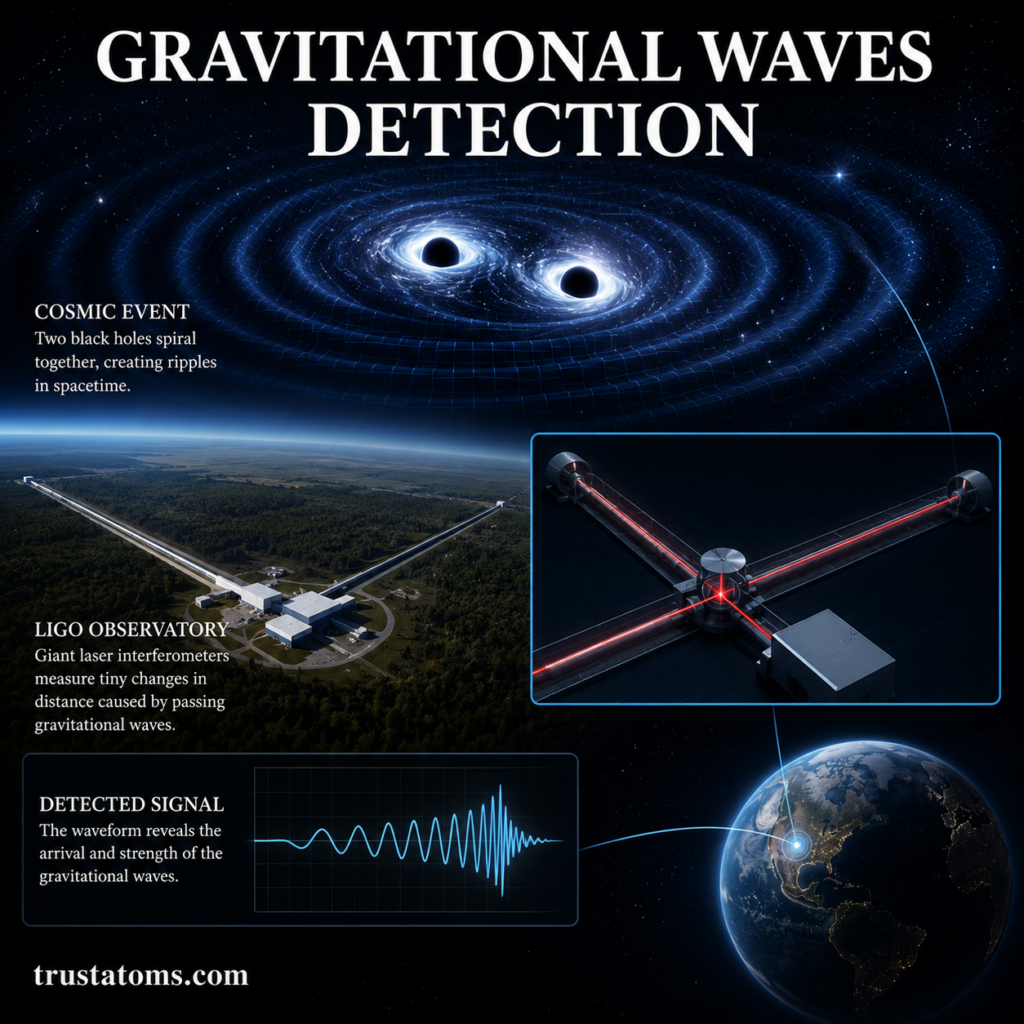
However, in 2015, scientists confirmed the first direct detection of gravitational waves — tiny ripples in spacetime predicted by Albert Einstein nearly 100 years earlier.
This breakthrough opened an entirely new way to study the cosmos. Instead of only seeing the universe, astronomers can now “listen” to some of the most violent events ever discovered.
Understanding gravitational waves detection helps explain one of the greatest achievements in modern physics and astronomy.
What Are Gravitational Waves?
Gravitational waves are ripples in spacetime produced by accelerating massive objects.
Einstein predicted their existence in 1916 through his theory of general relativity.
According to relativity:
- Massive objects warp spacetime
- Accelerating masses can create disturbances
- These disturbances travel outward at the speed of light
Gravitational waves spread through the universe similarly to ripples moving across water.
However, the distortions they create are extraordinarily tiny.
How Gravitational Waves Are Produced
Not all motion creates detectable gravitational waves.
The strongest waves come from extremely massive and energetic cosmic events.
Major Sources of Gravitational Waves
Scientists currently detect waves from events such as:
- Black hole mergers
- Neutron star collisions
- Supernova explosions
- Rapidly spinning neutron stars
The most powerful signals typically involve compact objects with enormous gravity.
Black Hole Mergers
When two black holes orbit one another:
- They gradually spiral inward
- Their speed increases
- Spacetime disturbances intensify
- They eventually collide and merge
This collision releases massive amounts of energy as gravitational waves.
For a brief moment, the power output can exceed the combined light of all stars in the observable universe.
Einstein’s Prediction of Gravitational Waves
Einstein’s equations showed that gravity is not simply a force acting through space.
Instead, gravity results from curved spacetime itself.
This framework predicts that changes in mass motion can create traveling spacetime distortions.
For decades, scientists doubted whether these waves could ever be detected because the distortions are incredibly small.
Even powerful gravitational waves alter distances by less than the width of a proton over kilometers.
Why Detecting Gravitational Waves Is Difficult
Gravitational waves interact very weakly with matter.
This makes them valuable for astronomy because they travel across the universe largely undisturbed.
However, it also makes them extremely difficult to measure.
Tiny Distortions
When a gravitational wave passes through Earth:
- Space itself stretches slightly
- Then compresses slightly
- These changes are incredibly small
The distortions are far smaller than atomic dimensions.
Environmental Noise
Detectors must filter out interference from:
- Earthquakes
- Traffic vibrations
- Wind
- Thermal noise
- Quantum fluctuations
Extraordinary engineering precision is required.
The LIGO Observatory
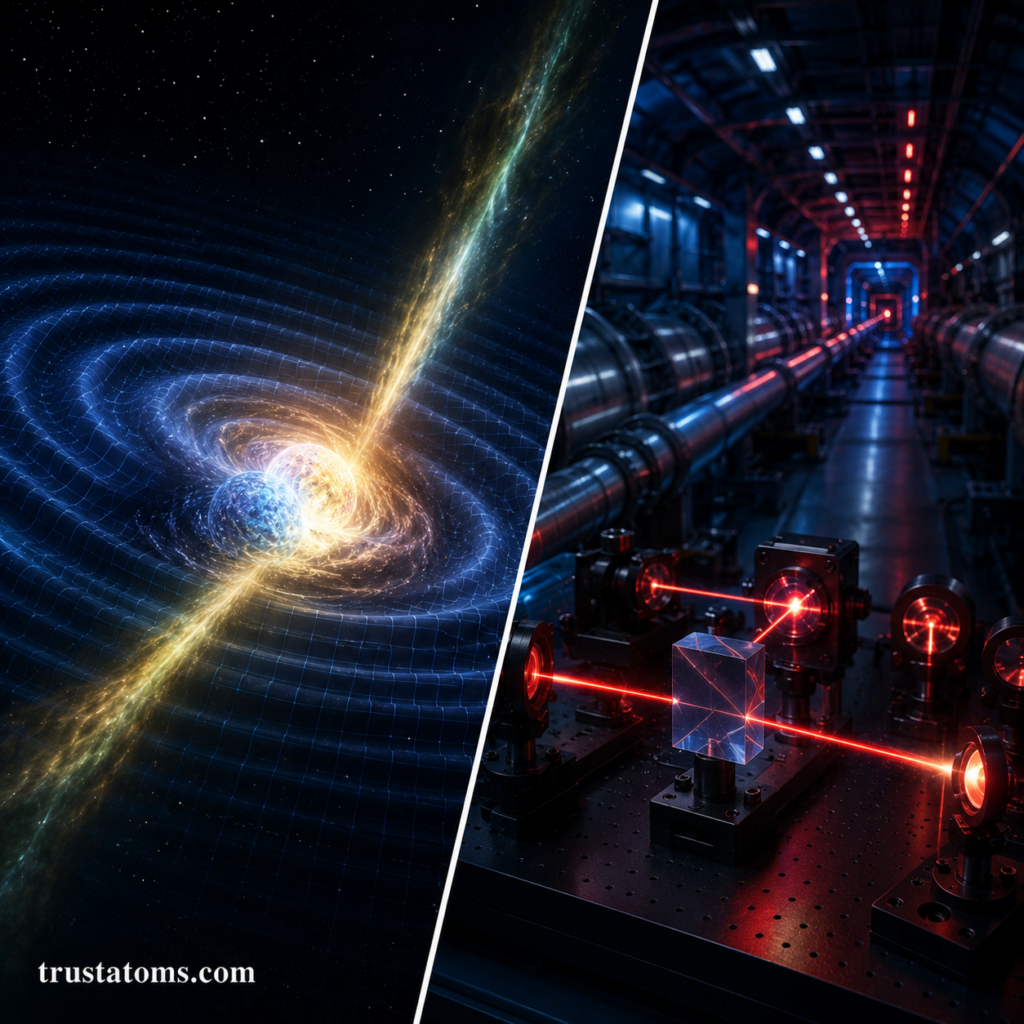
The Laser Interferometer Gravitational-Wave Observatory (LIGO) achieved the first direct gravitational wave detection.
LIGO consists of two major facilities in the United States.
How LIGO Works
Each observatory contains two perpendicular vacuum tunnels several kilometers long.
Laser beams travel back and forth through the tunnels.
When a gravitational wave passes:
- One tunnel stretches slightly
- The other compresses slightly
- Laser interference patterns change
- Scientists measure the distortion
This setup is called a laser interferometer.
Interferometry
Interferometry compares light waves very precisely.
Tiny distance changes affect how laser waves combine.
This allows detectors to measure incredibly small spacetime distortions.
The First Detection in 2015
On September 14, 2015, LIGO detected gravitational waves for the first time.
The signal came from two merging black holes approximately 1.3 billion light-years away.
Why This Discovery Was Historic
The detection:
- Confirmed Einstein’s prediction
- Verified black hole mergers directly
- Opened gravitational wave astronomy
- Demonstrated new observational technology
The discovery became one of the biggest breakthroughs in modern physics.
Scientists involved later received the Nobel Prize in Physics.
What Gravitational Waves Tell Scientists
Gravitational waves provide information unavailable through traditional telescopes.
Studying Black Holes
Black holes emit little or no visible light directly.
Gravitational waves allow scientists to study:
- Black hole masses
- Spin rates
- Collision behavior
- Merger dynamics
Neutron Star Collisions
Neutron star mergers create both gravitational waves and electromagnetic radiation.
Studying both signals together helps scientists investigate:
- Heavy element formation
- Gamma-ray bursts
- Extreme nuclear physics
Early Universe Research
Some scientists hope future detectors may study gravitational waves from the early universe itself.
This could reveal information about:
- Cosmic inflation
- Early spacetime conditions
- Fundamental physics
Virgo and International Detection Networks
LIGO is not the only gravitational wave detector.
Virgo Observatory
Virgo is a major European gravitational wave observatory located in Italy.
Working together, LIGO and Virgo improve:
- Signal accuracy
- Source location
- Noise filtering
- Detection confidence
Global Cooperation
Additional observatories include:
- KAGRA in Japan
- Future space-based missions
- Proposed next-generation detectors
International collaboration is essential for gravitational wave astronomy.
Space-Based Gravitational Wave Detectors
Future detectors may operate in space rather than on Earth.
LISA Mission
The Laser Interferometer Space Antenna (LISA) is a planned space-based observatory.
LISA would use spacecraft separated by millions of kilometers.
Advantages include:
- Reduced Earth interference
- Detection of lower-frequency waves
- Observation of larger cosmic systems
Space-based detectors could dramatically expand gravitational wave research.
Multi-Messenger Astronomy
One of the most exciting developments is multi-messenger astronomy.
This approach combines:
- Gravitational waves
- Light observations
- Neutrino detections
- Particle measurements
Studying multiple signals from the same event provides a much fuller understanding of cosmic phenomena.
Example: Neutron Star Collision
In 2017, scientists observed both gravitational waves and light from a neutron star merger.
This helped confirm:
- The origin of heavy elements like gold
- The behavior of neutron stars
- The physics of gamma-ray bursts
Multi-messenger astronomy represents a major advancement in astrophysics.
Gravitational Waves and Black Hole Physics
Gravitational wave observations provide direct evidence about black holes.
Scientists can now study:
- Black hole populations
- Merger rates
- Extreme gravity
- Relativistic effects
This helps test Einstein’s theory under conditions impossible to recreate on Earth.
Challenges in Gravitational Wave Astronomy
Although successful, gravitational wave detection still faces major challenges.
Sensitivity Limits
Detectors require extreme precision.
Improving sensitivity involves advances in:
- Laser systems
- Vacuum technology
- Seismic isolation
- Quantum measurement techniques
Signal Interpretation
Scientists must distinguish real signals from background noise.
Complex data analysis and computer modeling are essential.
Rare Event Detection
Many detectable events are extremely distant and infrequent.
Long observation periods improve detection rates.
Future Discoveries and Possibilities
Gravitational wave astronomy is still very new.
Future research may uncover:
- Primordial gravitational waves
- Unknown compact objects
- Intermediate black holes
- New physics beyond relativity
Scientists may eventually observe events never before detectable in astronomy.
Why Gravitational Waves Matter
Gravitational waves provide an entirely new way to explore the universe.
Unlike light, they can travel through matter and extreme environments without significant interference.
This allows scientists to study hidden cosmic events impossible to observe directly through traditional telescopes.
The field also strengthens connections between:
- Relativity
- Quantum physics
- Astrophysics
- Cosmology
Gravitational wave astronomy may help answer some of the biggest questions in modern science.
Final Thoughts
Gravitational waves detection represents one of the most important scientific achievements of the 21st century.
By measuring tiny ripples in spacetime, scientists can now observe black hole mergers, neutron star collisions, and other extreme cosmic events in entirely new ways.
The discovery confirmed Einstein’s predictions while opening a revolutionary branch of astronomy that continues transforming our understanding of the universe.
As detector technology improves and future space-based observatories launch, gravitational wave astronomy will likely reveal even deeper insights into gravity, spacetime, and the evolution of the cosmos itself.