Black holes are among the most fascinating and mysterious objects in astronomy. They possess gravitational forces so powerful that nothing — not even light — can escape once it crosses a certain boundary known as the event horizon.
Although black holes cannot be directly seen, scientists study them through their effects on nearby matter, radiation, and spacetime itself.
Modern astronomy has revealed that black holes exist throughout the universe, from stellar remnants to gigantic supermassive structures at the centers of galaxies.
Understanding black holes and event horizons helps explain gravity, relativity, and some of the most extreme conditions known in physics.
What Is a Black Hole?
A black hole is a region of spacetime where gravity becomes so intense that escape is impossible beyond a certain point.
Black holes form when a large amount of mass becomes compressed into an extremely small area.
The result is a gravitational field powerful enough to drastically warp spacetime.
Key characteristics of black holes include:
- Extremely strong gravity
- A central singularity
- An event horizon
- Intense spacetime distortion
- Powerful effects on nearby matter
Black holes are predicted by Albert Einstein’s theory of general relativity.
How Black Holes Form
Different types of black holes form through different cosmic processes.
Stellar Black Holes
Most known black holes form from massive stars.
When a very large star exhausts its nuclear fuel:
- The core collapses inward
- A supernova explosion may occur
- Gravity compresses the remaining core
- A black hole forms if enough mass remains
These black holes typically contain several times the mass of the Sun.
Supermassive Black Holes
Supermassive black holes exist at the centers of many galaxies.
They may contain:
- Millions
- Billions
- Even tens of billions of solar masses
Scientists still debate exactly how these enormous black holes form.
Possible explanations include:
- Merging smaller black holes
- Rapid early-universe growth
- Collapse of massive gas clouds
The Milky Way galaxy contains a supermassive black hole called Sagittarius A*.
Intermediate Black Holes
Intermediate black holes fall between stellar and supermassive sizes.
Evidence suggests they exist, but they are more difficult to detect.
What Is an Event Horizon?
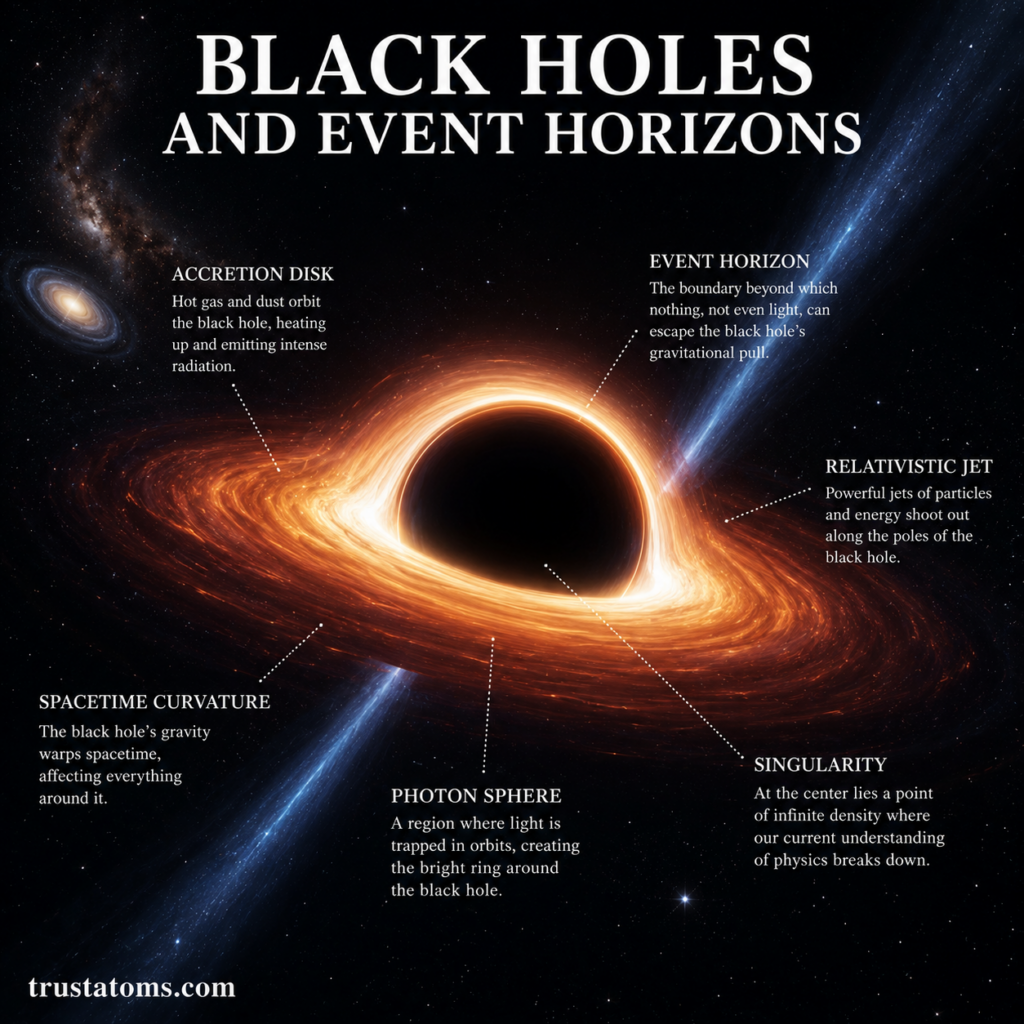
The event horizon is the boundary surrounding a black hole where escape becomes impossible.
Once an object crosses the event horizon:
- Escape velocity exceeds the speed of light
- No information can return outward
- The object becomes trapped by gravity
The event horizon is not a physical surface like solid matter.
Instead, it represents a gravitational boundary in spacetime.
Why It’s Called an “Event Horizon”
The term refers to the limit beyond which events can no longer affect outside observers.
Anything happening inside the event horizon becomes permanently hidden from the rest of the universe.
The Schwarzschild Radius
The size of a non-rotating black hole’s event horizon depends on its mass.
The radius defining the event horizon is called the Schwarzschild radius.
This relationship shows that larger masses produce larger event horizons.
Even though black holes are extremely dense, the event horizon itself may be very large for supermassive black holes.
What Happens Near a Black Hole?
Conditions near black holes become extremely unusual due to intense gravity.
Time Dilation
Einstein’s relativity predicts that time slows near strong gravitational fields.
Near a black hole:
- Time passes slower relative to distant observers
- Light becomes redshifted
- Clocks appear to slow dramatically
An outside observer would see an object approaching the event horizon appear to slow and fade.
Spaghettification
Strong gravitational differences across an object can stretch it vertically.
This effect is called spaghettification.
A person falling toward a smaller black hole could experience:
- Extreme stretching
- Compression
- Tidal forces powerful enough to destroy matter
Supermassive black holes may produce weaker tidal forces at the event horizon itself.
Accretion Disks and Radiation
Black holes themselves emit no light directly, but surrounding matter often becomes extremely bright.
Accretion Disks
Gas and dust falling toward a black hole form a rotating structure called an accretion disk.
Friction and gravitational forces heat the material to enormous temperatures.
Accretion disks may emit:
- Visible light
- X-rays
- Gamma rays
- Radio waves
Some of the brightest objects in the universe involve active black holes.
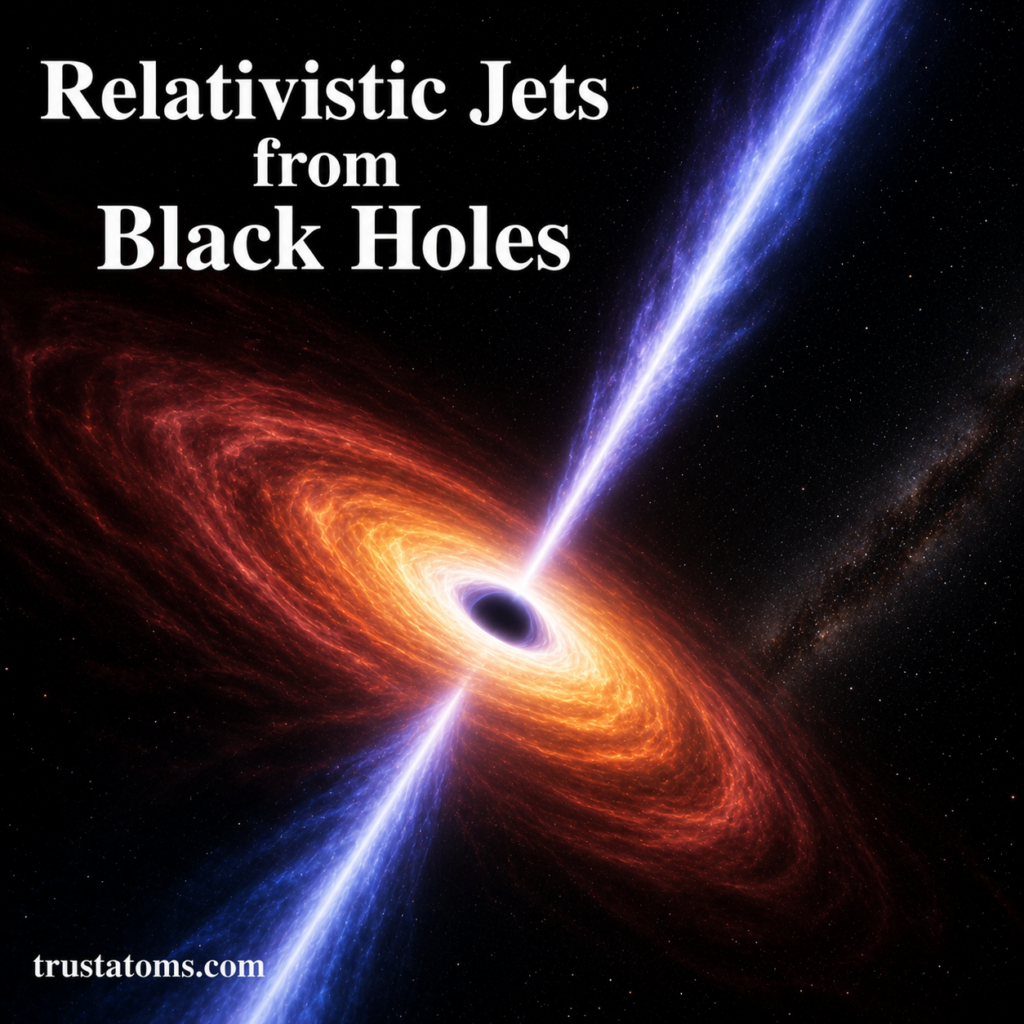
Relativistic Jets
Certain black holes produce enormous jets of particles traveling near light speed.
These jets can extend for thousands or even millions of light-years.
Scientists continue studying how black holes generate these powerful outflows.
Rotating Black Holes
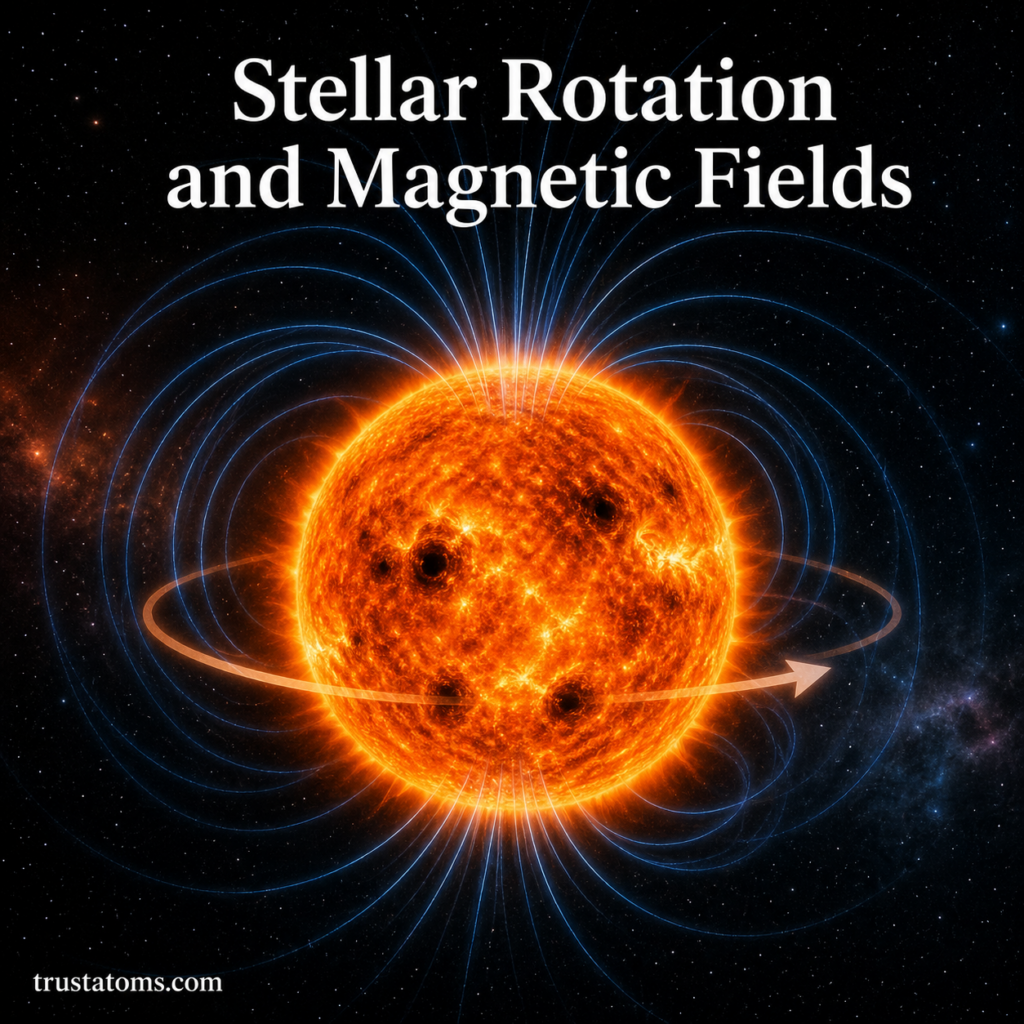
Many black holes rotate rapidly.
These are called Kerr black holes.
Rotation changes the structure of spacetime around the black hole.
Frame Dragging
A rotating black hole drags spacetime itself around with it.
This phenomenon is called frame dragging.
The rotating region outside the event horizon is called the ergosphere.
Within this area:
- Objects cannot remain stationary
- Spacetime motion becomes unavoidable
Rotating black holes are even more complex than non-rotating ones.
Can Black Holes Evaporate?
Physicist Stephen Hawking proposed that black holes may slowly lose energy through quantum effects.
This process is called Hawking radiation.
Hawking Radiation
Quantum fluctuations near the event horizon may allow black holes to emit tiny amounts of radiation.
Over extremely long periods:
- Black holes could lose mass
- Event horizons could shrink
- Black holes might eventually evaporate
Large black holes would take vastly longer than the current age of the universe to fully evaporate.
Hawking radiation remains one of the most important theoretical ideas connecting gravity and quantum mechanics.
The Information Paradox
One of the biggest mysteries in modern physics involves information loss in black holes.
The Problem
Quantum mechanics suggests information cannot be destroyed.
However, matter falling into a black hole appears permanently hidden beyond the event horizon.
This creates a contradiction between:
- General relativity
- Quantum mechanics
Scientists continue debating possible solutions to the black hole information paradox.
This problem remains central to efforts to develop a unified theory of physics.
How Scientists Detect Black Holes
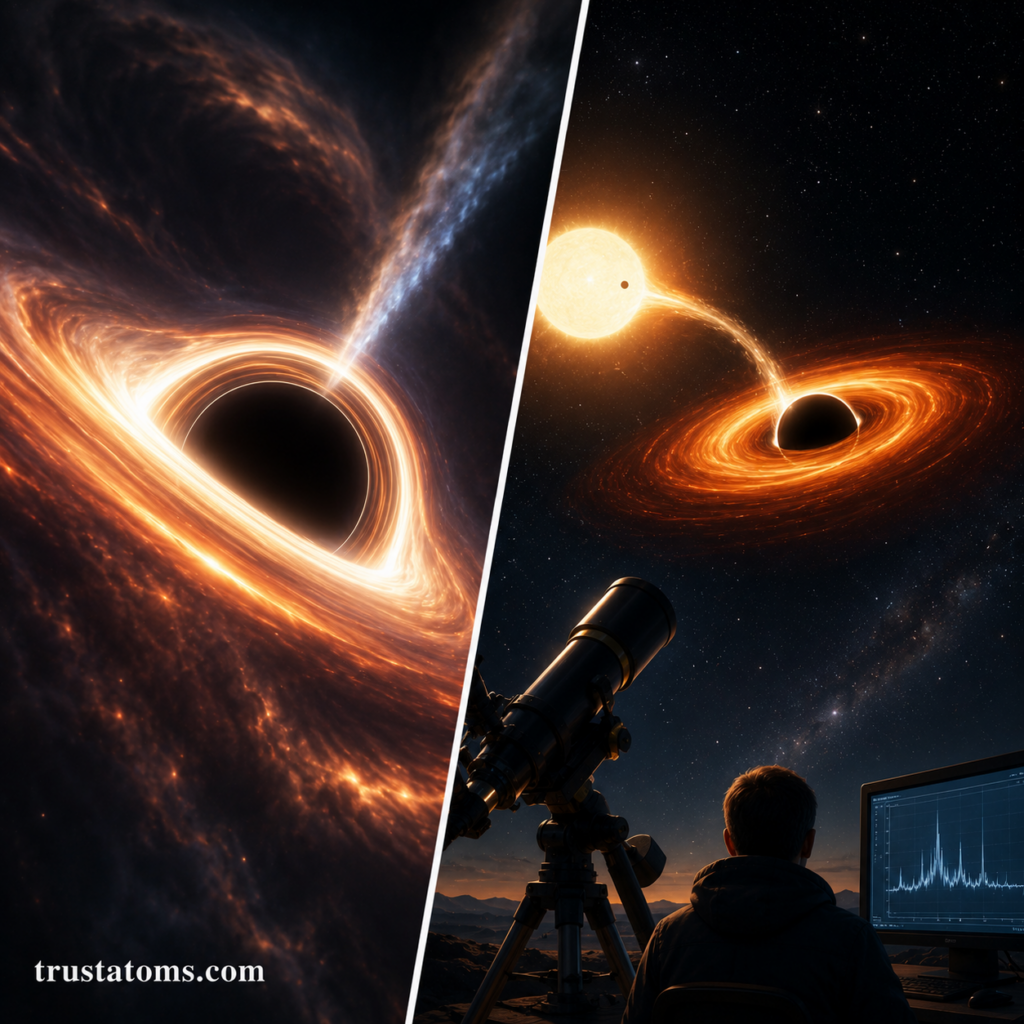
Because black holes emit no direct light, scientists detect them indirectly.
Observing Nearby Stars
Astronomers study stars orbiting invisible massive objects.
Rapid stellar motion can reveal the presence of a black hole.
X-Ray Emissions
Matter heating within accretion disks emits powerful X-rays.
Space telescopes monitor these emissions to identify black hole candidates.
Gravitational Waves
When black holes collide, they produce ripples in spacetime called gravitational waves.
Observatories such as LIGO detect these signals.
The first direct gravitational wave detection occurred in 2015 from merging black holes.
The First Black Hole Image
In 2019, scientists released the first direct image of a black hole’s shadow.
The image showed the supermassive black hole in galaxy M87.
Event Horizon Telescope
The Event Horizon Telescope combined radio telescopes worldwide to create a virtual Earth-sized telescope.
The image revealed:
- Bright surrounding plasma
- The black hole shadow
- Evidence supporting general relativity
This achievement became one of the most important breakthroughs in modern astronomy.
Supermassive Black Holes and Galaxies
Most large galaxies appear to contain supermassive black holes at their centers.
Scientists believe these black holes may influence galaxy evolution.
Possible effects include:
- Star formation regulation
- Gas movement
- Galactic structure development
- Energy distribution
The relationship between galaxies and black holes remains an active research area.
Could Humans Travel Into a Black Hole?
Current physics suggests surviving entry into a black hole would be extraordinarily unlikely.
Potential dangers include:
- Tidal forces
- Radiation exposure
- Extreme gravity
- Loss of escape
Some theoretical models suggest rotating black holes may contain unusual internal structures, but these ideas remain speculative.
No evidence currently supports practical black hole travel or wormhole transportation.
Black Holes in Popular Culture
Black holes appear frequently in science fiction because they represent mystery, danger, and extreme physics.
Movies, books, and television often portray:
- Wormholes
- Time distortion
- Parallel universes
- Interstellar travel
While some depictions are exaggerated, many modern portrayals incorporate real scientific ideas from relativity and astrophysics.
Why Black Holes Matter in Science
Black holes help scientists study:
- Gravity
- Quantum mechanics
- Relativity
- Galaxy evolution
- High-energy astrophysics
They serve as natural laboratories for testing the laws of physics under extreme conditions impossible to recreate on Earth.
Understanding black holes may eventually help unify general relativity and quantum theory.
Final Thoughts
Black holes and event horizons represent some of the most extraordinary phenomena in the universe.
Although invisible directly, their effects reveal powerful insights about gravity, spacetime, and the behavior of matter under extreme conditions.
From stellar collapse to supermassive galactic centers, black holes continue challenging scientific understanding while driving some of the most important discoveries in modern astronomy.
As observational technology improves, future research may uncover even deeper answers about event horizons, Hawking radiation, quantum gravity, and the true nature of spacetime itself.