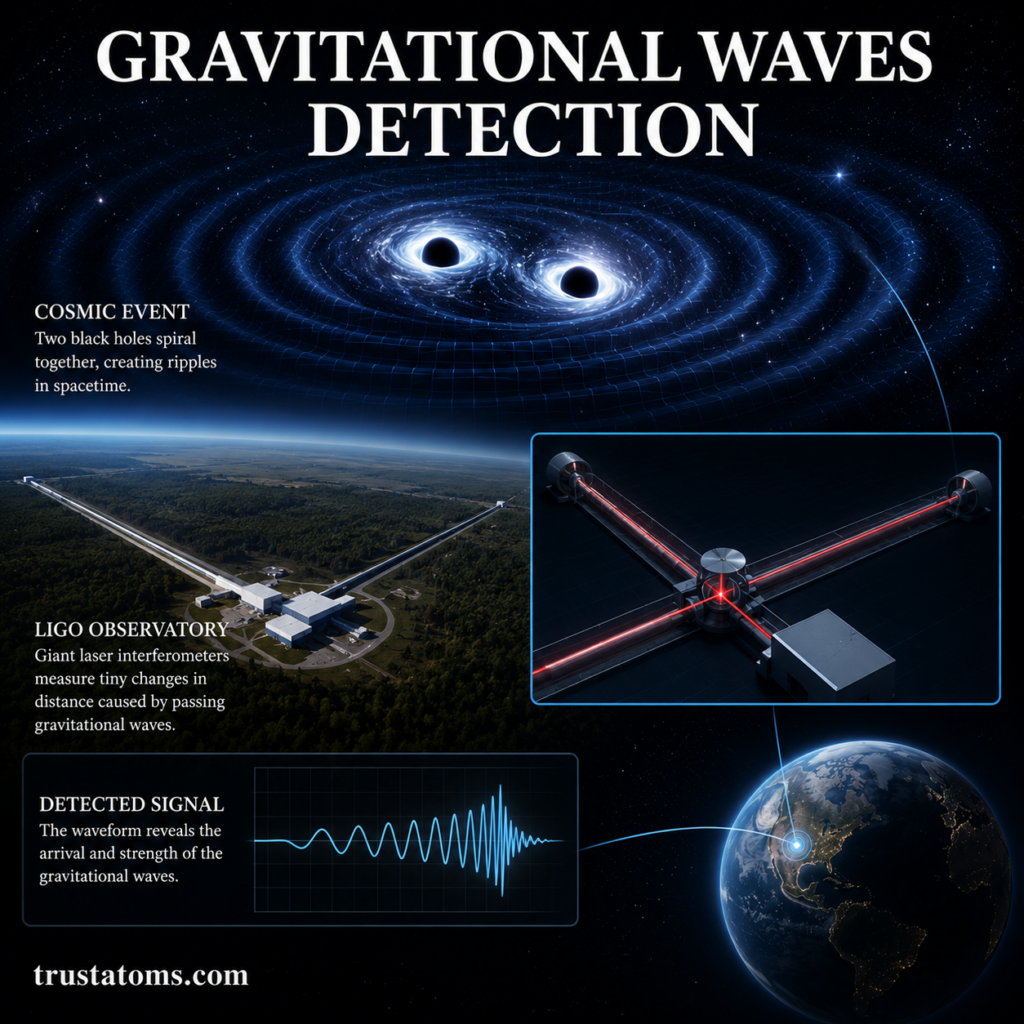
Scientists detect gravitational waves by measuring extraordinarily small changes in distance as ripples in spacetime pass through sensitive instruments called laser interferometers. Observatories such as LIGO compare laser beams traveling along perpendicular arms, allowing researchers to identify signals from events including merging black holes and neutron stars.
For centuries, astronomy relied primarily on electromagnetic radiation. Observations of visible light, radio waves, X-rays, and infrared radiation allowed scientists to explore planets, stars, galaxies, and black holes across the universe.
However, in 2015, scientists confirmed the first direct detection of gravitational waves — tiny ripples in spacetime predicted by Albert Einstein nearly 100 years earlier. The discovery established a new way to investigate cosmic events through their gravitational effects rather than relying entirely on light.
What Are Gravitational Waves?
Gravitational waves are traveling disturbances in the geometry of spacetime. Einstein predicted them in 1916 as a consequence of general relativity, which describes gravity through the curvature of spacetime caused by mass and energy.
When massive objects accelerate in certain changing arrangements, they can generate gravitational radiation. The resulting waves travel outward at the speed of light, carrying energy away from their source.
As a gravitational wave passes, it produces tiny, changing distortions in the distances between freely moving objects. These effects are described using a quantity called strain, which measures the fractional change in length.
Gravitational waves are different from the accelerated expansion investigated in Dark Energy Theories. Gravitational waves are propagating disturbances, while dark energy is a proposed explanation for the observed acceleration of cosmic expansion.
How Cosmic Events Produce Gravitational Waves
Gravitational waves arise when a system’s mass distribution changes in a suitable way. Ordinary objects also generate gravitational radiation under some circumstances, but their signals are generally far too weak for existing detectors to measure.
The strongest signals currently detected by ground-based interferometers come from compact objects whose enormous masses move rapidly through intense gravitational fields.
Merging Black Holes
Two black holes orbiting each other gradually lose orbital energy through gravitational-wave emission. As they approach, their orbital speed increases and the gravitational-wave signal becomes stronger and higher in frequency.
The black holes eventually merge into one larger black hole. The newly formed object then settles toward a stable state, producing a rapidly fading signal called ringdown.
The complete signal often resembles a chirp: a waveform that rises in frequency and amplitude before reaching its peak. Its shape allows scientists to estimate the masses and spins of the merging objects.
Neutron Star Mergers and Other Sources
Pairs of neutron stars can also spiral inward and merge, generating gravitational waves. Unlike many black hole mergers, these events may produce detectable electromagnetic radiation, including gamma-ray bursts and kilonovae.
Scientists also search for gravitational waves from rapidly rotating neutron stars, asymmetric stellar explosions, and other processes. However, these sources are generally more difficult to detect than the compact binary mergers already observed.
Why Gravitational Waves Are Difficult to Detect
Gravitational waves interact extremely weakly with matter. This allows them to travel across enormous distances with relatively little disturbance, but it also means their measurable effects on Earth are exceptionally small.
A typical detectable signal might produce a strain of approximately one part in 10 to the power of 21. Across a four-kilometer detector arm, that corresponds to a length change of roughly four billionths of a trillionth of a meter.
For comparison, a proton has a diameter of roughly one femtometer, or one quadrillionth of a meter. The distance changes measured by gravitational-wave observatories can be thousands of times smaller.
Detecting such signals requires researchers to distinguish them from disturbances caused by ground motion, temperature fluctuations, laser noise, and quantum effects.
How LIGO Detects Gravitational Waves
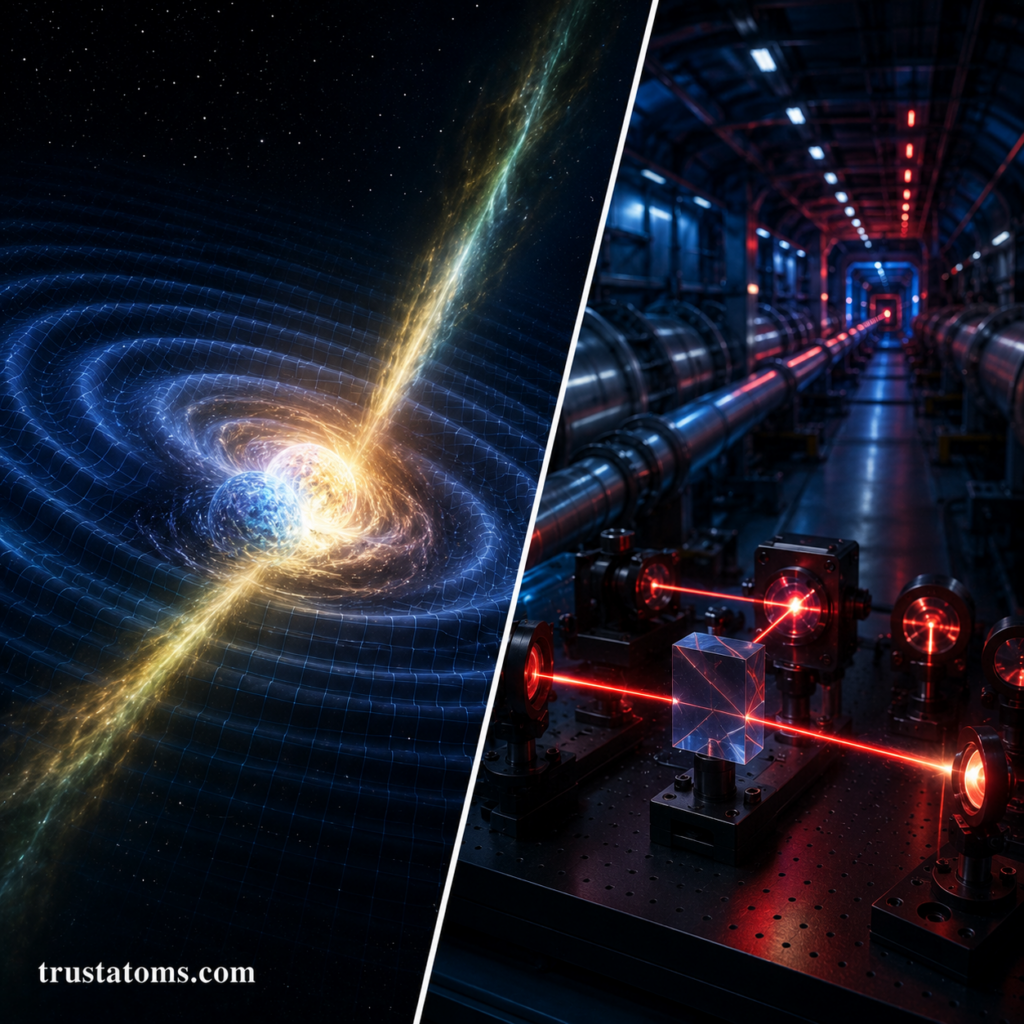
The Laser Interferometer Gravitational-Wave Observatory, or LIGO, consists of two major facilities in the United States: one in Hanford, Washington, and another in Livingston, Louisiana.
Each observatory contains two perpendicular arms, each approximately four kilometers long. Laser beams travel through vacuum tubes along these arms, reflecting repeatedly between carefully suspended mirrors.
The Laser Interferometry Process
- A laser beam enters the interferometer and is divided into two beams traveling along perpendicular arms.
- Mirrors reflect the beams repeatedly, increasing their effective travel distance and the instrument’s sensitivity.
- The beams return and recombine, producing an interference pattern determined by their relative phases.
- A passing gravitational wave can produce a changing difference between the effective lengths of the two arms.
- The resulting change in the interference signal is recorded and analyzed for evidence of gravitational radiation.
LIGO uses elaborate vibration isolation systems and sophisticated optical controls to reduce unwanted disturbances. Its mirrors are suspended so they can respond to gravitational-wave strain while remaining protected from much of the surrounding environmental noise.
The observatories also operate as a network. A genuine gravitational-wave signal should appear in multiple detectors with timing and waveform differences consistent with a wave traveling across Earth.
The First Direct Detection: GW150914
On September 14, 2015, the two LIGO observatories recorded a signal now known as GW150914. Scientists identified it as gravitational radiation from the merger of two black holes approximately 1.3 billion light-years away.
The black holes had estimated masses of about 36 and 29 times the Sun’s mass before merging. The resulting black hole had a mass of approximately 62 solar masses.
The difference of roughly three solar masses was released as gravitational-wave energy. Most of this radiation was emitted during the final moments of the merger.
These measurements provided the first direct observation of gravitational waves and the first direct detection of a binary black hole merger. The discovery was announced in February 2016, and the 2017 Nobel Prize in Physics recognized major contributions to LIGO and gravitational-wave detection.
How Scientists Confirm a Gravitational-Wave Signal
Finding a possible signal is only the beginning. Researchers must determine whether it represents an astrophysical event or an accidental pattern produced by detector noise.
One major technique is matched filtering. Scientists compare recorded data with predicted gravitational-wave patterns generated using general relativity and numerical simulations.
If a waveform closely matches the data, researchers estimate how likely it is that noise could produce a similar result. They also examine detector conditions and compare measurements from different observatories.
Signals that survive these checks can be analyzed to estimate source properties, including component masses, spins, distance, and approximate sky location.
What Gravitational Waves Reveal About Black Holes
Black holes do not emit light from inside their event horizons. Nevertheless, gravitational waves generated during mergers provide information about the motion and properties of these objects.
By studying waveform frequencies and amplitudes, astronomers can estimate black hole masses and spins. They can also test whether the merger and ringdown behave as predicted by general relativity.
Observing many mergers helps scientists investigate how black holes form, how frequently they merge, and what kinds of stellar environments produce compact binary systems.
Neutron Star Collisions and Multi-Messenger Astronomy
Gravitational-wave astronomy becomes especially informative when scientists detect more than one type of signal from the same event. This approach is called multi-messenger astronomy.
On August 17, 2017, detectors observed the gravitational-wave event GW170817, produced by two merging neutron stars. Approximately 1.7 seconds after the merger signal, space instruments detected a short gamma-ray burst.
Optical and infrared telescopes subsequently observed a kilonova in the galaxy NGC 4993. Its changing light provided evidence that neutron star mergers produce heavy elements through rapid neutron-capture processes.
Combining gravitational waves with electromagnetic observations allowed scientists to study the merger’s dynamics, identify its host galaxy, and investigate the properties of extremely dense nuclear matter.
Virgo, KAGRA, and International Detection Networks
LIGO is part of an international network of gravitational-wave observatories. Virgo, located near Pisa, Italy, operates a laser interferometer with three-kilometer arms, while Japan’s KAGRA observatory uses an underground interferometer with cryogenic mirror technology.
Multiple detectors improve confidence in candidate signals and help determine their locations in the sky. Differences in arrival times provide information about the direction from which a gravitational wave traveled.
Additional measurements also help researchers distinguish different wave polarizations and improve estimates of source properties. Detector availability and sensitivity can vary between observing runs.
Space-Based Gravitational Wave Detectors
Ground-based interferometers are especially sensitive to gravitational waves from compact stellar remnants. Detecting much lower-frequency waves requires instruments with different designs and substantially longer measurement baselines.
ESA’s planned Laser Interferometer Space Antenna, or LISA, is designed to use three spacecraft separated by approximately 2.5 million kilometers. Laser measurements between the spacecraft would allow scientists to investigate low-frequency gravitational waves.
Potential sources include merging supermassive black holes and compact objects orbiting much larger black holes. These observations would probe gravitational environments different from those accessible to current ground-based detectors.
The underlying physics connects to Space-Time Curvature, which describes how matter and energy influence the geometry through which gravitational waves propagate.
Gravitational-wave detectors also differ from instruments that study high-energy particles. Cosmic Rays and High-Energy Particles examines charged particles traveling through space, whereas gravitational-wave observatories measure distortions in spacetime itself.
Pulsar Timing Arrays and Very Low-Frequency Waves
Another detection method uses rapidly rotating neutron stars called millisecond pulsars. These objects emit radio pulses at highly regular intervals, allowing astronomers to monitor subtle changes in pulse arrival times.
A passing gravitational wave can alter the apparent timing of signals from multiple pulsars. By searching for correlated timing variations across many pulsars, scientists can investigate gravitational waves with periods lasting years.
In 2023, several pulsar timing collaborations reported evidence for a common gravitational-wave background with the expected spatial correlations. A leading explanation involves populations of supermassive black hole binaries, although researchers continue investigating the background’s detailed origins.
Challenges in Gravitational-Wave Astronomy
Gravitational-wave observatories must operate close to the limits of precision measurement. Environmental vibrations, thermal fluctuations, and quantum noise can obscure weak signals.
Another challenge is identifying faint or unusual events whose waveforms differ from familiar merger patterns. Researchers use several search methods, including approaches designed to recognize signals without assuming a precise waveform.
Distance also limits detection. As gravitational waves spread outward, their strain generally decreases, making remote sources harder to measure.
Improved detector sensitivity expands the volume of space that observatories can search, potentially revealing more mergers and less common astrophysical events.
Future Discoveries in Gravitational-Wave Research
Future instruments may detect gravitational waves from sources that current observatories cannot study. Proposed next-generation ground-based detectors include the Einstein Telescope and Cosmic Explorer, both intended to improve sensitivity across important frequency ranges.
Scientists are also searching for possible primordial gravitational waves associated with physical processes in the early universe. Such signals remain unconfirmed, and their detection would require careful separation from other astrophysical and instrumental effects.
By combining ground-based interferometers, space missions, pulsar timing arrays, and electromagnetic telescopes, researchers can investigate gravity across a much wider range of masses, distances, and timescales.
Frequently Asked Questions
Can humans hear gravitational waves?
No. Gravitational waves are not ordinary sound waves traveling through air. However, scientists can convert recorded gravitational-wave signals into audio, making their changing frequencies audible as chirps.
How accurate is LIGO’s gravitational-wave detection?
LIGO can measure fractional changes in distance of approximately one part in 10 to the power of 21 for suitable signals. Detecting these changes requires advanced laser systems, suspended mirrors, noise reduction, and statistical analysis.
Do gravitational waves travel at the speed of light?
General relativity predicts that gravitational waves travel at the speed of light in a vacuum. Observations of GW170817 and its associated gamma-ray burst strongly support this prediction, placing tight limits on any difference between their propagation speeds.
Gravitational-wave detection allows scientists to measure events that may produce little or no observable light, including mergers of distant black holes. As detector networks improve, their measurements will provide increasingly precise tests of gravity and new evidence about compact objects, neutron star matter, and the universe’s large-scale history.
Sources: LIGO Scientific Collaboration and Virgo Collaboration, Physical Review Letters (2016), Observation of Gravitational Waves from a Binary Black Hole Merger; LIGO Scientific Collaboration and Virgo Collaboration, Physical Review Letters (2017), GW170817: Observation of Gravitational Waves from a Binary Neutron Star Inspiral; European Space Agency, LISA mission science resources.