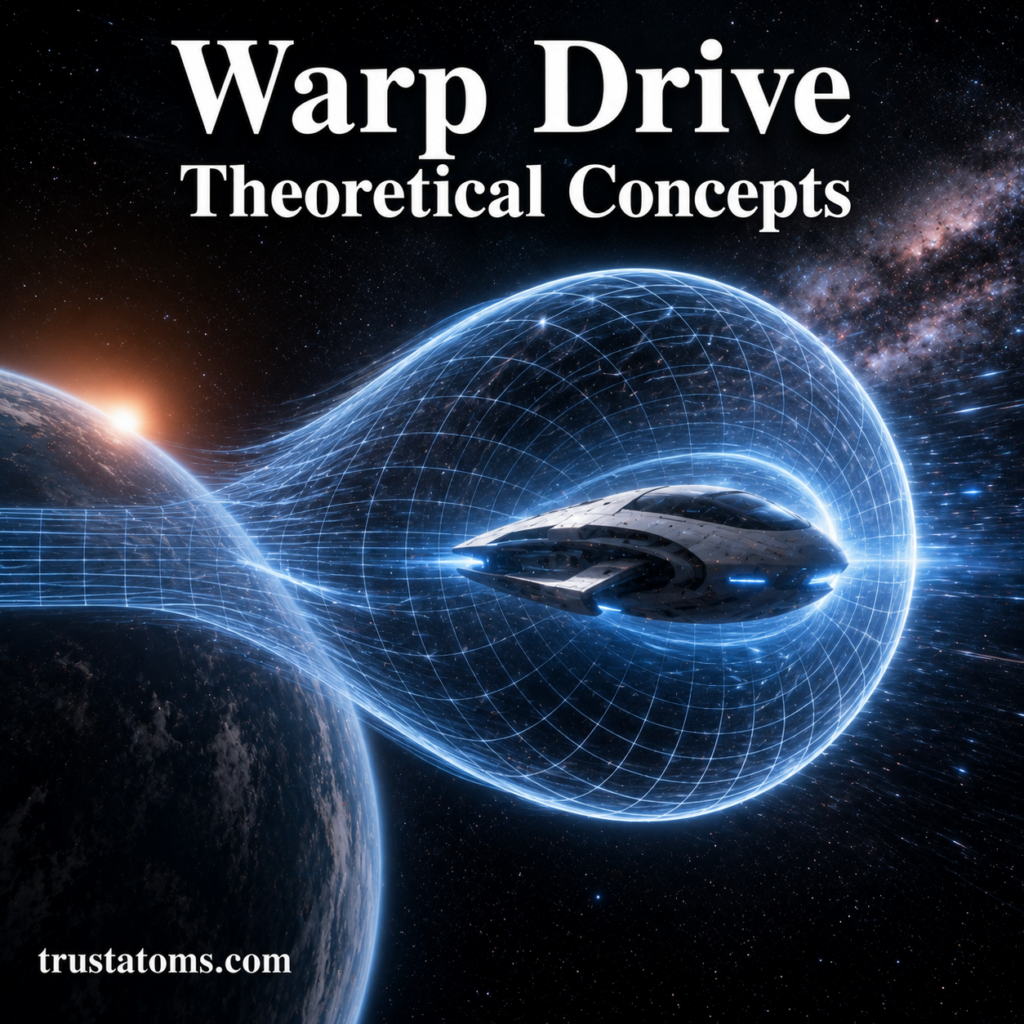
Warp drives are one of the most fascinating ideas in theoretical physics and science fiction. Popularized by movies and television, warp drives promise a way to travel across enormous cosmic distances faster than light without technically violating Einstein’s laws of relativity.
Although warp drives remain entirely theoretical, real physicists have explored whether certain mathematical models might allow spacetime itself to move in ways that could make apparent faster-than-light travel possible.
Understanding warp drive concepts requires examining relativity, spacetime geometry, exotic energy, and some of the biggest unanswered questions in modern physics.
What Is a Warp Drive?
A warp drive is a hypothetical propulsion system that manipulates spacetime to allow a spacecraft to travel vast distances extremely quickly.
Instead of accelerating a ship through space faster than light, a warp drive would theoretically:
- Compress spacetime in front of the spacecraft
- Expand spacetime behind it
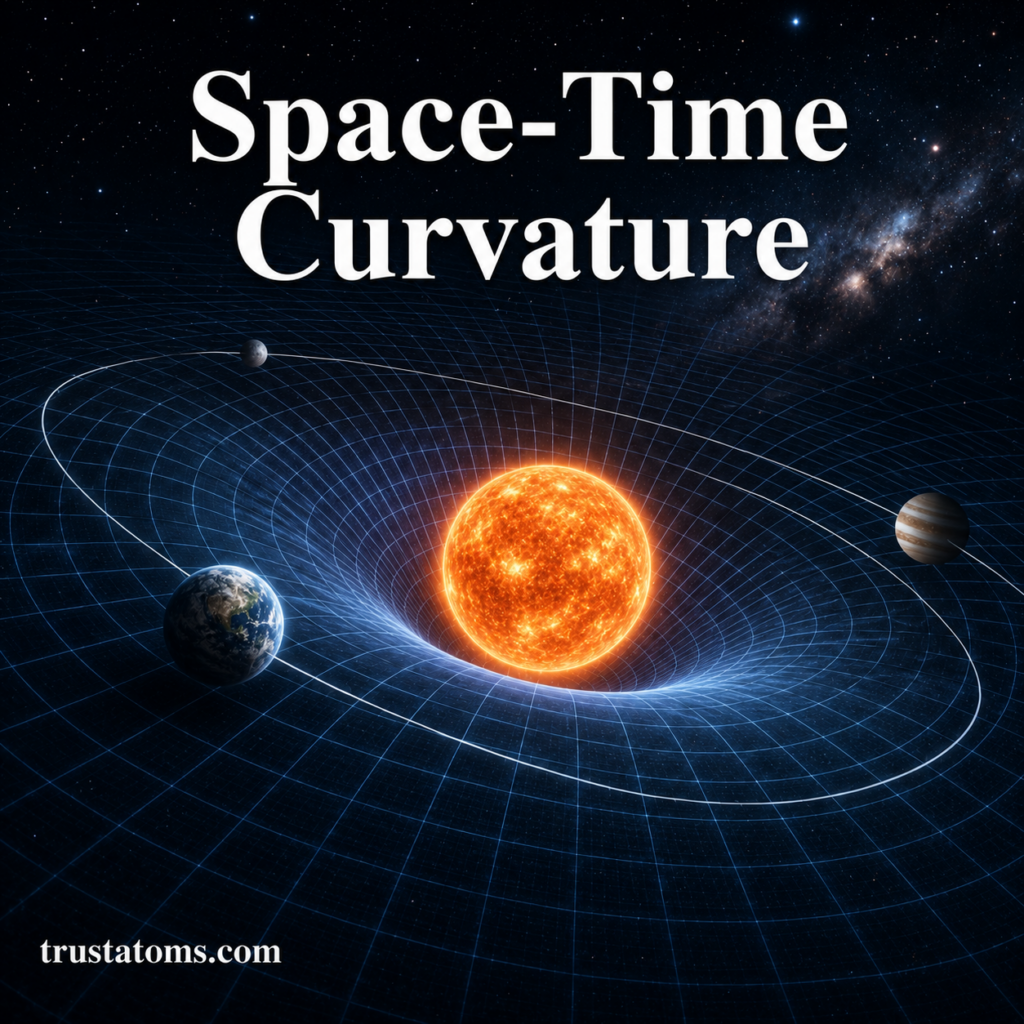
- Move the surrounding region of space itself
The spacecraft would effectively ride inside a “warp bubble.”
This concept attempts to bypass one of physics’ biggest limitations: the speed of light.
Why Faster-Than-Light Travel Is Difficult
According to Einstein’s special relativity, nothing with mass can accelerate to the speed of light because the required energy becomes infinite.
The Universal Speed Limit
Einstein’s famous equation describes the relationship between mass and energy:
As an object moves faster:
- Its energy requirements increase dramatically
- Acceleration becomes increasingly difficult
- Infinite energy would be required at light speed
This means conventional propulsion systems cannot achieve faster-than-light travel.
The Key Idea Behind Warp Drives
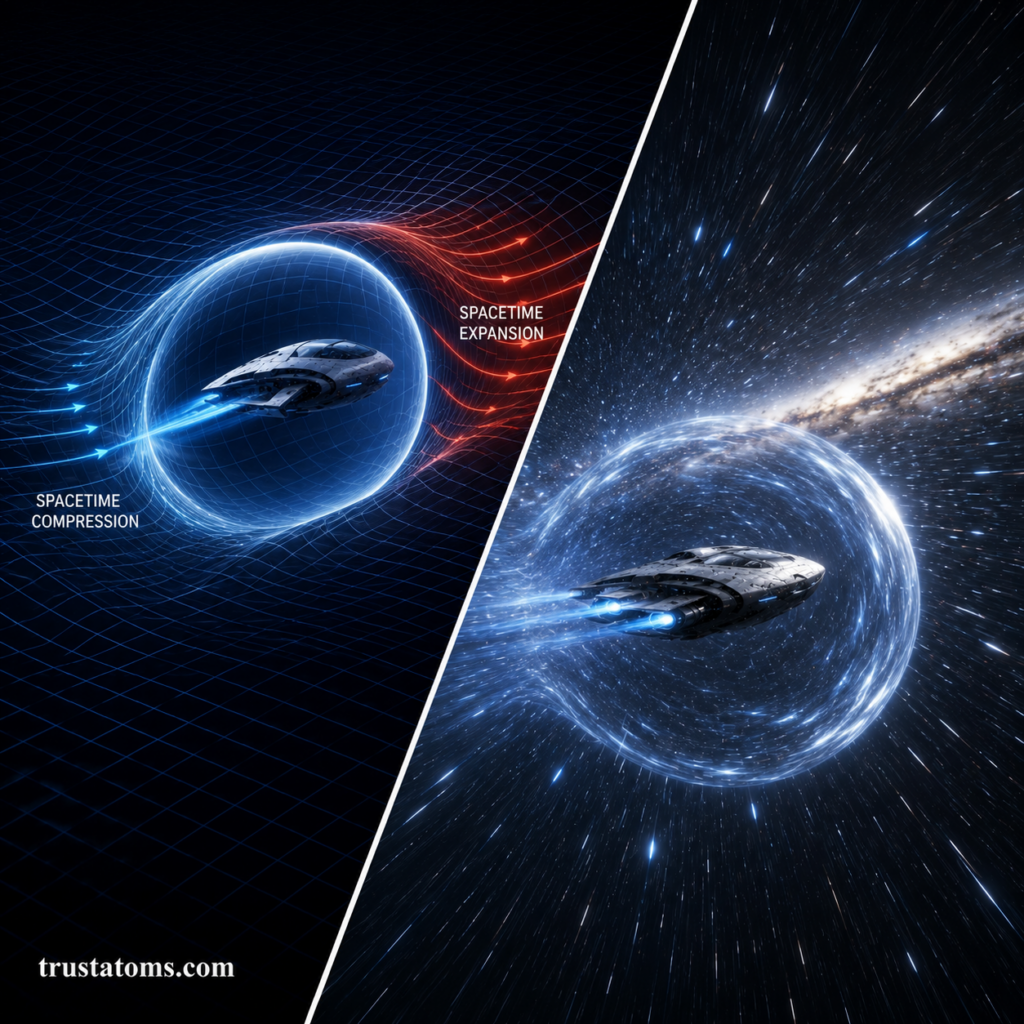
Warp drives attempt to avoid breaking relativity by changing spacetime itself rather than moving directly through space faster than light.
An analogy often used is a moving walkway:
- The traveler remains stationary relative to the walkway
- The walkway itself carries the traveler forward
In warp drive theory:
- The spacecraft remains locally stationary
- Spacetime moves around the ship
This distinction is important because relativity restricts movement through spacetime, not necessarily the expansion or contraction of spacetime itself.
The Alcubierre Warp Drive
The most famous warp drive concept was proposed in 1994 by physicist Miguel Alcubierre.
The Alcubierre Metric
Alcubierre developed a mathematical solution to Einstein’s field equations showing that a warp bubble might theoretically exist.
The concept involved:
- A contracting region of spacetime ahead of the ship
- An expanding region behind it
- A stable bubble carrying the spacecraft
Inside the bubble, the spacecraft itself would not locally exceed light speed.
Einstein’s Field Equations
Warp drive ideas rely heavily on general relativity.
These equations describe how matter and energy influence spacetime curvature.
The Alcubierre model suggested certain spacetime geometries might allow effective faster-than-light motion.
What Is a Warp Bubble?
A warp bubble is the theoretical region of distorted spacetime surrounding the spacecraft.
Inside the bubble:
- The crew would experience normal local physics
- The ship might avoid extreme acceleration forces
- Time effects could differ from outside observers
Outside the bubble:
- Spacetime distortion would carry the bubble forward
- Apparent faster-than-light travel could occur
The bubble itself becomes the “vehicle” moving through space.
Exotic Matter and Negative Energy
One of the biggest challenges with warp drives is the requirement for exotic matter.
What Is Negative Energy?
The Alcubierre model requires regions of spacetime containing negative energy density.
Normal matter has positive energy density, so negative energy behaves differently from anything commonly observed.
Possible theoretical sources include:
- Quantum vacuum effects
- Casimir effect phenomena
- Hypothetical exotic particles
However, no known technology can generate or control the enormous amounts required.
Why Exotic Matter Matters
Negative energy would theoretically help stabilize and shape the warp bubble.
Without it:
- The spacetime distortion may collapse
- The bubble could become unstable
- Faster-than-light behavior may be impossible
This remains one of the largest unresolved issues in warp drive research.
The Energy Problem
Early warp drive calculations suggested impossible energy requirements.
Some estimates indicated:
- More energy than contained in entire planets
- Energy comparable to stars
- Massive amounts of exotic matter
Later theoretical refinements reduced the estimated requirements, but they remain far beyond current technological capability.
Causality and Time Paradoxes
Faster-than-light travel creates potential problems involving causality.
What Is Causality?
Causality means causes occur before effects.
Relativity suggests faster-than-light travel could allow information or objects to arrive before they departed in certain reference frames.
This introduces paradoxes such as:
- Time travel problems
- Violations of chronological order
- Logical contradictions
Physicists remain uncertain whether nature fundamentally prevents such scenarios.
Radiation and Stability Problems
Even if a warp drive were possible mathematically, practical dangers remain.
Radiation Accumulation
Some models suggest particles and radiation could accumulate around the warp bubble.
When the bubble stops:
- Intense radiation may release forward
- Nearby regions could be damaged
- Hazardous energy bursts could occur
Bubble Stability
Maintaining a stable warp bubble may require perfect control over spacetime geometry.
Small instabilities might cause:
- Bubble collapse
- Violent energy release
- Loss of navigational control
Could Warp Drives Damage Space?
Some theoretical studies suggest warp drives might significantly disturb surrounding spacetime.
Potential concerns include:
- Gravitational wave effects
- Spacetime turbulence
- Vacuum instability
These ideas remain speculative but highlight the complexity of manipulating spacetime itself.
Quantum Physics and Warp Drives
Warp drive research often overlaps with quantum physics.
Quantum Vacuum Effects
Quantum theory suggests empty space is not truly empty.
Vacuum fluctuations may briefly produce tiny negative energy effects.
Scientists study whether these phenomena could someday contribute to advanced spacetime engineering.
Quantum Gravity Unknowns
Modern physics still lacks a complete theory combining:
- General relativity
- Quantum mechanics
Because of this, scientists cannot fully determine whether warp drives are fundamentally impossible or merely technologically unreachable.
Other Faster-Than-Light Concepts
Warp drives are not the only proposed faster-than-light idea.
Wormholes
Wormholes are hypothetical tunnels connecting distant regions of spacetime.
They could theoretically allow shortcuts across the universe.
However, stable wormholes may also require exotic matter.
Hyperspace Concepts
Science fiction often imagines alternate dimensions or hyperspace travel.
Currently, these ideas have no confirmed scientific evidence.
Are Warp Drives Scientifically Accepted?
Warp drives are considered speculative theoretical physics.
Scientists generally agree that:
- The mathematics is interesting
- General relativity permits unusual spacetime geometries
- Major practical barriers remain unresolved
No experimental evidence currently suggests warp drives can actually be built.
Why Scientists Study Warp Drives Anyway
Even if warp drives never become practical, studying them still benefits physics.
Research contributes to understanding:
- General relativity
- Quantum field theory
- Spacetime geometry
- Exotic energy conditions
- Cosmology
Exploring extreme theoretical ideas often leads to deeper insights into the universe.
Warp Drives in Popular Culture
Warp drives became widely known through science fiction franchises such as:
- Star Trek
- Star Wars-inspired faster travel concepts
- Various space exploration novels and films
These fictional portrayals helped inspire public interest in astrophysics and space travel.
While fictional warp engines are far more advanced than theoretical models, they sparked real scientific curiosity.
Could Humanity Ever Build a Warp Drive?
At present, humanity lacks:
- Exotic matter technology
- Spacetime manipulation capability
- Required energy generation systems
- A complete understanding of quantum gravity
Most scientists consider practical warp drives extremely unlikely with current physics and engineering knowledge.
However, physics has repeatedly evolved throughout history, and future discoveries may change what is considered possible.
Final Thoughts
Warp drive theoretical concepts sit at the intersection of science fiction and advanced theoretical physics.
While no evidence currently shows that faster-than-light travel is achievable, warp drive research explores profound questions about spacetime, energy, gravity, and the structure of the universe itself.
Even if warp drives remain impossible, studying them continues pushing the boundaries of human understanding and inspiring future generations of physicists, engineers, and explorers.