Singularities are among the most mysterious and controversial concepts in modern physics. They appear in mathematical models where physical quantities become infinite or impossible to define using current scientific theories.
Most commonly associated with black holes and the beginning of the universe, singularities challenge humanity’s understanding of space, time, gravity, and reality itself.
Physicists study singularities because they may reveal where our current laws of physics break down — and where entirely new theories may be needed.
What Is a Singularity?
In physics, a singularity is a point or region where known physical laws can no longer fully describe what happens.
Mathematically, singularities often involve:
- Infinite density
- Infinite curvature
- Undefined physical behavior
- Breakdown of equations
This does not necessarily mean infinities physically exist in nature. Instead, it may indicate that existing theories become incomplete under extreme conditions.
Why Singularities Matter
Singularities are important because they expose the limits of current physics.
They force scientists to confront difficult questions such as:
- What happens inside black holes?
- What existed before the Big Bang?
- Can gravity and quantum mechanics be unified?
- Do infinities truly exist in nature?
Studying singularities may eventually lead to breakthroughs in fundamental physics.
Singularities in Black Holes
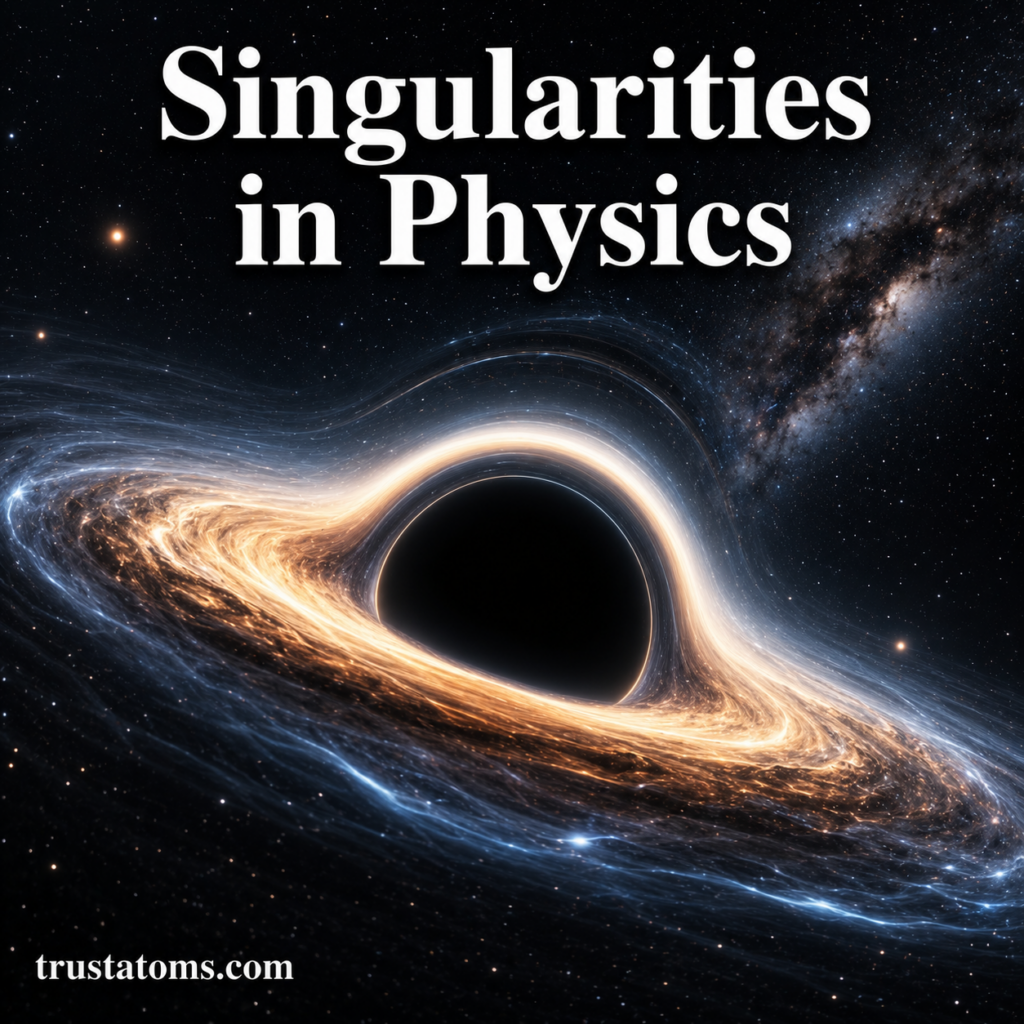
The most famous singularities are associated with black holes.
How Black Holes Form
Black holes typically form when massive stars collapse under their own gravity after exhausting nuclear fuel.
As the core collapses:
- Matter compresses into an extremely small region
- Gravity becomes incredibly strong
- Escape velocity exceeds the speed of light
Eventually, general relativity predicts the formation of a singularity.
The Event Horizon
The singularity itself is hidden behind a boundary called the event horizon.
The event horizon marks the point beyond which:
- Light cannot escape
- Information cannot return
- Outside observers cannot directly see the interior
Because singularities are hidden inside black holes, scientists cannot directly observe them.
General Relativity and Singularities
Einstein’s theory of general relativity predicts singularities under certain conditions.
Einstein’s Field Equations
General relativity describes gravity as curvature of spacetime.
Under extreme gravitational collapse, these equations can predict infinite spacetime curvature.
Spacetime Curvature
Mass and energy bend spacetime.
Near a black hole:
- Gravity intensifies dramatically
- Time slows relative to distant observers
- Tidal forces become enormous
At the singularity itself, curvature theoretically becomes infinite.
Do Singularities Really Exist?
Many physicists believe singularities in equations signal incomplete theories rather than physical reality.
Infinite values often suggest:
- Mathematical breakdowns
- Missing physics
- The need for quantum gravity
Current theories cannot fully describe conditions at extremely tiny scales and enormous densities simultaneously.
Quantum Mechanics vs. Gravity
One of the biggest problems in physics is combining:
- General relativity
- Quantum mechanics
General relativity works extremely well for large objects and gravity.
Quantum mechanics accurately describes tiny particles and microscopic interactions.
However, near singularities:
- Both theories become important simultaneously
- Their equations conflict
- Predictions become inconsistent
This is one reason physicists seek a unified “theory of everything.”
The Big Bang Singularity
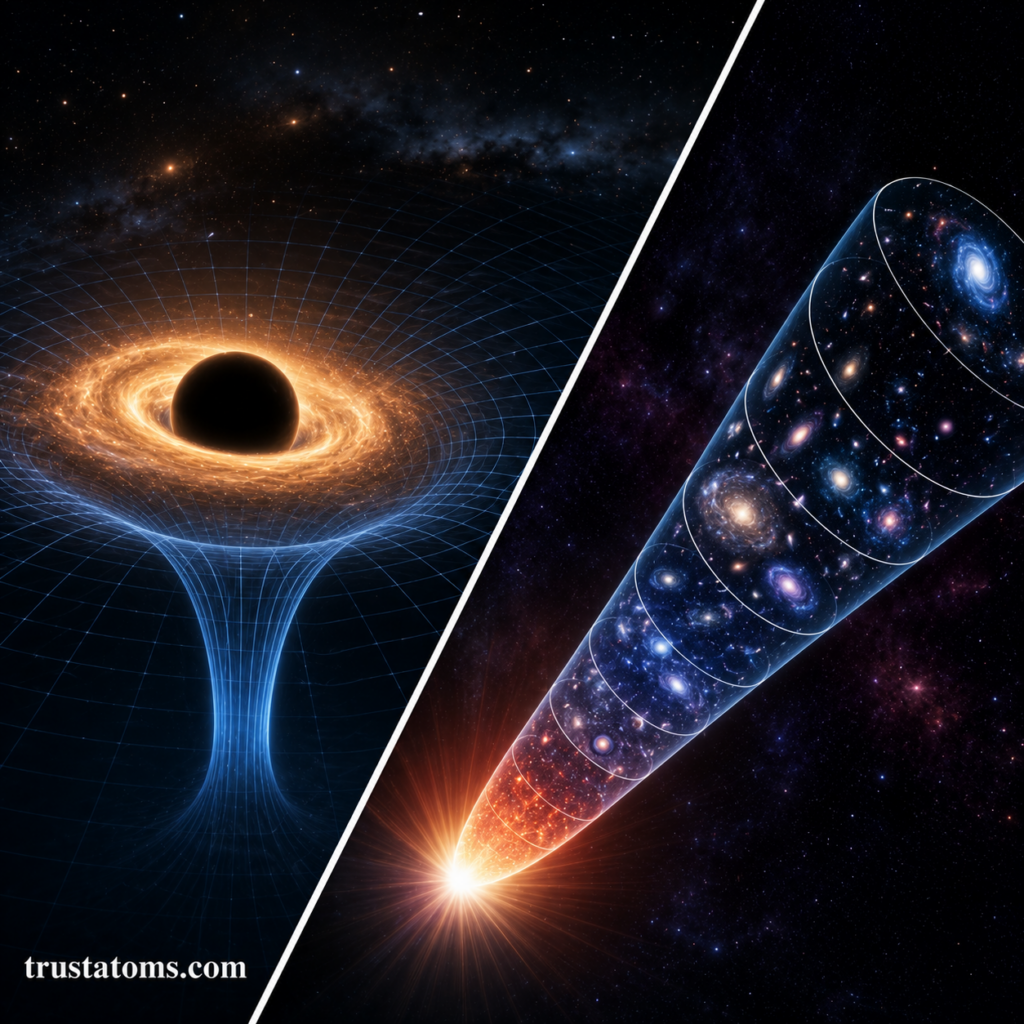
Singularities are also associated with the origin of the universe.
The Beginning of the Universe
The Big Bang model suggests the observable universe expanded from an extremely hot, dense state.
Tracing cosmic expansion backward mathematically leads toward:
- Extremely high temperatures
- Extreme density
- Tiny spatial scales
General relativity predicts a singularity at the beginning.
Was the Big Bang Truly a Singularity?
Scientists remain uncertain whether the universe actually began from a true singularity.
Possible alternatives include:
- Quantum bounce models
- Cyclic universes
- Inflationary scenarios
- Pre-Big Bang states
Modern cosmology continues exploring whether singularities can be avoided.
Types of Singularities
Not all singularities are identical.
Gravitational Singularities
These occur in spacetime under extreme gravity conditions, such as black holes.
Coordinate Singularities
Some singularities are only mathematical artifacts caused by coordinate systems.
For example:
- The event horizon of a black hole initially appears singular in some equations
- Improved coordinate systems remove the apparent problem
This differs from a true physical singularity.
Naked Singularities
A naked singularity would exist without an event horizon hiding it.
If naked singularities exist:
- Their effects could potentially be observable
- Predictability in physics may break down
Most physicists suspect nature prevents naked singularities through mechanisms such as cosmic censorship.
The Cosmic Censorship Hypothesis
Physicist Roger Penrose proposed the cosmic censorship hypothesis.
The basic idea suggests:
- Singularities are always hidden behind event horizons
- Nature prevents exposed singularities
- Physical predictability remains preserved
This hypothesis remains unproven.
Singularities and Infinite Density
Singularities are often described as points of infinite density.
Density relates mass to volume.ρ=Vm
If matter compresses into zero volume while maintaining mass, density mathematically approaches infinity.
However, many physicists believe quantum effects likely prevent true infinite density.
Planck Scale Physics
The Planck scale represents extremely tiny distances where quantum gravity effects likely become important.
At these scales:
- Spacetime may become quantized
- Classical geometry may fail
- New physics may emerge
The Planck length is extraordinarily small.
Current experiments cannot directly probe these conditions.
The Search for Quantum Gravity
Resolving singularities likely requires a successful theory of quantum gravity.
Several major approaches exist.
String Theory
String theory proposes that fundamental particles are tiny vibrating strings.
Potential advantages include:
- Natural incorporation of gravity
- Removal of point-like infinities
- Extra dimensions
However, experimental confirmation remains lacking.
Loop Quantum Gravity
Loop quantum gravity suggests spacetime itself has discrete structure.
This may:
- Prevent infinite compression
- Eliminate classical singularities
- Quantize spacetime geometry
Research continues in this area.
Other Approaches
Additional theories include:
- Causal dynamical triangulation
- Emergent gravity
- Quantum cosmology models
No approach has yet achieved complete scientific acceptance.
Information Paradox and Singularities
Black hole singularities connect closely to the black hole information paradox.
Quantum mechanics suggests information cannot be destroyed.
However, black holes appear to trap or erase information.
Stephen Hawking’s work on black hole radiation intensified this debate.
Resolving the paradox may require a deeper understanding of singularities and quantum gravity.
Can Humans Reach a Singularity?
Crossing into a black hole would expose travelers to extreme conditions.
Potential effects include:
- Intense tidal stretching (“spaghettification”)
- Radiation exposure
- Extreme gravitational forces
For smaller black holes, survival would be impossible near the singularity.
Some supermassive black holes may allow travelers to cross the event horizon before experiencing destructive forces, but survival deeper inside remains unlikely.
Singularities in Science Fiction
Science fiction frequently uses singularities in stories involving:
- Black holes
- Time travel
- Wormholes
- Advanced civilizations
- Cosmic gateways
Popular media often exaggerates or simplifies the physics, but these concepts help inspire public interest in astrophysics.
Are Singularities Real or Mathematical Artifacts?
Scientists still debate whether singularities physically exist.
Possibilities include:
- Singularities are real physical entities
- Singularities indicate incomplete mathematics
- Quantum gravity eliminates infinities
- Unknown physics changes spacetime behavior
At present, no definitive answer exists.
Why Singularities Fascinate Scientists
Singularities sit at the edge of human knowledge.
They connect multiple major fields:
- Cosmology
- Quantum mechanics
- Gravity
- Black hole physics
- Mathematical physics
Understanding singularities may eventually reveal entirely new laws governing the universe.
Final Thoughts
Singularities in physics represent some of the deepest mysteries in science.
They emerge when gravity, density, and spacetime reach extreme conditions beyond the reach of current theories. Whether found inside black holes or connected to the origins of the universe, singularities challenge scientists to rethink the foundations of reality itself.
Although much remains unknown, studying singularities continues driving progress in cosmology, relativity, and quantum physics — bringing humanity closer to understanding how the universe truly works.