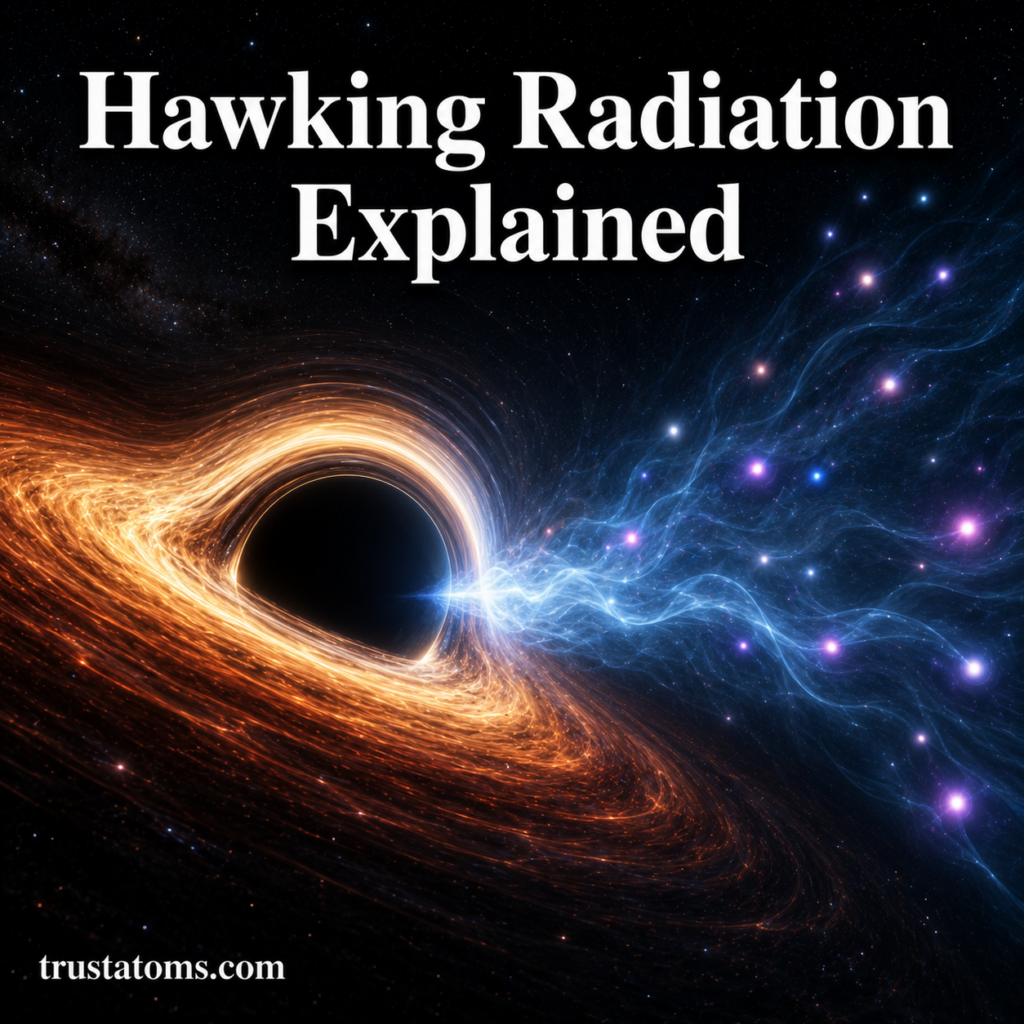
Hawking radiation is one of the most fascinating and surprising ideas in modern physics. Proposed by physicist Stephen Hawking in 1974, the theory suggests that black holes are not completely black after all.
Instead of trapping everything forever, black holes may slowly emit tiny amounts of radiation and eventually evaporate over enormous periods of time.
This groundbreaking idea connected two major areas of physics:
- General relativity
- Quantum mechanics
Because these theories normally describe very different scales of nature, Hawking radiation became one of the most important concepts in theoretical astrophysics.
What Is Hawking Radiation?
Hawking radiation is theoretical thermal radiation predicted to be emitted near the event horizon of a black hole.
The key idea is that quantum effects near the black hole allow energy to escape gradually.
Over extremely long timescales:
- Black holes lose mass
- They shrink slowly
- They may eventually disappear completely
This challenged the older belief that black holes only absorb matter and energy.
Why Black Holes Were Once Thought to Be Completely Black
Classical physics originally described black holes as objects with gravity so strong that nothing could escape once it crossed the event horizon.
This included:
- Matter
- Light
- Radiation
- Information
According to Einstein’s general relativity alone, black holes should simply grow larger as they absorb material.
However, quantum mechanics introduced a surprising twist.
Quantum Mechanics and Empty Space
One of the strange features of quantum physics is that empty space is not truly empty.
Quantum Vacuum Fluctuations
According to quantum field theory:
- Tiny particle pairs constantly appear and disappear
- These particles exist briefly before annihilating each other
- The vacuum contains fluctuating energy fields
This phenomenon is called quantum vacuum fluctuation.
Near a black hole’s event horizon, these fluctuations behave differently.
How Hawking Radiation Works
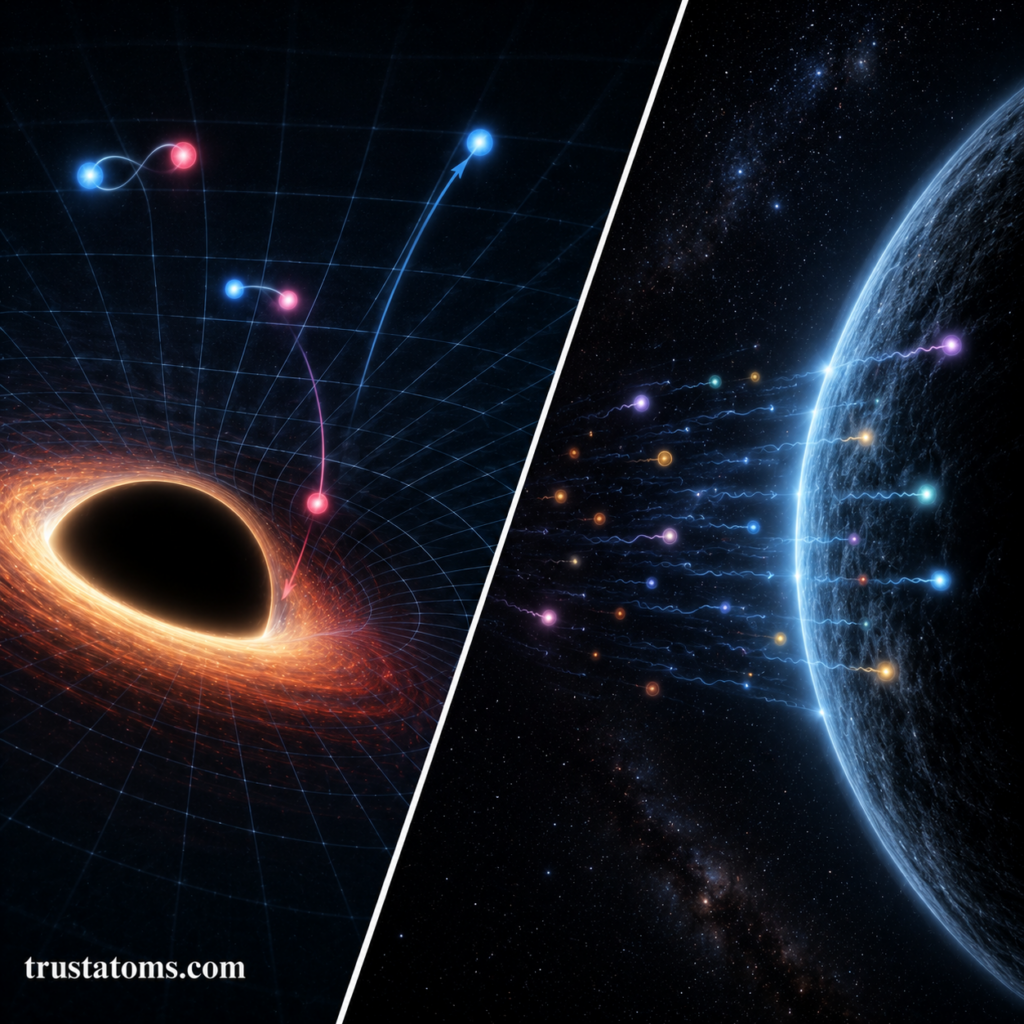
The simplified explanation for Hawking radiation involves virtual particle pairs.
Step-by-Step Overview
- A particle-antiparticle pair forms near the event horizon
- Normally, the particles quickly annihilate each other
- Near the event horizon, gravity may separate them
- One particle falls into the black hole
- The other escapes into space
The escaping particle becomes detectable radiation.
Loss of Black Hole Mass
To conserve energy, the escaping radiation effectively removes energy from the black hole.
Einstein’s mass-energy relation explains this connection:
Because energy and mass are related:
- Emitting radiation reduces black hole energy
- Reduced energy means reduced mass
- The black hole slowly evaporates
What Kind of Radiation Is Emitted?
Hawking radiation is expected to resemble thermal radiation.
Depending on the black hole’s size, it could involve:
- Photons
- Neutrinos
- Other elementary particles
Large black holes emit extremely tiny amounts of radiation and are colder than the surrounding universe.
Black Hole Temperature
One surprising aspect of Hawking’s theory is that black holes have temperature.
Smaller Black Holes Are Hotter
Hawking discovered that:
- Small black holes emit more radiation
- Small black holes are hotter
- Large black holes emit less radiation
This creates an inverse relationship between size and temperature.
Hawking Temperature
The Hawking temperature formula relates black hole mass to temperature.
This equation shows that temperature decreases as mass increases.
Black Hole Evaporation
Because Hawking radiation removes energy, black holes may eventually evaporate entirely.
Evaporation Process
The process would occur extremely slowly for large black holes.
As mass decreases:
- Radiation output increases
- Temperature rises
- Evaporation accelerates
The final stages may involve a massive burst of energy.
How Long Would It Take?
For stellar-mass black holes, evaporation times are enormous.
Some estimates exceed:
- Trillions upon trillions of years
- Far longer than the current age of the universe
This means no known astrophysical black holes are close to evaporating today.
Why Hawking Radiation Was Revolutionary
Hawking radiation changed scientific understanding in several major ways.
1. Black Holes Are Thermodynamic Objects
Black holes appear to follow thermodynamic principles involving:
- Temperature
- Entropy
- Energy exchange
2. Quantum Mechanics Affects Gravity
The theory demonstrated that quantum effects matter near black holes.
3. Black Holes May Not Last Forever
Black holes became dynamic rather than permanent cosmic objects.
Black Hole Entropy
Physicists discovered black holes also possess entropy.
Entropy measures disorder or information content.
Bekenstein-Hawking Entropy
Jacob Bekenstein and Stephen Hawking connected black hole entropy to event horizon area.
This relationship suggested deep connections between:
- Information
- Gravity
- Quantum physics
- Spacetime geometry
The Black Hole Information Paradox
Hawking radiation led directly to one of physics’ greatest unsolved problems.
The Core Problem
Quantum mechanics states that information cannot truly disappear.
However:
- Hawking radiation appears random
- Black holes may evaporate completely
- Information about swallowed matter may vanish
This creates the black hole information paradox.
Why It Matters
If information is destroyed:
- Quantum mechanics may be incomplete
- Fundamental physics could require revision
Scientists continue debating possible solutions.
Possible Solutions to the Information Paradox
Several theories attempt to resolve the paradox.
Information Escapes in Radiation
Some physicists believe information is subtly encoded within Hawking radiation.
Information Remains on the Event Horizon
The holographic principle suggests information may be stored on the black hole’s surface.
Black Hole Remnants
Some theories propose tiny remnants remain after evaporation, preserving information.
No consensus currently exists.
Have Scientists Observed Hawking Radiation?
Direct observation has not yet occurred.
Why Detection Is Difficult
Astrophysical black holes emit extremely weak Hawking radiation because they are massive and cold.
The radiation is far weaker than:
- Cosmic microwave background radiation
- Surrounding astrophysical emissions
This makes detection extremely challenging.
Laboratory Analogues
Scientists have created experimental systems that mimic aspects of Hawking radiation using:
- Fluid systems
- Bose-Einstein condensates
- Optical analogues
These experiments do not create real black holes but may help test related physics.
Primordial Black Holes and Hawking Radiation
Tiny hypothetical primordial black holes may have formed shortly after the Big Bang.
Because smaller black holes evaporate faster:
- Some may already have disappeared
- Others could emit detectable radiation today
Researchers continue searching for evidence.
Hawking Radiation and the Fate of the Universe
Over unimaginable timescales, Hawking radiation could influence the long-term future of the cosmos.
If the universe continues expanding indefinitely:
- Stars may eventually burn out
- Galaxies may fade
- Black holes may dominate the cosmos
- Hawking radiation may slowly erase even black holes
This scenario is sometimes called the “Black Hole Era.”
Why Hawking Radiation Matters
Hawking radiation remains one of the most important ideas in theoretical physics because it connects:
- Gravity
- Thermodynamics
- Quantum mechanics
- Cosmology
It may provide clues toward a future theory of quantum gravity capable of unifying modern physics.
Stephen Hawking’s Legacy
Stephen Hawking’s work transformed black hole research.
His discoveries helped show that:
- Black holes are dynamic systems
- Quantum effects shape spacetime
- The universe behaves in deeply surprising ways
Hawking radiation remains central to modern theoretical astrophysics decades after its proposal.
Final Thoughts
Hawking radiation revealed that black holes are not eternal prisons but slowly evolving quantum objects capable of losing energy and evaporating over time.
Although direct observation remains difficult, the theory profoundly changed scientific understanding of gravity, thermodynamics, and quantum mechanics.
By combining ideas from multiple branches of physics, Hawking radiation continues guiding researchers toward deeper insights about the universe and the fundamental laws that govern reality.