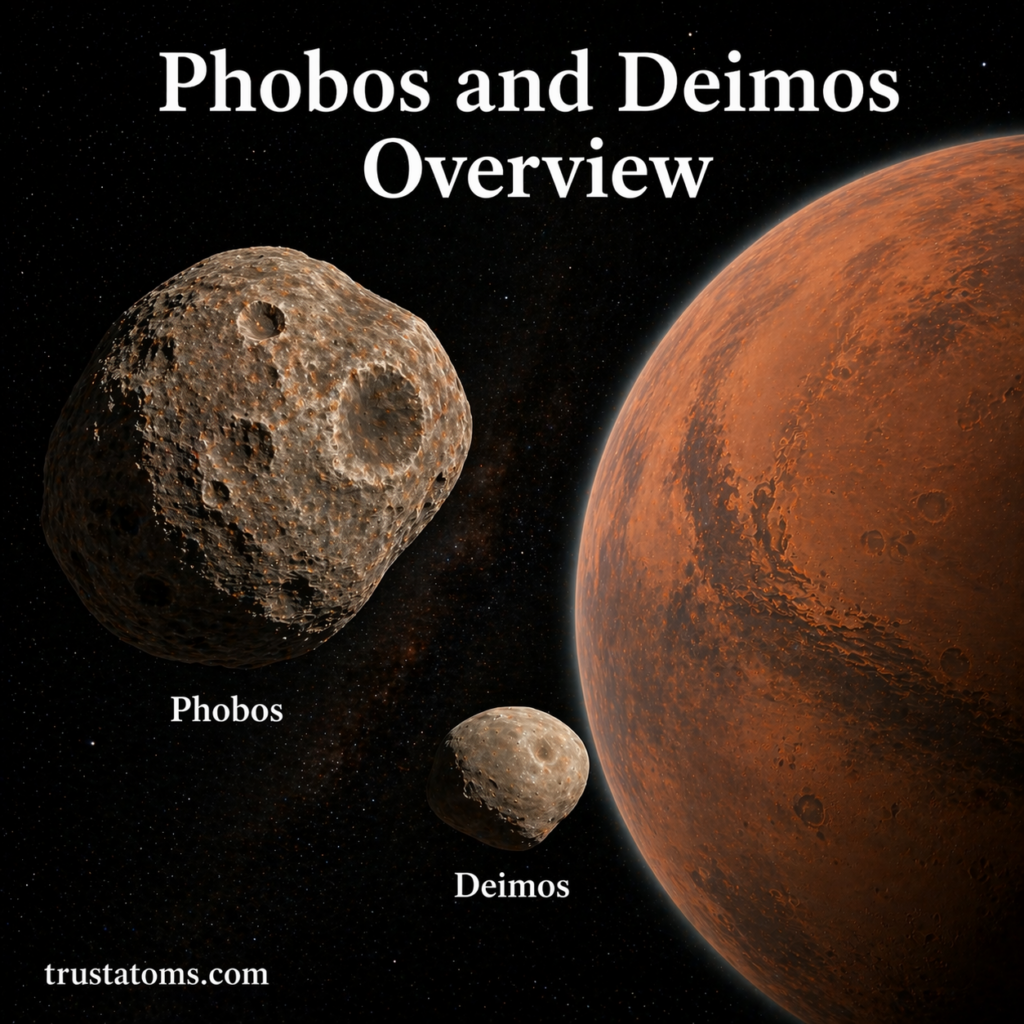
Mars is accompanied by two small, irregularly shaped moons: Phobos and Deimos. Unlike Earth’s large, spherical Moon, these moons are tiny, rugged, and oddly shaped—more like captured asteroids than traditional moons.
Despite their size, Phobos and Deimos offer valuable insights into planetary formation, orbital dynamics, and the history of the solar system.
Discovery of Phobos and Deimos
Phobos and Deimos were discovered in 1877 by American astronomer Asaph Hall at the United States Naval Observatory.
Naming Origins
Their names come from Greek mythology:
- Phobos: Meaning “fear”
- Deimos: Meaning “terror”
Both were sons of Ares (the Greek counterpart of Mars), symbolically accompanying the god of war.
Basic Characteristics
Phobos and Deimos are among the smallest moons in the solar system.
Phobos
- Average radius: ~11 km
- Orbits Mars in about 7 hours
- Closest moon to its planet in the solar system
- Heavily cratered with grooves and ridges
Deimos
- Average radius: ~6 km
- Orbits Mars in about 30 hours
- Smoother surface with fewer large craters
- More rounded than Phobos
Shape and Surface Features
Unlike most large moons, Phobos and Deimos are not spherical.
Why Are They Irregular?
Their low gravity is not strong enough to pull them into a round shape. As a result:
- They appear lumpy and elongated
- Surfaces are covered in dust and debris
- Large craters dominate their appearance
Notable Features on Phobos
- Stickney Crater: A massive impact crater that dominates its surface
- Grooved terrain: Likely caused by stress fractures or past impacts
Orbits Around Mars
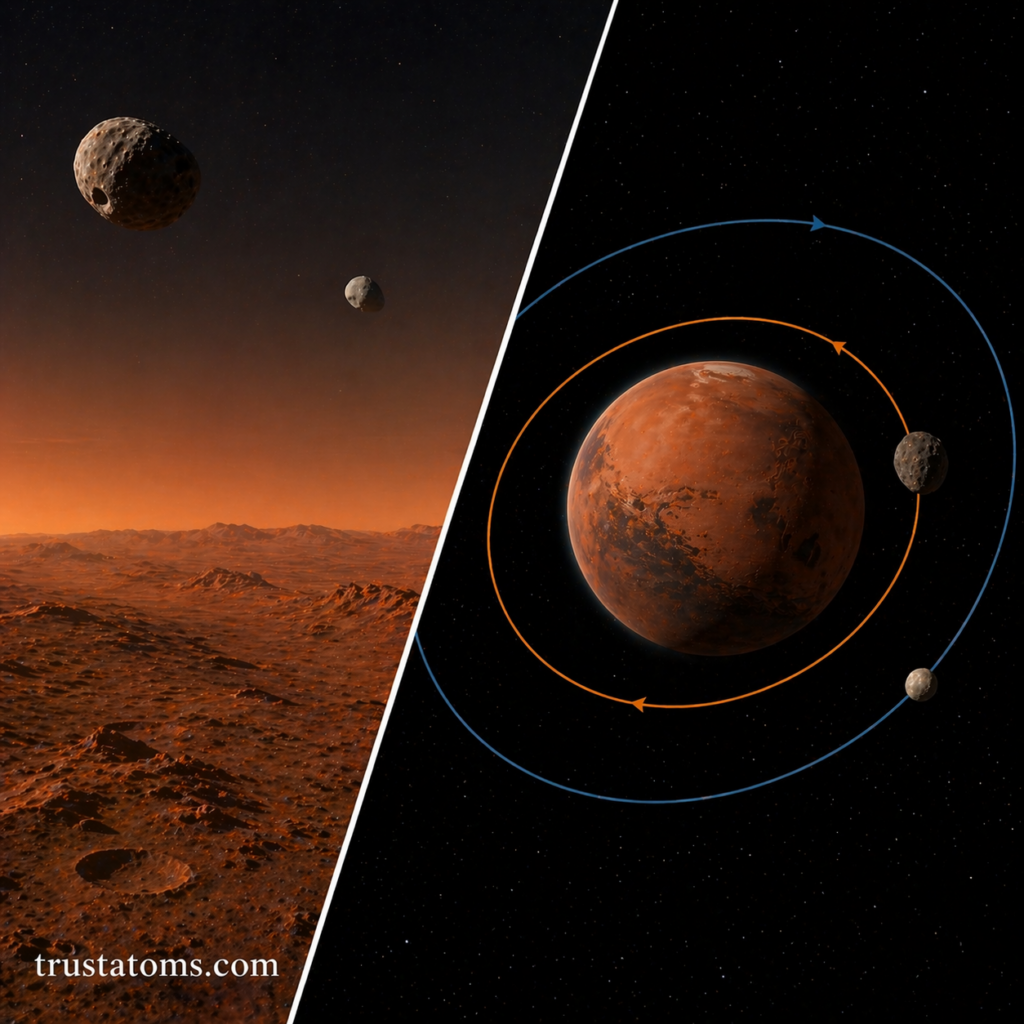
The orbits of Phobos and Deimos are relatively simple but very different from each other.
Phobos’ Orbit
- Extremely close to Mars (about 6,000 km above the surface)
- Rises in the west and sets in the east due to its fast orbit
- Completes multiple orbits in a single Martian day
Deimos’ Orbit
- Much farther from Mars
- Moves more slowly across the sky
- Appears more like a distant star from the Martian surface
Origin Theories
The origin of Phobos and Deimos is still debated among scientists.
1. Captured Asteroids
One theory suggests they were once asteroids pulled into Mars’ gravity.
Supporting points:
- Irregular shapes
- Dark, carbon-rich surfaces
Challenges:
- Their nearly circular orbits are unusual for captured objects
2. Impact Formation
Another theory proposes they formed from debris after a large impact on Mars.
Supporting points:
- More consistent with their stable orbits
- Similar to how Earth’s Moon formed
3. Hybrid Theories
Some scientists believe both processes may have played a role, or that they formed from a disk of debris around Mars.
Gravitational Effects and Tidal Forces
Phobos, in particular, is strongly affected by Mars’ gravity.
Tidal Decay
Phobos is gradually spiraling inward toward Mars due to tidal forces.
What Will Happen?
- In about 30–50 million years, Phobos may:
- Break apart and form a ring around Mars
- Or crash into the planet’s surface
Deimos, being farther away, is more stable and not expected to undergo such dramatic changes.
Importance for Future Exploration
Phobos and Deimos are considered potential targets for future missions.
Why They Matter
- Low gravity makes landing easier
- Could serve as staging points for Mars missions
- Provide insight into early solar system materials
Scientific Value
Studying these moons can help scientists understand:
- Planetary formation processes
- Impact history in the solar system
- Composition of primitive space materials
Comparison to Other Moons
Phobos and Deimos differ significantly from larger moons.
Key Differences
- Much smaller than typical moons
- Irregular shapes instead of spherical
- Weak gravity
- Limited geological activity
Similarities to Asteroids
- Rocky composition
- Dark surfaces
- Irregular structures
Final Thoughts
Phobos and Deimos may be small, but they hold big scientific value. Their unusual shapes, mysterious origins, and dynamic relationship with Mars make them important subjects of study.
As exploration of Mars continues, these moons could play a key role in future missions—and may even help us unlock secrets about the early solar system.