For centuries, humans have wondered whether life could exist beyond Earth. Modern astronomy has transformed that question from speculation into an active scientific field focused on planetary habitability.
Habitability refers to the potential of an environment to support life under suitable conditions. While Earth remains the only known world confirmed to host life, scientists continue discovering planets, moons, and environments that may possess some of the ingredients considered important for biological activity.
Advances in telescopes, planetary science, astrobiology, and atmospheric analysis have dramatically expanded the search for potentially habitable worlds throughout the universe.
This guide explores how scientists evaluate habitability beyond Earth, what conditions may support life, and which locations in space are considered promising candidates for future research.
What Does Habitability Mean?
Habitability does not necessarily mean a planet already contains life.
Instead, it refers to whether environmental conditions might allow life to exist or survive.
Scientists often study factors such as:
- Liquid water availability
- Temperature ranges
- Atmospheric composition
- Energy sources
- Chemical ingredients
- Radiation exposure
- Planetary stability
Habitability can vary widely depending on the type of life being considered.
For example:
- Complex organisms may require stable climates
- Microbial life may survive in much harsher environments
- Some organisms on Earth thrive in extreme heat, pressure, or acidity
These discoveries broaden scientific ideas about where life might potentially exist elsewhere.
Why Liquid Water Is Important
Liquid water is considered one of the most important ingredients for life as currently understood by science.
Water:
- Supports chemical reactions
- Transports nutrients
- Stabilizes temperatures
- Dissolves important compounds
Because of this, scientists often search for environments where liquid water could potentially exist.
However, researchers also recognize that life elsewhere may not necessarily function exactly like life on Earth.
The Habitable Zone
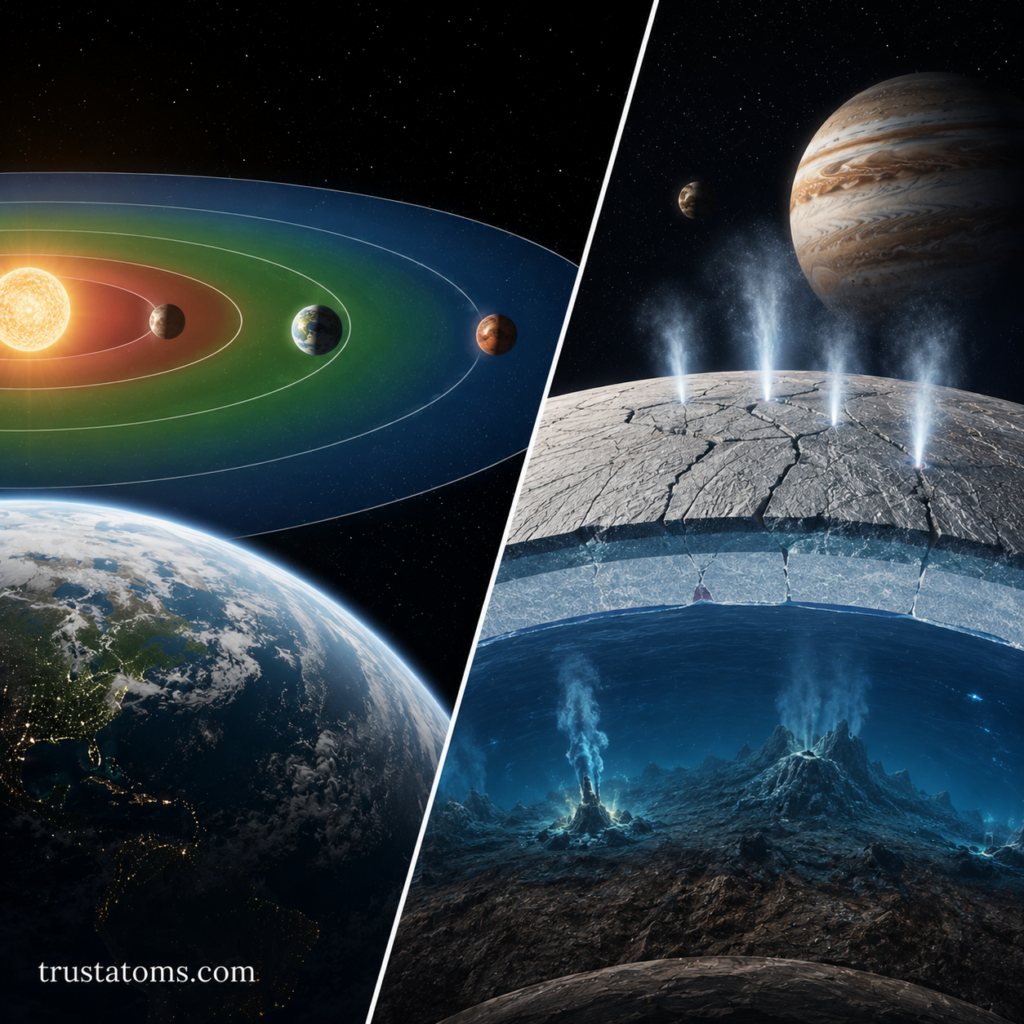
One major concept in astronomy is the habitable zone.
The habitable zone refers to the region around a star where temperatures may allow liquid water to remain stable on a planet’s surface under suitable atmospheric conditions.
Planets too close to their stars may become:
- Extremely hot
- Dry
- Radiation-heavy
Planets too far away may become:
- Frozen
- Ice-covered
- Unable to support surface liquid water
The habitable zone is sometimes called the “Goldilocks zone” because conditions may be “just right” for liquid water.
Habitability Depends on More Than Distance
Being located in a habitable zone does not automatically make a world habitable.
Other important factors include:
- Atmospheric thickness
- Greenhouse effects
- Planet size
- Magnetic fields
- Geological activity
- Orbital stability
For example:
- Venus lies near the Sun’s habitable zone but experiences extreme greenhouse heating
- Mars may once have had liquid water but lost much of its atmosphere over time
This shows that planetary conditions can evolve dramatically.
Exoplanets and Habitability
Exoplanets are planets orbiting stars outside our solar system.
Thousands of exoplanets have been discovered, including:
- Rocky terrestrial planets
- Gas giants
- Super-Earths
- Mini-Neptunes
Some exoplanets orbit within habitable zones around their stars.
Astronomers study these worlds using:
- Transit observations
- Spectroscopy
- Radial velocity measurements
- Direct imaging
These methods help estimate:
- Planet size
- Atmospheric composition
- Surface temperature potential
- Orbital characteristics
Super-Earths and Rocky Worlds
Super-Earths are planets larger than Earth but smaller than Neptune.
Some may possess:
- Rocky surfaces
- Atmospheres
- Potential water reservoirs
Scientists remain interested in whether these worlds could support stable climates.
However, many unknowns remain:
- Surface pressure
- Atmospheric chemistry
- Geological activity
- Radiation levels
Even planets with Earth-like sizes may have very different environments.
Red Dwarf Stars and Habitability
Many potentially habitable exoplanets orbit red dwarf stars.
Red dwarfs:
- Are smaller and cooler than the Sun
- Are extremely common in the galaxy
- Often host tightly orbiting planets
These systems attract scientific interest because habitable-zone planets are easier to detect around smaller stars.
However, red dwarfs can also produce:
- Powerful stellar flares
- Intense radiation bursts
- Strong magnetic activity
These factors may affect atmospheric stability and long-term habitability.
Atmospheres and Climate Stability
Atmospheres play a major role in habitability.
A stable atmosphere can:
- Regulate temperature
- Protect against radiation
- Support chemical cycles
- Maintain pressure for liquid water
Scientists search for atmospheric gases such as:
- Water vapor
- Oxygen
- Carbon dioxide
- Methane
These compounds help researchers evaluate planetary environments.
Clouds, weather systems, and greenhouse effects also influence planetary climates.
Magnetic Fields and Planetary Protection
Magnetic fields may help protect planets from harmful stellar radiation.
Earth’s magnetic field:
- Deflects many charged solar particles
- Helps reduce atmospheric erosion
- Supports long-term climate stability
Without sufficient magnetic protection, a planet’s atmosphere may gradually weaken over time.
Scientists investigate whether exoplanets may possess:
- Molten cores
- Magnetic dynamos
- Magnetospheres
These features could influence long-term habitability.
Moons as Potential Habitats
Scientists also study moons as possible environments for life.
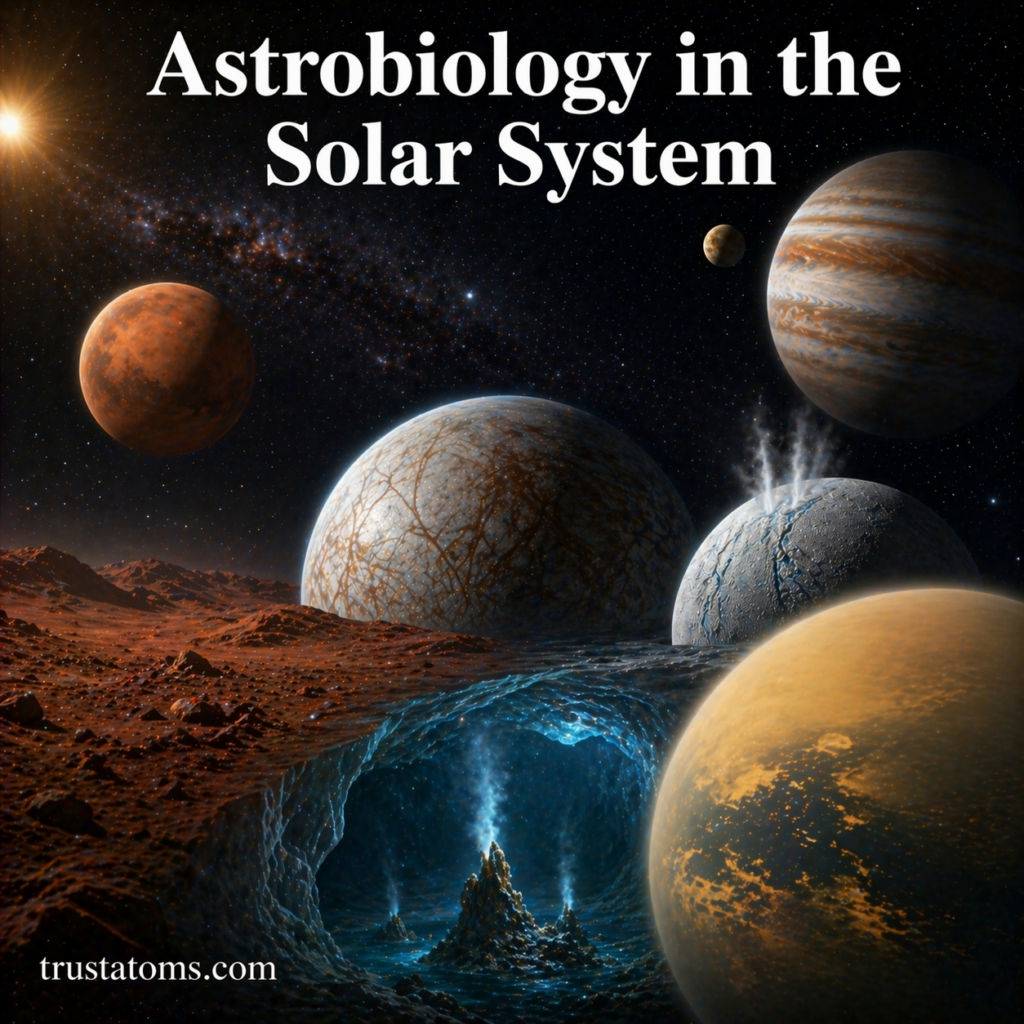
Several moons in our solar system show signs of subsurface oceans beneath icy crusts.
Europa
Europa, a moon of Jupiter, may contain:
- A deep underground ocean
- Internal heating
- Water-rock interactions
Enceladus
Enceladus, a moon of Saturn, ejects water-rich plumes into space.
Observations suggest:
- Liquid water beneath the surface
- Organic compounds
- Hydrothermal activity
These moons are considered important targets in astrobiology research.
Extremophiles and Expanding Habitability Concepts
Life on Earth exists in surprisingly harsh environments.
Extremophiles survive in:
- Deep ocean vents
- Acidic lakes
- Frozen ice
- Radioactive regions
- High-pressure environments
These organisms demonstrate that life can adapt to conditions once considered uninhabitable.
As a result, scientists now consider a wider range of planetary environments potentially suitable for microbial life.
Biosignatures and the Search for Life
Scientists search for biosignatures when evaluating potentially habitable worlds.
Biosignatures are detectable indicators that may suggest biological activity.
Possible biosignatures include:
- Atmospheric oxygen
- Methane imbalance
- Organic molecules
- Chemical disequilibrium
Researchers emphasize that biosignatures must be interpreted carefully because many chemical processes can occur without life.
Multiple lines of evidence are usually required before drawing strong conclusions.
Space Telescopes and Habitability Research
Modern telescopes play a major role in the search for habitable worlds.
James Webb Space Telescope (JWST)
JWST helps scientists analyze:
- Exoplanet atmospheres
- Temperature patterns
- Chemical signatures
- Infrared emissions
Hubble Space Telescope
Hubble contributed to:
- Atmospheric observations
- Exoplanet discoveries
- Planetary climate studies
Future Observatories
Upcoming missions may improve:
- Biosignature detection
- Atmospheric resolution
- Imaging of Earth-sized worlds
Future telescopes could greatly expand understanding of planetary habitability.
Challenges in Determining Habitability
Habitability research remains highly complex.
Major challenges include:
- Vast distances
- Limited observational data
- Atmospheric uncertainty
- Instrument limitations
- Unknown biological requirements
Scientists often rely on models and indirect evidence rather than direct observation.
Even nearby exoplanets remain difficult to study in detail.
Could Life Exist Beyond Earth?
Scientists continue investigating whether life may exist elsewhere in the universe.
Current possibilities include:
- Microbial life on icy moons
- Atmospheric biosignatures on exoplanets
- Subsurface ocean ecosystems
- Habitable rocky planets orbiting distant stars
At present, no confirmed evidence of extraterrestrial life has been established.
However, discoveries continue expanding the number of potentially habitable environments known to science.
Future of Habitability Research
The search for habitable worlds is advancing rapidly.
Future research may involve:
- More detailed atmospheric analysis
- Robotic missions to icy moons
- Improved exoplanet imaging
- Better climate simulations
- Expanded astrobiology studies
As technology improves, scientists may gain deeper insight into how common potentially life-supporting environments are throughout the galaxy.
Why Habitability Research Matters
Studying habitability helps scientists better understand:
- Planet formation
- Climate systems
- Atmospheric evolution
- Biological possibilities
- Earth’s uniqueness within the cosmos
This research also encourages collaboration between:
- Astronomy
- Biology
- Chemistry
- Geology
- Planetary science
The search for habitable worlds remains one of the most fascinating scientific efforts in modern astronomy.
Final Thoughts
Habitability beyond Earth is one of the most exciting and rapidly growing areas of scientific research. By studying planets, moons, atmospheres, and environmental conditions across the universe, scientists continue refining their understanding of where life might potentially exist.
Although many unanswered questions remain, discoveries involving exoplanets, subsurface oceans, atmospheric chemistry, and planetary climates continue expanding humanity’s view of the cosmos.
As telescopes and exploration missions become more advanced, the search for habitable environments beyond Earth will likely remain at the center of astronomy and astrobiology for decades to come.