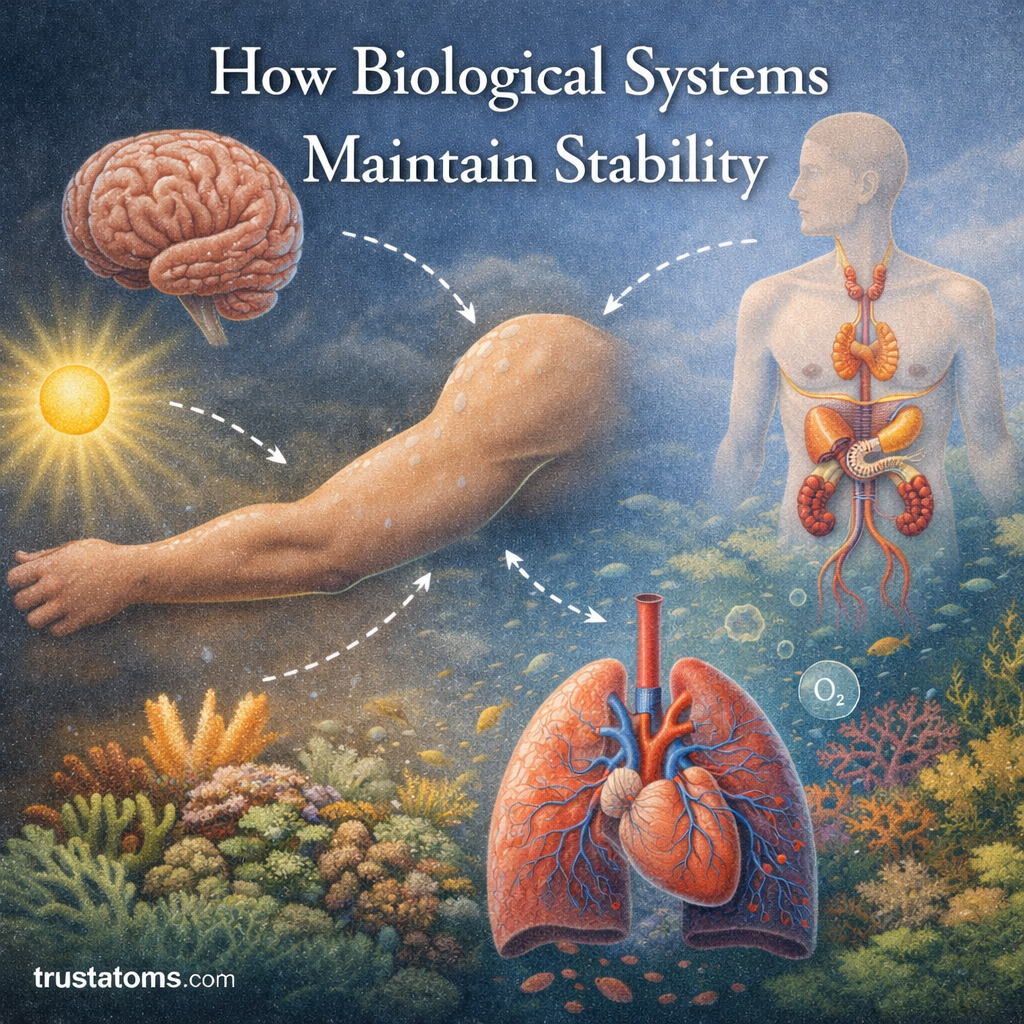
Ecophysiology is the study of how environmental conditions affect the internal functions of living organisms. It explains how plants and animals regulate temperature, water balance, metabolism, and other physiological processes to survive and reproduce in different environments.
As a branch of the science of biology, ecophysiology connects the study of bodily functions with ecology. Researchers examine how temperature, moisture, oxygen availability, sunlight, and nutrients influence an organism’s performance.
These relationships help explain why some species tolerate deserts, mountains, or cold oceans while others cannot. They also reveal the physiological limits that determine where organisms can live as environmental conditions change.
What Is Ecophysiology?
Ecophysiology combines ecology, which examines relationships between organisms and their surroundings, with physiology, which studies how living systems function.
Its central question is how environmental conditions influence biological processes. Researchers investigate several functions:
- Temperature regulation: Maintaining suitable conditions for cellular activity.
- Water and salt balance: Controlling fluid movement and dissolved substances.
- Gas exchange: Obtaining oxygen or carbon dioxide needed for metabolism.
- Energy use: Adjusting metabolic activity to available resources.
- Photosynthesis and nutrient uptake: Supporting plant growth under changing conditions.
Ecophysiology distinguishes short-term physiological adjustments from inherited adaptations. Acclimation occurs within an organism’s lifetime, while evolutionary adaptations develop across generations through changes in populations.
How Ecophysiology Explains Environmental Adaptation
Every species has environmental limits. Conditions outside its tolerable range can reduce growth, reproduction, or survival, even when food and habitat appear suitable.
For example, desert mammals may conserve water through concentrated urine, while cold-region animals use insulation and metabolic heat production to maintain body temperature.
Adaptation mechanisms in extreme environments illustrate how organisms tolerate conditions such as intense heat, cold, or limited water availability.
Plants face similar challenges. Plant adaptations to environmental conditions include structural and physiological features that influence water conservation, light capture, and temperature tolerance.
These responses are not unlimited. Understanding plant stress responses to environmental change helps explain why prolonged drought or extreme temperatures can eventually overwhelm protective mechanisms.
Temperature Regulation in Animals
Temperature affects enzyme activity, membrane function, and the speed of chemical reactions. Animals use different strategies to keep physiological processes within workable limits.
Ectotherms and Environmental Heat
Ectotherms, including most reptiles, amphibians, and fish, obtain much of the heat influencing their body temperature from their surroundings.
A lizard may bask in sunlight to warm its body, then retreat into shade to avoid overheating. Its activity depends partly on access to suitable temperatures.
Endotherms and Metabolic Heat
Birds and mammals are generally endothermic, producing substantial body heat through metabolism.
They may conserve heat using fur, feathers, or body fat. Sweating, panting, and changes in blood flow help release excess heat, although these responses can require energy or water.
Water Balance and Osmoregulation

Water is essential for chemical reactions, nutrient transport, and cellular structure. Organisms regulate water and dissolved substances within their bodies through osmoregulation.
Freshwater and Marine Animals
Freshwater fish generally gain water through osmosis because their body fluids contain more dissolved substances than the surrounding water. Many remove excess water by producing large amounts of dilute urine.
Marine bony fish face the opposite challenge: they tend to lose water to seawater. Many drink seawater and eliminate excess salts through specialized cells in their gills.
Water Conservation on Land
Terrestrial organisms must replace water lost through evaporation, breathing, and waste removal. Desert mammals may produce concentrated urine, while plants use waxy surfaces and stomatal regulation to limit water loss.
These mechanisms help maintain internal balance, but water conservation can involve trade-offs, such as reduced cooling or slower carbon dioxide uptake.
Gas Exchange and Oxygen Availability
Oxygen availability influences aerobic respiration, the process cells use to release energy from nutrients. Its availability changes with altitude, water temperature, and environmental conditions.
At high elevations, atmospheric pressure decreases, reducing the amount of oxygen available with each breath. Some animals respond through changes in breathing, circulation, or oxygen-carrying capacity.
In aquatic environments, fish obtain dissolved oxygen using gills. Warm water generally holds less dissolved oxygen than cold water, potentially increasing physiological stress during heatwaves.
Some organisms tolerate oxygen-poor conditions by reducing energy demands or using metabolic pathways that require less oxygen.
Metabolism and Energy Conservation
Organisms must balance energy intake with the demands of movement, maintenance, growth, and reproduction. Environmental conditions influence both energy availability and metabolic costs.
When resources become scarce, some animals temporarily reduce metabolic activity. Torpor involves a controlled decrease in body temperature and energy expenditure, while hibernation often includes prolonged periods of torpor.
These responses help certain species survive cold seasons or periods when food is limited. However, reduced activity can also limit feeding and reproduction.
Plant Ecophysiology and Environmental Stress
Plants depend on sunlight, carbon dioxide, water, and mineral nutrients. Because they cannot relocate when conditions become unfavorable, physiological regulation strongly influences their survival.
Stomata are small openings that allow carbon dioxide to enter leaves while permitting water vapor to escape. Closing them during drought conserves water but can also reduce photosynthesis.
Roots adjust water and nutrient uptake according to soil conditions. Plants may also produce protective compounds or alter growth patterns when exposed to heat, cold, or salinity.
A Concrete Example: How a Cactus Conserves Water
Imagine a cactus growing through several hot, dry days without rainfall. Its thick stem stores water, while a waxy outer surface limits evaporation.
Many cacti use crassulacean acid metabolism, or CAM photosynthesis. They open their stomata mainly at night, when temperatures are generally lower and water loss is reduced.
Carbon dioxide taken in at night is temporarily stored in chemical compounds and released internally during daylight for photosynthesis.
This strategy improves water-use efficiency, although it can limit how quickly the plant acquires carbon dioxide and grows. The example shows how physiological adaptations involve both advantages and constraints.
Ecophysiology and Climate Change
Changing temperatures, rainfall patterns, and ocean conditions can push organisms closer to their physiological limits.
Researchers measure heat tolerance, water-use efficiency, metabolic rates, and oxygen requirements to understand these risks.
For example, a species may survive occasional hot days but experience reduced reproduction when high temperatures persist throughout its breeding season.
By studying ecophysiology, scientists gain insight into how life responds to environmental stress, climate variability, and ecosystem change.
Applications in Conservation and Environmental Science
Ecophysiological measurements help researchers identify suitable habitats, assess species vulnerability, and improve environmental management.
- Wildlife conservation: Identifying temperature and water conditions needed for survival.
- Agriculture: Evaluating crop responses to drought, heat, and soil salinity.
- Habitat restoration: Selecting species suited to local environmental conditions.
- Climate research: Estimating how physiological limits may affect future species distributions.
These applications are most reliable when physiological measurements are combined with ecological observations, because survival also depends on food availability, competition, and other species interactions.
Frequently Asked Questions
What is the difference between ecology and ecophysiology?
Ecology studies relationships among organisms and their environments. Ecophysiology focuses more specifically on how environmental conditions influence internal biological functions, including metabolism, temperature regulation, and water balance.
What is an example of ecophysiological adaptation?
CAM photosynthesis in many desert plants is one example. By taking in carbon dioxide mainly at night, these plants reduce water loss while continuing to support photosynthesis.
Can organisms adjust to environmental changes during their lifetime?
Yes. Many organisms undergo acclimation, adjusting physiological processes in response to changing conditions. However, acclimation has limits and differs from inherited adaptations that arise across generations.
Ecophysiology explains how organisms meet the physical and chemical demands of their surroundings through temperature regulation, water balance, gas exchange, and energy management. These responses help determine where species can survive and how they perform when conditions change. Studying their physiological limits gives researchers practical evidence for conservation, agriculture, and assessments of environmental change.
Sources: Schmidt-Nielsen, Animal Physiology: Adaptation and Environment; Taiz et al., Plant Physiology and Development; OpenStax, Biology 2e.