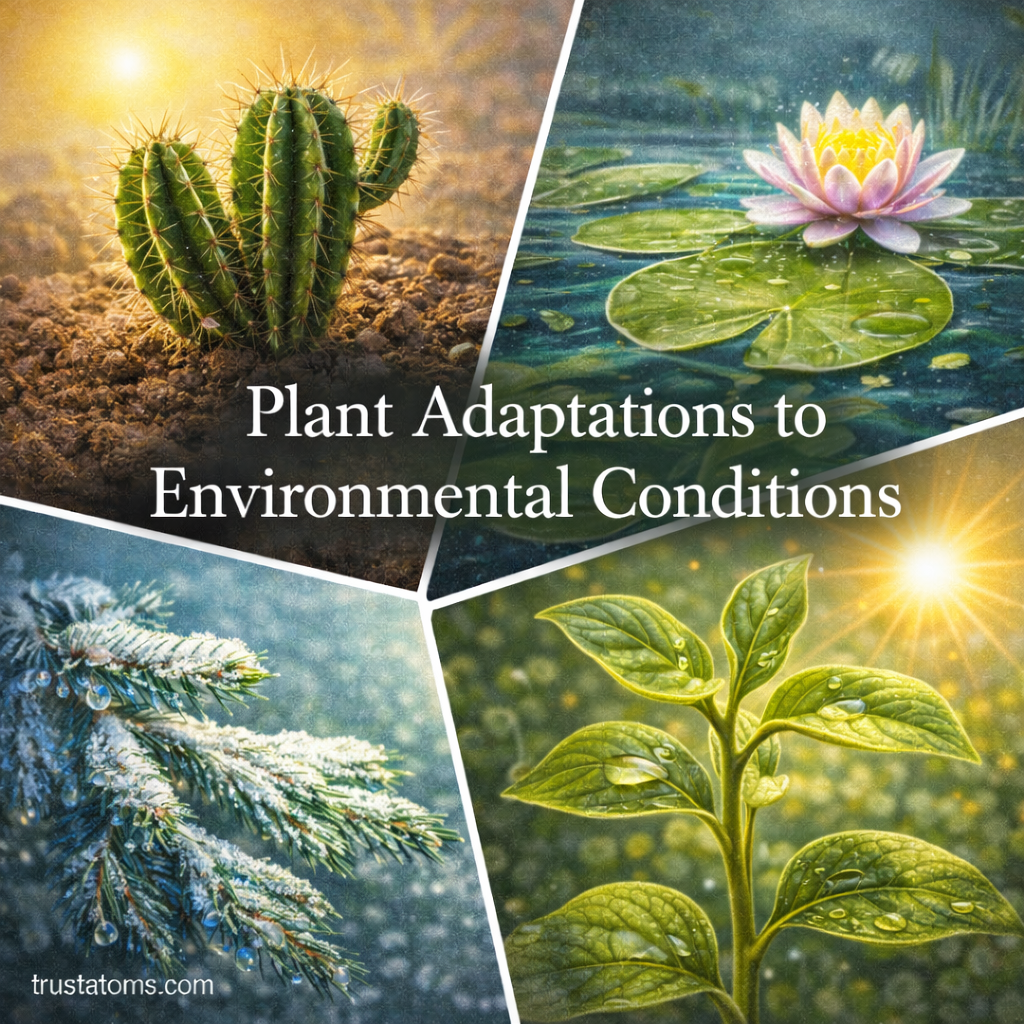
Plant adaptations to environmental conditions are inherited structural and physiological traits that help plants survive and reproduce in particular habitats. These adaptations allow plants to conserve water, tolerate temperature extremes, capture sunlight, obtain nutrients, and defend themselves against organisms that might damage them.
From desert cacti to aquatic water lilies, plants possess features suited to the challenges of their surroundings. Studying these characteristics is an important part of the science of biology because it reveals how plant structures, internal processes, and environmental conditions influence survival.
Not every response to environmental change is an inherited adaptation. Plants can also adjust their growth and physiology during their lifetimes, allowing them to respond to changing conditions without genetic changes across generations.
What Are Plant Adaptations?
A plant adaptation is an inherited characteristic that improves survival or reproductive success in a particular environment. According to evolutionary biology, adaptations arise across generations through processes such as natural selection, which can increase the frequency of beneficial inherited traits in a population.
Plant adaptations can be grouped into three broad categories:
- Structural adaptations: Physical characteristics such as specialized leaves, roots, and stems.
- Physiological adaptations: Internal processes involving metabolism, water regulation, and chemical defenses.
- Growth and response mechanisms: Processes that allow plants to adjust their development or activity in response to environmental signals.
Together, these traits help plants cope with environmental stresses.
Plant responses often involve hormones and other signaling molecules. Understanding chemical signaling in plants helps explain how environmental information influences growth, defense, and physiological activity.
Structural Adaptations in Leaves, Roots, and Stems
Plant structures differ considerably between habitats because water, sunlight, nutrients, and physical conditions create different challenges.
Leaf Adaptations
Leaves capture sunlight for photosynthesis while exchanging gases with the atmosphere. Their size, shape, and surface characteristics influence both light absorption and water loss.
- Waxy surfaces: Reduce water loss through the leaf cuticle.
- Needle-shaped leaves: Provide a relatively small exposed surface and help many conifers tolerate cold or dry conditions.
- Broad leaves: Increase light interception, particularly in shaded forest environments.
- Spines: Reduce leaf surface area in many cacti while providing protection against herbivores.
Root Adaptations
Root systems influence how effectively plants obtain water and nutrients. Deep roots can access moisture below the soil surface, while widespread shallow roots rapidly absorb water from brief rainfall.
Some plants develop specialized roots. Mangroves may produce aerial root structures that facilitate gas exchange in waterlogged sediments, while certain orchids have exposed roots capable of absorbing moisture from their surroundings.
Stem Adaptations
Stems provide structural support and transport water, minerals, and sugars. In many cacti, thick green stems also store water and perform photosynthesis. Underground stems, including rhizomes, can store reserves that support regrowth after unfavorable seasons.
Physiological Adaptations That Protect Plant Cells
Physiological adaptations involve biochemical processes that help plants maintain cellular function when environmental conditions become challenging.
Examples include:
- Water regulation: Controlling stomatal openings to balance carbon dioxide uptake against water loss.
- Cold tolerance: Accumulating protective sugars and proteins that help reduce freezing-related cellular damage.
- Heat tolerance: Producing heat-shock proteins that help maintain or restore normal protein function.
- Chemical defense: Producing compounds that deter herbivores or inhibit pathogens.
These mechanisms differ among species. A plant adapted to prolonged drought may tolerate water shortages that would severely damage a species from a consistently moist habitat.
Adaptations to Dry Environments
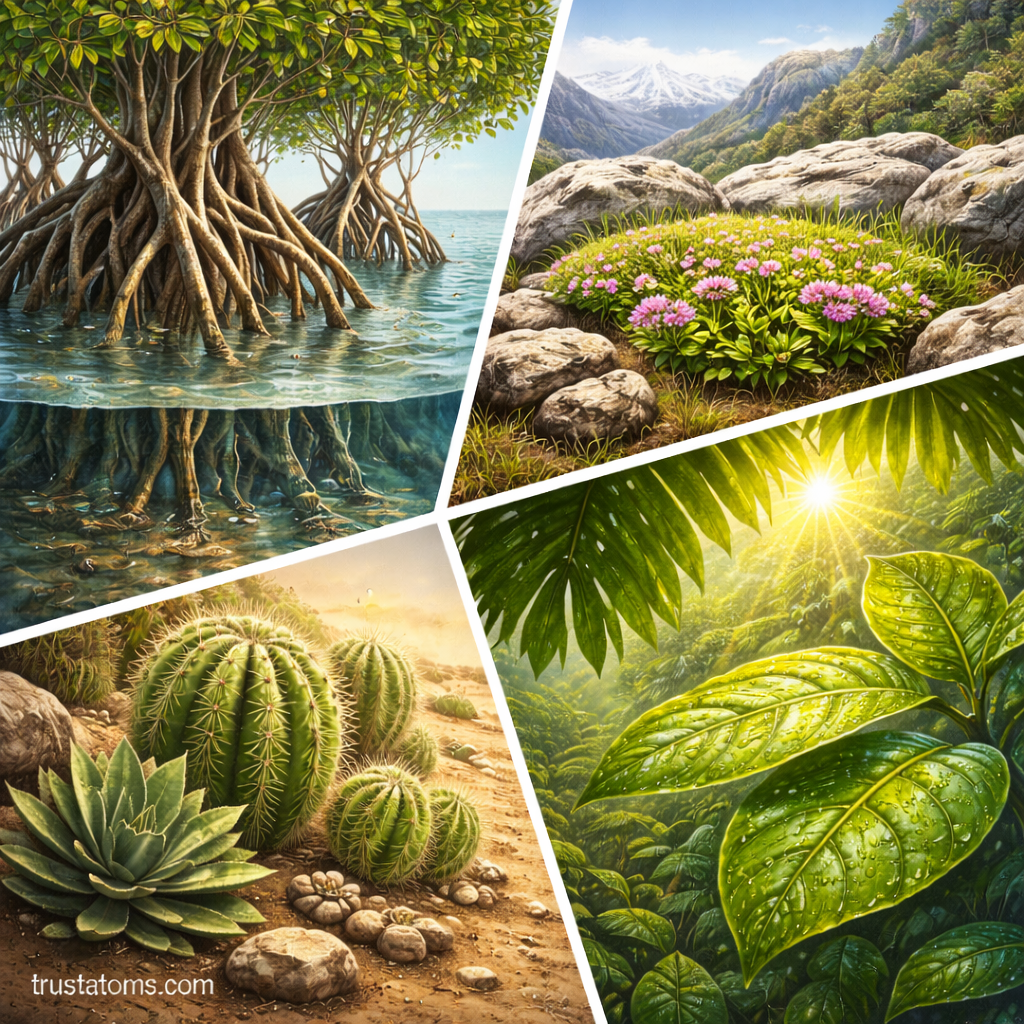
Desert plants face limited rainfall, intense sunlight, and high evaporation rates. Their adaptations often emphasize water conservation, efficient water absorption, and protection against overheating.
Many cacti have water-storing stems, protective spines, and shallow, spreading roots. Their stems perform photosynthesis while their reduced leaves minimize water loss.
For a concrete example, consider a cactus and a typical garden bean plant experiencing several weeks without rain. The cactus can draw on water stored in its stem and reduce daytime water loss, while the bean plant may wilt as soil moisture becomes unavailable. Their different responses reflect contrasting structural and physiological characteristics.
Desert survival illustrates broader adaptation mechanisms in extreme environments, where organisms possess specialized traits suited to persistent environmental challenges.
Adaptations to Aquatic and Waterlogged Habitats
Plants growing in water face challenges involving oxygen availability, buoyancy, and access to sunlight. Submerged tissues may receive less oxygen because gases diffuse more slowly through water than through air.
Common aquatic adaptations include:
- Aerenchyma: Air-filled tissue that facilitates internal gas movement and can contribute to buoyancy.
- Floating leaves: Position photosynthetic surfaces near sunlight and atmospheric gases.
- Flexible stems: Bend with moving water instead of resisting currents rigidly.
- Specialized roots: Help some wetland plants obtain oxygen despite waterlogged soil.
Water lilies demonstrate several of these features through broad floating leaves and air spaces within their tissues. Mangrove species possess additional adaptations for growing in saline coastal environments.
Adaptations to Cold and Windy Climates
Cold environments expose plants to freezing temperatures, short growing seasons, and strong winds. Plants may reduce exposure, protect cellular structures, or temporarily suspend growth.
Alpine cushion plants grow close to the ground, where their compact form can reduce wind exposure and create a more sheltered environment around leaves and stems.
Many conifers retain needle-like leaves throughout winter, allowing photosynthesis to resume when conditions become favorable. Other plants survive cold seasons through dormancy, shedding leaves or maintaining protected underground tissues.
Adaptations to Intense Sunlight
Strong sunlight provides energy for photosynthesis but can also increase leaf temperature and water loss. Some plants have reflective leaf hairs, protective pigments, or leaf orientations that reduce excessive radiation exposure.
Other adaptations involve photosynthetic pathways. C4 plants, including corn and sugarcane, concentrate carbon dioxide around the enzyme RuBisCO, helping reduce photorespiration under hot, bright conditions.
Many CAM plants, including cacti and pineapple, primarily open their stomata at night. This reduces daytime water loss while allowing stored carbon dioxide to support photosynthesis during daylight hours.
Rapid Responses to Environmental Changes
Plants also respond to environmental signals within their lifetimes. These responses differ from inherited evolutionary adaptations because they involve changes in an individual plant’s activity, physiology, or growth.
Examples include phototropism, in which shoots grow toward light; gravitropism, which helps roots grow downward; and thigmotropism, which allows climbing plants to respond to contact with supporting structures.
Researchers studying ecophysiology in environmental adaptation examine how environmental conditions influence plant function. Related research on plant stress responses to environmental change investigates how plants detect unfavorable conditions and adjust their physiology.
For example, a plant experiencing temporary drought may close its stomata within a relatively short period, reducing water loss without requiring an inherited change across generations.
Comparing Plant Adaptations Across Habitats
| Environment | Common challenge | Representative adaptation |
|---|---|---|
| Desert | Limited water | Water-storing stems and reduced leaves |
| Aquatic | Restricted gas movement | Air-filled tissues |
| Alpine | Cold temperatures and wind | Compact growth and cold tolerance |
| Shaded forest | Limited sunlight | Broad leaves and shade-tolerant physiology |
| Saline coast | Excess salt and waterlogged soil | Salt regulation and specialized roots |
These examples show that successful adaptations depend on environmental context. A characteristic that benefits a plant in one habitat may offer little advantage, or even impose a cost, in another.
Frequently Asked Questions
What Is the Difference Between Adaptation and Acclimation?
Adaptation refers to inherited characteristics shaped across generations, while acclimation describes physiological or developmental adjustments made by an individual organism during its lifetime. A plant adjusting its stomatal activity during drought is demonstrating a short-term response rather than evolving a new inherited adaptation.
How Do Desert Plants Survive With Very Little Water?
Desert plants may store water in specialized tissues, reduce evaporation through waxy surfaces, develop extensive roots, or use CAM photosynthesis. Different species combine these strategies in ways suited to their environments.
Can Plants Adapt to Rapid Climate Change?
Some plant populations may undergo evolutionary changes over generations, while individual plants can adjust their physiology within certain limits. However, rapid environmental changes can exceed these capacities, especially for species with narrow habitat requirements or long generation times.
Plant adaptations explain how different species survive challenges ranging from desert drought to waterlogged soils and freezing temperatures. Structural features, physiological processes, and environmental responses work together, but their effectiveness depends on the habitat. Distinguishing inherited adaptations from short-term adjustments also helps scientists understand how plants may respond to changing environmental conditions.
Sources: Taiz, Zeiger, Møller, and Murphy, Plant Physiology and Development; Lambers, Chapin, and Pons, Plant Physiological Ecology; Raven, Evert, and Eichhorn, Biology of Plants.