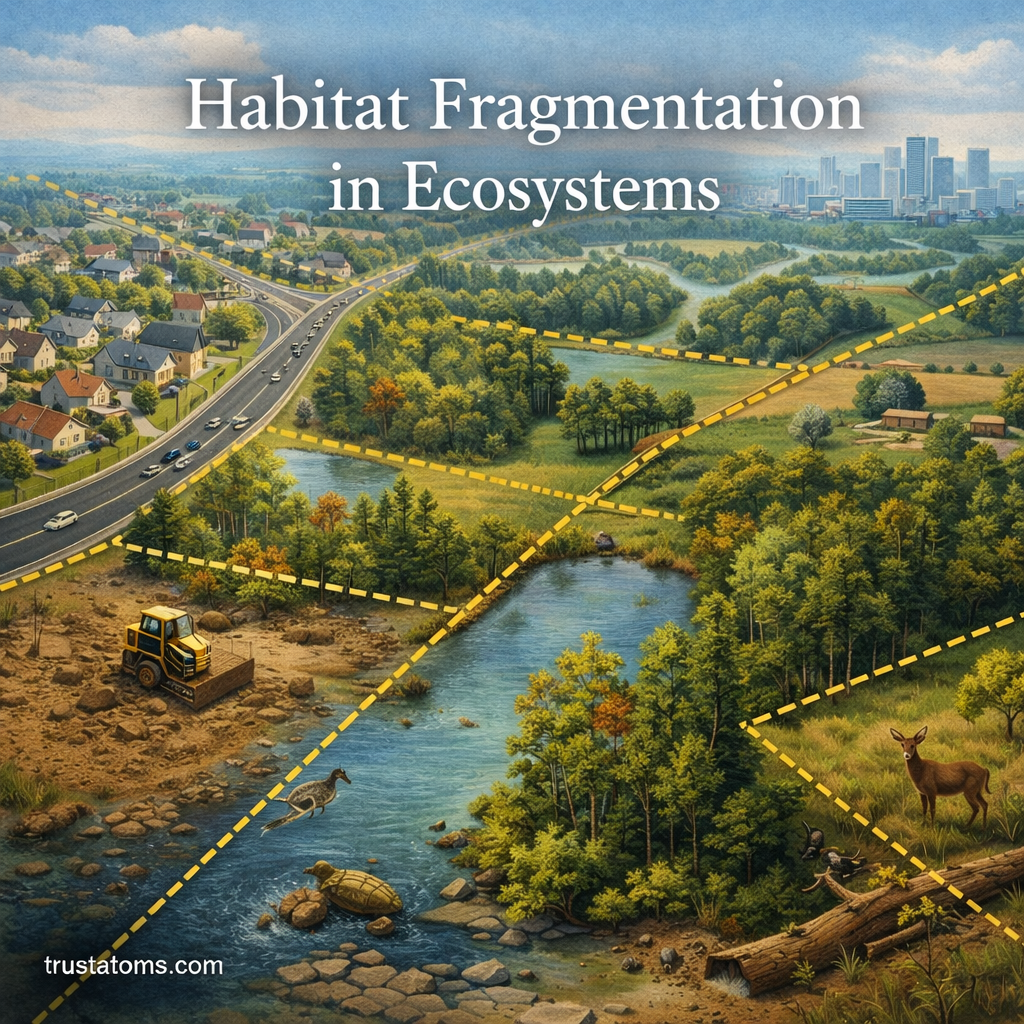
Habitat fragmentation occurs when a large, continuous natural habitat is divided into smaller, separated patches by roads, agriculture, development, or natural disturbances. This division can restrict wildlife movement, isolate populations, increase exposure to habitat edges, and disrupt ecological processes.
In ecological biology, fragmentation is studied to understand how landscape changes affect species survival and ecosystem stability. Understanding habitat fragmentation helps scientists and conservationists develop strategies to protect biodiversity and maintain ecosystem stability.
What Is Habitat Fragmentation?
Habitat fragmentation is the process of breaking a continuous habitat into separate areas surrounded by land or water that may be unsuitable for its original species.
Imagine a forest that once stretched across an entire valley. After a highway and several farms are built, the remaining trees form separate patches. Forest animals may still live in those patches, but traveling between them becomes more difficult or dangerous.
Scientists distinguish habitat fragmentation from habitat loss. Habitat loss reduces the total amount of suitable habitat, while fragmentation changes how the remaining habitat is arranged and connected. The two processes often occur together.
What Causes Habitat Fragmentation?
Fragmentation results from human land use and natural disturbances. Its effects depend on the landscape, the size of the remaining patches, and the species living there.
Human Activities
Human development is a widespread cause of habitat fragmentation. Common activities include:
- Road construction: Highways divide forests and create dangerous crossing points for wildlife.
- Agriculture: Converting forests or grasslands into fields separates remaining natural vegetation.
- Urban expansion: Buildings, parking areas, and neighborhoods replace or isolate habitats.
- Logging and mining: Land clearing creates gaps and changes conditions around habitat boundaries.
- Dams: River barriers interrupt aquatic connectivity and can prevent fish migration.
Natural Disturbances
Wildfires, floods, landslides, and volcanic activity can also divide habitats. Their effects may be temporary or long-lasting, depending on the disturbance and how vegetation or waterways recover.
Not every naturally occurring gap is harmful. Some ecosystems depend on a mixture of habitat patches created by periodic disturbances. Problems arise when fragmentation prevents species from accessing resources or maintaining viable populations.
How Habitat Fragmentation Affects Wildlife
Smaller Habitats Support Fewer Resources
Small habitat patches may contain fewer nesting sites, food sources, and breeding opportunities than larger continuous areas. Animals requiring extensive territories can be particularly vulnerable.
However, patch size is not the only consideration. Habitat quality and the surrounding landscape also influence whether a population can survive.
Population Isolation Reduces Gene Flow
When animals cannot move between habitat patches, populations may become genetically isolated. Reduced movement means fewer opportunities for individuals from different populations to reproduce.
Over generations, small isolated populations may experience increased inbreeding and reduced genetic diversity. These changes can make populations more vulnerable to disease and environmental disturbances.
Edge Effects Change Living Conditions
Habitat edges are boundaries between natural habitats and surrounding environments. A forest beside a road or agricultural field may receive more sunlight, wind, and human disturbance than its interior.
These conditions can change vegetation, temperature, moisture, and predator activity. Some species benefit from edges, while others require sheltered interior habitat.
Movement and Migration Become Difficult
Animals move to find food, mates, shelter, and breeding sites. Fragmentation can interrupt these movements by introducing physical barriers or areas that animals avoid crossing.
Roads are particularly concerning because animals attempting to cross may be struck by vehicles. Other species may avoid roads entirely, even when suitable habitat exists on the opposite side.
A Practical Example: A Forest Divided by a Highway
Consider a hypothetical 100-hectare forest that is divided into two 50-hectare sections by a new highway. Although the forest still occupies approximately the same total area in this simplified example, its connectivity has changed.
A small mammal that previously moved throughout the forest may now remain on one side of the road. If few animals cross successfully, the two groups could gradually become isolated.
The highway also creates additional forest edges, exposing nearby vegetation to different light, temperature, and disturbance conditions. The actual impact depends on road width, traffic, species behavior, and available crossing routes.
This example illustrates why protecting habitat area alone may not preserve the ecological connections that species need.
Impacts on Ecosystem Processes
Habitat fragmentation affects more than individual animal populations. It can alter interactions among plants, animals, microorganisms, and their physical environment.
Important processes that may be disrupted include:
- Pollination: Isolated plant populations may receive fewer visits from certain pollinators.
- Seed dispersal: Reduced animal movement can limit how far seeds travel.
- Nutrient cycling: Changes in vegetation and soil conditions can affect decomposition.
- Predator-prey relationships: Altered habitat boundaries may change hunting opportunities and population balance.
- Water movement: Roads and land conversion can change drainage patterns and runoff.
Fragmentation often interacts with other pressures, including warming temperatures and altered rainfall. Climate Impacts on Ecosystem Stability explains how changing environmental conditions can affect ecological resilience.
Land conversion, pollution, and resource extraction can intensify these changes. Environmental Drivers of Ecosystem Change examines these broader pressures.
Where fragmentation has already damaged habitats, restoration can help recover ecological functions. Ecosystem Restoration in Environmental Science describes methods for repairing degraded environments.
Examples of Fragmentation in Different Ecosystems
Tropical Forests
Clearing tropical forests for agriculture, roads, and settlements can leave isolated patches surrounded by developed land. Species that depend on extensive forest interiors may struggle to survive in smaller remnants.
Grasslands
Grasslands divided by farms and infrastructure may lose continuous areas needed by ground-nesting birds and wide-ranging mammals. Changes in grazing patterns and vegetation can create additional challenges.
Rivers and Wetlands
Dams and water-control structures can interrupt fish migration and change sediment transport. Wetland drainage may also isolate aquatic habitats that were previously connected during seasonal flooding.
Conservation Strategies to Reduce Fragmentation
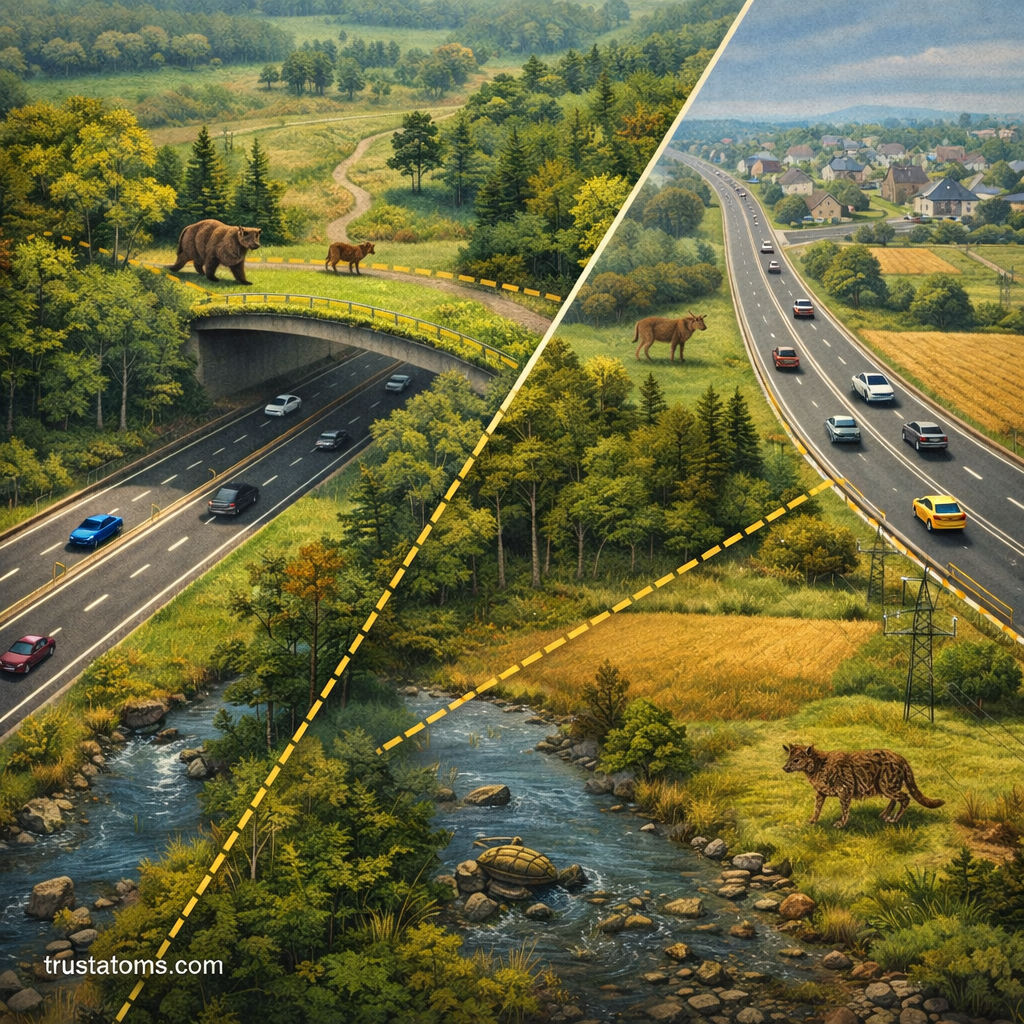
Conservation efforts aim to preserve suitable habitat, reduce barriers, and reconnect isolated populations. Conservation Strategies for Biodiversity explores additional approaches to protecting species and ecosystems.
Wildlife Corridors and Crossings
Wildlife corridors connect habitat patches through strips or networks of suitable land. Forested connections, vegetated streambanks, and protected movement routes can help animals travel between populations.
Wildlife overpasses and underpasses can reduce road barriers when designed for the species that need them. Their effectiveness depends on location, surrounding habitat, and whether animals use the crossings.
Protected Areas and Land-Use Planning
Protecting large habitat areas can reduce fragmentation before it occurs. Land-use planning can also limit development in important movement routes and preserve connections between reserves.
Conservation easements, sustainable forestry practices, and coordinated management across property boundaries may help maintain connectivity.
Restoring Damaged Habitat
Restoration projects may involve replanting native vegetation, reconnecting wetlands, or removing obsolete barriers from rivers. These actions can improve habitat quality and create routes for wildlife movement.
Restoration takes time, and newly planted corridors may not immediately provide the shelter or resources needed by sensitive species.
How Scientists Measure Habitat Connectivity
Scientists use satellite imagery, geographic information systems, and field surveys to map habitat patches and barriers. They may measure patch size, distance between patches, and the amount of suitable habitat surrounding them.
Animal tracking, camera traps, and genetic studies can reveal whether individuals actually move between separated areas. These measurements help determine where corridors or habitat protection would provide the greatest benefit.
Connectivity is species-specific: a narrow road may stop a small amphibian but present little difficulty for a flying bird. Conservation planning must therefore consider the movement abilities and habitat requirements of the organisms being protected.
Frequently Asked Questions
What is the difference between habitat loss and fragmentation?
Habitat loss reduces the total area available to species, while fragmentation divides the remaining habitat into separate patches. Both can occur together, but fragmentation also changes connectivity and exposure to habitat edges.
Can wildlife corridors reverse habitat fragmentation?
Wildlife corridors can reduce isolation by allowing animals to move between habitat patches. However, they cannot replace all lost habitat, and their effectiveness depends on corridor design, habitat quality, and species behavior.
Which species are most vulnerable to habitat fragmentation?
Species requiring large territories, specialized habitats, or regular movement between breeding areas are often vulnerable. Animals reluctant to cross open land or roads may also experience greater isolation than highly mobile species.
Habitat fragmentation changes ecosystems by separating wildlife populations, increasing habitat edges, and disrupting movement between natural areas. Protecting large habitat patches and maintaining suitable connections can reduce these effects, especially when conservation plans reflect the needs of individual species. Combining wildlife crossings, careful land-use planning, and habitat restoration offers practical ways to improve long-term ecosystem connectivity.
Sources: Haddad et al., Habitat Fragmentation and Its Lasting Impact on Earth’s Ecosystems; Fahrig, Effects of Habitat Fragmentation on Biodiversity; International Union for Conservation of Nature, Guidelines for Conserving Connectivity through Ecological Networks and Corridors.