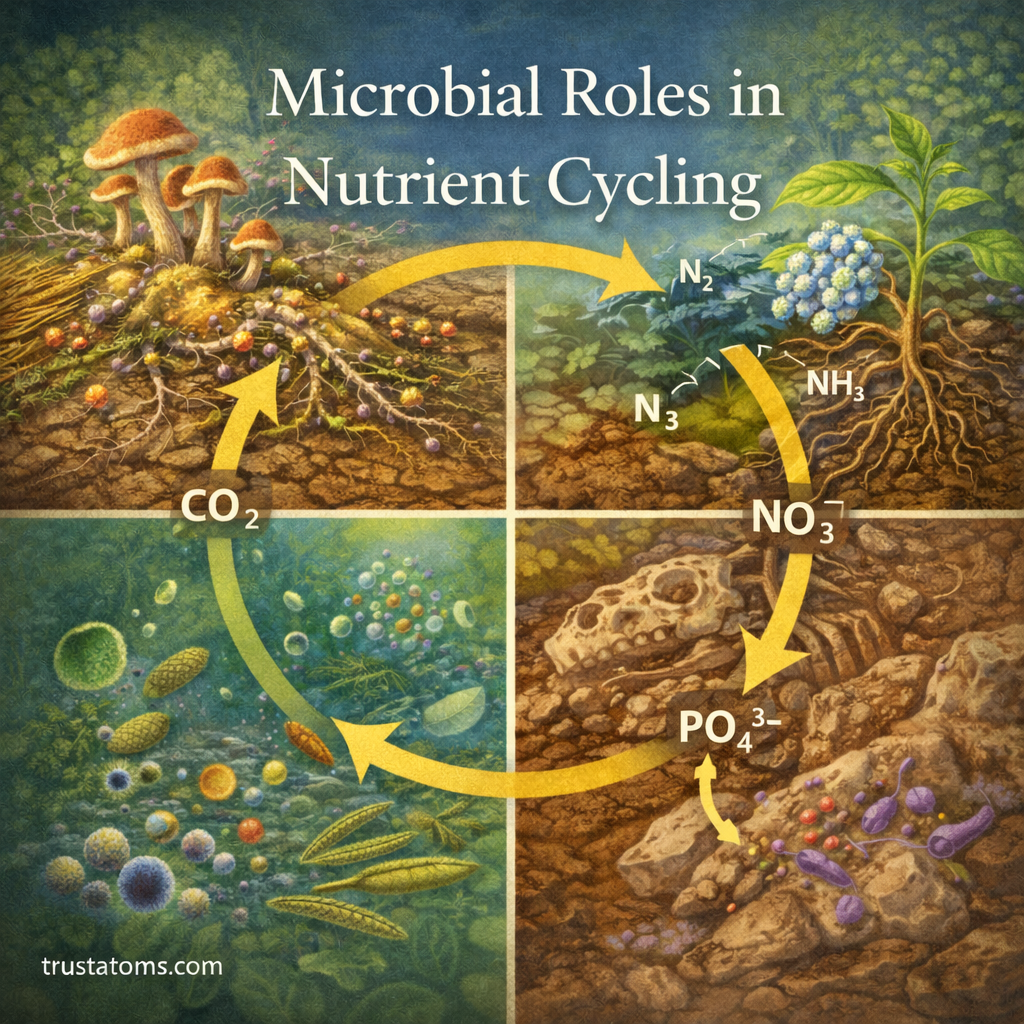
Microorganisms play a fundamental role in maintaining the balance of ecosystems. Bacteria, fungi, archaea, and other microbes help recycle essential nutrients that support plant growth, sustain food webs, and regulate environmental processes.
These microscopic organisms drive nutrient cycling—the continuous movement and transformation of elements such as carbon, nitrogen, phosphorus, and sulfur through ecosystems. Without microbial activity, nutrients would remain locked in dead organisms and waste materials, making them unavailable to living organisms.
Understanding the role of microbes in nutrient cycling helps scientists better understand soil health, ecosystem productivity, and global environmental processes.
What Is Nutrient Cycling?
Nutrient cycling refers to the movement and reuse of chemical elements within ecosystems. These nutrients circulate through living organisms, the soil, water, and the atmosphere.
Key nutrients involved in ecological cycles include:
- Carbon
- Nitrogen
- Phosphorus
- Sulfur
- Oxygen
Microbes act as biological processors that break down organic matter and convert nutrients into forms that plants and other organisms can use.
Without microbial activity, ecosystems would quickly run out of available nutrients needed to sustain life.
Why Microbes Are Essential in Ecosystems
Microorganisms serve as ecosystem recyclers. Their metabolic processes transform complex organic materials into simpler chemical forms that re-enter biological cycles.
Microbes contribute to ecosystem functioning by:
- Decomposing dead plants and animals
- Recycling organic matter in soils and water
- Transforming nutrients into biologically usable forms
- Supporting plant growth through symbiotic relationships
- Regulating atmospheric gases
Because microbes are present in nearly every environment on Earth, they influence nutrient cycles on both local and global scales.
Microbial Decomposition
Decomposition is one of the most important roles microbes play in ecosystems.
When plants, animals, or microorganisms die, their tissues contain large amounts of organic material such as proteins, carbohydrates, and lipids. Microbial decomposers break down these materials into simpler compounds.
Common microbial decomposers include:
- Soil bacteria
- Saprotrophic fungi
- Actinomycetes
- Aquatic microbes
During decomposition, microbes release nutrients such as nitrogen and phosphorus back into the soil or water.
This process allows plants and other organisms to reuse these nutrients for growth and development.
Microbial Roles in the Nitrogen Cycle
Nitrogen is an essential nutrient required for proteins, DNA, and cellular metabolism. Although nitrogen gas makes up most of Earth’s atmosphere, most organisms cannot use it directly.
Microbes play critical roles in converting nitrogen into usable forms through several biological processes.
Nitrogen Fixation
Nitrogen fixation converts atmospheric nitrogen gas into ammonia, a form that plants can absorb.
This process is carried out by specialized bacteria such as:
- Rhizobium species found in legume root nodules
- Free-living soil bacteria
- Certain cyanobacteria in aquatic environments
These microbes form symbiotic relationships with plants, providing usable nitrogen in exchange for carbohydrates.
Nitrification
Nitrification is the microbial conversion of ammonia into nitrate.
This process occurs in two stages:
- Ammonia is converted into nitrite by ammonia-oxidizing bacteria.
- Nitrite is converted into nitrate by nitrite-oxidizing bacteria.
Nitrate is a key nitrogen source for plant growth.
Denitrification
Denitrification occurs when certain bacteria convert nitrate back into nitrogen gas.
This process typically occurs in low-oxygen environments such as wet soils or sediments.
Although it removes usable nitrogen from ecosystems, denitrification helps regulate nitrogen levels and maintain balance in nutrient cycles.
Microbial Roles in the Carbon Cycle
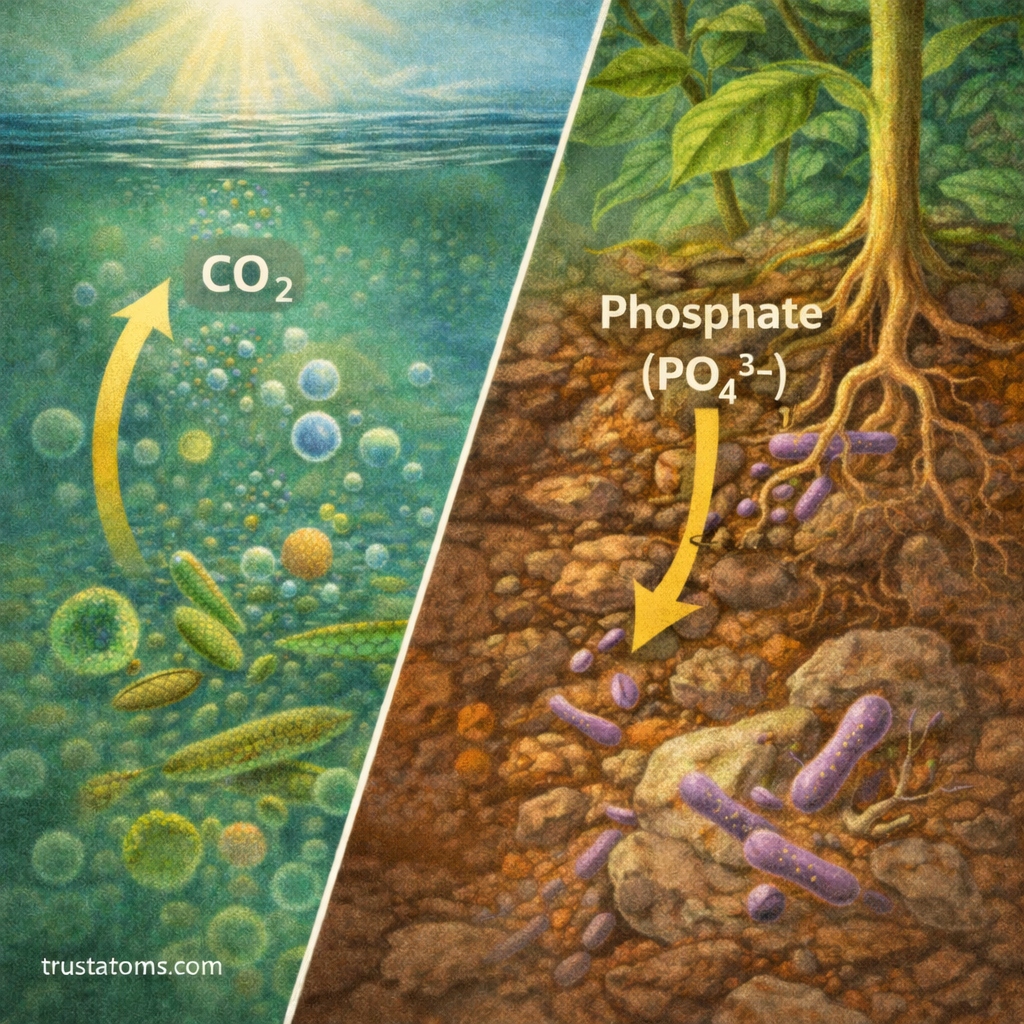
The carbon cycle describes the movement of carbon through living organisms, the atmosphere, and Earth’s surface.
Microbes play several key roles in carbon transformation.
Decomposition of Organic Carbon
When microbes break down organic matter, carbon stored in dead organisms is released as:
- Carbon dioxide through microbial respiration
- Methane in anaerobic environments such as wetlands
These processes return carbon to the atmosphere, where it can re-enter the biological cycle through photosynthesis.
Soil Carbon Storage
Some microbial processes contribute to long-term carbon storage in soils.
Microbial activity helps form stable organic compounds that can remain in soils for long periods.
Healthy soil microbial communities therefore play a role in regulating atmospheric carbon levels.
Microbial Roles in the Phosphorus Cycle
Phosphorus is another essential nutrient required for energy transfer, DNA synthesis, and cell membrane structure.
Unlike nitrogen, phosphorus does not have a major atmospheric component. Instead, it cycles mainly through rocks, soils, water, and living organisms.
Microbes assist in phosphorus cycling by:
- Breaking down organic phosphorus compounds
- Releasing phosphate into soil and water
- Solubilizing mineral phosphorus from rocks
Certain soil bacteria and fungi make phosphorus more available to plants by converting it into soluble forms that plant roots can absorb.
Mycorrhizal Fungi and Plant Nutrition
Mycorrhizal fungi form symbiotic relationships with plant roots and play a significant role in nutrient cycling.
In these partnerships:
- Fungal networks extend into the soil, increasing nutrient absorption
- Plants provide carbohydrates produced through photosynthesis
- Nutrients such as phosphorus and nitrogen are transferred to the plant
Mycorrhizal networks can connect multiple plants within ecosystems, helping distribute nutrients across plant communities.
These underground fungal networks are sometimes called “wood wide webs” because they link plant roots through vast fungal connections.
Microbes in Aquatic Nutrient Cycling
Microbial nutrient cycling is not limited to soils. Aquatic microbes also play critical roles in lakes, rivers, oceans, and wetlands.
Aquatic microbial processes include:
- Decomposition of organic material in water
- Recycling of nutrients in sediments
- Nitrogen transformation in aquatic environments
- Carbon cycling in marine ecosystems
Phytoplankton and marine bacteria are especially important in regulating global carbon and oxygen cycles.
These microorganisms contribute significantly to Earth’s biological productivity.
Human Impacts on Microbial Nutrient Cycling
Human activities can influence microbial nutrient cycles in several ways.
Examples include:
- Fertilizer use that alters nitrogen and phosphorus levels
- Pollution that affects microbial communities
- Deforestation that changes soil microbial activity
- Climate change that alters microbial metabolism
Changes to microbial communities can disrupt nutrient cycling and impact ecosystem health.
Scientists study these interactions to understand how ecosystems respond to environmental changes.
Why Microbial Nutrient Cycling Matters
Microbial nutrient cycling supports the productivity and stability of ecosystems around the world.
Healthy microbial communities help maintain:
- Fertile soils
- Productive agricultural systems
- Balanced nutrient availability
- Stable ecological food webs
Understanding microbial processes allows scientists to improve sustainable farming practices, manage natural ecosystems, and better predict environmental changes.
Final Thoughts
Microorganisms are the hidden engines of nutrient cycling in ecosystems. Through decomposition, chemical transformation, and symbiotic relationships, microbes continuously recycle essential nutrients such as nitrogen, carbon, and phosphorus.
These microscopic organisms support plant growth, regulate environmental chemistry, and sustain ecosystem productivity. By studying microbial roles in nutrient cycling, scientists gain deeper insight into the biological processes that keep Earth’s ecosystems functioning.