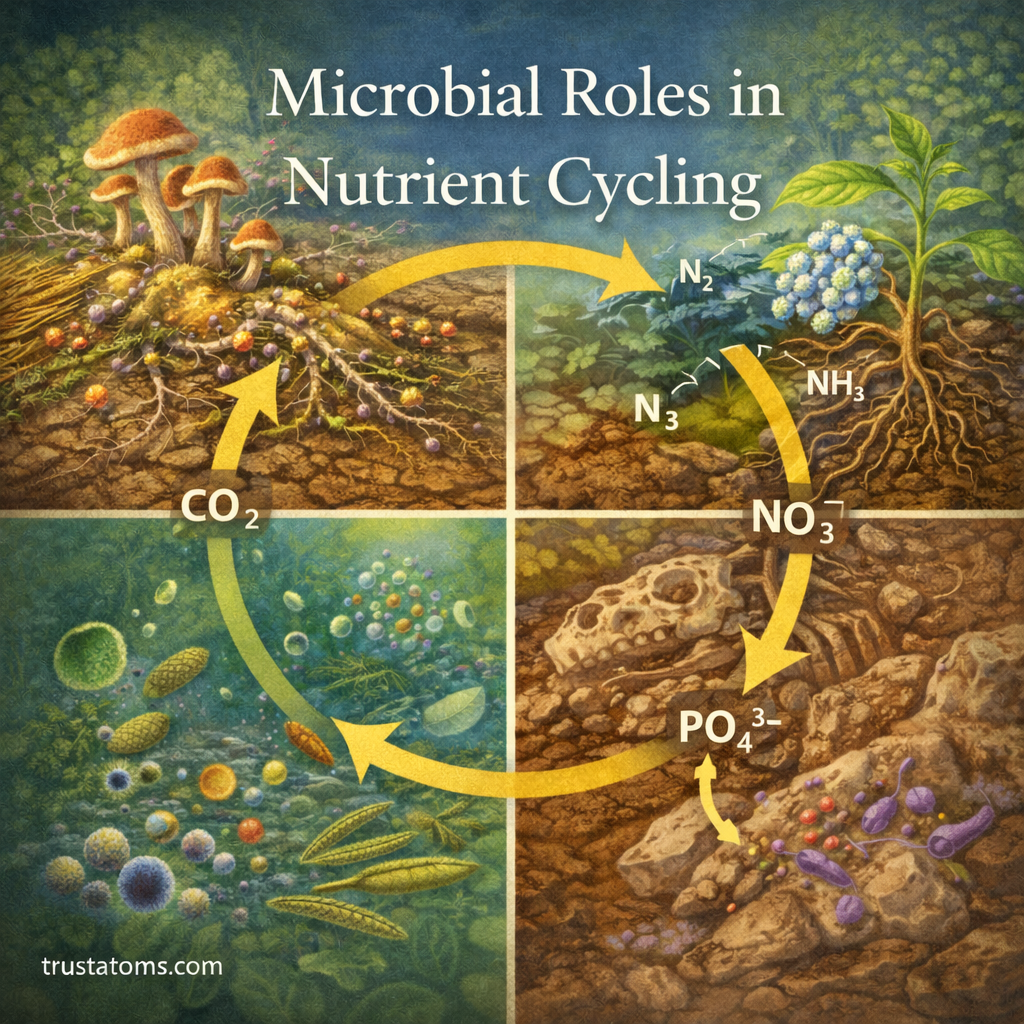
Microorganisms recycle essential nutrients by decomposing organic matter and transforming chemical elements into forms that plants and other organisms can use. Bacteria, fungi, archaea, and other microbes drive the carbon, nitrogen, phosphorus, and sulfur cycles through processes such as decomposition, nitrogen fixation, and mineralization.
These microscopic organisms drive nutrient cycling—the continuous movement and transformation of elements such as carbon, nitrogen, and phosphorus through ecosystems. Their activities connect soil, water, living organisms, and the atmosphere, making microbial metabolism an important subject in the study of biology.
Without microbial decomposition and chemical transformations, many nutrients would remain trapped in organic materials or unavailable chemical forms. Understanding these processes helps explain soil fertility, plant growth, and the movement of nutrients through natural environments.
What Is Nutrient Cycling?
Nutrient cycling is the movement and transformation of chemical elements between organisms and their physical surroundings. Nutrients enter living systems, become incorporated into biological molecules, and eventually return to soil, water, or the atmosphere.
Major nutrient cycles involve carbon, nitrogen, phosphorus, and sulfur. Each element follows different chemical pathways, but microbial activity influences how readily it moves between environmental reservoirs.
These processes form part of the broader biogeochemical cycles in Earth systems, which describe how biological, geological, and chemical processes redistribute elements.
Microbes contribute by breaking down organic compounds, releasing inorganic nutrients, and converting substances between different chemical forms. Some transformations make nutrients more accessible to plants, while others return elements to the atmosphere or incorporate them into microbial biomass.
Microbial Decomposition Returns Nutrients to Ecosystems
Decomposition begins when dead organisms, fallen leaves, animal waste, and other organic materials become available to decomposers. These materials contain proteins, carbohydrates, lipids, and additional compounds that store essential elements.
Bacteria and fungi and their characteristics contribute to decomposition by producing enzymes that break complex organic molecules into smaller substances. Microorganisms then absorb and metabolize these products.
During mineralization, organic nutrients are converted into inorganic forms. For example, decomposition of nitrogen-containing organic matter can release ammonium, which may subsequently enter other nitrogen-cycle reactions.
The study of microbial ecology in environmental systems examines how temperature, moisture, oxygen, and community composition influence decomposition rates.
Microbes also interact with plants and other organisms. Microbial symbiosis in environmental systems explains how partnerships between microorganisms and hosts can influence nutrient acquisition and recycling.
How Microbes Transform Nitrogen
Nitrogen is required for proteins, nucleic acids, and numerous cellular compounds. Although atmospheric nitrogen gas is abundant, most plants cannot use it directly.
Microorganisms transform nitrogen through several distinct biochemical processes.
Nitrogen Fixation
Nitrogen fixation converts atmospheric nitrogen gas into ammonia, which generally exists as ammonium in many soil environments. Specialized bacteria and archaea perform this energy-demanding process using the enzyme nitrogenase.
Some nitrogen-fixing bacteria, including certain rhizobia, live in root nodules of legumes. The bacteria receive carbon compounds from the plant while supplying biologically available nitrogen.
Nitrification
Nitrification converts ammonia or ammonium into nitrite and then nitrate. Ammonia-oxidizing bacteria and archaea participate in the first step, while nitrite-oxidizing microorganisms perform the second.
Nitrate is an important nitrogen source for many plants, although it can also move through soil water and enter nearby waterways.
Denitrification
Denitrification converts nitrate through intermediate nitrogen compounds into gaseous products, including nitrogen gas. It commonly occurs under oxygen-limited conditions, such as waterlogged soils and sediments.
Incomplete denitrification can release nitrous oxide, a greenhouse gas. The balance between nitrogen retention and gaseous nitrogen loss therefore affects both soil fertility and atmospheric chemistry.
A Practical Example: Nitrogen Cycling in a Vegetable Garden
Consider a vegetable garden where fallen leaves and plant residues are mixed into the soil. These materials contain organic nitrogen, but vegetable roots cannot directly absorb most of that nitrogen while it remains bound in complex organic compounds.
Decomposer microbes break down the residues, and mineralization releases ammonium. Under suitable oxygen conditions, nitrifying microorganisms convert some ammonium into nitrate.
Vegetable roots can absorb both ammonium and nitrate. However, if heavy rainfall saturates the soil, reduced oxygen availability may favor denitrification, causing some nitrate nitrogen to be lost as gas.
This example shows why soil moisture, aeration, and organic matter influence nutrient availability. Adding organic material does not make all its nutrients immediately accessible; microbial processing determines when and how nutrients are released.
Microbial Contributions to the Carbon Cycle
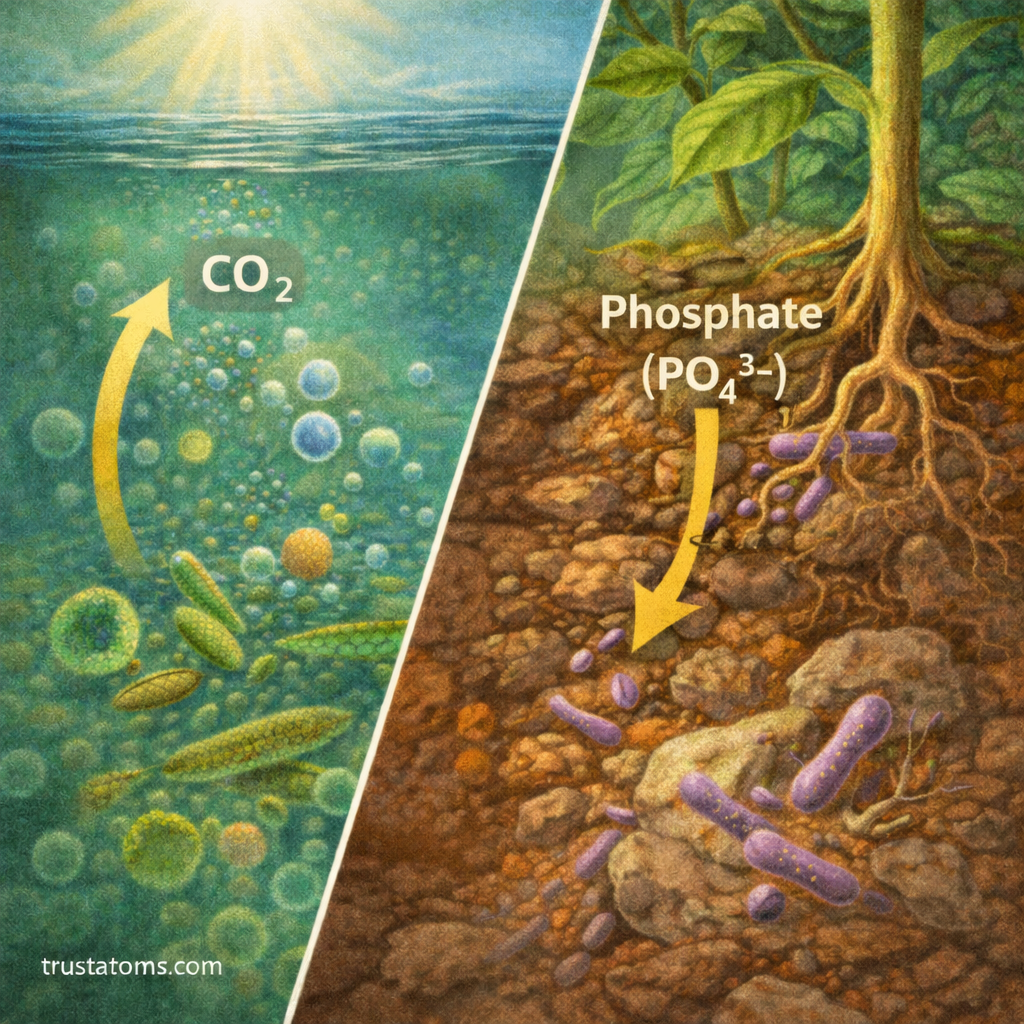
Microorganisms influence carbon cycling by decomposing organic matter, releasing carbon dioxide, and incorporating carbon into their own cells.
During aerobic respiration, microbes use oxygen while breaking down organic compounds, producing carbon dioxide and water. In oxygen-depleted environments, other metabolic pathways become more important.
For example, methane-producing archaea, called methanogens, generate methane under anaerobic conditions. These organisms occur in environments such as wetlands, waterlogged sediments, and some animal digestive systems.
Microbial activity also influences soil carbon storage. Some carbon becomes incorporated into microbial biomass and residues that may associate with soil minerals or become physically protected within soil aggregates.
Whether soil gains or loses carbon depends on the balance between organic inputs, decomposition, environmental conditions, and stabilization processes.
How Microbes Make Phosphorus Available
Phosphorus is required for ATP, DNA, RNA, and cell membranes. Unlike nitrogen and carbon, phosphorus has no major gaseous phase in its ordinary biological cycle.
Much of the phosphorus in soil exists in organic compounds or mineral forms that plants cannot readily absorb. Microorganisms influence its availability through two important mechanisms.
- Organic phosphorus mineralization: Microbial enzymes release inorganic phosphate from phosphorus-containing organic compounds.
- Phosphate solubilization: Some microorganisms produce organic acids or other substances that increase the availability of phosphate associated with certain minerals.
These processes can improve plant access to phosphorus, although their effectiveness depends on soil chemistry, microbial activity, and environmental conditions.
Mycorrhizal Fungi and Plant Nutrient Uptake
Mycorrhizal fungi form associations with plant roots. Their threadlike structures, called hyphae, extend into surrounding soil and increase the area from which nutrients can be acquired.
In many mycorrhizal relationships, fungi supply phosphorus and other nutrients to plants in exchange for carbon compounds produced through photosynthesis.
Some fungal networks connect multiple plants, although the movement of nutrients through these connections varies and does not necessarily benefit every connected plant equally.
These partnerships demonstrate that nutrient acquisition depends not only on chemical transformations but also on biological interactions between organisms.
Microbial Roles in Sulfur Cycling
Sulfur is needed for certain amino acids and proteins. Microorganisms transform sulfur between several chemical forms, including sulfate, sulfide, and elemental sulfur.
Under oxygen-limited conditions, sulfate-reducing microorganisms can use sulfate during respiration, producing sulfide. Other microorganisms oxidize reduced sulfur compounds, sometimes using the released energy to support growth.
These transformations influence sulfur availability, sediment chemistry, and interactions between sulfur and other nutrient cycles.
Nutrient Cycling in Lakes, Rivers, and Oceans
Aquatic microorganisms recycle nutrients within water columns and sediments. Bacteria and archaea decompose organic material, transform nitrogen compounds, and participate in carbon cycling.
Photosynthetic microorganisms, including cyanobacteria and many microscopic algae, incorporate carbon dioxide into organic matter. Other microbes consume dissolved and particulate organic compounds, returning nutrients to aquatic food webs.
Oxygen availability strongly influences these reactions. Oxygen-rich surface waters may support nitrification, while oxygen-poor sediments can favor denitrification and other anaerobic processes.
How Human Activities Change Microbial Nutrient Cycling
Agriculture, pollution, land-use changes, and climate conditions can alter microbial activity and nutrient movement.
- Excess fertilizer: Additional nitrogen and phosphorus can increase nutrient runoff and contribute to aquatic eutrophication.
- Soil disturbance: Changes in soil structure can influence oxygen availability, decomposition, and microbial habitats.
- Pollution: Toxic substances may inhibit sensitive microorganisms or favor communities capable of tolerating contaminants.
- Temperature and moisture changes: Shifts in environmental conditions can accelerate or restrict microbial metabolic processes.
Understanding these responses helps researchers evaluate soil management practices, nutrient pollution, and ecosystem changes.
Frequently Asked Questions
Which microorganisms are responsible for nutrient cycling?
Bacteria, archaea, fungi, and other microorganisms participate in nutrient cycling. Different groups perform specific reactions, including decomposition, nitrogen fixation, nitrification, denitrification, and sulfur transformations.
How do microbes improve soil fertility?
Microbes decompose organic matter, release nutrients through mineralization, transform nitrogen compounds, and help make certain forms of phosphorus more available. Their activity contributes to nutrient supplies that support plant growth.
What happens to nutrient cycling when microbial activity decreases?
Reduced microbial activity can slow decomposition and certain nutrient transformations. However, the effects depend on which microbial processes decline, because different organisms perform different functions within nutrient cycles.
Microorganisms connect the carbon, nitrogen, phosphorus, and sulfur cycles through decomposition, chemical transformations, and relationships with other organisms. Their activity determines when nutrients become available, where those nutrients move, and whether they remain in ecosystems or enter the atmosphere and waterways. Understanding these processes helps explain how soil fertility and ecosystem productivity respond to environmental change.
Sources: Madigan et al., Brock Biology of Microorganisms; Paul, Soil Microbiology, Ecology and Biochemistry; Schlesinger and Bernhardt, Biogeochemistry: An Analysis of Global Change.