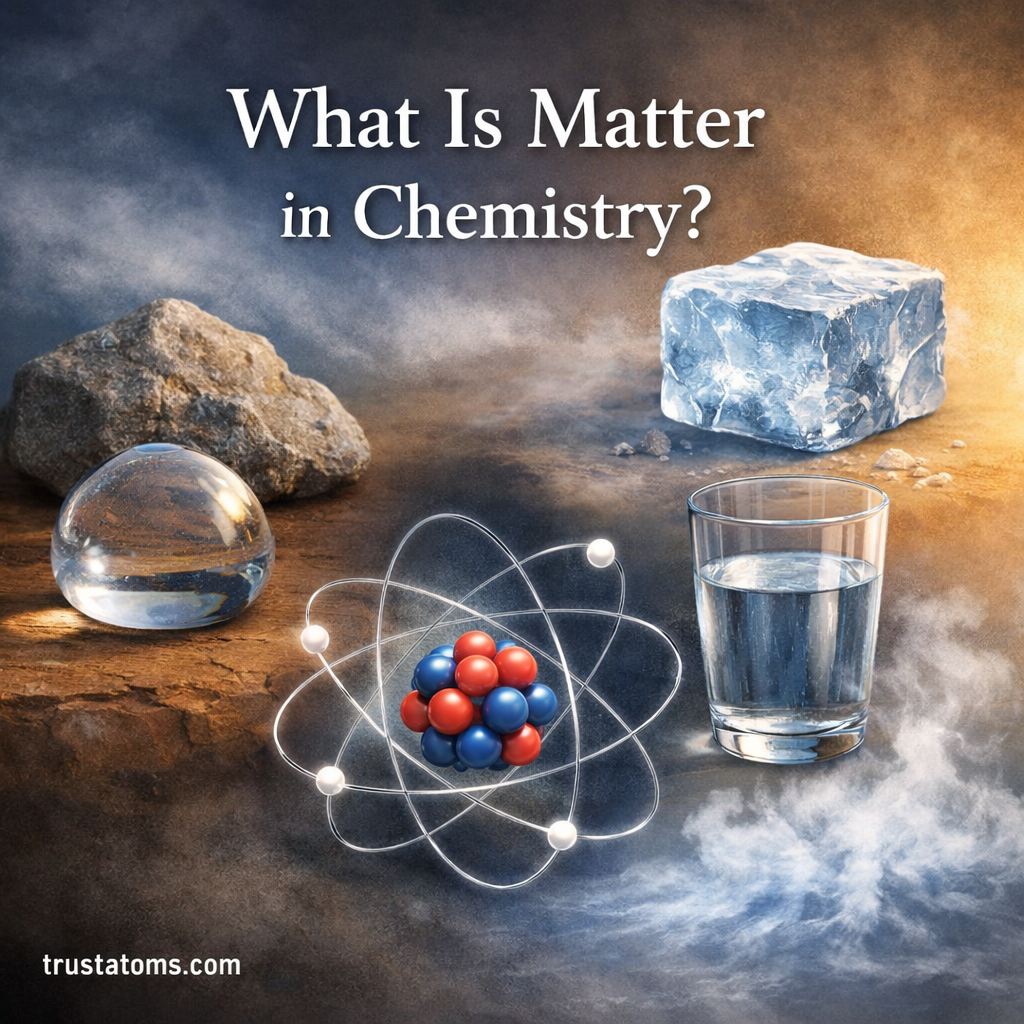
Matter in chemistry is anything that has mass and occupies space. It includes familiar substances such as water, air, rocks, metals, and living tissue, all of which contain particles that determine their physical and chemical properties.
Understanding matter is the starting point for the study of chemistry, which examines what substances are made of, how they behave, and how they change. Matter can exist in different physical states, be classified by composition, and undergo changes that either preserve or alter its chemical identity.
Although some forms of matter are easy to see and touch, others are invisible under ordinary conditions. The air inside a balloon, for example, is matter because it has mass and occupies volume even though the individual gas particles cannot be seen.
What Is Matter? The Scientific Definition
In introductory chemistry, matter is defined by two characteristics: mass and volume. Mass describes an object’s resistance to acceleration and is related to the amount of material present, while volume describes the three-dimensional space it occupies.
This definition includes a vast range of materials and substances. Solids, liquids, and gases are all forms of matter. Even objects that seem invisible, like air, are made of matter because they still have mass and take up space.
Examples include a glass of water, oxygen in the atmosphere, a wooden desk, a copper wire, and the cells inside a living organism. These substances differ in composition and structure, but each consists of physical material.
Light and sound are not classified as matter in introductory chemistry. Light is electromagnetic radiation, while sound is a mechanical wave traveling through a medium. Both can transfer energy, but neither is itself an ordinary material substance.
Mass and Volume: The Two Defining Characteristics
Mass Measures an Object’s Inertia
Mass is commonly measured in grams (g) or kilograms (kg). Unlike weight, which depends on the local gravitational field, an object’s mass remains the same whether it is on Earth or the Moon, assuming no material is added or removed.
A laboratory balance measures mass by using calibrated forces or comparisons. A sample with a mass of 100 grams contains the same mass of material regardless of its location, although its weight would be different under different gravitational conditions.
Volume Measures Occupied Space
Volume is measured in units such as liters (L), milliliters (mL), and cubic centimeters (cm³). One milliliter equals one cubic centimeter, making these units convenient for laboratory measurements.
Liquids are commonly measured using graduated cylinders, while the volume of a regularly shaped solid can be calculated from its dimensions. For irregular solids, water displacement can provide a practical measurement when the material does not dissolve or react with water.
Worked Example: Calculating the Density of Matter
Density connects mass and volume. It describes how much mass is contained within a given volume and is calculated using the formula:
Density = Mass ÷ Volume
Suppose a metal sample has a mass of 54 grams and occupies 20 cubic centimeters. Its density can be calculated in three steps.
- Identify the mass: 54 grams.
- Identify the volume: 20 cubic centimeters.
- Divide mass by volume: 54 ÷ 20 = 2.7 grams per cubic centimeter.
The sample has a density of 2.7 g/cm³. This is approximately the density of aluminum near room temperature, although density alone cannot establish a material’s identity with certainty.
Density also helps explain floating and sinking. An object with an average density lower than that of the surrounding fluid can float under suitable conditions. This is why ice floats in liquid water even though both consist of the same chemical substance.
Matter Is Made of Atoms, Molecules, and Ions
Ordinary chemical matter is made from atoms. An atom contains a nucleus with protons and, in most cases, neutrons, surrounded by electrons. The number of protons identifies the chemical element, while the arrangement of electrons strongly influences chemical behavior.
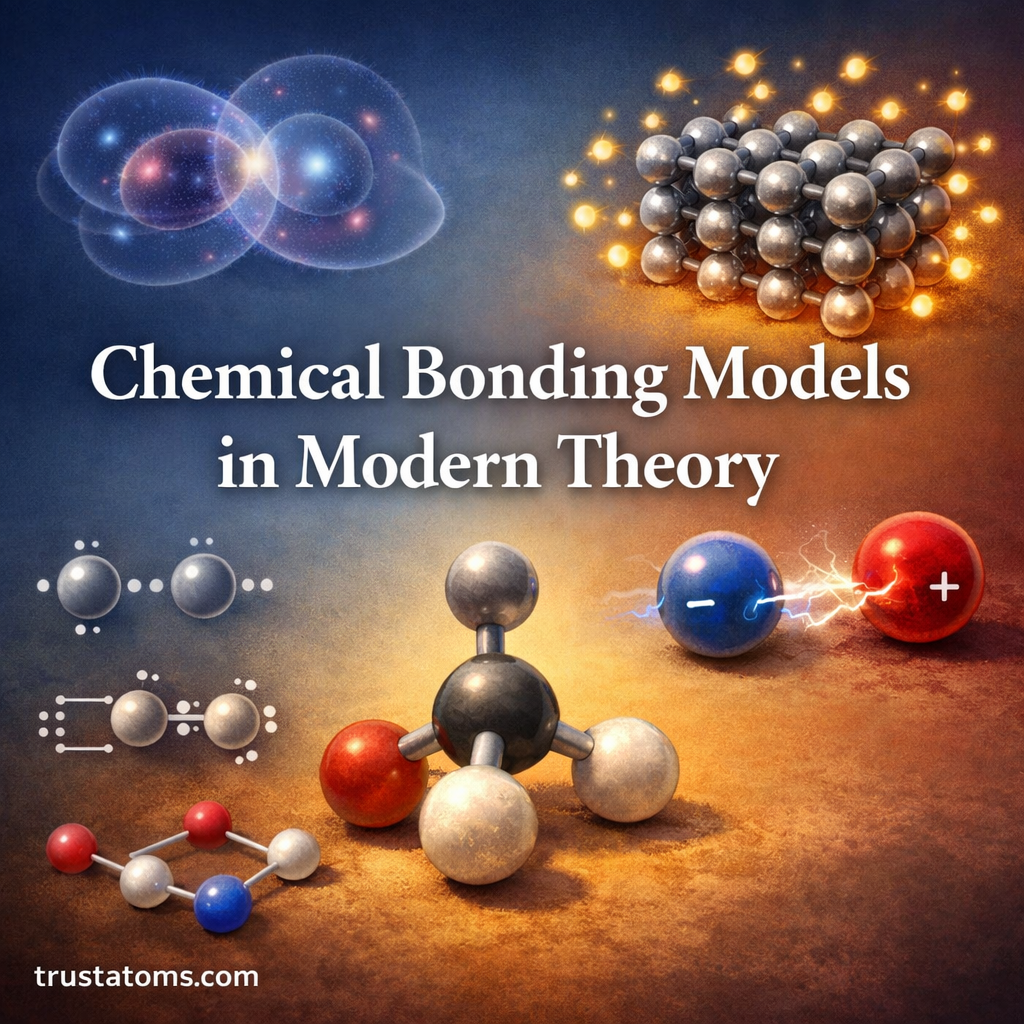
Atoms can join through chemical bonding to form molecules or extended structures. Water (H₂O) consists of molecules containing two hydrogen atoms and one oxygen atom. Carbon dioxide (CO₂) contains one carbon atom bonded to two oxygen atoms.
Not every compound exists as separate molecules. Solid sodium chloride (NaCl), for example, contains sodium and chloride ions arranged in an extended crystal lattice. The formula NaCl represents the simplest ratio of sodium ions to chloride ions rather than an individual molecule in the crystal.
The arrangement of atoms and the forces between particles help explain why substances have different densities, melting points, electrical conductivities, and chemical properties.
The Three Common States of Matter
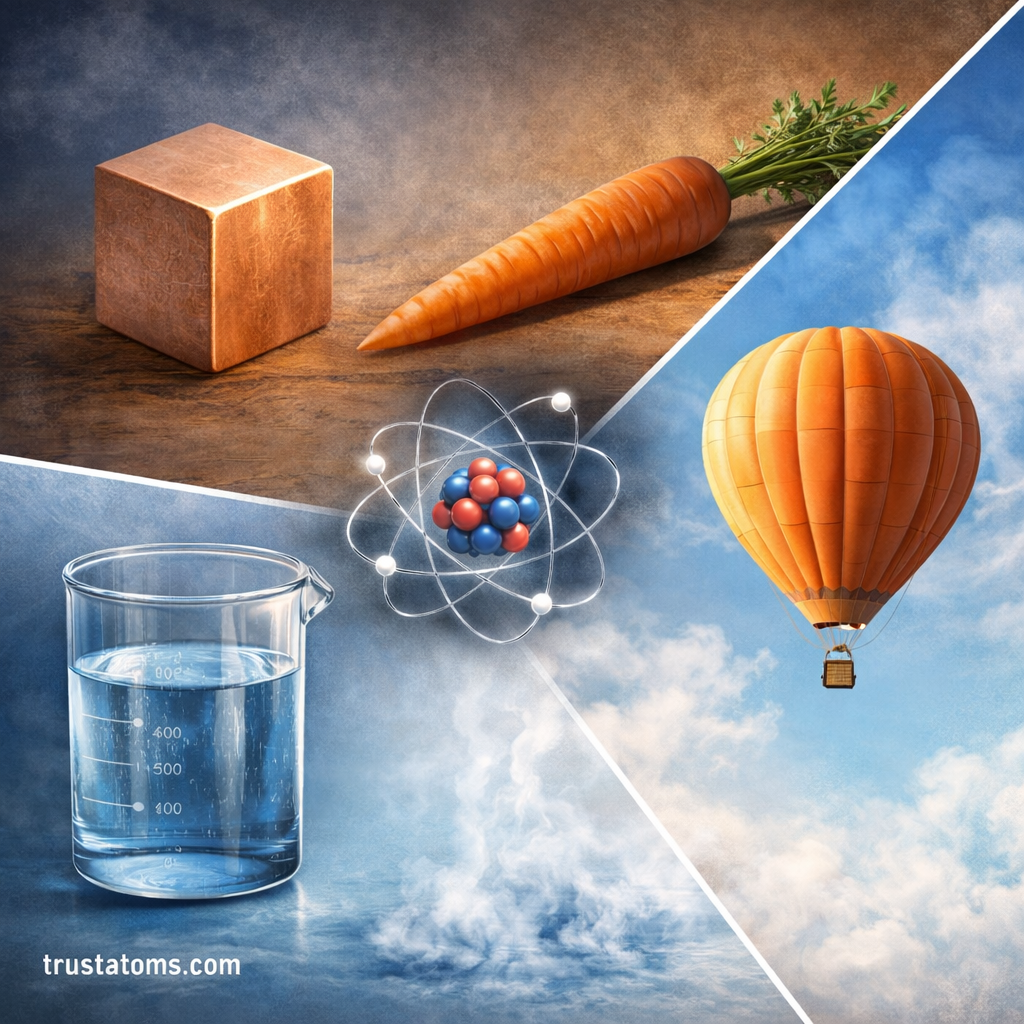
Matter exists in different physical forms known as states of matter. The three most common states are solid, liquid, and gas. Their properties depend on particle motion, intermolecular attractions, temperature, and pressure.
Solids Have a Definite Shape and Volume
Solids generally maintain their shape and volume under ordinary conditions. Their particles occupy relatively fixed positions or arrangements, although they continue to move through vibrations and other microscopic motions.
Ice, stone, copper, and wood are familiar solids. Some solids have ordered crystalline structures, while others, such as ordinary glass, are amorphous and lack long-range crystalline order.
Liquids Have a Definite Volume but Change Shape
Liquids maintain an approximately fixed volume but flow to take the shape of their containers. Their particles remain relatively close together while moving past one another.
Water, cooking oil, and ethanol are examples. Liquids are generally difficult to compress because their particles are already closely spaced.
Gases Expand to Fill Available Space
Gases have neither a fixed shape nor a fixed volume. Their particles are widely separated compared with those in liquids and solids, allowing gases to expand and be compressed relatively easily.
Oxygen, nitrogen, helium, and carbon dioxide can exist as gases under ordinary atmospheric conditions. Gas pressure results from particle interactions with the walls of a container.
| Property | Solid | Liquid | Gas |
|---|---|---|---|
| Shape | Definite | Takes container shape | Fills container |
| Volume | Definite | Nearly definite | Variable |
| Particle arrangement | Relatively fixed | Close, mobile | Widely separated |
| Compressibility | Usually very low | Usually low | Relatively high |
| Example | Ice | Liquid water | Water vapor |
Other States of Matter: Plasma and Bose–Einstein Condensates
Plasma is an ionized state of matter containing free electrons and ions. It can conduct electricity and respond strongly to electromagnetic fields. Examples include much of the material inside stars, lightning channels, and certain specialized laboratory devices.
A Bose–Einstein condensate can form when certain particles are cooled to extremely low temperatures. Under suitable conditions, many particles occupy the same quantum state, allowing collective quantum behavior to become observable on a larger scale.
These examples demonstrate that the familiar solid-liquid-gas classification is useful but does not describe every possible physical state of matter.
Classifying Matter as Pure Substances and Mixtures
Chemists classify matter according to its composition. A pure substance has a definite chemical composition, while a mixture contains multiple substances in proportions that can vary.
Elements and Compounds Are Pure Substances
An element contains atoms with the same number of protons. Gold, oxygen, carbon, and iron are examples. Elements cannot be decomposed into simpler chemical substances by ordinary chemical reactions.
A compound contains two or more elements chemically combined in definite proportions. Water, carbon dioxide, and sodium chloride are compounds. Their chemical properties can differ substantially from those of their constituent elements.
Mixtures Contain Physically Combined Substances
A mixture consists of two or more substances that are physically combined but not chemically bonded to each other to form one new pure substance. Its components retain their chemical identities, even though interactions between them may affect the mixture’s overall properties.
Homogeneous mixtures have a uniform composition on the scale being examined. Examples include saltwater and well-mixed air. Heterogeneous mixtures have nonuniform composition, such as sand suspended in water or a mixture of gravel and soil.
Mixtures can often be separated through physical methods such as filtration, evaporation, distillation, or chromatography. Separating a compound into its constituent elements, however, requires chemical or other processes that change its chemical identity.
Physical and Chemical Properties of Matter
Properties help chemists describe and identify substances. The distinction between physical and chemical properties depends on whether observing a characteristic requires a change in chemical identity.
Physical properties include density, color, hardness, electrical conductivity, melting point, and boiling point. Measuring a sample’s density or observing its color does not require converting it into another chemical substance.
Chemical properties describe how substances can undergo chemical reactions. Examples include flammability, susceptibility to corrosion, and reactivity with acids or oxygen. These properties become apparent through processes that produce chemical changes.
Properties can also be classified as intensive or extensive. Intensive properties, such as density and temperature, do not depend directly on the amount of sample. Extensive properties, such as mass and total volume, depend on how much material is present.
How Matter Changes Without Disappearing
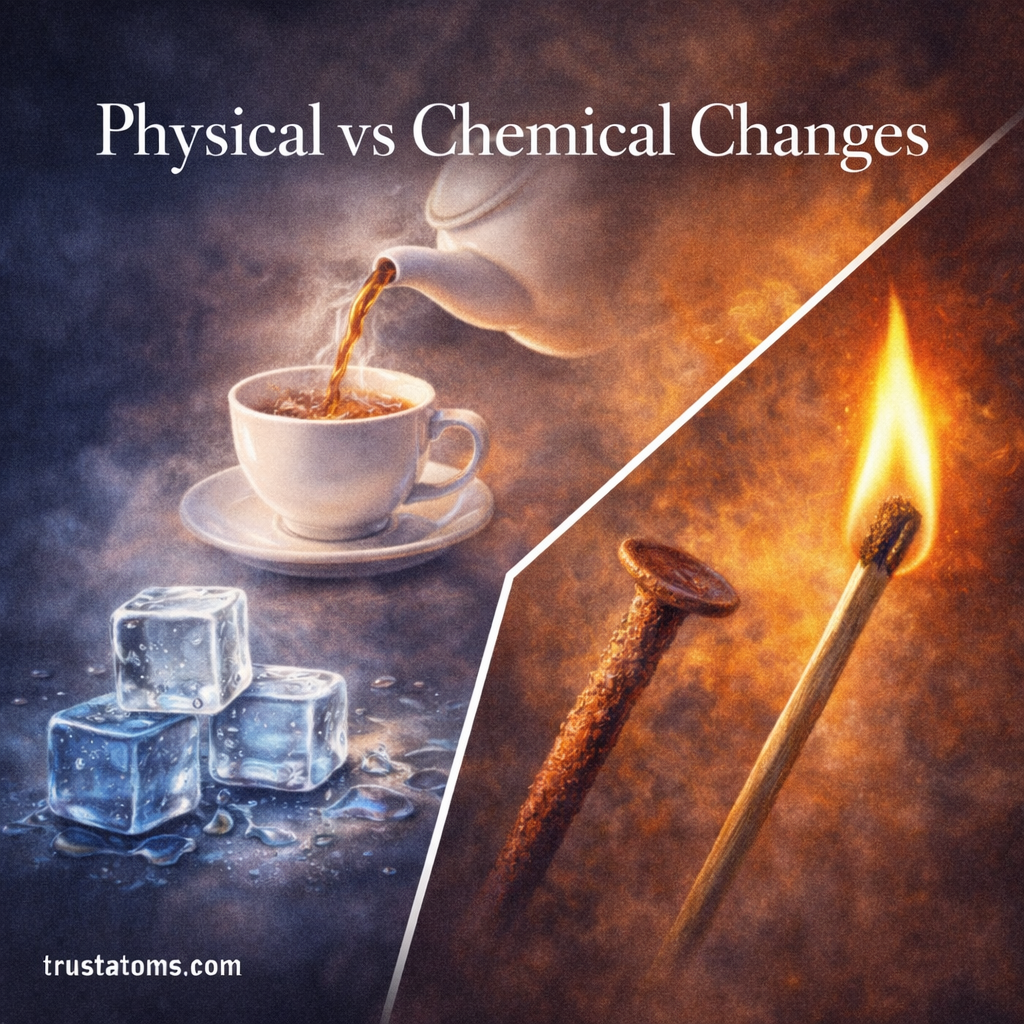
In chemistry, matter undergoes both physical and chemical changes. Understanding physical versus chemical changes helps distinguish a change in form from a change in chemical composition.
Melting ice, boiling water, crushing a rock, and dissolving sugar are familiar physical changes. The substances involved retain their chemical identities, although their appearance, arrangement, or physical state may change.
Burning fuel, rusting iron, and cooking an egg involve chemical transformations. Atoms are rearranged as chemical bonds break and form, producing substances with different chemical compositions or structures.
In ordinary chemical reactions conducted within a closed system, total mass is conserved. For example, if 12 grams of carbon react completely with 32 grams of oxygen, the reaction produces 44 grams of carbon dioxide. The atoms are rearranged, but none are created or destroyed by the chemical reaction.
Common Misconceptions About Matter
Misconception: Air Is Not Matter Because It Is Invisible
Air has mass and occupies volume. Inflating a balloon adds gas particles, increasing the amount of matter inside it. Visibility is not a requirement for something to be matter.
Misconception: Mass and Weight Are the Same
Mass describes inertia and is measured in kilograms or grams. Weight is the gravitational force acting on an object and is measured in newtons. Weight changes with gravitational conditions, while mass does not.
Misconception: Matter Disappears When Water Evaporates
Evaporation changes liquid water into water vapor. The water molecules remain present in the gas phase and can condense back into liquid under suitable conditions.
Misconception: All Matter Is Made of Separate Molecules
Some substances contain discrete molecules, but others form ionic crystals, metallic structures, or extended covalent networks. The microscopic organization of matter varies considerably between materials.
Frequently Asked Questions
What is matter in chemistry in simple terms?
Matter is anything that has mass and occupies space. Examples include water, air, food, rocks, and metals. Ordinary matter consists of atoms and the structures they form.
What are the three most common states of matter?
The three most familiar states are solid, liquid, and gas. Solids generally maintain shape and volume, liquids maintain volume but flow, and gases expand to fill their containers.
Is light considered matter?
No. Light is electromagnetic radiation composed of photons and is not classified as matter in introductory chemistry. Light carries energy and momentum, but it is not a material substance with rest mass and ordinary volume.
What is the difference between matter and energy?
Matter refers to physical material, while energy is a measurable property associated with the state and interactions of physical systems. Matter can store and transfer energy, and mass and energy are related through Einstein’s mass-energy equivalence.
What is the difference between a pure substance and a mixture?
A pure substance has a definite chemical composition and includes elements and compounds. A mixture contains two or more substances physically combined in variable proportions, such as saltwater or air.
Matter provides the physical foundation for studying substances, their properties, and their transformations. By understanding mass, volume, atomic structure, physical states, and chemical composition, students can explain how materials behave and how chemical reactions produce new substances while conserving atoms.
Sources: OpenStax, Chemistry 2e; Theodore L. Brown, H. Eugene LeMay, Bruce E. Bursten, Catherine Murphy, Patrick Woodward, and Matthew Stoltzfus, Chemistry: The Central Science; International Union of Pure and Applied Chemistry, Compendium of Chemical Terminology (Gold Book); Peter Atkins, Julio de Paula, and James Keeler, Atkins’ Physical Chemistry.