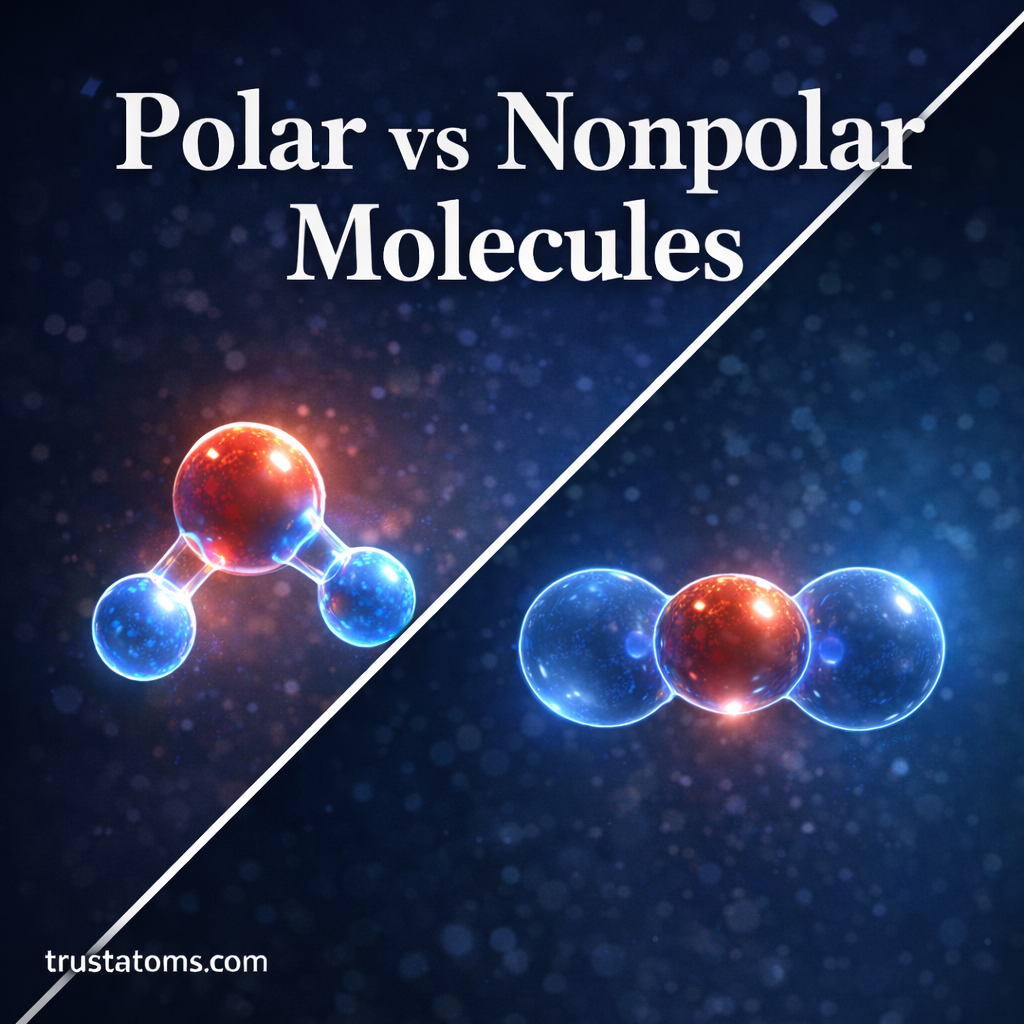
Molecules behave differently depending on how their electrons are distributed. Some molecules have an uneven distribution of electrical charge, while others share electrons evenly across their structure. These differences create two major categories in chemistry: polar molecules and nonpolar molecules.
Understanding the difference between polar and nonpolar molecules helps explain many chemical properties, including solubility, intermolecular forces, and how substances interact with one another. From water dissolving salt to oil separating from water, molecular polarity plays a key role in the behavior of matter.
What Are Polar Molecules?
A polar molecule is a molecule that has an uneven distribution of electrical charge. This happens when electrons are shared unequally between atoms, creating regions with partial positive and partial negative charges.
This unequal distribution results in a dipole, meaning the molecule has two poles:
- A partially negative side
- A partially positive side
Polar molecules typically form when atoms in a molecule have different electronegativities and the molecular shape prevents the charges from canceling out.
Common examples of polar molecules include:
- Water (H₂O)
- Ammonia (NH₃)
- Hydrogen fluoride (HF)
- Sulfur dioxide (SO₂)
Because of their charge separation, polar molecules tend to interact strongly with other polar molecules.
What Are Nonpolar Molecules?
A nonpolar molecule has an even distribution of electrons across the molecule. This means there is no overall positive or negative region.
Nonpolar molecules usually occur when:
- Atoms share electrons equally, or
- The molecule’s shape cancels out individual bond polarities
Even if a molecule contains polar bonds, the overall structure may balance the charges, resulting in a nonpolar molecule.
Examples of nonpolar molecules include:
- Oxygen (O₂)
- Nitrogen (N₂)
- Methane (CH₄)
- Carbon dioxide (CO₂)
In these molecules, electron distribution remains symmetrical, preventing the formation of a dipole.
Why Molecular Shape Matters
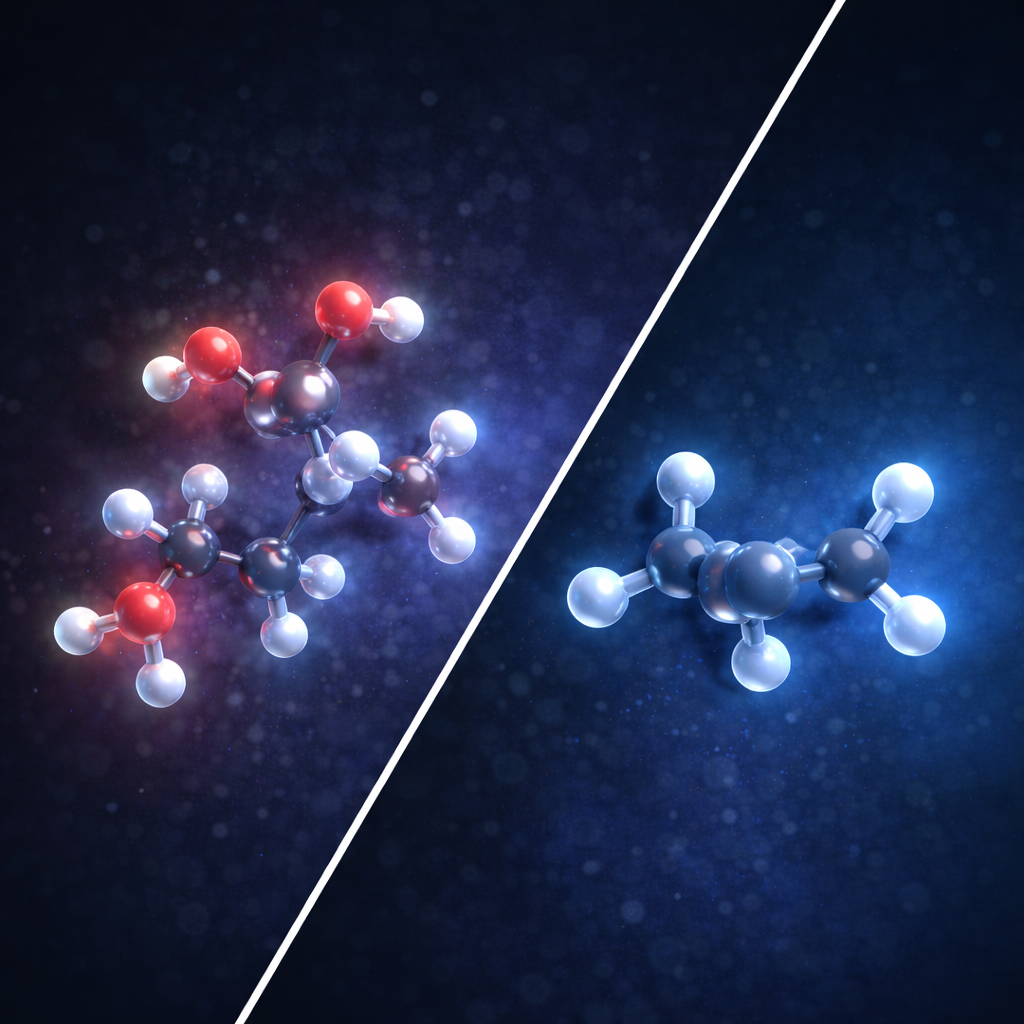
The geometry of a molecule determines whether polar bonds create an overall polar molecule.
Some molecules contain polar bonds but remain nonpolar because the bond dipoles cancel each other out.
For example:
- Carbon dioxide (CO₂) has polar bonds between carbon and oxygen.
- However, the molecule is linear and symmetrical.
- The dipoles cancel, making the molecule nonpolar overall.
In contrast:
- Water (H₂O) has polar bonds and a bent shape.
- The dipoles do not cancel.
- This makes water a strongly polar molecule.
Molecular shape is therefore essential when determining polarity.
Key Differences Between Polar and Nonpolar Molecules
Polar and nonpolar molecules differ in several important ways.
Polar Molecules
Polar molecules have:
- Uneven electron distribution
- Partial positive and negative regions
- Strong intermolecular attractions
- Higher solubility in water
They often interact through forces such as dipole-dipole interactions and hydrogen bonding.
Nonpolar Molecules
Nonpolar molecules typically have:
- Even electron distribution
- No overall dipole
- Weaker intermolecular forces
- Poor solubility in water
These molecules mainly interact through London dispersion forces, which are weaker than other intermolecular forces.
The “Like Dissolves Like” Rule
One of the most useful chemistry rules involving molecular polarity is:
Like dissolves like.
This means substances tend to dissolve in solvents with similar polarity.
Examples include:
Polar dissolving polar:
- Salt dissolving in water
- Sugar dissolving in water
- Alcohol mixing with water
Nonpolar dissolving nonpolar:
- Oil dissolving in other oils
- Grease dissolving in nonpolar solvents
- Waxes dissolving in hydrocarbons
This rule helps chemists predict how substances will mix.
Everyday Examples of Polar and Nonpolar Molecules
Polarity influences many everyday substances.
Examples of polar molecules include:
- Water
- Vinegar
- Ammonia
- Alcohol
Examples of nonpolar molecules include:
- Cooking oils
- Butter fats
- Gasoline
- Wax
This difference explains why oil and water separate instead of mixing.
When oil is added to water:
- Water molecules attract each other strongly.
- Oil molecules attract each other instead.
- The substances separate into layers.
Why Polarity Matters in Chemistry and Biology
Molecular polarity influences a wide range of chemical and biological processes.
Important effects include:
- Solubility of compounds
- Strength of intermolecular forces
- Molecular interactions in cells
- Chemical reaction behavior
- Protein folding and enzyme activity
In biological systems, polarity helps determine how molecules interact with cell membranes, proteins, and DNA.
For example:
- Many biological molecules dissolve in water because they are polar.
- Lipids (fats) are nonpolar, which is why they form cell membranes.
Without polarity, many essential biological processes would not function properly.
How to Identify Polar vs Nonpolar Molecules
To determine whether a molecule is polar or nonpolar, follow these steps:
- Identify the bonds between atoms.
- Determine if the bonds are polar using electronegativity differences.
- Examine the molecular shape.
- Check whether the bond dipoles cancel out.
If the dipoles cancel, the molecule is nonpolar.
If they do not cancel, the molecule is polar.
Chemists often use molecular geometry models and electronegativity values to make these predictions.
Final Thoughts
Polar and nonpolar molecules differ in how they distribute electrical charge. Polar molecules have uneven electron distribution that creates partial positive and negative regions, while nonpolar molecules distribute electrons evenly.
These differences affect how molecules interact, dissolve, and behave in chemical reactions. From the unique properties of water to the separation of oil and water, molecular polarity explains many everyday phenomena.
Understanding the difference between polar and nonpolar molecules is an important step in learning how chemical structures influence the behavior of matter.