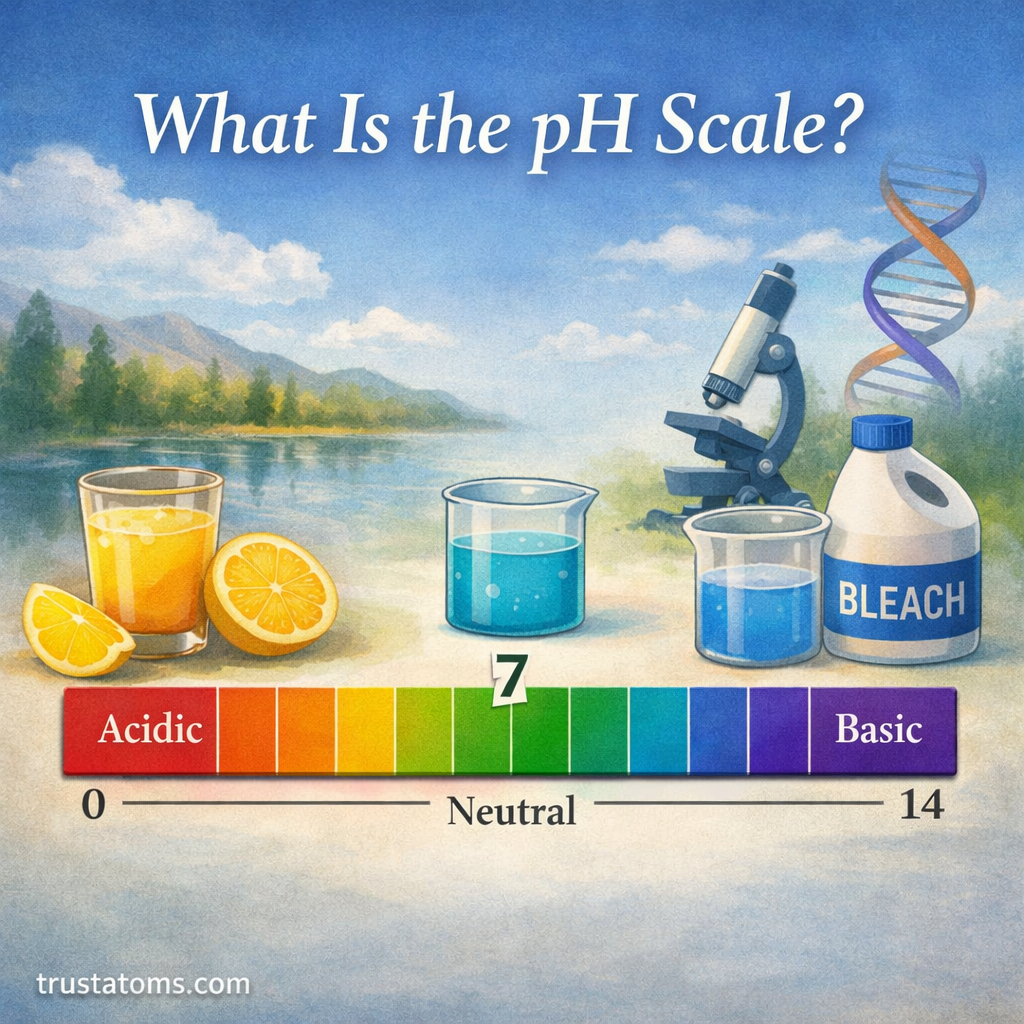
The pH scale is a measurement system used in chemistry to describe how acidic or basic (alkaline) a substance is. It plays a central role in chemistry, biology, environmental science, and even everyday activities such as cooking, cleaning, and maintaining drinking water.
The scale ranges from 0 to 14, with lower numbers representing stronger acids and higher numbers representing stronger bases. Substances with a pH of 7 are considered neutral.
Understanding the pH scale helps scientists and students predict chemical behavior, determine solution properties, and maintain balanced chemical environments in natural and industrial systems.
What Does pH Mean?
The term pH stands for “potential of hydrogen” or “power of hydrogen.”
It measures the concentration of hydrogen ions (H⁺) in a solution. Hydrogen ions are charged particles that influence how a substance reacts chemically.
In simple terms:
- More hydrogen ions → more acidic → lower pH
- Fewer hydrogen ions → more basic → higher pH
Because hydrogen ions strongly affect chemical reactions, measuring their concentration provides a reliable way to classify substances as acids or bases.
The pH Scale Range
The pH scale runs from 0 to 14, although extremely strong acids or bases can sometimes fall slightly outside this range under special conditions.
Here is how the scale is generally categorized:
| pH Range | Classification | Example |
|---|---|---|
| 0–3 | Strong acids | Battery acid |
| 4–6 | Weak acids | Tomato juice |
| 7 | Neutral | Pure water |
| 8–10 | Weak bases | Baking soda solution |
| 11–14 | Strong bases | Bleach |
Each step on the scale represents a tenfold change in acidity, meaning a substance with pH 3 is ten times more acidic than pH 4 and one hundred times more acidic than pH 5.
This logarithmic nature is what makes the pH scale especially powerful for comparing chemical solutions.
Examples of pH in Everyday Substances
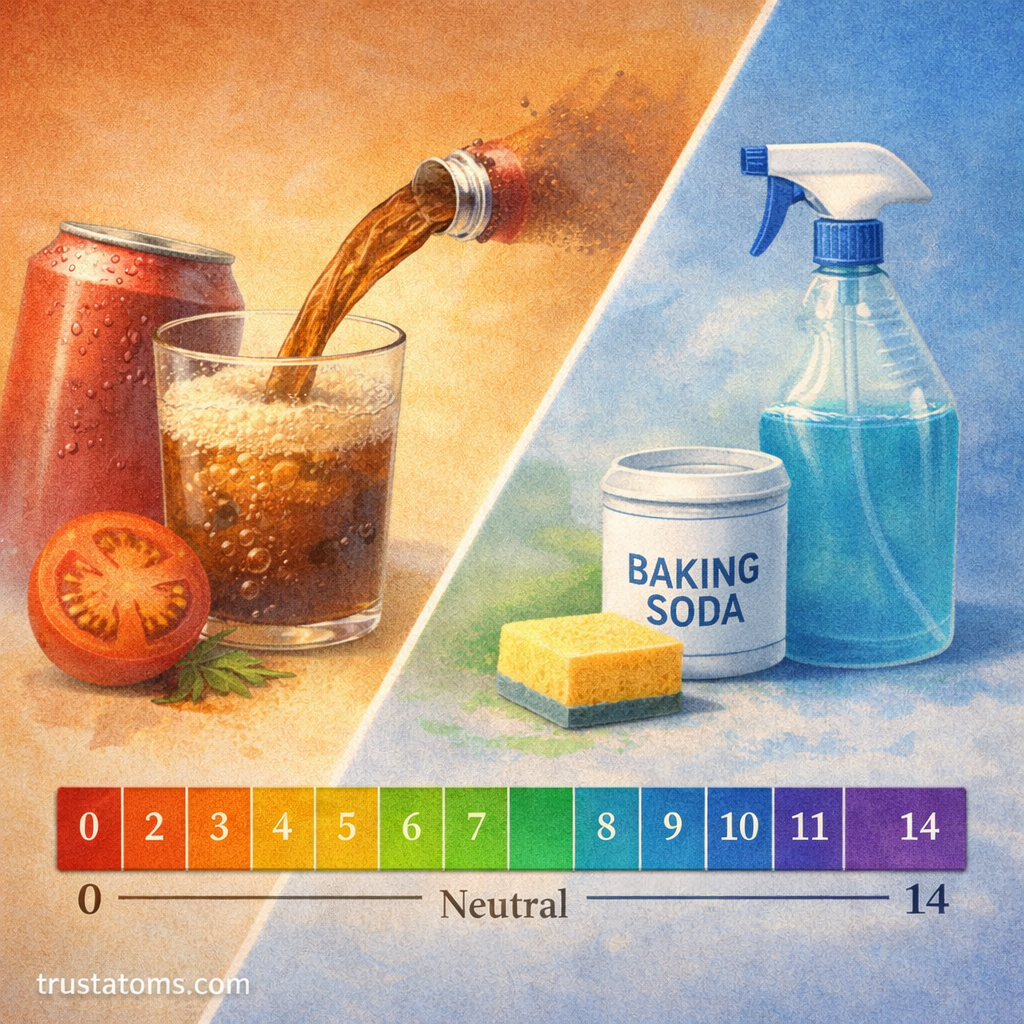
Many common substances fall at recognizable points along the pH scale.
Examples include:
Acids:
- Lemon juice (pH ~2)
- Vinegar (pH ~3)
- Soda (pH ~3–4)
Neutral:
- Pure water (pH 7)
Bases:
- Baking soda (pH ~8)
- Soap (pH ~9–10)
- Household ammonia (pH ~11–12)
These differences explain why certain substances taste sour, feel slippery, or react strongly with other chemicals.
Why the pH Scale Is Logarithmic
Unlike simple number scales, the pH scale is logarithmic, meaning each whole number change represents a 10× difference in hydrogen ion concentration.
For example:
- pH 5 is 10× more acidic than pH 6
- pH 4 is 100× more acidic than pH 6
- pH 3 is 1,000× more acidic than pH 6
This logarithmic structure allows scientists to represent very large concentration differences using a relatively small numerical range.
How pH Is Measured
Scientists measure pH using several different tools and techniques.
1. pH Indicators
Chemical indicators change color depending on acidity or alkalinity.
Examples include:
- Litmus paper
- Universal indicator solutions
- Natural indicators like red cabbage extract
These methods provide quick visual estimates of pH levels.
2. pH Test Strips
Test strips contain indicator chemicals embedded in paper. When dipped into a liquid, they change color to match a reference chart showing approximate pH values.
3. pH Meters
A pH meter is the most precise measurement method. It uses an electronic probe to detect hydrogen ion activity and calculate an exact pH reading.
pH meters are commonly used in:
- Scientific laboratories
- Environmental monitoring
- Food production
- Water treatment systems
Why pH Is Important
The pH scale plays an important role in many scientific and practical fields.
Environmental Science
Natural ecosystems depend on stable pH levels.
Examples include:
- Ocean pH affects coral reefs and marine life
- Soil pH influences plant growth and nutrient availability
- Rainwater pH helps detect acid rain pollution
Human Biology
Many biological systems require tightly controlled pH levels.
Examples:
- Human blood maintains a pH around 7.35–7.45
- Digestive fluids in the stomach are highly acidic
- Enzymes function best within specific pH ranges
Industrial Applications
Industries monitor pH to maintain safe and effective chemical processes.
Examples include:
- Drinking water purification
- Food production
- Pharmaceutical manufacturing
- Agriculture and fertilizers
Common Misconceptions About the pH Scale
Several misunderstandings about pH are common among beginners.
pH Is Not Linear
Many people assume the difference between pH values is equal, but the scale is logarithmic. A one-unit change represents a tenfold chemical difference.
Neutral Does Not Always Mean Safe
Although pH 7 is neutral, substances near this value can still contain harmful chemicals depending on their composition.
Strong Acids Are Not Always More Dangerous
Some weak acids can be harmful if concentrated, while some strong acids may be diluted enough to be relatively safe.
Understanding pH requires considering both concentration and chemical composition.
How the pH Scale Connects to Acids and Bases
The pH scale is directly tied to the chemical behavior of acids and bases.
Acids typically:
- Donate hydrogen ions (H⁺)
- Have pH values below 7
- Taste sour
- React with metals and carbonates
Bases typically:
- Accept hydrogen ions or release hydroxide ions (OH⁻)
- Have pH values above 7
- Taste bitter
- Feel slippery in solution
These properties help chemists classify substances and predict reactions.
The Role of pH in Scientific Education
Learning about the pH scale introduces students to several important chemistry concepts:
- Ion concentration
- Acid–base reactions
- Logarithmic measurement scales
- Chemical equilibrium
- Environmental chemistry
Because of its broad relevance, the pH scale is one of the first quantitative measurement systems taught in chemistry education.
Final Thoughts
The pH scale is a simple yet powerful way to measure how acidic or basic a substance is. By tracking hydrogen ion concentration, the scale allows scientists to compare solutions, understand chemical reactions, and monitor biological and environmental systems.
From the acidity of lemon juice to the delicate balance of ocean water, pH plays a crucial role in the chemistry of everyday life and the functioning of natural ecosystems.
Understanding the pH scale provides an essential foundation for studying acids, bases, and chemical behavior in the world around us.