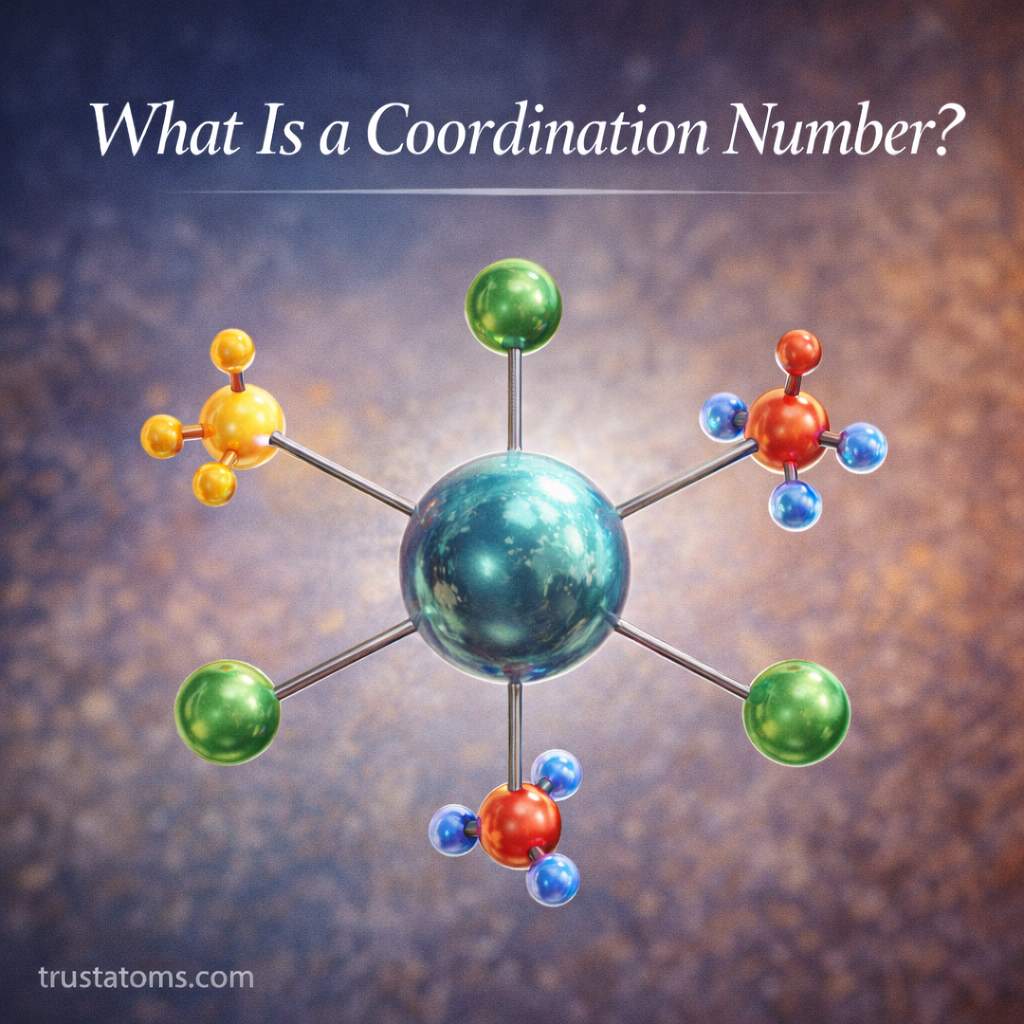
In chemistry, the coordination number describes how many atoms, ions, or molecules are directly attached to a central atom in a chemical structure. The concept is most commonly used in coordination chemistry, which studies compounds where metal atoms bond with surrounding molecules or ions called ligands.
Understanding coordination numbers helps chemists determine the structure, bonding, and geometry of complex compounds, especially those involving transition metals.
Coordination numbers also play an important role in fields such as materials science, crystallography, catalysis, and biochemistry.
Definition of Coordination Number
The coordination number refers to the number of atoms, ions, or molecules directly bonded to a central atom or ion.
These surrounding atoms or molecules are known as ligands.
For example:
- If a metal ion is surrounded by four ligands, the coordination number is 4.
- If it is surrounded by six ligands, the coordination number is 6.
The coordination number helps chemists understand how atoms arrange themselves around a central atom in a compound.
Coordination Numbers in Coordination Compounds
Coordination numbers are most commonly used when studying coordination compounds, which consist of:
- A central metal ion
- One or more ligands attached to it
Ligands can include:
- Water molecules
- Ammonia
- Chloride ions
- Cyanide ions
- Organic molecules
These ligands donate electron pairs to the central metal ion, forming coordinate covalent bonds.
Common Coordination Numbers
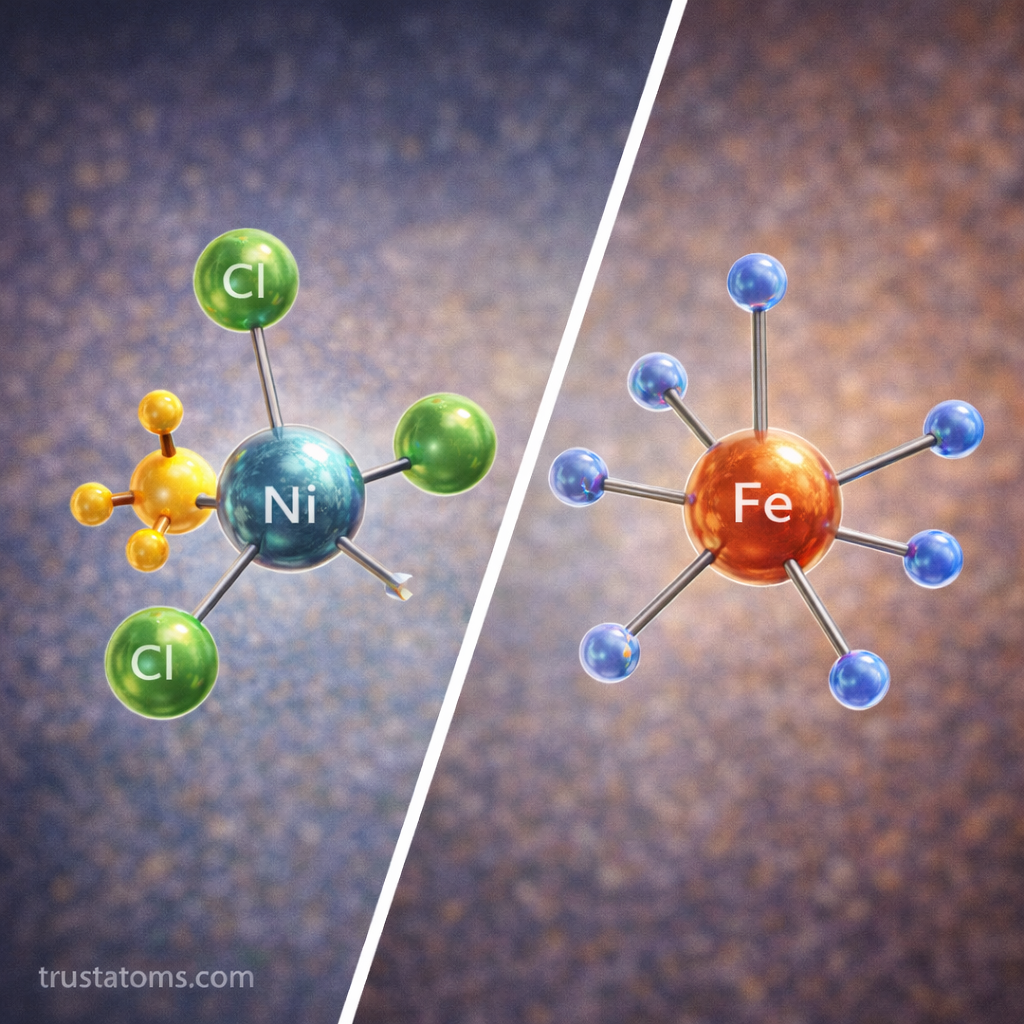
Certain coordination numbers appear frequently in chemistry because they correspond to stable geometric structures.
Coordination Number 2
A coordination number of 2 often produces a linear geometry.
Examples include:
- Silver complexes
- Some copper compounds
In this arrangement, two ligands are positioned opposite each other around the central atom.
Coordination Number 4
A coordination number of 4 commonly forms one of two shapes:
- Tetrahedral geometry
- Square planar geometry
Examples include:
- Nickel complexes
- Platinum compounds
- Zinc ions with four ligands
These structures influence the chemical reactivity and properties of the compound.
Coordination Number 6
A coordination number of 6 is one of the most common arrangements in coordination chemistry.
This arrangement typically forms an octahedral geometry, where six ligands surround the central atom.
Examples include:
- Iron complexes
- Chromium complexes
- Many transition metal compounds
Octahedral coordination structures are highly stable and appear frequently in inorganic chemistry.
Coordination Number in Crystals
The concept of coordination number is also important in crystallography, which studies how atoms are arranged in solid materials.
In crystal structures, the coordination number refers to the number of nearest neighboring atoms surrounding a given atom in the lattice.
Examples include:
- Sodium chloride crystals, where ions surround each other in a repeating structure
- Metal crystals where atoms pack closely together
The coordination number helps scientists understand how atoms pack together in solid materials.
Factors That Affect Coordination Number
Several factors influence the coordination number of a compound.
Size of the Central Atom
Larger atoms can accommodate more ligands around them.
Smaller atoms often have lower coordination numbers.
Size of the Ligands
Large ligands occupy more space around the central atom.
This may limit how many ligands can attach.
Smaller ligands allow more atoms to fit around the central metal.
Charge of the Metal Ion
Metal ions with higher charges can attract more ligands due to stronger electrostatic forces.
This can increase the coordination number.
Steric Effects
Steric effects occur when ligands physically block each other.
Bulky molecules may prevent additional ligands from attaching to the central atom.
Coordination Number in Biological Systems
Coordination chemistry is also essential in biology.
Many biological molecules contain metal centers with specific coordination numbers.
Examples include:
Hemoglobin
Hemoglobin contains an iron ion coordinated by surrounding atoms in the heme group.
This coordination structure allows hemoglobin to bind oxygen efficiently in the bloodstream.
Enzymes
Many enzymes use metal ions such as:
- Zinc
- Magnesium
- Copper
These metal ions often have specific coordination numbers that help the enzyme perform chemical reactions.
Coordination Numbers in Materials Science
Coordination numbers are also important in materials science and solid-state chemistry.
Scientists use coordination numbers to understand:
- Crystal structures
- Metal alloys
- Semiconductor materials
- Catalytic surfaces
The arrangement of atoms around each other strongly influences properties such as:
- Strength
- Conductivity
- Reactivity
- Stability
Why Coordination Number Matters
The coordination number helps chemists predict how atoms interact and how molecules are structured.
It allows scientists to:
- Understand molecular geometry
- Predict chemical reactions
- Design catalysts
- Develop new materials
- Study biological metal complexes
Because of its importance in multiple scientific fields, coordination number is a key concept in inorganic chemistry and structural chemistry.
Final Thoughts
The coordination number describes how many atoms, ions, or molecules directly surround a central atom in a chemical structure. It is a crucial concept for understanding coordination compounds, crystal structures, and many biological systems.
By studying coordination numbers, chemists can better understand molecular geometry, chemical bonding, and the behavior of complex chemical systems.
This concept helps explain how atoms organize themselves in molecules, materials, and biological structures across a wide range of chemical environments.