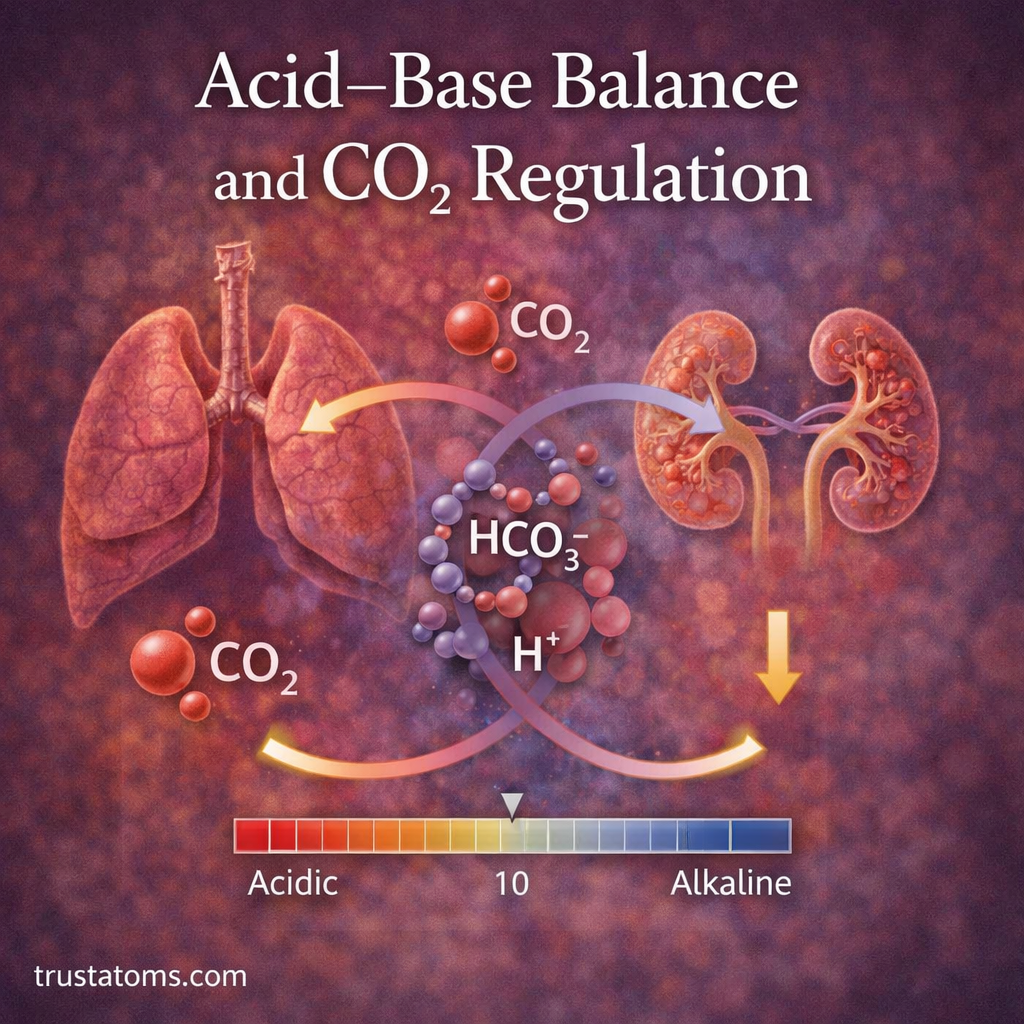
Acid–base balance is the process of maintaining the body’s hydrogen ion concentration within a narrow range so cells and organs can function normally. Carbon dioxide (CO₂) helps regulate this balance because changes in its concentration affect blood acidity, while the lungs and kidneys work together to stabilize pH.
In human anatomy, acid–base regulation connects the respiratory, circulatory, and urinary systems. The lungs adjust how much CO₂ leaves the body, while the kidneys regulate bicarbonate and hydrogen ions to provide longer-term control.
These adjustments occur continuously, including during exercise, sleep, and changes in breathing. They help keep arterial blood pH near its normal range of 7.35–7.45.
What Is Acid–Base Balance?
Acid–base balance refers to the regulation of hydrogen ion concentration in body fluids. The pH scale expresses this concentration: lower pH means greater acidity, while higher pH means lower acidity.
Normal arterial blood pH is approximately 7.35–7.45, making it slightly alkaline. A pH below 7.35 indicates acidemia, while a value above 7.45 indicates alkalemia. Significant disturbances can interfere with enzyme activity, nerve signaling, and muscle function.
Carbon dioxide produced by cells travels through the bloodstream to the lungs. Carbon Dioxide Transport in Blood explains how CO₂ moves in dissolved form, bound to proteins, and primarily as bicarbonate.
Removing CO₂ through breathing is one of the body’s fastest methods of adjusting acidity. Carbon Dioxide Removal and Ventilation examines how airflow and gas exchange influence this process.
The Role of CO₂ in pH Regulation
Carbon dioxide is produced during cellular metabolism and enters the blood from body tissues. Some dissolved CO₂ reacts with water to form carbonic acid, which can dissociate into hydrogen ions and bicarbonate ions.
The reversible reaction can be summarized as CO₂ + H₂O ⇌ H₂CO₃ ⇌ H⁺ + HCO₃⁻. An enzyme called carbonic anhydrase accelerates the conversion between CO₂ and carbonic acid, particularly within red blood cells.
When CO₂ rises while other conditions remain constant, the reaction shifts toward greater hydrogen ion production, lowering pH. When CO₂ falls, hydrogen ion concentration tends to decrease and pH rises.
Acid–base regulation also depends on kidney function, electrolyte handling, and circulation. Blood Volume Regulation and Homeostasis provides related context about how the kidneys help maintain the body’s internal fluid environment.
How the Bicarbonate Buffer System Works
The carbonic acid–bicarbonate buffer system helps resist sudden changes in blood pH. Bicarbonate can accept hydrogen ions, while the carbonic acid system can release them as chemical conditions change.
Its effectiveness depends on two components that the body can regulate separately: dissolved CO₂, influenced mainly by the lungs, and bicarbonate, controlled largely by the kidneys.
Other buffers, including hemoglobin and intracellular proteins, also help stabilize pH. Buffers act rapidly, but they do not permanently eliminate excess acid or carbon dioxide; respiratory and renal processes are needed for ongoing regulation.
The Role of the Respiratory System
The respiratory system changes blood CO₂ levels by adjusting alveolar ventilation, the movement of fresh air into the gas-exchanging regions of the lungs.
- Increased alveolar ventilation: Removes CO₂ more rapidly, generally lowering arterial CO₂ and raising pH if bicarbonate remains unchanged.
- Decreased alveolar ventilation: Retains CO₂, generally increasing arterial CO₂ and lowering pH if bicarbonate remains unchanged.
Breathing adjustments can begin within seconds to minutes. At high altitude, reduced oxygen availability stimulates ventilation, which can initially lower CO₂ and raise blood pH. Respiratory Adaptations at High Altitude explains how breathing and kidney responses change during acclimatization.
The Role of the Kidneys
The kidneys provide sustained acid–base regulation by recovering filtered bicarbonate, excreting hydrogen ions, and generating new bicarbonate to replace what is consumed when acids are buffered.
Hydrogen ions can be eliminated in urine with phosphate buffers or as ammonium. These mechanisms allow the body to remove nonvolatile acids that cannot be exhaled through the lungs.
Renal compensation develops over hours to days, making it slower than respiratory adjustments but essential for maintaining balance during prolonged disturbances.
Four Types of Acid–Base Imbalance
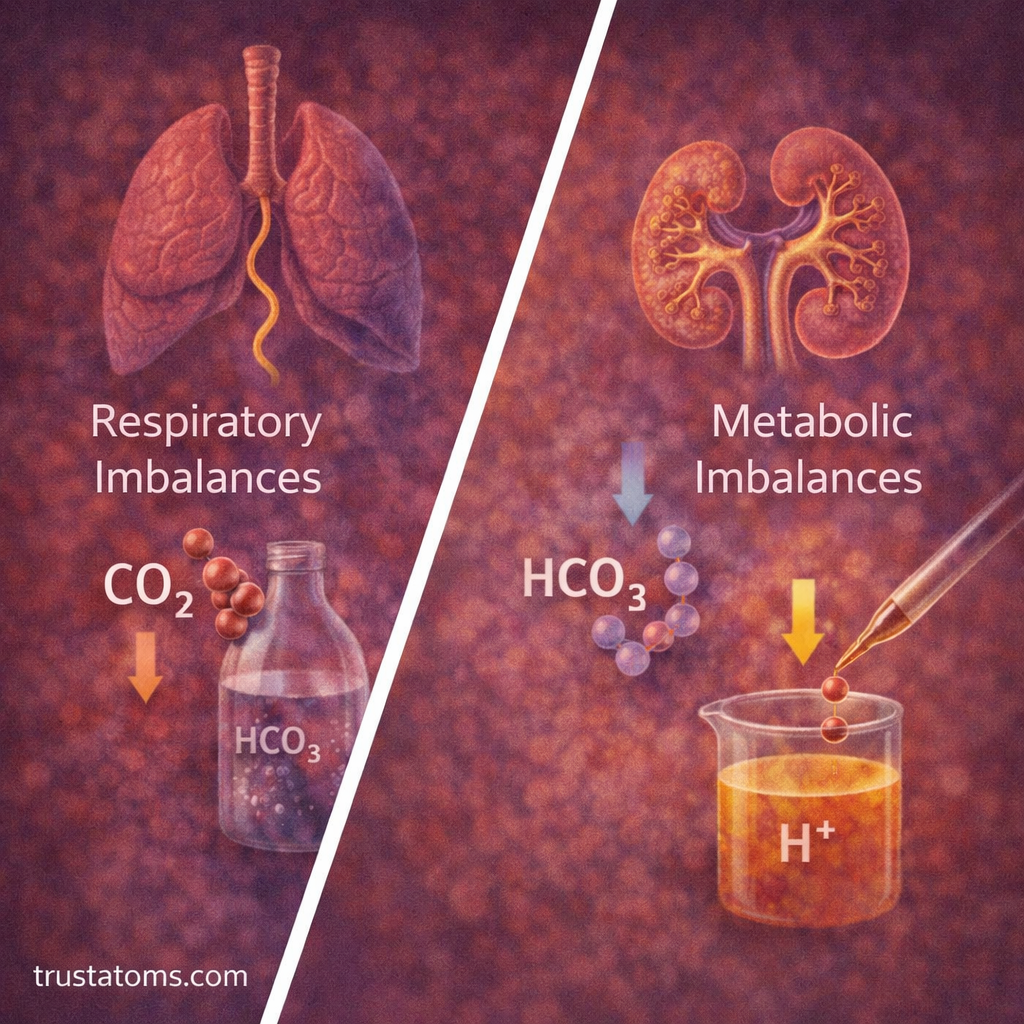
Acid–base disorders are classified according to whether the primary disturbance involves CO₂ or bicarbonate and other metabolic acids or bases. The body may partially compensate, but compensation does not necessarily restore normal pH.
| Disorder | Primary Change | Possible Cause |
|---|---|---|
| Respiratory acidosis | Increased arterial CO₂ | Inadequate ventilation |
| Respiratory alkalosis | Decreased arterial CO₂ | Excessive ventilation |
| Metabolic acidosis | Reduced bicarbonate or excess nonvolatile acid | Diabetic ketoacidosis or severe diarrhea |
| Metabolic alkalosis | Increased bicarbonate relative to acid | Prolonged vomiting or certain diuretics |
Clinicians evaluate acid–base disturbances using measurements such as blood pH, arterial CO₂ pressure, bicarbonate, and other laboratory findings. A person can also have more than one acid–base disorder at the same time.
How Chemoreceptors Help Control Breathing
Chemoreceptors detect changes in CO₂ and pH, helping the nervous system adjust ventilation. Central chemoreceptors respond mainly to changes in the pH of fluid surrounding the brain, influenced by arterial CO₂, while peripheral chemoreceptors respond to arterial oxygen, CO₂, and pH.
Signals from these receptors influence respiratory centers in the brainstem. When CO₂ rises, ventilation usually increases, helping eliminate the excess. This feedback mechanism supports stable blood chemistry during changing metabolic demands.
Everyday Example: Rapid Breathing and Blood pH
Imagine a person who begins breathing unusually quickly during an episode of anxiety. If their alveolar ventilation increases beyond what is needed to remove the CO₂ their body produces, arterial CO₂ pressure may fall.
For illustration, a normal arterial CO₂ pressure is approximately 40 mmHg. If it falls to 30 mmHg while bicarbonate initially remains near 24 mmol/L, the bicarbonate buffer relationship predicts a rise in pH. The precise pH depends on the person’s physiological state and any compensatory changes.
The resulting respiratory alkalosis can contribute to lightheadedness or tingling sensations. Similar symptoms can have other causes, so they should not automatically be attributed to anxiety or treated by deliberately restricting breathing.
Frequently Asked Questions
How Does Carbon Dioxide Affect Blood pH?
Carbon dioxide participates in a reversible chemical reaction that produces hydrogen ions and bicarbonate. When CO₂ increases without a matching compensatory change, blood pH generally falls; when CO₂ decreases, pH generally rises.
What Is the Normal pH of Human Blood?
Normal arterial blood pH is approximately 7.35–7.45. Values outside this range indicate acidemia or alkalemia and require interpretation alongside other clinical findings.
How Do the Lungs and Kidneys Work Together to Regulate pH?
The lungs adjust CO₂ removal through ventilation, providing relatively rapid control. The kidneys regulate bicarbonate and hydrogen ion excretion over longer periods, helping compensate for sustained acid–base disturbances.
Acid–base balance depends on coordinated control of carbon dioxide, bicarbonate, and hydrogen ions. The lungs can change CO₂ levels quickly, while the kidneys provide longer-term adjustments that help maintain the narrow pH range required for normal cellular function.
This article is for general education and is not medical advice. Talk to a qualified health professional about any medical concern.
Sources: OpenStax, Anatomy and Physiology 2e; Guyton and Hall Textbook of Medical Physiology; National Center for Biotechnology Information, Bookshelf.