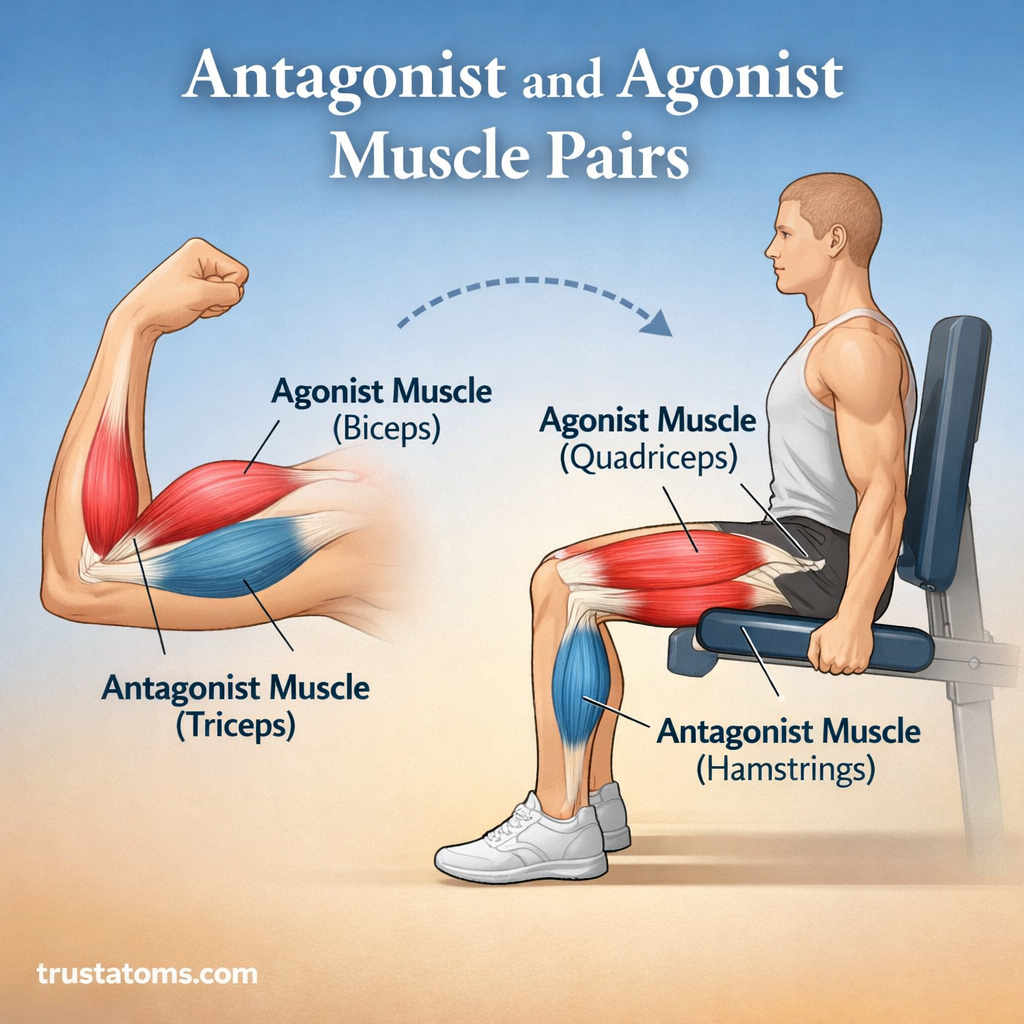
Agonist and antagonist muscle pairs are muscles that produce opposing actions at a joint, allowing the body to move in different directions and control those movements. The agonist is the primary muscle producing a particular action, while the antagonist opposes that action or helps control it, with their roles changing when the direction of movement changes.
In human anatomy, the biceps and triceps provide a familiar example: one helps bend the elbow, while the other helps straighten it. Similar relationships occur throughout the body during walking, lifting, reaching, and maintaining posture.
What Are Agonist and Antagonist Muscles?
Muscles generate force by contracting and pulling on their attachments. Because skeletal muscles cannot actively push bones apart, movements in opposite directions generally require different muscles or muscle groups.
Agonist Muscles: Producing a Movement
An agonist is a muscle that produces a particular joint action. The muscle contributing most prominently to that action is often called the prime mover.
During a typical biceps curl, the biceps brachii helps flex the elbow by generating force that brings the forearm toward the upper arm. Other elbow flexors, including the brachialis and brachioradialis, also contribute.
Antagonist Muscles: Opposing or Controlling Movement
An antagonist produces an action opposite to that of the agonist. During elbow flexion, the triceps brachii is an antagonist because its primary elbow action is extension.
The antagonist does not always become completely inactive. It may remain slightly active to stabilize the joint or contract to slow a movement. Understanding these changing roles helps explain coordination between muscles and joints.
Muscle forces also create turning effects around joints, a mechanical principle described in torque production at joints. During tasks such as reaching for a cup, the relationship between opposing muscle groups becomes part of the broader mechanics of the upper limb, explored in upper limb mechanics in reaching.
How Muscle Pairs Work Together
Agonist and antagonist muscles coordinate their forces to produce movement while controlling its speed and direction. Their activity depends on the task, the load being moved, and whether the body is accelerating, slowing, or holding a position.
During a simple elbow-bending movement, the nervous system increases activation of the elbow flexors while reducing unnecessary resistance from the extensors. When the elbow straightens actively, the triceps can become the prime mover and the elbow flexors become antagonists.
This coordination depends on the arrangement of muscle fibers, tendons, and connective tissues described in skeletal muscle structure and function.
Movement also involves synergists, muscles that assist an agonist or prevent unwanted motion. The nervous system organizes these contributions into coordinated patterns, as explained in muscle synergies in coordinated motion.
Common Examples of Agonist and Antagonist Muscle Pairs
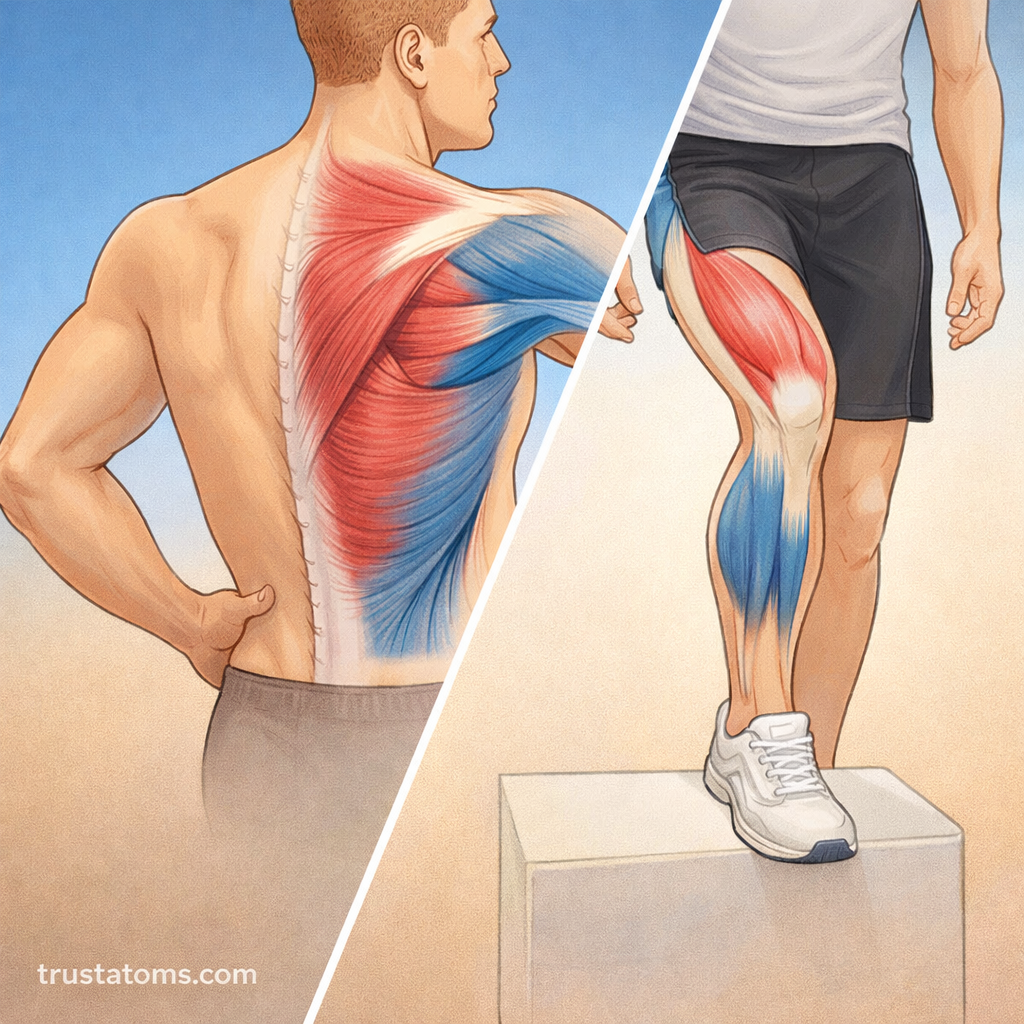
Different muscle groups take opposing roles depending on the movement being performed. The following examples describe common actions under conditions where the muscles actively produce the movement.
| Joint Movement | Main Agonist | Antagonist |
|---|---|---|
| Elbow flexion | Biceps brachii and other elbow flexors | Triceps brachii |
| Elbow extension | Triceps brachii | Elbow flexors |
| Knee extension | Quadriceps femoris | Hamstrings |
| Knee flexion | Hamstrings | Quadriceps femoris |
| Ankle plantarflexion | Gastrocnemius and soleus | Tibialis anterior |
| Ankle dorsiflexion | Tibialis anterior | Plantarflexor muscles |
These relationships are useful examples rather than fixed assignments. During complex activities, multiple muscles contribute, and a muscle may serve as an agonist, antagonist, or stabilizer at different moments.
An Everyday Example: Lifting and Lowering a Grocery Bag
Imagine holding a grocery bag and bending your elbow to lift it toward your shoulder. The elbow flexors generate force to overcome the downward torque created by the bag’s weight and move the forearm upward.
Now slowly lower the bag. Although the elbow is extending, the elbow flexors may remain active while lengthening under tension. This is called an eccentric contraction, and it allows the muscles to control the descent rather than letting gravity pull the bag downward abruptly.
The example shows why the agonist is not necessarily the muscle that shortens. Muscle roles depend on which forces are producing or controlling the movement, not simply on whether the joint is bending or straightening.
How the Nervous System Coordinates Opposing Muscles
Motor commands from the nervous system activate muscle fibers through motor neurons. Sensory information from muscles, tendons, and joints helps the nervous system adjust those commands as movement occurs.
One coordinating mechanism is reciprocal inhibition. When a muscle is activated, spinal neural circuits can reduce activity in its antagonist, making the intended movement easier.
However, reciprocal inhibition does not mean opposing muscles can never contract together. Co-contraction, in which agonist and antagonist muscles are active simultaneously, can increase joint stiffness and help maintain stability during demanding or precise tasks.
Why Opposing Muscle Actions Support Joint Stability
Joint movement requires a balance between producing sufficient force and avoiding unnecessary motion. Agonists, antagonists, and stabilizing muscles contribute to this balance in several ways.
- Movement control: Opposing muscles can accelerate, decelerate, or stop a moving limb.
- Joint stability: Coordinated muscle tension helps maintain joint position under changing loads.
- Postural adjustments: Muscle groups continually adjust their activity to support standing, sitting, and balance.
- Precise actions: Controlled opposing forces help regulate movements such as writing, grasping, and placing objects.
These functions depend on timing and coordination as well as strength. Strong muscles alone do not guarantee smooth or stable movement.
What Happens When Muscle Coordination Is Disrupted?
Weakness, injury, pain, reduced mobility, or neurological conditions can change how opposing muscles work together. Depending on the cause, a person may experience limited range of motion, reduced strength, difficulty controlling movement, or joint instability.
For example, weakness in the ankle dorsiflexors can make it difficult to lift the front of the foot while walking. This may interfere with toe clearance during the swing phase of gait.
Not every difference in strength between opposing muscle groups is abnormal. Muscles have different anatomical functions and naturally produce different amounts of force. Clinical assessment considers symptoms, movement quality, and functional ability rather than assuming every strength difference causes injury.
Training Agonist and Antagonist Muscle Groups
A well-rounded exercise program includes movements that train opposing actions at major joints. This helps develop strength and control across a useful range of motion.
- Elbow: Biceps curls and triceps extensions train opposing elbow actions.
- Knee: Leg extensions and hamstring curls emphasize opposing knee movements.
- Upper body: Pressing and rowing exercises train different combinations of shoulder and elbow muscles.
- Ankle: Calf raises and controlled toe raises strengthen plantarflexion and dorsiflexion.
Exercise selection should account for individual mobility, experience, and physical limitations. Training both directions of movement is useful, but the two sides do not necessarily require identical loads or repetitions.
Frequently Asked Questions
Do agonist and antagonist muscles always work in pairs?
Opposing muscle actions are common throughout the body, but movement usually involves more than two muscles. Several agonists, antagonists, synergists, and stabilizers may contribute to a single joint action.
Can agonist and antagonist muscles contract at the same time?
Yes. Simultaneous activation, called co-contraction, can help stabilize a joint or control movement under load. It is especially useful when the body needs additional stiffness or precision.
Do muscles switch roles when movement reverses?
Often they do during active movements in opposite directions. However, when gravity or an external load drives the motion, a muscle may remain active while lengthening to control it, so the relationship is more complex than simply switching with joint direction.
Agonist and antagonist relationships explain how muscles produce opposing joint actions while cooperating to control speed, direction, and stability. The biceps and triceps illustrate this principle at the elbow, but walking, lifting, and maintaining posture require coordinated activity across many muscle groups. Understanding both active movement and controlled muscle lengthening provides a more accurate picture of how the body moves.
This article is for general education and is not medical advice. Talk to a qualified health professional about any medical concern.
Sources: Gray’s Anatomy for Students; Guyton and Hall Textbook of Medical Physiology; Neumann’s Kinesiology of the Musculoskeletal System.