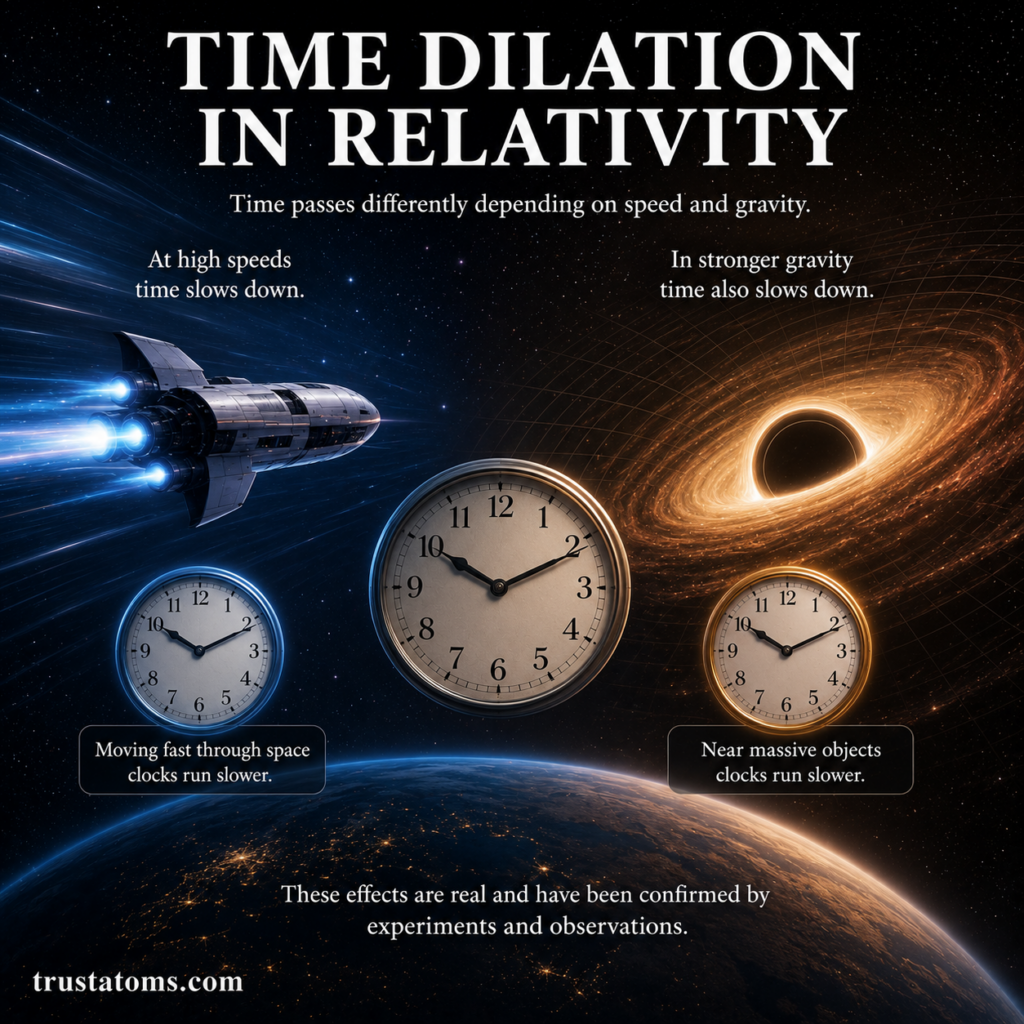
Time dilation in relativity occurs because clocks can measure different amounts of elapsed time depending on their relative motion and the gravitational conditions they experience. According to Albert Einstein’s theories of relativity, a rapidly moving clock can accumulate less time than another clock, while a clock deeper in a gravitational field runs more slowly than one farther away.
Time feels constant in everyday life, but physics shows that it is not universal. According to Einstein’s theories of relativity, time can slow down depending on speed and gravity. This phenomenon is called time dilation, and its effects extend from laboratory experiments to the objects studied in modern astronomy.
Scientists have confirmed these predictions using atomic clocks, fast-moving particles, and satellite navigation systems. The same principles also help explain time dilation in cosmology, where the timing of distant astronomical events provides information about the expanding universe.
What Is Time Dilation in Relativity?
Time dilation is the difference in elapsed time measured along different paths through spacetime or under different gravitational conditions. Two accurate clocks can begin together, follow different journeys, and show different readings when compared again.
Relativity describes two main forms of time dilation:
- Velocity time dilation: Special relativity describes how relative motion affects measured time intervals.
- Gravitational time dilation: General relativity describes how differences in gravitational potential affect clock rates.
Neither effect means a person feels their own time slowing down. Every observer experiences their local clock ticking normally. Differences emerge when measurements are compared between observers.
How Special Relativity Explains Moving Clocks
Einstein introduced special relativity in 1905. His theory begins with two principles: the laws of physics are identical in all inertial reference frames, and the speed of light in a vacuum is the same for every inertial observer.
An inertial reference frame is one that is not accelerating. Observers moving at constant velocities relative to one another can disagree about elapsed time and distance while still measuring the same speed of light.
The Velocity Time Dilation Formula
For two events occurring at the same location in a moving clock’s reference frame, special relativity gives the relationship:
Δt = Δτ / √(1 − v²/c²)
Here, Δτ is the proper time measured by the clock traveling between the events, Δt is the corresponding interval measured in another inertial frame, v is their relative speed, and c is the speed of light in a vacuum.
As relative speed increases, the difference between the measured intervals becomes larger. At ordinary human speeds, the effect is extremely small.
Example: A Spacecraft Traveling at 80% of Light Speed
Imagine a spacecraft traveling at 80% of the speed of light relative to Earth. At this speed, the time dilation factor is approximately 1.67.
If 10 years pass on Earth between the spacecraft’s departure and arrival at a distant destination, as measured in Earth’s reference frame, approximately 6 years pass aboard the spacecraft during that constant-speed journey.
The astronauts experience those six years normally. Their clocks, biological processes, and daily activities proceed at ordinary rates from their perspective. The difference becomes apparent when the two elapsed-time measurements are compared.
Why the Speed of Light Sets the Limit
The speed of light in a vacuum is approximately 299,792 kilometers per second. According to special relativity, an object with mass cannot be accelerated to this speed because doing so would require unlimited energy.
Maintaining the same measured light speed across inertial reference frames requires space and time measurements to be related in ways that differ from everyday expectations.
These relationships produce time dilation, length contraction, and the relativity of simultaneity. They are connected consequences of spacetime geometry rather than separate adjustments made to individual clocks.
The Twin Paradox: Why One Twin Ages Less
The twin paradox illustrates how different journeys through spacetime can produce different amounts of elapsed time.
Imagine identical twins. One remains on Earth while the other travels toward a distant star at a speed approaching that of light, turns around, and returns home.
When they reunite, the traveling twin has aged less. Although each twin measures their own time normally, their paths through spacetime are different.
The apparent paradox comes from treating the journeys as symmetrical. The traveling twin changes direction and switches inertial reference frames, while the Earth-bound twin approximately remains in one frame. Calculating the proper time along each journey resolves the apparent contradiction.
Experimental Evidence That Moving Clocks Run Differently
Muon Lifetime Experiments
Muons are unstable particles produced when cosmic rays interact with Earth’s atmosphere. A muon at rest has an average lifetime of approximately 2.2 microseconds before decaying.
Many atmospheric muons travel close to light speed. From Earth’s reference frame, their decay processes are time-dilated, allowing more muons to reach the surface than would be expected without relativity.
Measurements of these particles provide experimental confirmation of special relativity.
Atomic Clocks on Aircraft
In 1971, physicists Joseph Hafele and Richard Keating flew atomic clocks aboard commercial aircraft traveling around Earth.
Afterward, the airborne clocks were compared with clocks that remained on the ground. Their readings differed by tiny amounts consistent with predictions accounting for both motion and gravity.
Modern atomic clocks can detect even smaller relativistic differences, including those caused by modest changes in elevation.
How Gravity Changes the Passage of Time
Einstein’s general theory of relativity, completed in 1915, describes gravity through the geometry of spacetime. Matter and energy influence that geometry, affecting how objects move and how clocks measure time.
Gravitational time dilation means a clock deeper in a gravitational field generally runs more slowly than a comparable clock at a higher gravitational potential.
For example, an atomic clock at sea level runs slightly more slowly than an equivalent clock at the top of a mountain. The difference is too small for ordinary clocks to reveal easily, but sufficiently precise instruments can measure it.
The Gravitational Time Dilation Equation
Outside a spherical, nonrotating mass, the Schwarzschild solution provides a relationship for a stationary clock compared with a distant stationary observer:
Δτ = Δt × √(1 − 2GM/rc²)
In this equation, Δτ represents proper time for the clock at radius r, Δt represents the corresponding time interval far from the mass, G is the gravitational constant, M is the mass, and c is the speed of light.
The equation applies outside a spherical, nonrotating mass under the stated conditions. Real astronomical systems may require more detailed calculations, particularly when rotation or orbital motion becomes significant.
Time Dilation Near Black Holes
Black holes create some of the strongest gravitational time dilation effects in the universe.
Near a black hole, spacetime curvature becomes extreme. A clock held stationary close to the event horizon of a nonrotating black hole would run much more slowly relative to a clock far away.
To a distant observer, light signals emitted from progressively closer to the horizon become increasingly delayed and gravitationally redshifted. However, an observer freely falling through the horizon of a sufficiently large black hole would not experience their own clock stopping there.
Extreme differences in elapsed time are theoretically possible near black holes, but the details depend on the observer’s trajectory, the black hole’s mass and rotation, and whether a stable orbit is available.
GPS Satellites: Time Dilation in Everyday Technology

The Global Positioning System provides a practical demonstration of both forms of time dilation. GPS satellites carry atomic clocks that must remain synchronized with the system’s time reference.
Two relativistic effects influence these clocks:
- Special relativity: Satellite motion makes onboard clocks run approximately 7 microseconds per day slower than comparable Earth-surface clocks.
- General relativity: Weaker gravity at satellite altitude makes their clocks run approximately 45 microseconds per day faster.
The combined effect is approximately 38 microseconds per day faster for GPS satellite clocks. Although this difference seems insignificant, failing to account for it would cause navigation errors to accumulate by roughly 10 kilometers per day.
GPS incorporates relativistic corrections into its clock design and navigation calculations, demonstrating that relativity is necessary for accurate satellite positioning.
Time Dilation and Space Travel
Time dilation becomes especially significant when considering spacecraft traveling at substantial fractions of light speed. Astronauts aboard such spacecraft could experience much less elapsed time than people remaining on Earth.
The relationship between motion, distance, and elapsed time becomes clearer through Space-Time and Relativity Basics, which explains how different observers measure events.
Gravity also influences spacecraft trajectories and clock measurements. Understanding Space-Time Curvature helps explain how massive objects affect the paths followed by matter and light.
Relativistic travel could theoretically allow astronauts to cross enormous distances while experiencing comparatively little time. However, accelerating a spacecraft to such speeds would demand extraordinary amounts of energy.
These engineering obstacles, along with radiation exposure, propulsion limitations, and long-duration mission requirements, are examined in Interstellar Travel Physics Challenges.
Relativity of Simultaneity and Spacetime
Time dilation is connected to another prediction of special relativity: observers moving relative to one another may disagree about whether two distant events occurred simultaneously.
For example, two lightning strikes that appear simultaneous in one inertial reference frame may occur at different coordinate times in another. Neither observer is necessarily mistaken; simultaneity depends on the reference frame used to assign times to distant events.
Mathematician Hermann Minkowski developed a four-dimensional description combining three dimensions of space with one dimension of time. This framework allows physicists to describe events, motion, and elapsed time within a unified spacetime geometry.
How Astronomers Observe Relativistic Effects
Relativity helps astronomers interpret observations of objects moving at enormous speeds or located in intense gravitational fields.
Jets associated with actively accreting black holes can contain matter moving at relativistic speeds. Their observed brightness and apparent motion are influenced by relativistic effects, including Doppler boosting and light-travel-time differences.
Gravity also changes the frequency of light escaping massive objects, producing gravitational redshift. This effect is closely connected to gravitational time dilation because the frequency of light can serve as a measure of clock rates.
These observations allow researchers to test predictions of relativity beyond the conditions available in terrestrial laboratories.
Frequently Asked Questions
Does time actually slow down, or do clocks just behave differently?
Time dilation is not merely a mechanical effect on clocks. Atomic processes, particle decay, and other physical processes follow the same relativistic relationships. Clocks measure elapsed time along their paths through spacetime, and those elapsed times can genuinely differ.
Can time dilation make someone travel into the future?
Yes, in the sense that a traveler moving at relativistic speeds can experience less elapsed time than people on Earth. Returning after such a journey would mean arriving in Earth’s future having aged less. This does not demonstrate that travel backward into the past is possible.
Is gravitational time dilation happening on Earth?
Yes. Clocks at different elevations experience slightly different gravitational conditions and accumulate time at different rates. The differences are extremely small over ordinary distances, but modern atomic clocks can measure them, confirming predictions of general relativity.
Time dilation demonstrates that elapsed time depends on the path an observer follows through spacetime, including motion and gravitational conditions. Measurements involving atomic clocks, atmospheric muons, and GPS satellites confirm these predictions, while observations near compact astronomical objects test relativity under more extreme conditions. The same physics that keeps satellite navigation accurate also explains why future high-speed space travelers could age differently from people remaining on Earth.
Sources: Albert Einstein, Relativity: The Special and the General Theory; National Institute of Standards and Technology (NIST), research and educational resources on atomic clocks and relativity; Neil Ashby, Relativity in the Global Positioning System, Living Reviews in Relativity.