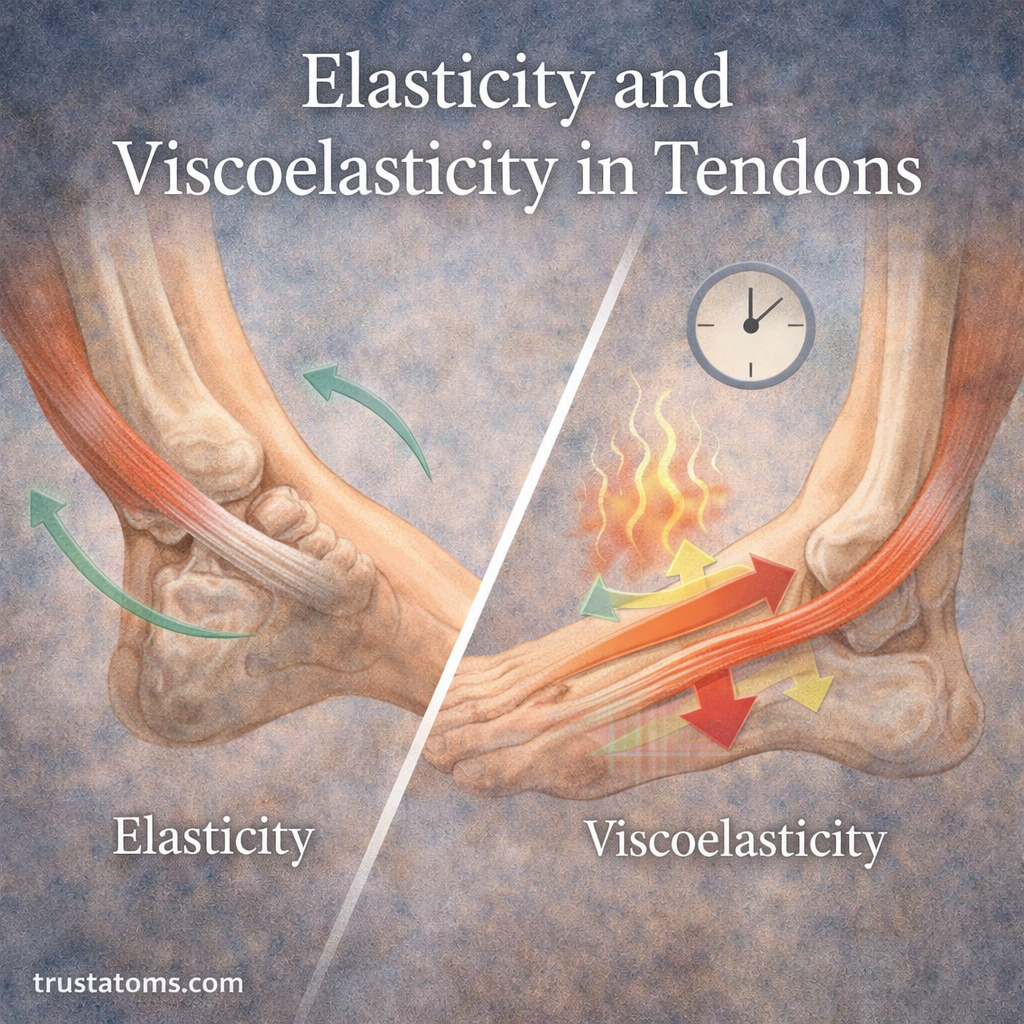
Tendon elasticity is the ability to deform under force and recover its original shape when the force is removed, while viscoelasticity describes how tendon deformation and recovery depend on loading speed and duration. Together, these mechanical properties allow tendons to transmit muscle forces, store and release elastic energy, and respond to repeated movements such as walking, running, and jumping.
These properties reflect the specialized structure of tendons and illustrate how tissue organization influences movement in human anatomy. Understanding their differences helps explain why tendons behave like springs during rapid movement but respond differently when stretched or loaded for longer periods.
What Are Tendons?
Tendons are strong, flexible tissues that connect muscles to bones, enabling movement and force transmission throughout the body.
Tendons are dense connective tissues made primarily of collagen fibers.
When a muscle contracts, its tendon transfers tension to the attached bone, helping produce movement around a joint. The relationship between muscle force, tendon attachment, and joint rotation is explained in Torque Production at Joints.
Because tendons must handle repeated mechanical stress, their structure is designed for both strength and controlled flexibility.
Understanding Elasticity in Tendons
Elasticity describes a material’s ability to recover its shape after deformation. When tension stretches a tendon within its recoverable range, energy is stored in the tissue and can be released as the tendon recoils.
This behavior resembles a spring, although biological tendons are not perfectly elastic. Some mechanical energy is dissipated during each loading and unloading cycle.
Elastic tendon behavior supports several functions:
- Force transmission: Transfers muscular tension to bones while allowing controlled deformation.
- Energy storage: Temporarily stores mechanical energy when stretched.
- Energy return: Releases stored energy during recoil, contributing to efficient movement.
Elastic recovery occurs when loading remains within the tendon’s physiological limits. Excessive force can damage collagen fibers and cause deformation that does not fully recover.
What Is Viscoelasticity in Tendons?
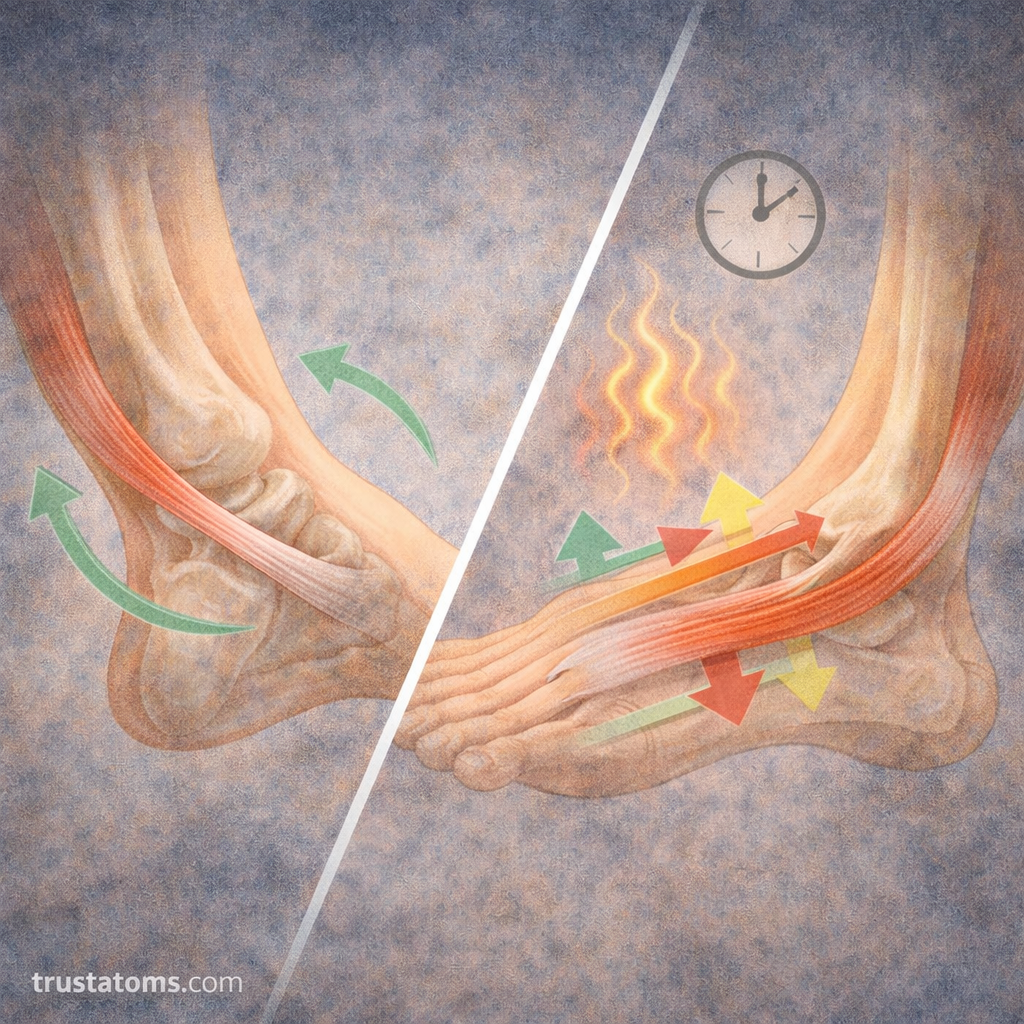
Viscoelasticity combines elastic recovery with time-dependent mechanical behavior. A tendon’s response depends not only on how much force is applied but also on how quickly the force increases and how long it remains.
Unlike an ideal elastic spring, a tendon can gradually lengthen under a sustained load or require less force to maintain a fixed stretch over time. These responses arise from interactions among collagen fibers, water, and other components of the extracellular matrix.
Four Viscoelastic Behaviors of Tendons
Creep: Gradual Lengthening Under Constant Force
Creep occurs when a tendon continues to elongate gradually while a constant tensile load is maintained. The initial stretch is followed by additional time-dependent deformation.
For example, a sustained mechanical load may cause a small increase in tendon length even though the applied force remains unchanged. Creep does not necessarily mean permanent stretching; recovery depends on the magnitude and duration of loading.
Stress Relaxation: Declining Force at a Fixed Length
Stress relaxation occurs when a tendon is stretched to a fixed length and held there. The internal tension gradually decreases despite the tendon remaining at approximately the same length.
This differs from creep: during creep, force stays constant while length changes; during stress relaxation, length stays constant while force decreases.
Hysteresis: Energy Lost During Loading and Unloading
Hysteresis describes the difference between the energy absorbed during tendon stretching and the energy returned during recoil. Some energy is dissipated, largely as heat, because the tissue is viscoelastic rather than perfectly elastic.
Lower hysteresis generally means a greater proportion of stored mechanical energy can be returned during movement, although actual tendon behavior varies with loading conditions and tissue properties.
Strain Rate Sensitivity: Response to Stretching Speed
Strain rate describes how quickly a material changes length relative to its original length. Tendons generally show greater stiffness when loaded rapidly than when loaded slowly under comparable conditions.
This behavior influences force transmission during sudden movements. However, rapid loading can also produce high internal forces, so greater stiffness does not automatically prevent injury.
Elasticity vs. Viscoelasticity: Main Differences
| Property | Elasticity | Viscoelasticity |
|---|---|---|
| Response to force | Deformation depends on applied load | Depends on load and time |
| Recovery | Idealized immediate recovery | Recovery may be delayed |
| Energy | Ideally stored and fully returned | Some energy is dissipated |
| Loading speed | No rate dependence in an ideal elastic material | Mechanical response varies with rate |
| Examples | Spring-like recoil | Creep, relaxation, hysteresis |
Real tendons display both behaviors simultaneously. Elasticity explains their capacity to store and return energy, while viscoelasticity explains why that response changes with time and loading conditions.
How Tendon Structure Determines Mechanical Behavior
Tendon properties arise from a hierarchical arrangement of collagen molecules, fibrils, fibers, and larger bundles. Type I collagen provides much of the tensile strength needed to resist pulling forces.
At rest, collagen fibers have a slightly wavy arrangement called crimp. Under initial tension, these waves straighten before the tissue becomes substantially stiffer. This contributes to the curved initial region of the tendon stress-strain relationship.
Water and extracellular matrix components, including proteoglycans, influence how fibers interact and how the tissue responds over time. Tendon stiffness also depends on dimensions and material properties, not simply collagen content.
Example: How the Achilles Tendon Stores Energy While Running
Consider a runner landing on one foot. As the ankle moves under load, the calf muscles and Achilles tendon experience tension. The tendon elongates slightly, storing elastic energy while helping control ankle movement.
During push-off, the Achilles tendon recoils and returns part of that stored energy, contributing to forward propulsion. This spring-like action can reduce the amount of mechanical work that muscle fibers must perform during certain phases of running.
Because the tendon is viscoelastic, not all stored energy is recovered. The amount returned depends on tendon properties, loading conditions, and movement mechanics.
How Tendons Adapt to Repeated Mechanical Loading
Tendons are living tissues containing cells called tenocytes that maintain and remodel the extracellular matrix. Appropriate repeated loading can stimulate adaptations in tendon structure and mechanical properties.
Progressive resistance training may increase tendon stiffness and improve its ability to transmit force. These changes develop gradually and depend on training intensity, frequency, recovery, and individual characteristics.
In contrast, prolonged inactivity can reduce tendon mechanical capacity. Excessive loading without sufficient recovery may contribute to tendon pain or tendinopathy, a condition involving changes in tendon structure and function.
Role in Movement and Performance
Tendon elasticity helps store and release mechanical energy during walking, running, and jumping. Viscoelasticity influences how forces develop, how energy is dissipated, and how tendons respond to repeated loading cycles.
Other connective tissues also contribute to movement mechanics. The Role of Fascia in Movement explains how surrounding connective tissue helps organize and transmit forces throughout the musculoskeletal system.
Greater tendon stiffness can improve force transmission in some activities, but optimal mechanical properties vary by tendon and task. A tendon must tolerate loading while maintaining sufficient capacity for controlled deformation.
Factors That Influence Tendon Elasticity and Stiffness
- Age: Aging can change collagen organization, cross-linking, and tendon mechanical behavior, although effects vary among tendons.
- Activity level: Regular progressive loading supports tendon adaptation, while prolonged unloading can reduce mechanical capacity.
- Temperature: Tissue temperature can influence viscoelastic responses, but warming does not guarantee protection against injury.
- Health and nutrition: Adequate nutrients support normal collagen maintenance and tissue repair, while certain metabolic conditions can alter tendon properties.
Frequently Asked Questions
What is the difference between tendon elasticity and viscoelasticity?
Elasticity describes a tendon’s ability to deform and recover when force is removed. Viscoelasticity describes the additional effects of time, loading speed, delayed recovery, and energy dissipation.
Do tendons become stronger when repeatedly stretched?
Tendons can adapt to appropriate mechanical loading, but stretching alone does not necessarily increase strength. Progressive resistance and other structured loading programs can stimulate changes in tendon stiffness and mechanical capacity over time.
Why are tendons compared to springs?
Tendons can store mechanical energy when stretched and release part of it during recoil, much like a spring. Unlike an ideal spring, however, their behavior is time-dependent and some energy is lost during each loading cycle.
Tendon elasticity allows muscle-generated forces to produce movement while storing and returning mechanical energy. Viscoelasticity adds time-dependent responses such as creep, stress relaxation, and hysteresis, which influence tendon behavior during sustained and repeated loading. Together, these properties explain how tendons combine strength, controlled deformation, and efficient force transmission across different activities.
This article is for general education and is not medical advice. Talk to a qualified health professional about any medical concern.
Sources: Nordin and Frankel’s Basic Biomechanics of the Musculoskeletal System; Gray’s Anatomy for Students; Journal of Applied Physiology.