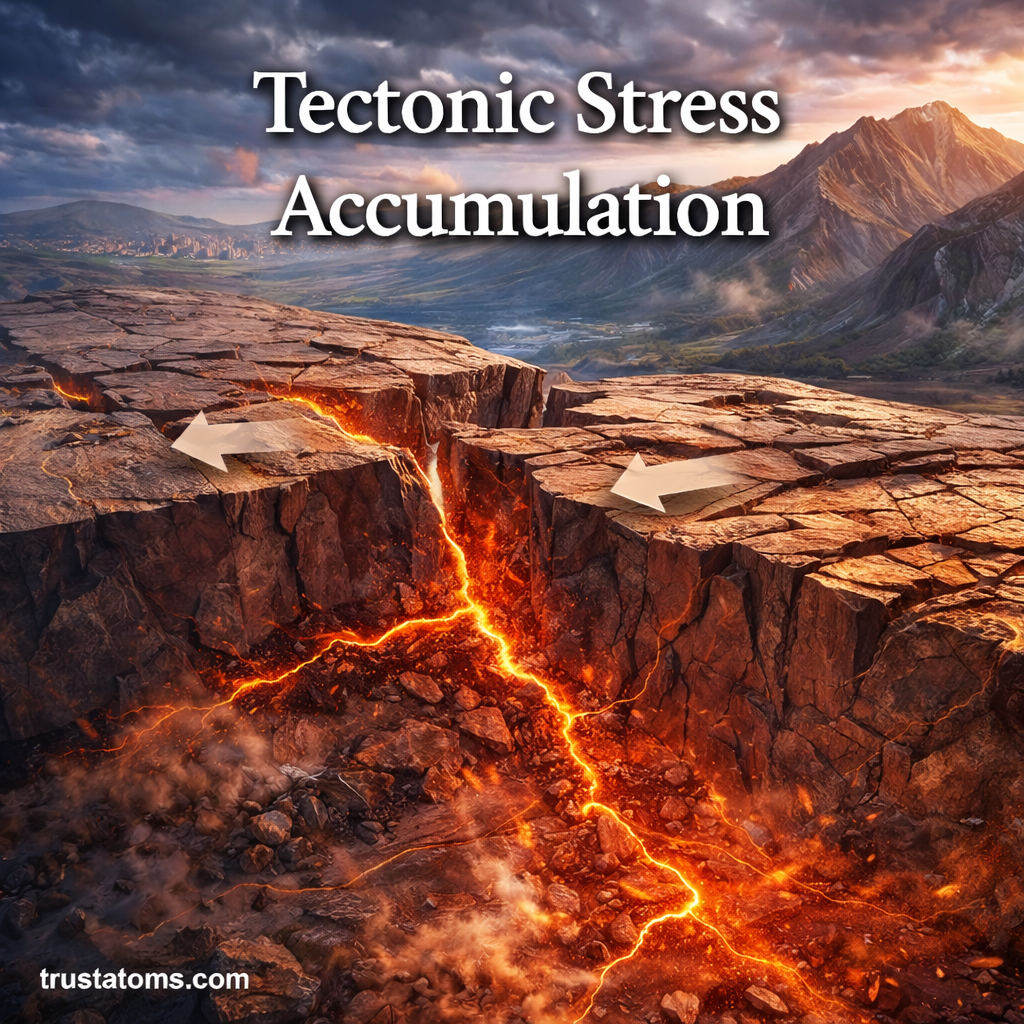
Beneath the Earth’s surface, enormous forces are constantly at work. Tectonic plates are always moving—slowly but relentlessly. As they interact, stress builds up over time. When that stress is suddenly released, it can result in earthquakes.
This process, known as tectonic stress accumulation, is a fundamental concept in Earth science and key to understanding seismic activity.
What Is Tectonic Stress Accumulation?
Tectonic stress accumulation refers to the gradual buildup of energy in the Earth’s crust due to the movement of tectonic plates.
Instead of moving smoothly, plates often become “locked” along fault lines. As they continue trying to move, stress increases until it exceeds the strength of the الصخور (rocks), causing a sudden release of energy.
This release produces seismic waves—what we experience as an earthquake.
How Tectonic Plates Move
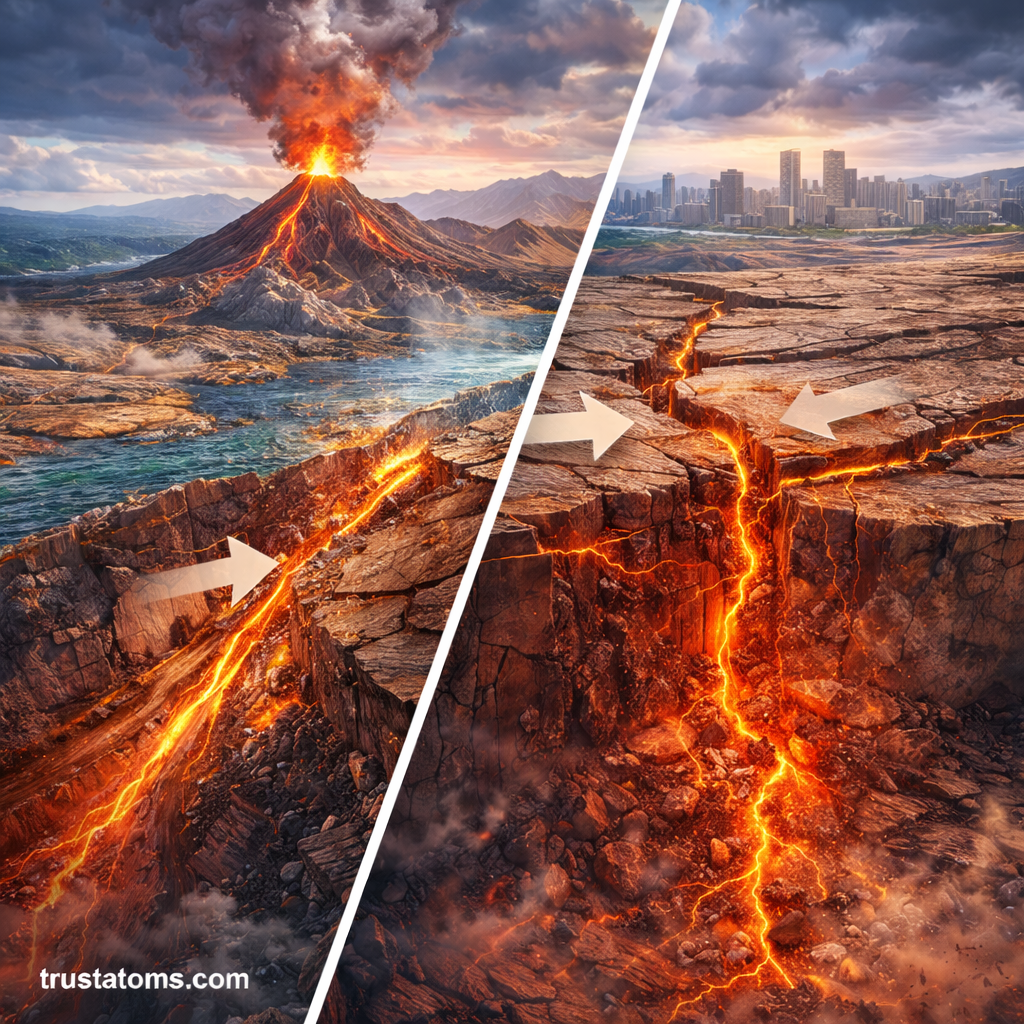
The Earth’s outer layer is divided into large sections called tectonic plates. These plates move at rates of a few centimeters per year.
There are three main types of plate boundaries:
1. Convergent Boundaries
- Plates move toward each other
- One plate may slide beneath another (subduction)
- High potential for powerful earthquakes
2. Divergent Boundaries
- Plates move apart
- Magma rises to create new crust
- Typically less intense earthquakes
3. Transform Boundaries
- Plates slide past each other horizontally
- Stress builds up along faults
- Sudden release can cause strong earthquakes
A well-known example is the San Andreas Fault in California.
The Elastic Rebound Theory
One of the key ideas explaining stress accumulation is the elastic rebound theory.
According to this theory:
- Tectonic plates become locked along a fault
- Stress builds as plates continue moving
- Rocks deform (bend) under pressure
- When stress exceeds strength, the fault slips
- Energy is released as seismic waves
This cycle repeats over time, leading to recurring earthquakes in the same regions.
Where Does Stress Build Up?
Tectonic stress does not accumulate evenly across the Earth. It tends to concentrate in specific areas.
Fault Lines
Faults are fractures in the Earth’s crust where movement occurs. Stress builds up along these weak points.
Plate Boundaries
The edges of tectonic plates are the most active zones for stress accumulation.
Subduction Zones
Where one plate dives beneath another, stress can build to extreme levels—often leading to the largest earthquakes on Earth.
Types of Tectonic Stress
There are three primary types of stress that affect rocks in the Earth’s crust:
1. Compression
- Rocks are pushed together
- Common at convergent boundaries
- Can cause folding or faulting
2. Tension
- Rocks are pulled apart
- Common at divergent boundaries
- Leads to thinning and cracking
3. Shear
- Rocks slide past each other
- Common at transform boundaries
- Causes horizontal displacement
From Stress to Earthquakes
Not all accumulated stress results in earthquakes right away. Sometimes, stress is released gradually.
Slow Release (Creep)
- Movement occurs slowly along faults
- Reduces the likelihood of large earthquakes
Sudden Release
- Stress builds until a breaking point
- Results in a rapid slip along the fault
- Produces seismic waves and ground shaking
The magnitude of an earthquake depends on how much stress has built up and how much is released.
Why Stress Accumulation Matters
Understanding tectonic stress accumulation is critical for several reasons:
Earthquake Prediction Efforts
While exact predictions are not yet possible, scientists use stress data to estimate:
- Likely earthquake zones
- Probability of future events
- Seismic hazards in specific regions
Infrastructure Planning
Knowledge of stress accumulation helps engineers:
- Design earthquake-resistant buildings
- Strengthen bridges and roads
- Improve urban planning in high-risk areas
Early Warning Systems
Monitoring stress and seismic activity contributes to early warning systems that can save lives.
How Scientists Measure Tectonic Stress
Studying stress deep within the Earth is challenging, but scientists use advanced tools to gather data.
Key Methods Include:
- GPS measurements to track plate movement
- Seismographs to detect small tremors
- Satellite imaging to observe ground deformation
- Rock sampling to analyze stress history
These tools help build models of how stress accumulates and is released over time.
Common Misconceptions
“Earthquakes happen randomly”
Earthquakes may seem random, but they are usually the result of long-term stress accumulation along faults.
“Small earthquakes prevent big ones”
Minor earthquakes do not always release enough stress to prevent larger events.
“We can predict earthquakes exactly”
Current science can identify risk zones, but precise timing and location predictions are still not possible.
Lessons From Tectonic Stress Accumulation
Studying this process provides valuable insights:
- Earth’s surface is constantly changing
- Stress builds silently over long periods
- Sudden releases can have major impacts
- Preparedness is essential in seismic regions
Final Thoughts
Tectonic stress accumulation is an invisible but powerful force shaping our planet. It reminds us that even slow, gradual processes can lead to sudden and dramatic events.
By understanding how stress builds and is released, scientists and communities can better prepare for earthquakes—reducing risk and protecting lives.