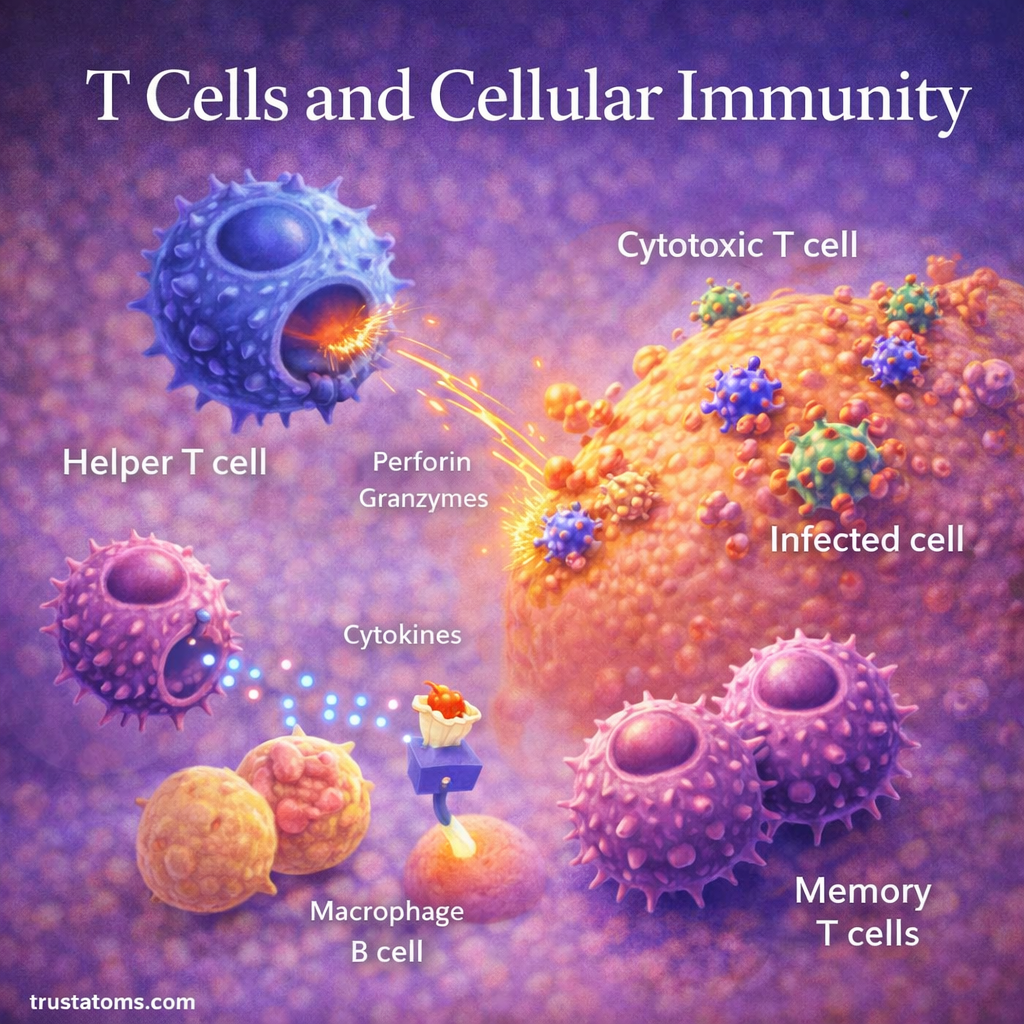
Your immune system has multiple ways to defend against disease. While antibodies handle many threats outside cells, T cells specialize in identifying and eliminating infected or abnormal cells from within. This process is known as cellular immunity.
T cells are a central part of adaptive immunity, providing precision, coordination, and long-term protection against specific pathogens.
What Are T Cells?
T cells (or T lymphocytes) are a type of white blood cell that develops in the thymus—hence the name “T.”
Core Functions
- Recognize infected or abnormal cells
- Coordinate immune responses
- Destroy harmful cells directly
- Support immune memory
Unlike other immune cells, T cells do not attack freely floating pathogens. Instead, they focus on cells that have already been infected or altered.
What Is Cellular Immunity?
Cellular immunity refers to immune responses that involve direct action by immune cells, rather than antibodies.
Key Characteristics
- Targets infected or cancerous cells
- Does not rely on antibodies
- Highly specific to particular antigens
- Involves T cell activation and response
This makes cellular immunity especially important for fighting viruses and intracellular bacteria.
Types of T Cells and Their Roles
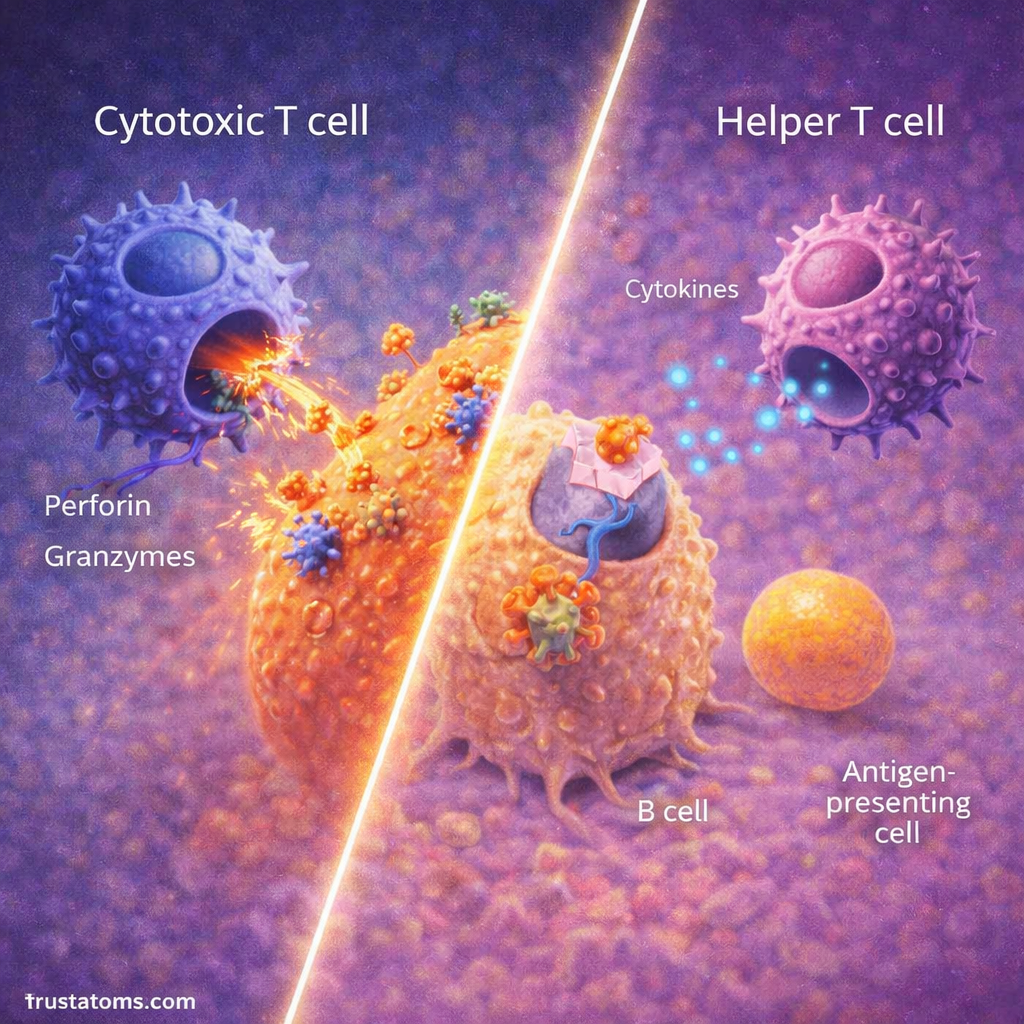
Different types of T cells perform specialized functions in the immune response.
Helper T Cells (CD4+)
- Coordinate immune activity
- Release signaling molecules called cytokines
- Activate B cells, macrophages, and cytotoxic T cells
Cytotoxic T Cells (CD8+)
- Directly kill infected or abnormal cells
- Recognize antigens presented on MHC Class I
- Release enzymes that trigger cell death
Regulatory T Cells (Tregs)
- Prevent excessive immune responses
- Maintain immune system balance
- Reduce risk of autoimmunity
Memory T Cells
- Remain in the body after infection
- Provide faster responses upon re-exposure
- Enable long-term immunity
How T Cells Recognize Threats
T cells rely on antigen presentation to identify which cells are infected or abnormal.
The Role of MHC Molecules
- MHC Class I presents internal antigens to cytotoxic T cells
- MHC Class II presents external antigens to helper T cells
Each T cell has a unique receptor that recognizes a specific antigen-MHC combination.
How T Cells Are Activated
T cell activation is a carefully controlled process to ensure accurate targeting.
Step-by-Step Activation
- Antigen Presentation
- An antigen-presenting cell displays a fragment of a pathogen
- Recognition
- A T cell receptor binds to the antigen-MHC complex
- Co-stimulation
- Additional signals confirm the threat
- Clonal Expansion
- The T cell multiplies into many identical cells
- Differentiation
- Cells become specialized (helper, cytotoxic, memory)
How Cytotoxic T Cells Kill Infected Cells
Once activated, cytotoxic T cells eliminate infected or abnormal cells through targeted mechanisms.
Killing Mechanisms
- Release perforin to create holes in the target cell
- Release granzymes to trigger programmed cell death (apoptosis)
- Ensure minimal damage to surrounding healthy tissue
This precision makes T cells highly effective and controlled defenders.
T Cells and Immune Memory
One of the most powerful features of T cells is their ability to “remember” past infections.
How Memory Works
- Some activated T cells become memory cells
- They persist long-term in the body
- Respond faster and more efficiently upon re-exposure
This is why many infections only occur once—or are less severe the second time.
Cellular Immunity vs Humoral Immunity
The immune system uses both cellular and humoral responses to protect the body.
Cellular Immunity
- Involves T cells
- Targets infected or abnormal cells
- No direct use of antibodies
Humoral Immunity
- Involves B cells and antibodies
- Targets pathogens in body fluids
- Prevents infection spread
Both systems work together to provide comprehensive protection.
Factors That Affect T Cell Function
T cell performance can be influenced by various internal and external factors.
Potential Challenges
- Chronic stress
- Poor nutrition
- Lack of sleep
- Aging
- Certain infections or immune disorders
Supporting Healthy T Cell Function
- Balanced diet rich in vitamins and minerals
- Regular exercise
- Adequate sleep
- Stress management
Why T Cells Are Essential
T cells are critical for maintaining immune defense and balance.
Key Contributions
- Eliminate infected and cancerous cells
- Coordinate immune responses
- Provide long-term immunity
- Prevent uncontrolled immune activity
Without T cells, the body would struggle to control infections that occur inside cells.
Final Thoughts
T cells and cellular immunity form a highly specialized and powerful defense system within your body. By targeting infected cells directly and coordinating broader immune responses, T cells ensure that threats are handled with precision and efficiency.
Understanding how T cells work highlights the complexity and adaptability of your immune system—and how it protects you every day.