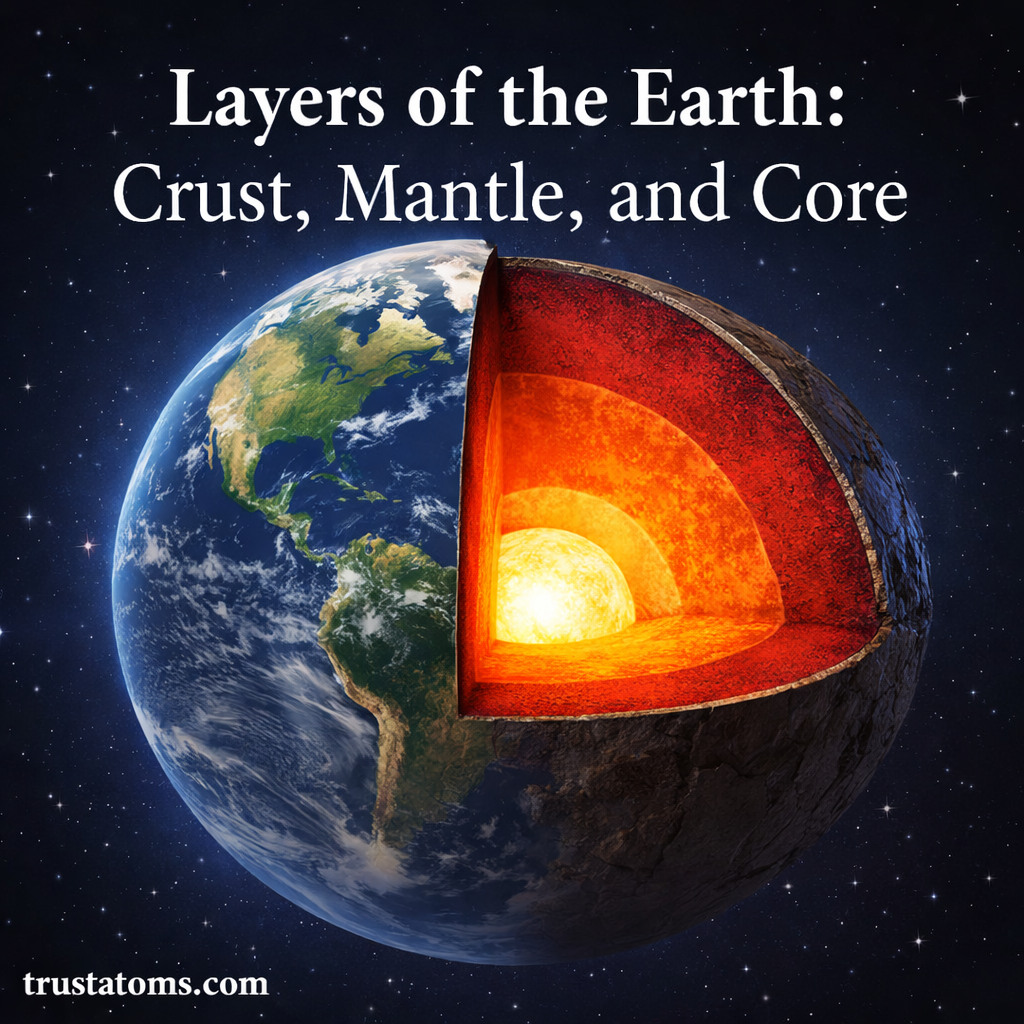
Earth has three main layers based on composition: the crust, mantle, and core, with the core further divided into a liquid outer core and a solid inner core. These layers differ in thickness, temperature, pressure, and materials, helping explain earthquakes, volcanic activity, plate movement, and Earth’s magnetic field.
The crust forms the rocky surface beneath our feet, while the mantle extends thousands of kilometers below it and the core occupies the planet’s center. Studying these regions is part of Earth science, which examines how the planet’s interconnected systems operate and change.
Overview of Earth’s Layers
Scientists classify Earth’s interior by chemical composition and by how materials behave under pressure and heat. The three compositional layers are the crust, mantle, and core, but their physical properties create additional divisions, including the lithosphere, asthenosphere, outer core, and inner core.
| Layer | Approximate Depth | Composition and State |
|---|---|---|
| Crust | Surface to 5–70 km | Solid silicate rock |
| Mantle | Base of crust to 2,900 km | Mostly solid, magnesium- and iron-rich rock |
| Outer core | 2,900–5,150 km | Liquid iron-rich metal |
| Inner core | 5,150–6,371 km | Solid iron-rich metal |
Depths are approximate because Earth’s boundaries vary slightly by location. The planet’s average radius is about 6,371 kilometers, making the crust remarkably thin compared with the regions beneath it.
Differences in composition help explain Earth’s density and interior structure, including why denser materials are concentrated toward the center. The distribution of Earth’s internal heat influences how mantle rock deforms and moves. These processes also provide the physical foundation for the theory of plate tectonics.
The Crust: Earth’s Thin, Rocky Outer Layer
The crust is Earth’s outermost compositional layer. It contains the continents, ocean floors, mountains, and much of the rock directly accessible to scientists. Although it is solid, its thickness and density differ substantially between continental and oceanic regions.
Continental and Oceanic Crust
- Thickness ranges from about 5 km (oceanic crust) to 70 km (continental crust).
- Continental crust is generally thicker, less dense, and richer in silica, with granite being a familiar example.
- Oceanic crust is generally thinner, denser, and predominantly basaltic.
- Both types are solid rock and form the uppermost portion of Earth’s rigid outer shell.
For a concrete comparison, imagine a location with 7 kilometers of oceanic crust and another with 40 kilometers of continental crust. The continental crust would be nearly six times thicker, even though both are extremely thin relative to Earth’s radius.
The Mantle: Earth’s Thickest Layer
The mantle begins beneath the crust and extends to approximately 2,900 kilometers below the surface. It accounts for about 84% of Earth’s volume and consists mainly of silicate minerals rich in magnesium and iron.
Contrary to a common misconception, the mantle is not a global ocean of molten rock. Most mantle material remains solid because the enormous pressure at depth raises its melting temperature. However, hot mantle rock can slowly deform and flow over geological timescales.
Upper Mantle, Lower Mantle, and the Asthenosphere
The upper mantle extends to roughly 660 kilometers deep, while the lower mantle continues to the core boundary. Within the upper mantle, the relatively weak asthenosphere can deform more readily than the rigid lithosphere above it.
Heat transfer, mantle convection, and gravitational forces associated with sinking and spreading plates contribute to tectonic movement. Partial melting in certain mantle regions also supplies magma that can eventually reach the surface through volcanic systems.
The Core: A Liquid Outer Layer and Solid Center
Earth’s core begins approximately 2,900 kilometers beneath the surface and is composed primarily of iron, with nickel and lighter elements also present. Its two regions behave differently because temperature and pressure affect whether their metallic materials remain liquid or solid.
Outer Core: Moving Liquid Metal
The outer core extends from approximately 2,900 to 5,150 kilometers deep. Its iron-rich material is liquid, allowing electrically conductive metal to circulate. Combined with Earth’s rotation, this movement sustains the geodynamo responsible for generating most of the planet’s magnetic field.
The magnetic field helps deflect charged particles from the solar wind and contributes to the magnetosphere surrounding Earth. It also provides the directional reference used by magnetic compasses.
Inner Core: Solid Metal Under Extreme Pressure
The inner core extends from approximately 5,150 kilometers deep to Earth’s center at 6,371 kilometers. Scientists estimate temperatures near the center reach roughly 5,000–6,000°C. Despite this intense heat, the inner core remains solid because pressure is sufficiently high to prevent the iron-rich material from melting.
How Earth’s Layers Interact
Earth’s layers exchange heat and interact mechanically, although they do not all move at the same speed or behave like the same material. Internal heat escapes through the mantle and crust, while plate motion reshapes the surface over millions of years.
- Heat moves outward from the core and through the mantle.
- Mantle movement shifts tectonic plates in the crust.
- Plate interactions produce earthquakes, mountain building, and many volcanic eruptions.
- Liquid metal circulation in the outer core generates Earth’s magnetic field.
More precisely, tectonic plates consist of the crust and rigid uppermost mantle, together called the lithosphere. They move over the weaker mantle beneath, driven by interacting forces that include slab pull, ridge push, and mantle flow.
How Temperature and Pressure Change With Depth
Temperature and pressure generally increase toward Earth’s center, but they do not rise at a constant rate. Near the surface, geothermal gradients can reach several tens of degrees Celsius per kilometer; this rate cannot simply be extended throughout the planet.
Pressure increases because deeper materials support the weight of everything above them. This helps explain why most mantle rock remains solid despite high temperatures and why the inner core is solid even though the hotter-than-surface conditions would melt iron at ordinary pressure.
How Scientists Study Layers They Cannot Reach
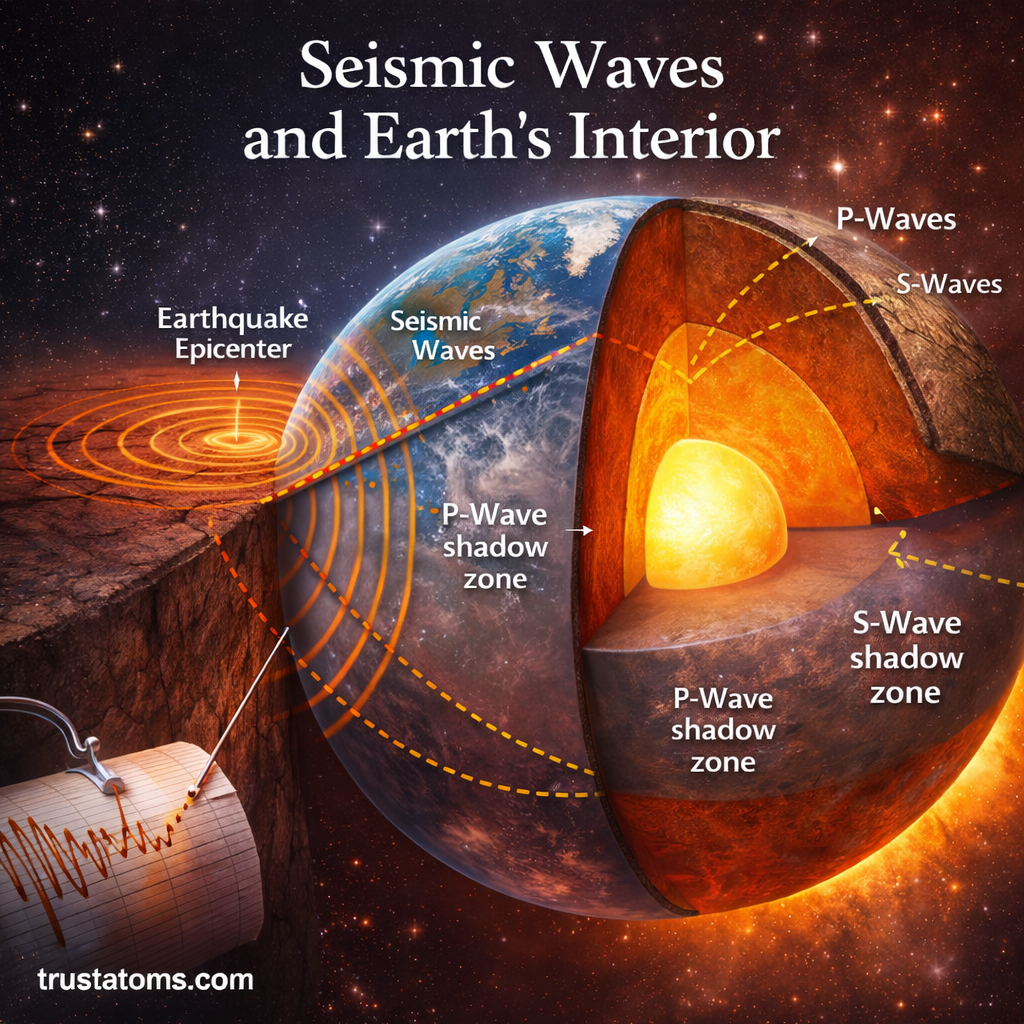
Scientists cannot directly drill into the mantle’s deepest regions or the core. Instead, they investigate Earth’s interior using seismic waves produced by earthquakes, gravity measurements, laboratory experiments, and computer models.
Seismic waves provide especially strong evidence. Shear waves, called S-waves, cannot travel through liquids, so their absence through the outer core supports its liquid state. Compressional P-waves change speed and direction as they cross internal boundaries, helping scientists estimate layer depths and material properties.
Frequently Asked Questions
What are the four main layers of Earth?
When the core is divided into its two parts, Earth has four commonly taught layers: crust, mantle, outer core, and inner core. The first two consist primarily of silicate rock, while the core is predominantly metallic.
Which layer of Earth is the thickest?
The mantle is Earth’s thickest major compositional layer, extending approximately 2,900 kilometers from the crust-mantle boundary to the outer core. It also occupies the largest proportion of Earth’s volume.
Why is the outer core liquid but the inner core solid?
Both regions are extremely hot, but the inner core experiences much greater pressure. That pressure raises the melting temperature of iron-rich material enough for the inner core to remain solid, while the lower-pressure outer core stays liquid.
Earth’s thin crust, slowly deforming mantle, and metallic core form a connected interior whose properties explain many observable geological processes. Seismic evidence reveals their boundaries, while differences in heat, pressure, and material behavior explain everything from moving plates to the magnetic field surrounding the planet.
Sources: U.S. Geological Survey (USGS), This Dynamic Earth: The Story of Plate Tectonics; Encyclopaedia Britannica, Earth: Interior; OpenStax, Astronomy 2e.