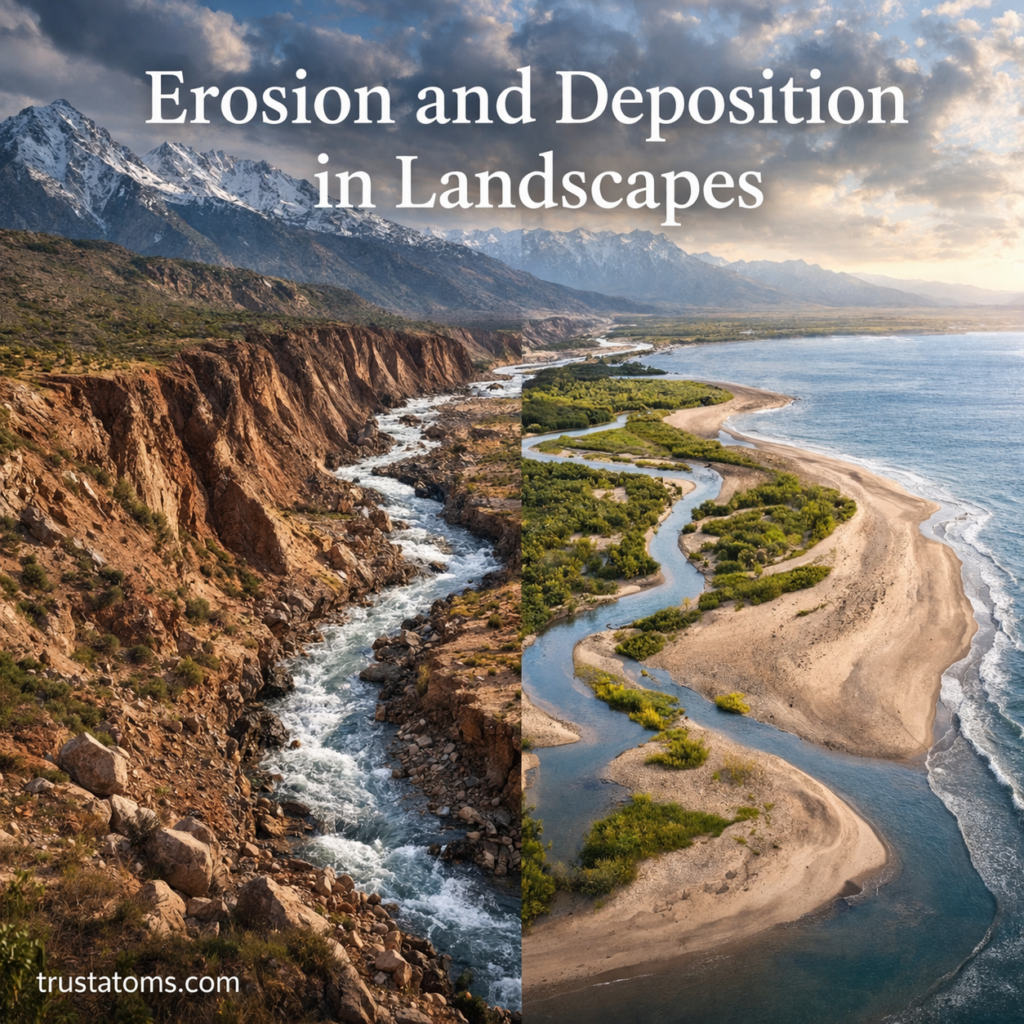
Erosion and deposition reshape landscapes by removing rock and soil from one location, transporting the material, and accumulating it somewhere else. Erosion moves sediment through water, wind, ice, or gravity, while deposition occurs when that transported material settles and builds new landforms.
These connected processes explain how rivers carve valleys, glaciers reshape mountains, and sediment forms beaches and deltas. They are fundamental topics in Earth science because they reveal how landscapes respond to natural forces and human activity.
What Is Erosion?
Erosion is the removal and transportation of rock fragments, soil, and sediment from Earth’s surface. It differs from weathering, which breaks down rock in place through physical, chemical, or biological processes without necessarily moving the material.
For example, rainwater can loosen soil on a hillside, while flowing runoff carries those particles downhill. Weathering helps produce loose material, and erosion transports it.
Rivers are especially effective at moving sediment and cutting valleys, as explained in River Systems and Valley Formation. In dry environments, Desert Landforms and Wind Erosion shows how moving air reshapes exposed surfaces.
These processes connect to broader Earth Surface Processes and Change, including weathering and sediment movement. Their combined effects contribute to Landscape Evolution Over Time, as valleys deepen, slopes retreat, and sediment accumulates elsewhere.
Four Main Agents of Erosion
Water: Rivers, Rainfall, and Waves
Running water carries sediment ranging from fine clay to large gravel. Rivers erode their channels through hydraulic action and abrasion, while rainfall can wash exposed topsoil from fields and hillsides. Along coastlines, waves remove material from cliffs and beaches.
Wind: Moving Sand and Dust
Wind erosion is especially noticeable where soil is dry, loose, and sparsely vegetated. Wind lifts fine particles into the air and moves sand close to the ground. Blowing sand can also abrade exposed rock surfaces.
Glaciers: Ice That Carves Valleys
Glaciers are slowly moving masses of ice that can scrape and pluck rock from the ground beneath them. Over time, glacial erosion can widen mountain valleys into distinctive U-shaped profiles and deepen basins.
Gravity: Material Moving Downhill
Gravity drives landslides, rockfalls, mudflows, and slow soil creep. These movements are collectively called mass wasting. Heavy rainfall, earthquakes, and unstable slopes can trigger rapid movement, while some soil shifts occur almost imperceptibly.
What Is Deposition?
Deposition occurs when transported sediment settles or accumulates in a new location. This commonly happens when moving water, wind, or ice loses the ability to carry its sediment load.
In rivers, faster currents can transport larger particles, while slower currents often allow sand and gravel to settle. Very fine silt and clay may remain suspended longer and travel farther before deposition.
Deposition does not simply replace eroded material where it originated. Sediment may travel from mountains to rivers, across floodplains, and eventually into lakes or oceans, where it can accumulate in layers.
Common Depositional Landforms
The shape of a depositional landform depends on the transporting agent, sediment supply, and local conditions.
- River deltas: Sediment accumulates where rivers enter lakes or oceans, provided deposition exceeds removal by waves and currents.
- Floodplains: Repeated flooding can deposit layers of fine sediment beside river channels.
- Beaches and spits: Waves and coastal currents redistribute sand and gravel along shorelines.
- Sand dunes: Wind deposits sand where airflow slows or obstacles trap moving grains.
- Moraines: Glaciers leave accumulations of rock debris and sediment along their margins or former positions.
Glacial deposits often contain a mixture of particle sizes because ice can transport everything from clay to boulders. Glacial Landforms and Ice Movement examines how advancing and retreating glaciers create these features.
How Erosion and Deposition Work Together

Erosion and deposition frequently occur within the same landscape, sometimes only a short distance apart. A river may erode its outer bank while depositing sand along the slower-moving inner bank of a bend.
Example: A River After Heavy Rain
Imagine a stream flowing through a wooded valley. During a heavy storm, runoff increases the stream’s discharge and speed, allowing it to pick up additional soil, sand, and gravel from its banks and bed.
Farther downstream, the stream enters a wider, flatter channel and slows. Some gravel and sand settle onto the streambed, forming a small bar. If the stream overflows its banks, finer sediment may settle across the floodplain as floodwater slows.
This single storm illustrates erosion, transportation, and deposition occurring within one connected river system. The exact outcome depends on flow conditions, sediment size, and channel shape.
Factors That Control Erosion and Deposition
| Factor | Effect on the Landscape |
|---|---|
| Rainfall and climate | Heavy rain can increase runoff and sediment transport; dry conditions can expose soil to wind. |
| Slope | Steep slopes encourage downhill movement, while gentler terrain may favor sediment accumulation. |
| Vegetation | Roots stabilize soil, and plant cover reduces the direct impact of rainfall. |
| Rock and soil type | Loose or weakly consolidated material is generally easier to erode than resistant rock. |
| Human activity | Construction, deforestation, and poorly managed agriculture can expose soil and increase erosion. |
These factors interact. A steep, bare hillside during intense rainfall is generally more vulnerable to rapid soil loss than a gently sloping hillside protected by dense vegetation.
How Erosion and Deposition Affect People
Erosion can remove fertile topsoil, undermine roads, damage riverbanks, and threaten buildings near unstable slopes or coastlines. Excess sediment entering waterways can reduce water quality and fill reservoirs.
Deposition can also be beneficial. River sediment can replenish floodplain soils, build coastal wetlands, and create habitats for plants and wildlife. However, excessive sediment buildup may obstruct navigation channels or increase maintenance needs.
Communities manage these effects through vegetation restoration, erosion-control measures, careful land-use planning, and monitoring of rivers and coastlines. The goal is often to reduce harmful sediment loss while allowing natural landscape processes to continue where possible.
Frequently Asked Questions
What is the difference between weathering and erosion?
Weathering breaks down rock or changes its minerals in place, while erosion removes and transports material. Weathering can make rock easier to erode, but the two processes are distinct.
Can erosion and deposition happen in the same place?
Yes. A river bend can experience erosion along its outer bank and deposition along its inner bank. The balance may change as water levels and currents shift.
Is erosion always harmful?
No. Erosion is a natural process that creates valleys, exposes rock formations, and supplies sediment for new landforms. It becomes a concern when it causes excessive soil loss, property damage, or ecosystem degradation.
Erosion and deposition are two connected parts of sediment movement: one removes and transports material, while the other allows it to accumulate. Recognizing where water, wind, ice, and gravity move sediment helps explain both the gradual formation of landscapes and sudden changes after storms, floods, or landslides.
Sources: U.S. Geological Survey, Water Science School and erosion resources; National Park Service, Geology and Geomorphology educational resources; Encyclopaedia Britannica, Erosion and Deposition reference articles.