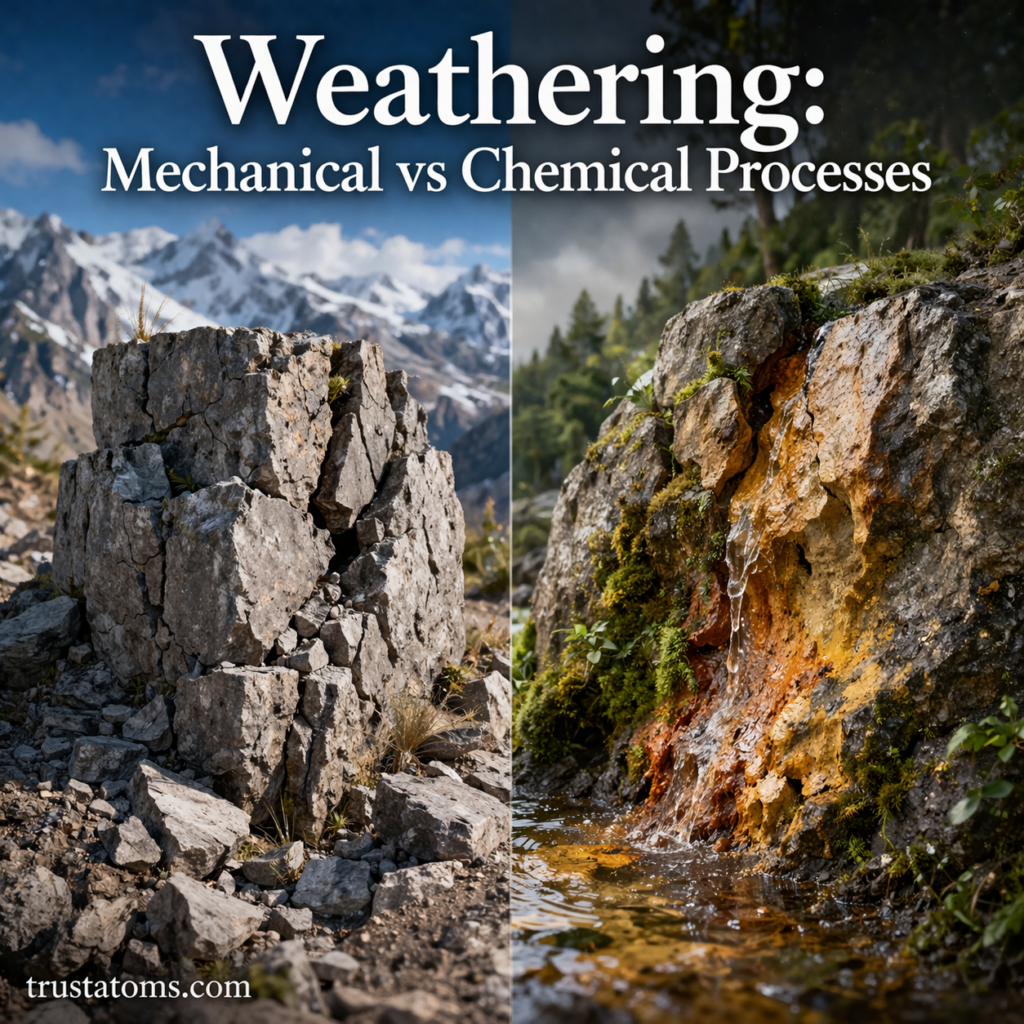
Mechanical weathering breaks rocks into smaller pieces without changing their chemical composition, while chemical weathering changes or dissolves minerals through chemical reactions. Both processes act at or near Earth’s surface, often working together to weaken rock, produce sediment, and help form soil.
Weathering is a fundamental process studied in Earth science because it helps explain how exposed rock gradually changes. Water, temperature fluctuations, oxygen, and living organisms can all contribute, but the way they affect rock depends on whether physical forces or chemical reactions are involved.
Over time, it shapes landscapes, forms soil, and influences ecosystems. Unlike erosion, which moves material, weathering works in place—gradually weakening and altering rock. The distinction helps explain why a rock can crack, dissolve, or develop a rusty surface before its fragments are carried away.
What Is Weathering?
Weathering is the physical breakdown or chemical alteration of rocks and minerals exposed to conditions at or near Earth’s surface. It can affect a large rock formation, a loose stone, or individual mineral grains within soil.
Unlike erosion, weathering does not require the transport of material from one location to another. A rock can weather while remaining in place. Once its fragments become loose, moving water, wind, ice, or gravity may transport them.
Weathering also contributes to the production of mineral particles and dissolved substances involved in soil development. The relationship between these processes is explored further in Soil Formation and Weathering Processes.
Weathering connects with The Rock Cycle and Earth Materials because it helps transform exposed rocks into sediment that may eventually become sedimentary rock. In limestone regions, chemical weathering can produce distinctive features such as those described in Karst Landscapes and Limestone Erosion.
Mechanical Weathering: Breaking Rock Without Changing Its Minerals
Mechanical weathering, also called physical weathering, breaks rock into smaller fragments while leaving the chemical identity of its minerals essentially unchanged. The resulting pieces may be large blocks, gravel, sand-sized grains, or smaller particles.
The forces responsible include freezing water, pressure changes, temperature-related expansion, growing roots, and friction between moving particles. Different environments favor different mechanisms.
Freeze-Thaw Weathering and Ice Wedging
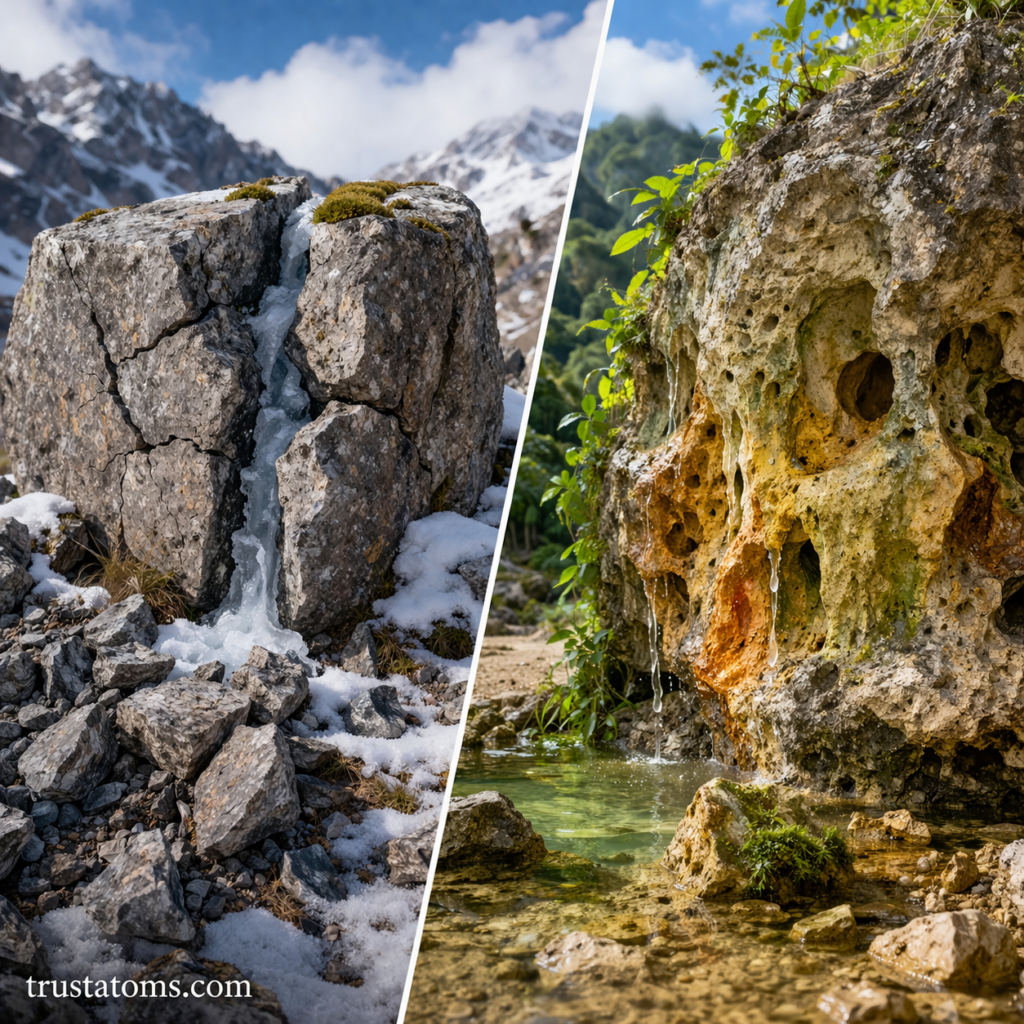
Freeze-thaw weathering occurs when water enters rock fractures and freezes. Water expands by approximately 9% in volume when it turns into ordinary ice, creating the potential for pressure within confined cracks.
Repeated freezing and thawing, particularly where water is available and temperatures fluctuate around freezing, can progressively weaken rock. Ice wedging and related frost-cracking processes are common in mountain environments and cold regions.
Thermal Expansion and Temperature Changes
Rock minerals expand when heated and contract when cooled. Because different minerals and parts of a rock may respond differently, repeated temperature changes can produce internal stresses.
These stresses can contribute to cracking and surface flaking, particularly where rock surfaces experience intense heating and cooling. However, temperature changes alone do not always produce rapid weathering; moisture, existing fractures, and rock composition also influence the outcome.
Root Wedging and Biological Activity
Plant roots can grow into existing rock fractures. As roots increase in thickness, they may exert pressure on fracture walls and gradually separate pieces of rock.
Burrowing animals can also expose previously protected rock and soil to air and water. Biological activity may therefore encourage both physical breakdown and chemical alteration.
Pressure Release and Exfoliation
Rocks formed deep underground experience pressure from overlying material. When erosion removes that material, the reduction in pressure can allow exposed rock to expand and develop fractures.
In some massive rock formations, curved sheets separate from the surface. This process, known as exfoliation, can contribute to the rounded appearance of exposed granite domes.
Abrasion by Moving Sediment
Abrasion occurs when rock fragments scrape, collide, or grind against other surfaces. Sand carried by wind, stones moving in rivers, and sediment transported by glaciers can wear down exposed rock.
Abrasion involves mechanical breakdown, although the movement of sediment that causes it is associated with erosion and transport. The two processes can therefore occur together.
Chemical Weathering: Changing the Minerals Inside Rock
Chemical weathering changes the composition or structure of minerals through chemical reactions. Rather than simply breaking existing minerals into smaller pieces, it may produce new minerals or release substances into water.
Water is especially influential because it can dissolve substances, transport reactive chemicals into rock fractures, and participate directly in mineral reactions. Chemical weathering contributes to Earth Surface Processes and Change by altering exposed materials and making them more susceptible to further breakdown.
Hydrolysis: Turning Feldspar Into Clay Minerals
Hydrolysis involves reactions between minerals and water, often involving hydrogen ions in the water. Feldspar, a common mineral in granite, can undergo hydrolysis and gradually transform into clay minerals while releasing dissolved ions.
This transformation weakens the original rock structure because newly formed clay minerals have different physical and chemical properties. Granite may become crumbly as feldspar alters while more resistant quartz grains remain.
Oxidation: Iron-Bearing Minerals React With Oxygen
Oxidation occurs when minerals undergo reactions involving the loss of electrons, commonly through interactions with oxygen. Iron-bearing minerals can produce iron oxides and oxyhydroxides, which often give weathered rocks yellow, orange, brown, or reddish colors.
The familiar rusting of iron is a useful comparison, although natural rock weathering involves several mineral reactions. Oxidation can alter mineral structures and contribute to the weakening of rock.
Carbonation and Limestone Dissolution
Carbon dioxide from the atmosphere or soil can dissolve in water, producing a weak carbonic acid solution. This mildly acidic water reacts with calcium carbonate, the main mineral component of limestone, allowing calcium and bicarbonate ions to enter the water.
Over time, water moving through limestone fractures may enlarge openings and contribute to caves, underground drainage systems, and sinkholes. The process is especially effective where water can repeatedly enter and circulate through carbonate rock.
Dissolution: Minerals Entering Water
Some minerals dissolve readily when exposed to water. Halite, the mineral form of common salt, is an example. Its constituent ions separate and enter the water without requiring the formation of a new solid mineral.
Dissolution can remove material from rock and create openings or weakened zones. Its effectiveness depends on mineral solubility, water chemistry, and the availability of moving water.
Mechanical vs Chemical Weathering: Comparison Table
The clearest difference is whether the rock’s minerals remain chemically unchanged or undergo chemical alteration. Both processes may occur in the same location, but their mechanisms and products differ.
| Feature | Mechanical Weathering | Chemical Weathering |
|---|---|---|
| Main process | Physical fragmentation | Chemical alteration or dissolution |
| Mineral composition | Essentially unchanged | Changed or dissolved |
| Typical causes | Ice, pressure, roots, temperature stress | Water, oxygen, acids, dissolved substances |
| Common examples | Ice wedging, exfoliation, root wedging | Hydrolysis, oxidation, carbonation |
| Typical products | Smaller fragments of existing rock | New minerals and dissolved ions |
| Favorable conditions | Depends on mechanism; freezing or pressure release can be influential | Often favored by warm, moist conditions |
| Effect on other weathering | Can expose additional reactive surfaces | Can weaken minerals and rock structure |
Neither type is universally faster. A fractured rock may break suddenly during a freezing event, while some minerals can dissolve relatively quickly in suitable water. Other rocks resist alteration for long periods because of their mineral composition or limited exposure to moisture.
Worked Example: How a Cracked Granite Rock Weathers
Consider a granite rock exposed on a mountain slope. It contains quartz, feldspar, and mica, and a narrow fracture allows rainwater to enter. This example shows how mechanical and chemical weathering can reinforce each other.
- Water enters the fracture. Rainwater seeps into a small opening between mineral grains or along an existing crack.
- Freezing creates expansion. Suppose 10 milliliters of water freezes. With approximately 9% volumetric expansion, the resulting ice would occupy about 10.9 milliliters if unconstrained.
- The fracture may widen. In a confined, water-filled fracture, ice formation can contribute to stress. Repeated freezing under suitable conditions may enlarge the crack, although one freezing event does not guarantee that the rock will split.
- Additional surfaces become exposed. As fractures develop, more rock surface becomes accessible to water and dissolved substances.
- Minerals begin changing. Feldspar exposed along the fracture can undergo hydrolysis, producing clay minerals and dissolved ions. The altered material may become easier to dislodge.
- Fragments eventually separate. Continued physical stress and chemical alteration may loosen mineral grains or larger pieces. Gravity or flowing water can then transport them away.
The 10-milliliter calculation illustrates the expansion of water during freezing, not a prediction of fracture growth. Actual cracking depends on confinement, temperature, water supply, rock strength, and the geometry of existing fractures.
How Mechanical and Chemical Weathering Reinforce Each Other
Mechanical fragmentation can increase the surface area exposed to water and air. Chemical weathering can then attack minerals along those newly accessible surfaces, potentially weakening the rock further.
For a simple geometric illustration, imagine a cube of rock measuring 10 centimeters on each side. Its original surface area is 600 square centimeters. If divided into eight separate cubes measuring 5 centimeters per side, their combined surface area becomes 1,200 square centimeters.
That is twice the original surface area, even though the total rock volume remains unchanged. If all those surfaces are accessible to water, chemical reactions have more exposed material to act upon. Real rocks have irregular shapes and fractures, so actual exposure varies.
The reverse interaction also occurs. Chemical alteration can weaken bonds within a rock, making it easier for physical forces to separate mineral grains. Weathering is therefore often a combination of processes rather than a single isolated mechanism.
What Controls the Rate of Weathering?
Weathering rates depend on the interaction between environmental conditions and the properties of the exposed material. Two rocks in the same climate may weather differently, while similar rocks in different climates may develop distinct weathering patterns.
- Climate: Moisture supports many chemical reactions, while temperature fluctuations and freezing conditions influence particular physical processes.
- Mineral composition: Some minerals are less stable under surface conditions. Quartz is generally more resistant to chemical alteration than many feldspar minerals.
- Fractures and surface area: Cracked or fragmented rocks provide more pathways for water and air to reach internal surfaces.
- Biological activity: Roots can exert physical pressure, while organisms and decaying organic matter may influence soil acidity and chemical reactions.
- Exposure and drainage: Water availability, drainage conditions, and the duration of exposure influence how minerals react.
Warm, humid environments commonly support extensive chemical weathering because water and suitable temperatures encourage mineral reactions. Cold environments with frequent freezing and available moisture can favor frost-related mechanical weathering. These are broad patterns rather than absolute rules.
How Weathering Produces Soil and Changes Landscapes
Weathering helps generate the mineral material from which soils develop. Mechanical breakdown produces smaller particles, while chemical reactions can form clay minerals and release dissolved nutrients. Organic matter, organisms, water movement, and time contribute to the development of recognizable soil horizons.
Weathering also influences the shapes of mountains, slopes, and exposed rock formations. Differential weathering occurs when some minerals or rock layers resist breakdown more effectively than others, leaving distinctive surfaces and landforms.
Chemical reactions involving silicate minerals can also participate in Earth’s long-term carbon cycle by consuming carbon dioxide during weathering and transporting dissolved products through water systems. The relationship is complex, but it demonstrates that weathering affects more than the visible appearance of rocks.
Common Misconceptions About Weathering
Misconception 1: Weathering and Erosion Are the Same Process
Weathering breaks down or alters material in place, while erosion removes and transports material. They frequently occur together, but transport is the defining distinction.
Misconception 2: Mechanical Weathering Always Happens Faster
Neither category has a universally faster rate. Weathering speed depends on the mineral, climate, water availability, exposed surface area, and specific process involved.
Misconception 3: Chemical Weathering Requires Strong Acids
Ordinary water, dissolved oxygen, and naturally occurring weak acids can cause chemical weathering. Strong industrial acids are not necessary for minerals to change or dissolve.
Misconception 4: Weathering Only Happens in Extreme Climates
Weathering occurs in deserts, forests, mountains, coastal regions, and ordinary temperate environments. The dominant mechanisms vary with local conditions, but exposed rock can undergo weathering almost anywhere.
Frequently Asked Questions
What Is the Main Difference Between Mechanical and Chemical Weathering?
Mechanical weathering physically breaks rock into smaller pieces without substantially changing its mineral chemistry. Chemical weathering alters minerals through reactions or dissolution, sometimes producing new minerals and dissolved substances.
What Are Three Examples of Mechanical Weathering?
Three examples are ice wedging in rock fractures, plant roots widening cracks, and exfoliation caused by pressure release. Each involves physical forces rather than chemical transformation of the original minerals.
What Are Three Examples of Chemical Weathering?
Common examples include feldspar changing into clay minerals through hydrolysis, iron-bearing minerals undergoing oxidation, and limestone dissolving in mildly acidic water containing dissolved carbon dioxide.
Can Mechanical and Chemical Weathering Happen at the Same Time?
Yes. Physical fractures expose additional mineral surfaces to water and air, while chemical alteration can weaken rock and make further fragmentation easier. Both processes commonly operate within the same rock formation.
Which Type of Weathering Is Most Common in Warm, Wet Climates?
Chemical weathering is often especially active in warm, wet climates because moisture and suitable temperatures support mineral reactions. Mechanical weathering can still occur in these environments through roots, pressure changes, and other physical forces.
The distinction between mechanical and chemical weathering comes down to physical fragmentation versus mineral alteration. In natural landscapes, these processes frequently reinforce one another, helping explain how solid rock becomes fractured material, chemically altered minerals, and eventually part of developing soils and changing landforms.
Sources: U.S. Geological Survey (USGS); OpenStax, Physical Geology; Steven Earle, Physical Geology (BCcampus Open Education).