Volcanic arcs and island chains are some of the most fascinating features on Earth’s surface. Stretching across oceans and continents, these formations reveal powerful tectonic processes happening deep beneath our feet.
From the curved line of the Aleutian Islands to the explosive volcanoes of Japan, volcanic arcs and island chains are closely tied to plate boundaries and the movement of Earth’s crust.
What Are Volcanic Arcs and Island Chains?
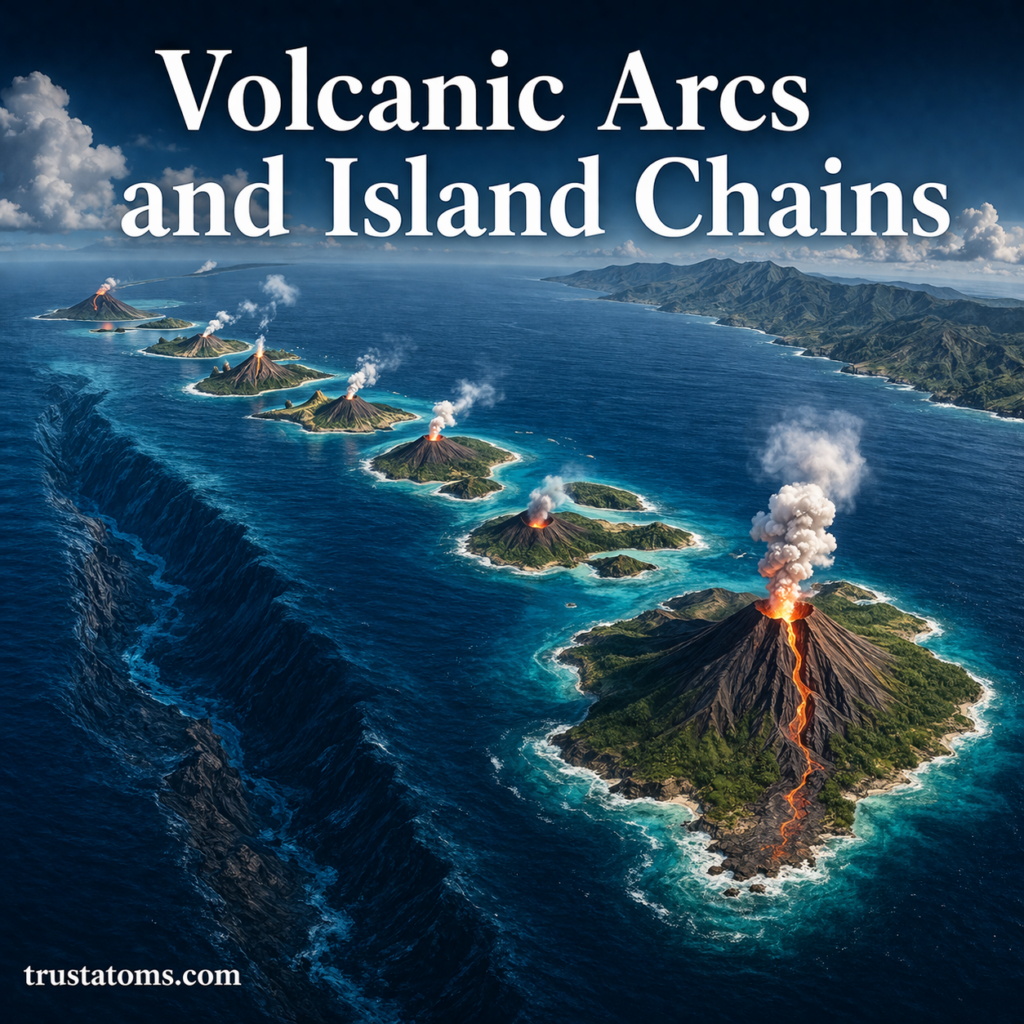
Volcanic arcs are curved chains of volcanoes that form near subduction zones—areas where one tectonic plate is forced beneath another.
Island chains are sequences of islands that often form from volcanic activity, either along plate boundaries or over hotspots.
While the terms are sometimes used interchangeably, they differ slightly:
- Volcanic arcs typically form at subduction zones
- Island chains can form from subduction or hotspot activity
The Role of Plate Tectonics
The formation of volcanic arcs and many island chains is driven by plate tectonics.
At convergent boundaries:
- An oceanic plate moves toward another plate
- The denser plate subducts beneath the other
- Water and sediments are carried into the mantle
- Heat and pressure generate magma
- Magma rises to the surface, forming volcanoes
Over time, repeated eruptions create a chain of volcanic peaks.
How Volcanic Arcs Form
Volcanic arcs form in a distinct curved pattern due to the geometry of subduction zones and the shape of Earth’s surface.
Key Steps in Formation
- Subduction begins as one plate dives beneath another
- The descending plate releases water into the mantle
- This lowers the melting point of surrounding rock
- Magma forms and rises through the crust
- Volcanoes emerge in a line parallel to the trench
Why Are They Curved?
Volcanic arcs are often curved because:
- Earth’s surface is spherical
- Subduction zones are not perfectly straight
- Plate movement varies along boundaries
This creates the characteristic arc shape seen in many regions.
Types of Volcanic Arcs
There are two main types of volcanic arcs, depending on where they form.
Oceanic Island Arcs
Oceanic island arcs form when one oceanic plate subducts beneath another.
Characteristics:
- Entirely surrounded by ocean
- Chains of volcanic islands
- Often associated with deep ocean trenches
Examples include:
- The Aleutian Islands
- The Mariana Islands
- The Tonga Arc
These arcs can form some of the deepest trenches and most active volcanoes on Earth.
Continental Volcanic Arcs
Continental volcanic arcs form when an oceanic plate subducts beneath a continental plate.
Characteristics:
- Located along continental margins
- Volcanoes form on land
- Often associated with mountain building
Examples include:
- The Andes Mountains in South America
- The Cascade Range in North America
These regions can produce large, explosive volcanic eruptions.
Island Chains Formed by Hotspots
Not all island chains are formed by subduction. Some are created by hotspots—areas where plumes of hot material rise from deep within the mantle.
How Hotspot Chains Form
- A stationary hotspot exists beneath a moving tectonic plate
- Magma rises and creates a volcano
- The plate moves, carrying the volcano away
- A new volcano forms over the hotspot
- A chain of islands develops over time
Key Features
- Linear (rather than curved) arrangement
- Age progression along the chain
- Oldest islands are farthest from the hotspot
A well-known example is the Hawaiian Islands, where active volcanoes are found at one end of the chain.
Differences Between Volcanic Arcs and Hotspot Chains
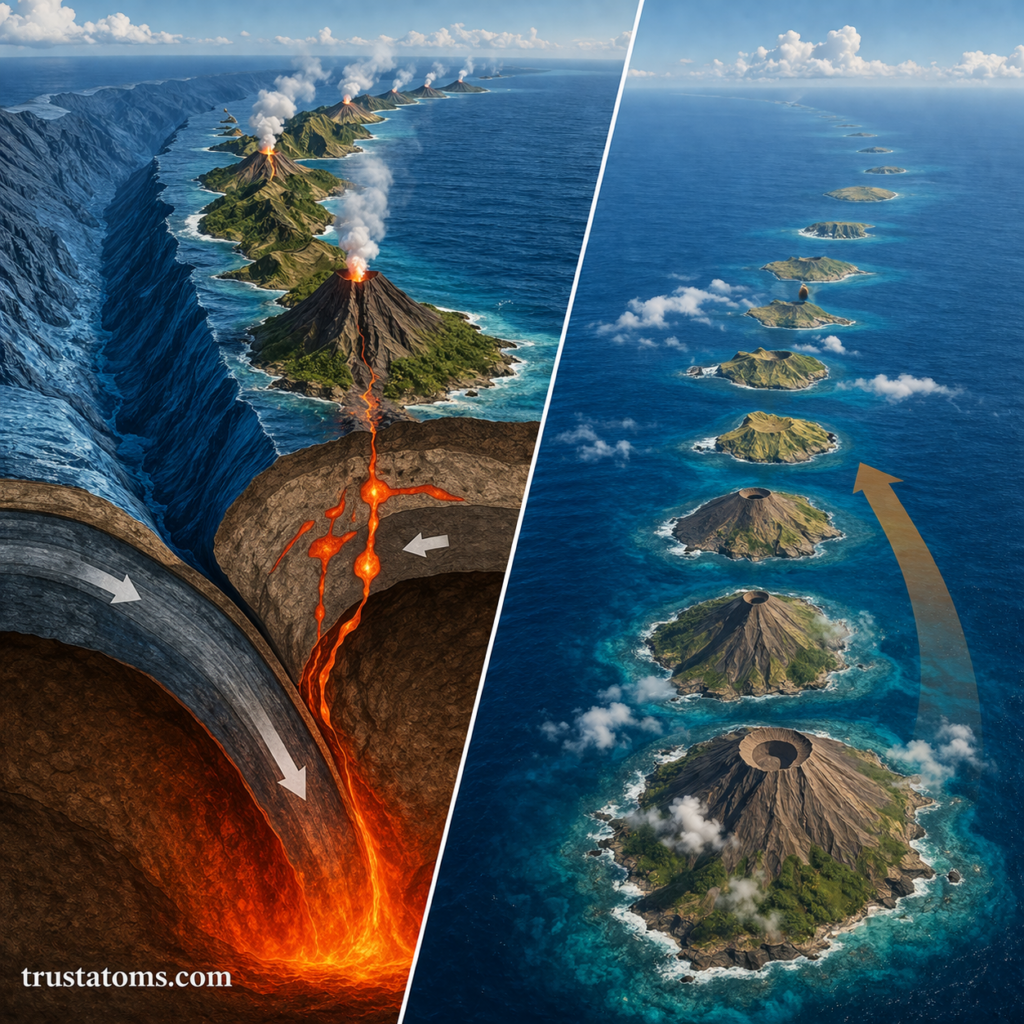
Understanding the differences helps clarify how these features form.
Volcanic arcs:
- Form at subduction zones
- Typically curved
- Associated with trenches and earthquakes
Hotspot island chains:
- Form in the middle of tectonic plates
- Typically linear
- Show clear age progression
Geological and Environmental Importance
Volcanic arcs and island chains play a significant role in Earth systems.
Natural Hazards
These regions are often associated with:
- Volcanic eruptions
- Earthquakes
- Tsunamis
Resource Formation
Volcanic activity can create valuable resources:
- Mineral deposits (copper, gold)
- Fertile soils for agriculture
- Geothermal energy sources
Biodiversity
Island chains often develop unique ecosystems:
- Isolated evolution leads to endemic species
- Diverse habitats across elevation zones
The Life Cycle of Volcanic Island Chains
Like all geological features, volcanic arcs and island chains evolve over time.
Stages include:
- Active volcanism and island formation
- Growth and expansion
- Erosion and subsidence
- Coral reef development (in tropical regions)
- Eventual flattening or submergence
Older islands may become atolls or disappear beneath the ocean surface entirely.
Key Takeaways
- Volcanic arcs form at subduction zones where plates collide
- Island chains can form from subduction or hotspot activity
- Oceanic and continental arcs differ in location and structure
- Hotspot chains are linear and show age progression
- These formations influence natural hazards, ecosystems, and resources
Final Thoughts
Volcanic arcs and island chains offer a window into Earth’s dynamic interior. They show how tectonic forces shape the planet over millions of years, creating both breathtaking landscapes and powerful natural events.
By understanding these processes, we gain deeper insight into how Earth works—and how it continues to change.