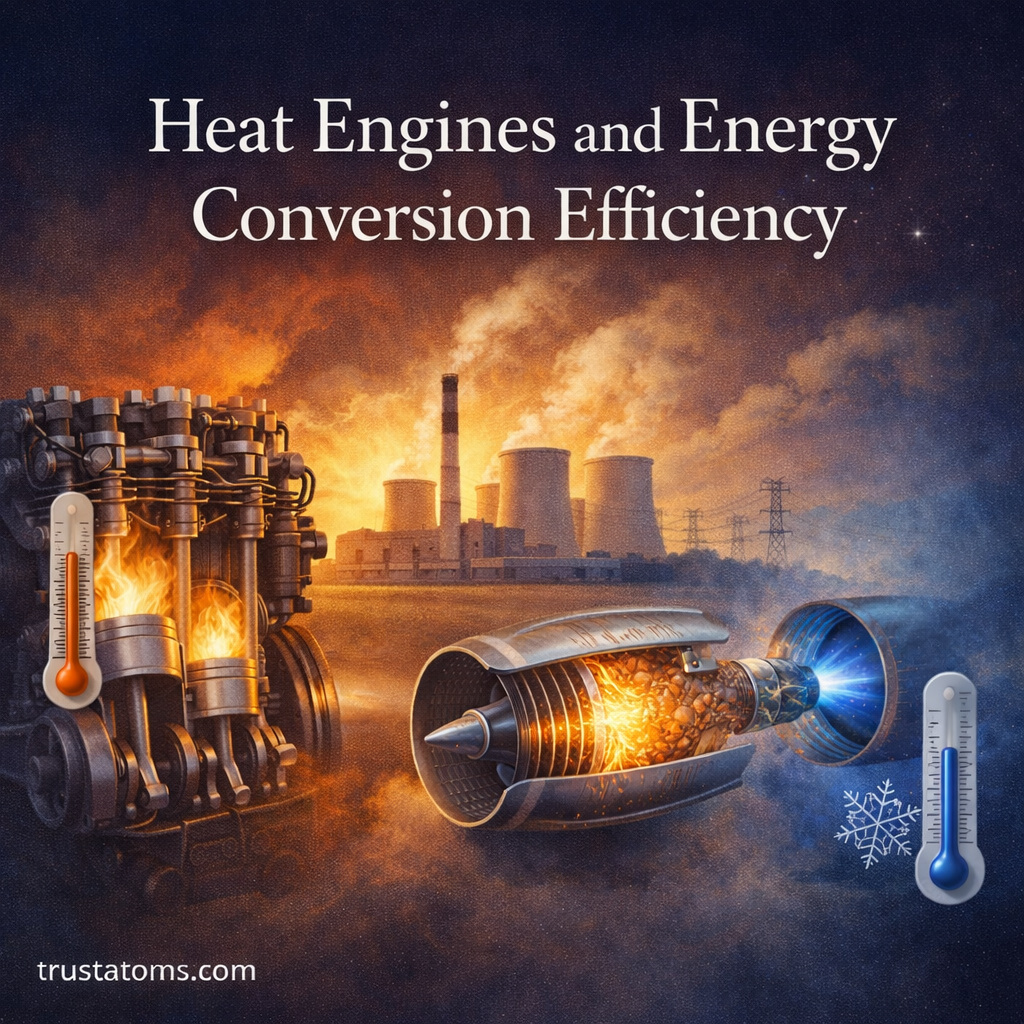
Heat engines are devices that convert thermal energy into mechanical work. They power automobiles, generate electricity in power plants, and even describe how living organisms use energy.
Understanding heat engines and energy conversion efficiency is essential for grasping how energy flows through physical systems — and why no engine can ever be 100% efficient.
This guide explores how heat engines work, the laws governing them, and the limits imposed by thermodynamics.
What Is a Heat Engine?
A heat engine is a system that:
- Absorbs heat from a high-temperature source
- Converts part of that energy into useful work
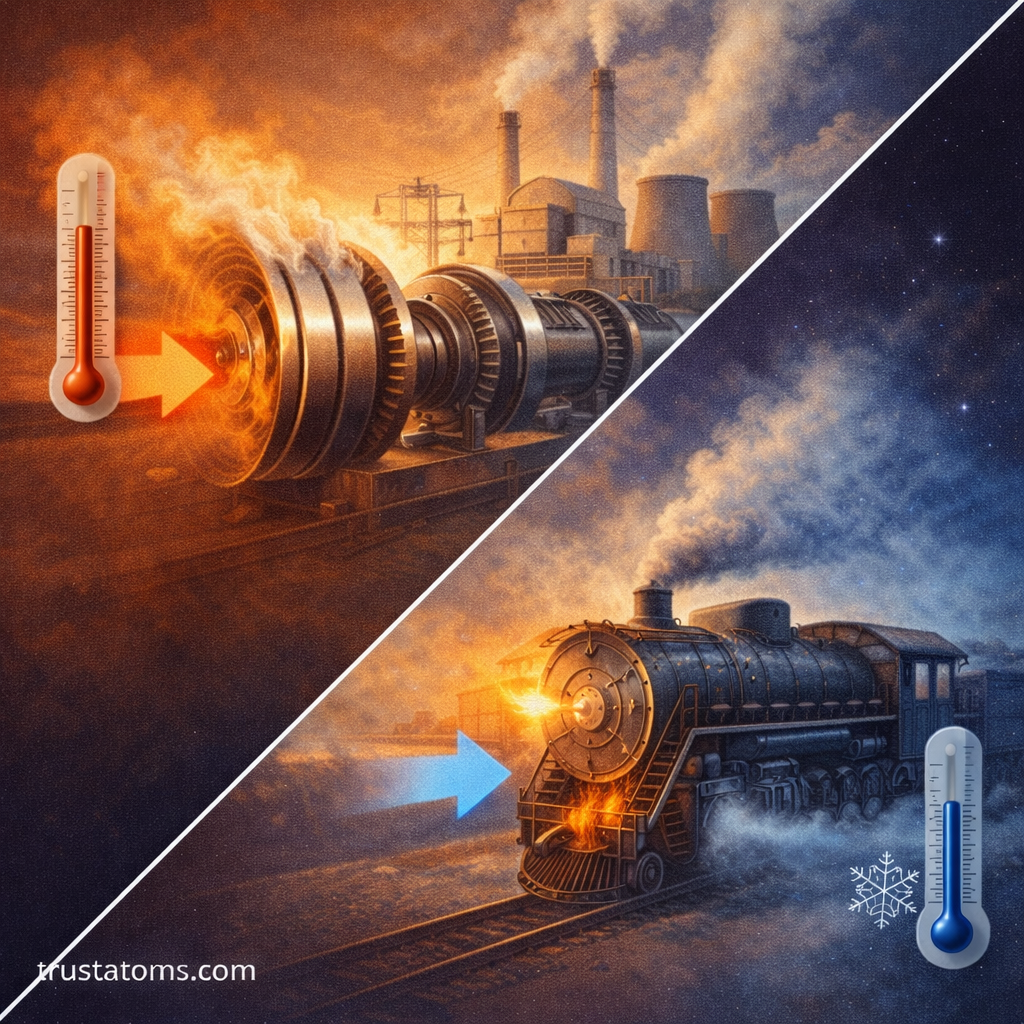
- Releases remaining heat to a low-temperature sink
Every heat engine operates between two thermal reservoirs:
- Hot reservoir (high temperature)
- Cold reservoir (low temperature)
The temperature difference drives energy conversion.
Basic Components of a Heat Engine
All heat engines share three essential elements:
- Working substance (gas, steam, etc.)
- Heat source
- Heat sink
The working substance undergoes a thermodynamic cycle, meaning it returns to its original state after completing one full sequence of processes.
The First Law of Thermodynamics and Heat Engines
The First Law states:
Energy cannot be created or destroyed — only transformed.
For a heat engine:
Heat absorbed from hot source = Work done + Heat expelled to cold sink
In simple terms:
Input energy = Useful output + Waste energy
Some energy must always be rejected to the cold reservoir.
What Is Energy Conversion Efficiency?
Efficiency measures how much input heat is converted into useful work.
It is defined as:
Efficiency = (Work Output) / (Heat Input)
Efficiency is often expressed as a percentage.
For example:
- If 100 units of heat are absorbed
- And 40 units become work
Efficiency = 40%
The remaining 60% must be expelled as waste heat.
Why 100% Efficiency Is Impossible
The Second Law of Thermodynamics imposes a strict limit:
No heat engine can convert all absorbed heat into work.
Why?
Because:
- Energy naturally spreads out
- Entropy increases
- Some energy must be discarded
A hypothetical engine with 100% efficiency would violate the Second Law.
The Carnot Engine: Theoretical Maximum Efficiency
The Carnot engine is an idealized heat engine that defines the maximum possible efficiency between two temperatures.
Its efficiency depends only on:
- Temperature of hot reservoir (Th)
- Temperature of cold reservoir (Tc)
The Carnot efficiency shows:
Higher temperature difference → Higher possible efficiency
But even a Carnot engine:
- Cannot reach 100% efficiency
- Cannot eliminate waste heat entirely
It represents a theoretical upper limit.
Real-World Heat Engines
Internal Combustion Engines
Used in cars and trucks.
- Fuel burns inside cylinders
- Expanding gases push pistons
- Mechanical work drives wheels
Efficiency: Typically 20–35%
Much energy is lost as heat.
Steam Turbines
Used in power plants.
- Water is heated into steam
- Steam spins turbines
- Turbines generate electricity
Efficiency: Around 30–45%
Modern combined-cycle plants improve this further.
Jet Engines
- Burn fuel to produce high-speed exhaust
- Thrust propels aircraft forward
Efficiency varies depending on speed and design.
Factors That Affect Heat Engine Efficiency
Several variables influence performance:
- Temperature difference between reservoirs
- Friction and mechanical losses
- Heat transfer inefficiencies
- Material limitations
- Irreversible processes
Increasing the hot reservoir temperature generally improves efficiency — but materials must withstand extreme conditions.
Types of Thermodynamic Cycles
Different heat engines use different cycles.
Otto Cycle
Used in gasoline engines.
Diesel Cycle
Used in diesel engines.
Rankine Cycle
Used in steam power plants.
Brayton Cycle
Used in gas turbines and jet engines.
Each cycle has distinct characteristics, but all obey thermodynamic limits.
Energy Losses in Heat Engines
Energy is lost through:
- Exhaust heat
- Friction
- Sound
- Radiation
- Incomplete combustion
Engineers work to minimize these losses but can never eliminate them entirely.
Heat Pumps and Refrigerators: Reverse Heat Engines
A refrigerator works like a reversed heat engine.
Instead of producing work from heat:
- It uses work to move heat from cold to hot regions
Efficiency in these systems is measured differently, using a coefficient of performance (COP).
Environmental Implications
Because heat engines reject waste heat:
- Power plants warm surrounding water or air
- Internal combustion engines waste fuel energy
- Fossil fuel burning increases greenhouse gas emissions
Improving efficiency reduces:
- Fuel consumption
- Environmental impact
- Operating costs
This is a major focus of modern engineering.
The Role of Entropy
Entropy explains why efficiency is limited.
In every real process:
- Some energy becomes unavailable for work
- Disorder increases
- Perfect reversibility is impossible
Heat engines operate between order (high temperature energy) and disorder (low temperature waste heat).
How Engineers Improve Efficiency
Modern strategies include:
- Increasing maximum operating temperature
- Using better insulating materials
- Reducing friction
- Recycling waste heat (combined-cycle systems)
- Improving combustion precision
Even small improvements can save enormous energy globally.
Why Heat Engines Matter in Physics
Heat engines illustrate core thermodynamic principles:
- Conservation of energy
- Entropy increase
- Irreversibility
- Energy transformation limits
They connect theoretical physics to practical technology.
From car engines to nuclear power plants, nearly all large-scale electricity generation depends on heat engine principles.
Final Thoughts
Heat engines demonstrate a powerful truth about energy:
Not all energy can become useful work.
The laws of thermodynamics place fundamental limits on efficiency, shaping technology, engineering, and environmental policy.
Understanding heat engines and energy conversion efficiency provides insight into:
- Why waste heat exists
- Why energy systems have limits
- Why temperature differences drive mechanical work
It’s one of the clearest real-world examples of thermodynamics in action.