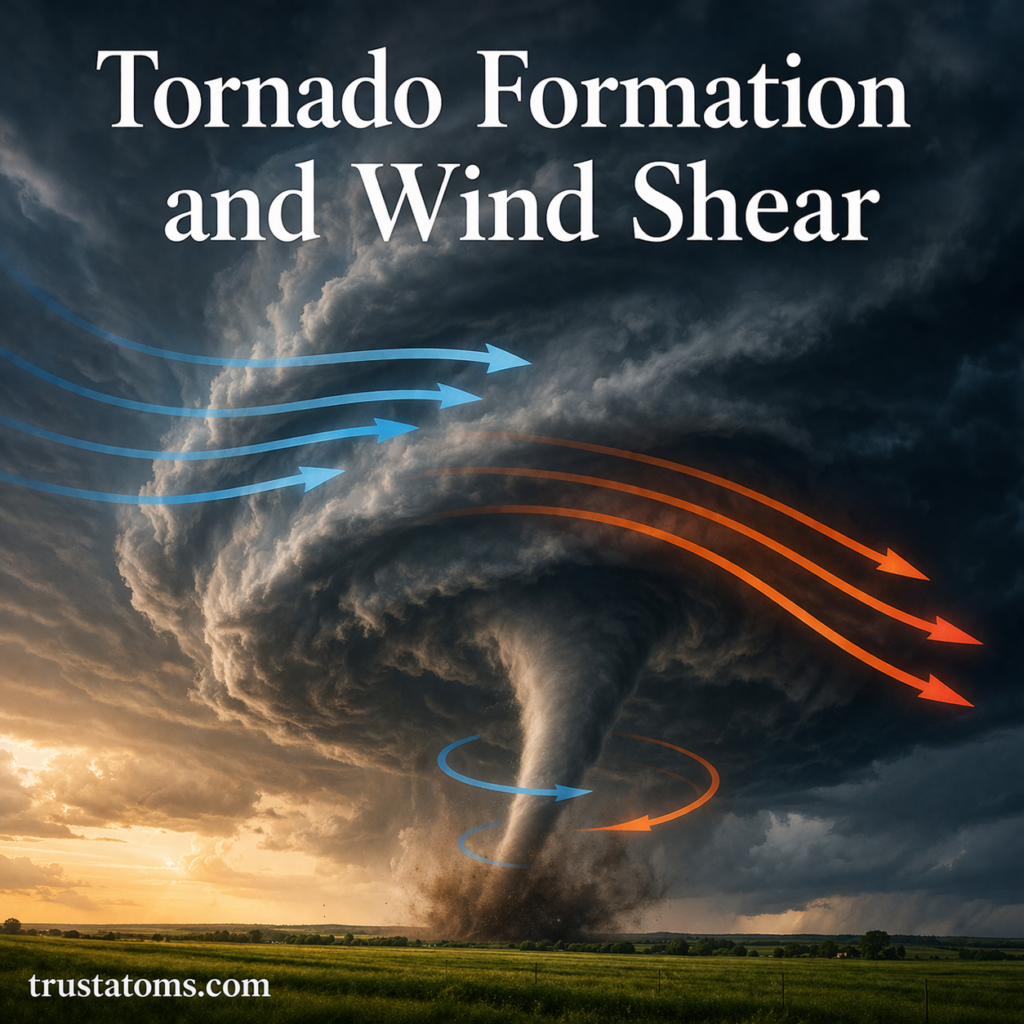
Tornadoes are among the most intense and destructive weather phenomena on Earth. With violently rotating columns of air that extend from thunderstorms to the ground, they can form quickly and cause significant damage in minutes.
At the core of tornado formation is a key atmospheric concept: wind shear. Understanding how wind shear interacts with thunderstorms helps explain how and why tornadoes develop.
What Is a Tornado?
A tornado is a rapidly rotating column of air that:
- Extends from a thunderstorm to the ground
- Is visible as a funnel cloud (when condensation occurs)
- Produces extremely strong winds
Tornadoes vary in size and strength, from narrow, short-lived events to massive, long-track storms.
What Is Wind Shear?
Wind shear refers to a change in wind speed and/or direction over a short distance in the atmosphere.
Types of Wind Shear
- Speed shear – Wind speed increases or decreases with height
- Directional shear – Wind direction changes with height
Both types are critical for tornado development.
Why Wind Shear Matters
Wind shear helps create rotation in the atmosphere before a tornado even forms.
Horizontal Rotation
- Near the ground, winds may blow in one direction
- Higher up, winds blow faster and in a different direction
- This creates a horizontal spinning motion in the air
Think of it like a rolling tube of air parallel to the ground.
From Horizontal Spin to Vertical Rotation
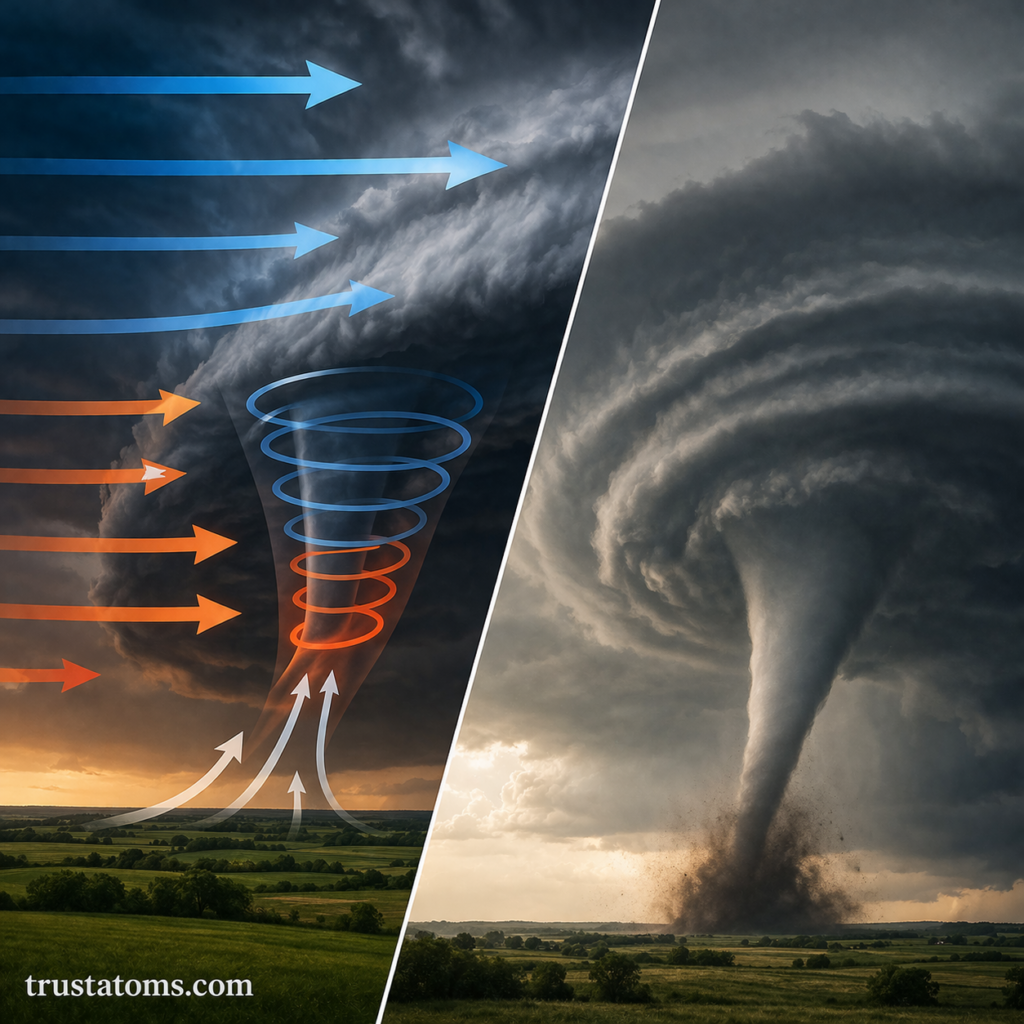
For a tornado to form, this horizontal rotation must be tilted vertically.
How This Happens
- Strong updrafts develop within a thunderstorm
- Rising air lifts the horizontally spinning air
- The rotation tilts into a vertical position
- A rotating updraft forms, called a mesocyclone
This rotating column of air is the foundation for tornado development.
The Role of Supercell Thunderstorms
Most strong tornadoes form within supercell thunderstorms, which are highly organized storms with persistent rotating updrafts.
Key Features of Supercells
- Long-lasting and structured storms
- Strong updrafts and downdrafts
- Presence of a mesocyclone
- Capable of producing severe weather
Supercells provide the ideal environment for tornado formation.
Steps in Tornado Formation
While not all supercells produce tornadoes, many follow a similar process.
Step-by-Step Process
- Wind shear creates horizontal rotation
- Updraft tilts rotation vertically
- Mesocyclone forms within the storm
- Rotation intensifies and tightens
- A funnel cloud develops
- The funnel reaches the ground, forming a tornado
Not every rotating storm produces a tornado, but strong wind shear increases the likelihood.
The Role of Downdrafts
Downdrafts also play a critical role in tornado formation.
Rear-Flank Downdraft (RFD)
- A descending current of air wrapping around the mesocyclone
- Helps concentrate rotation near the ground
- Can strengthen or weaken tornado formation
The balance between updrafts and downdrafts is essential.
Tornado Intensity: The Enhanced Fujita Scale
Tornadoes are rated based on the damage they cause using the Enhanced Fujita (EF) Scale.
EF Scale Categories
- EF0: 65–85 mph (minor damage)
- EF1: 86–110 mph (moderate damage)
- EF2: 111–135 mph (considerable damage)
- EF3: 136–165 mph (severe damage)
- EF4: 166–200 mph (devastating damage)
- EF5: 200+ mph (incredible destruction)
The EF scale helps scientists assess tornado strength after the event.
Common Tornado Environments
Tornadoes most often occur in regions where atmospheric conditions favor strong storms.
Typical Conditions
- Warm, moist air near the surface
- Cooler, dry air above
- Strong wind shear
- A triggering mechanism (such as a cold front)
These ingredients are commonly found in areas like the central United States, often called “Tornado Alley.”
Why Not All Storms Produce Tornadoes
Even when conditions seem favorable, tornadoes do not always form.
Reasons Include
- Weak or poorly organized wind shear
- Insufficient updraft strength
- Imbalance between updrafts and downdrafts
- Lack of sustained rotation
Tornado formation requires a precise combination of factors.
Why Tornadoes Matter
Tornadoes are important to study because they:
- Pose serious risks to life and property
- Develop quickly with little warning
- Help scientists understand atmospheric dynamics
Improved forecasting and research continue to enhance early warning systems.
Final Thoughts
Tornado formation is a complex process driven by the interaction between thunderstorms and wind shear. From horizontal rotation to powerful vertical funnels, each step depends on precise atmospheric conditions.
By understanding the role of wind shear and storm structure, we gain insight into how these powerful events form—and how to better prepare for them.