Hurricanes are among the most powerful and destructive weather systems on Earth. These massive storms form over warm ocean waters and can impact millions of people through strong winds, heavy rainfall, and storm surges.
Understanding how hurricanes form and how they are structured helps scientists predict their behavior and allows communities to better prepare for their impact.
What Is a Hurricane?
A hurricane is a type of tropical cyclone—a rotating storm system that forms over warm ocean waters.
Depending on location, these storms are known by different names:
- Hurricane – Atlantic Ocean and northeastern Pacific
- Typhoon – Northwestern Pacific
- Cyclone – Indian Ocean and southern Pacific
Despite the different names, they all share the same basic structure and formation process.
Conditions Required for Hurricane Formation
Hurricanes do not form randomly. They require specific environmental conditions to develop.
Key Requirements
- Warm ocean water (at least 26.5°C or 80°F)
- Moist air in the lower and middle atmosphere
- Low wind shear (minimal changes in wind speed/direction with height)
- Pre-existing disturbance (such as a tropical wave)
- Coriolis effect (to initiate rotation)
Without these conditions, a storm cannot grow into a hurricane.
How Hurricanes Form: Step-by-Step
Hurricane formation is a gradual process that begins with a simple disturbance.
1. Tropical Disturbance
A cluster of thunderstorms forms over warm ocean waters.
2. Tropical Depression
- Winds reach up to 38 mph (61 km/h)
- A low-pressure center begins to develop
3. Tropical Storm
- Winds increase to 39–73 mph (63–118 km/h)
- The system becomes more organized
- Receives an official name
4. Hurricane
- Winds exceed 74 mph (119 km/h)
- A well-defined structure forms, including an eye
As long as the storm remains over warm water and favorable conditions, it can continue to strengthen.
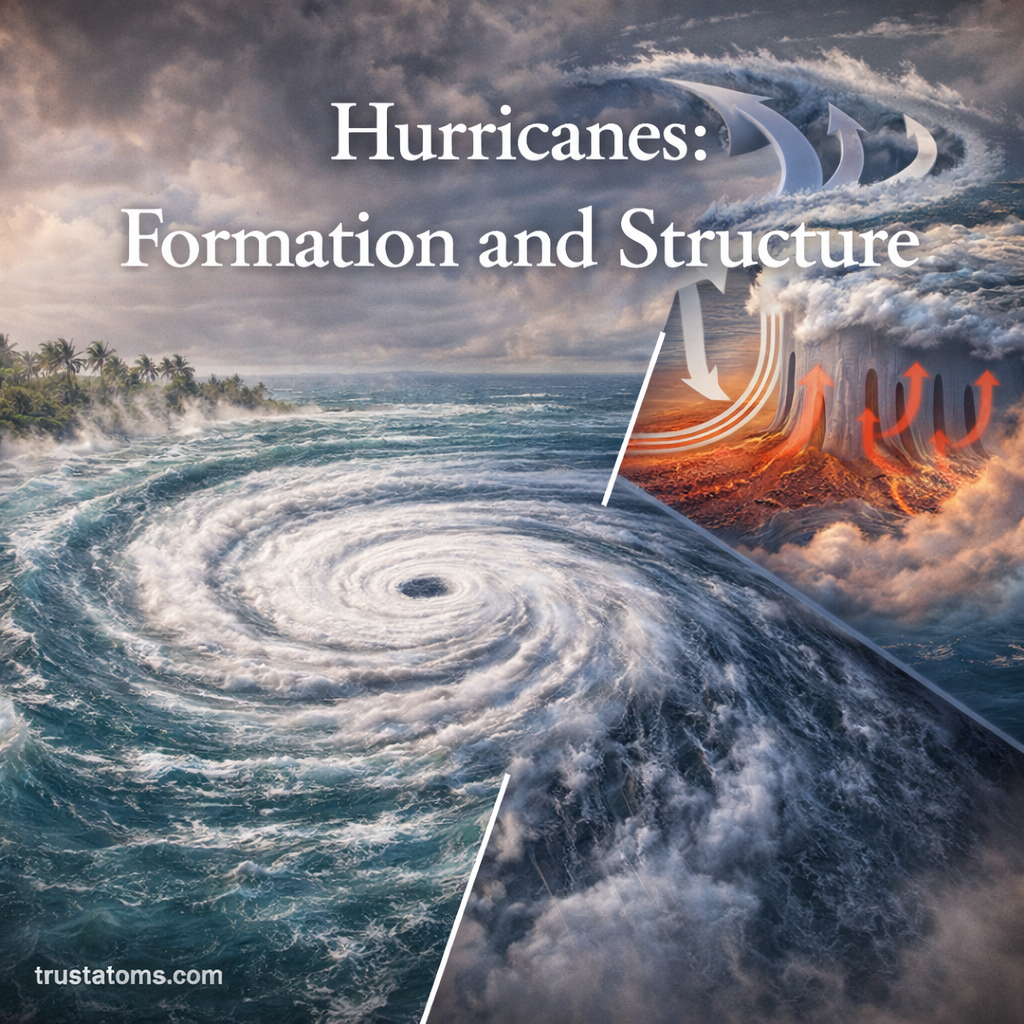
The Structure of a Hurricane
Hurricanes have a distinct structure made up of several key parts, each playing a role in the storm’s intensity.
The Eye
The eye is the calm center of the hurricane.
- Typically 20–40 miles wide
- Clear skies and light winds
- Surrounded by intense storm activity
Despite being the calmest part, it signals the presence of a powerful storm.
The Eyewall
The eyewall surrounds the eye and is the most dangerous part of the hurricane.
- Contains the strongest winds
- Produces the heaviest rainfall
- Features powerful updrafts
Damage is often most severe in areas impacted by the eyewall.
Rainbands
Rainbands are spiral bands of clouds and storms extending outward from the center.
- Can stretch hundreds of miles
- Produce heavy rain and gusty winds
- Often cause flooding and tornadoes
They give hurricanes their characteristic spiral appearance.
Outflow
Outflow occurs at the top of the hurricane.
- Air rises in the storm and spreads outward
- Helps maintain low pressure at the center
- Supports continued storm growth
Strong outflow is a sign of a well-developed hurricane.
The Role of Heat and Energy
Hurricanes are powered by heat from warm ocean water.
Energy Process
- Warm water evaporates into the atmosphere
- Rising air cools and condenses into clouds
- Heat is released during condensation
- This heat fuels further rising motion
This continuous cycle allows hurricanes to intensify.
Hurricane Categories: The Saffir-Simpson Scale
Hurricanes are classified based on wind speed using the Saffir-Simpson Hurricane Wind Scale.
Categories
- Category 1: 74–95 mph (minimal damage)
- Category 2: 96–110 mph (moderate damage)
- Category 3: 111–129 mph (major damage)
- Category 4: 130–156 mph (severe damage)
- Category 5: 157+ mph (catastrophic damage)
Categories 3–5 are considered major hurricanes.
What Weakens a Hurricane?
Hurricanes weaken when they lose access to their energy source or encounter unfavorable conditions.
Common Factors
- Moving over land (loss of warm water energy)
- Entering cooler waters
- Increased wind shear
- Interaction with other weather systems
Once weakened, hurricanes can transition into other types of storms.
Hazards Associated with Hurricanes
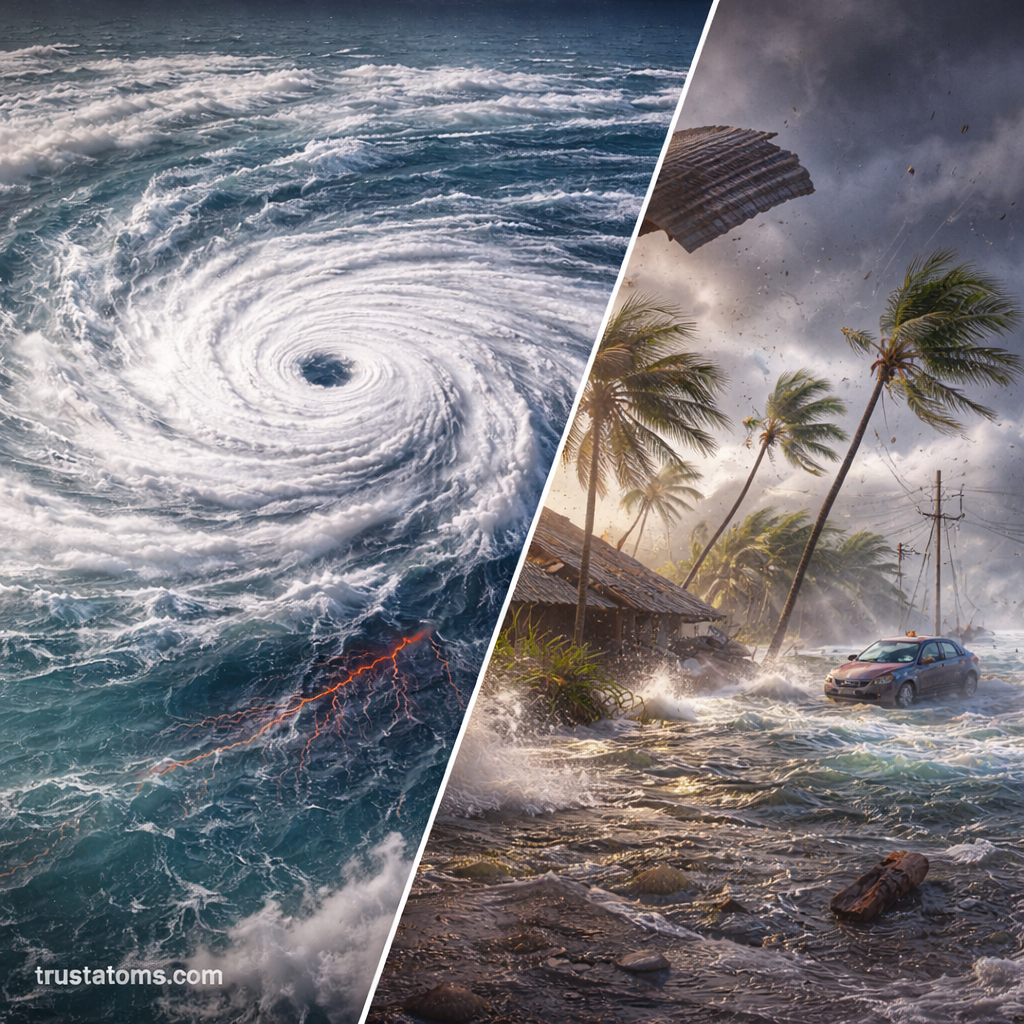
Hurricanes pose multiple dangers beyond strong winds.
Major Threats
- Storm surge – coastal flooding caused by rising sea levels
- Heavy rainfall – leading to inland flooding
- High winds – damaging structures and vegetation
- Tornadoes – often embedded within rainbands
Storm surge and flooding are often the deadliest effects.
Why Understanding Hurricanes Matters
Studying hurricanes is essential for protecting lives and property.
Key Benefits
- Improved forecasting and tracking
- Better evacuation planning
- Stronger building codes
- Increased public awareness
Advances in meteorology have significantly improved hurricane prediction, but preparation remains critical.
Final Thoughts
Hurricanes are complex systems driven by heat, moisture, and atmospheric dynamics. Their formation and structure reveal how energy moves through Earth’s climate system.
By understanding how hurricanes develop and behave, scientists and communities can better anticipate their impacts and reduce the risks associated with these powerful storms.