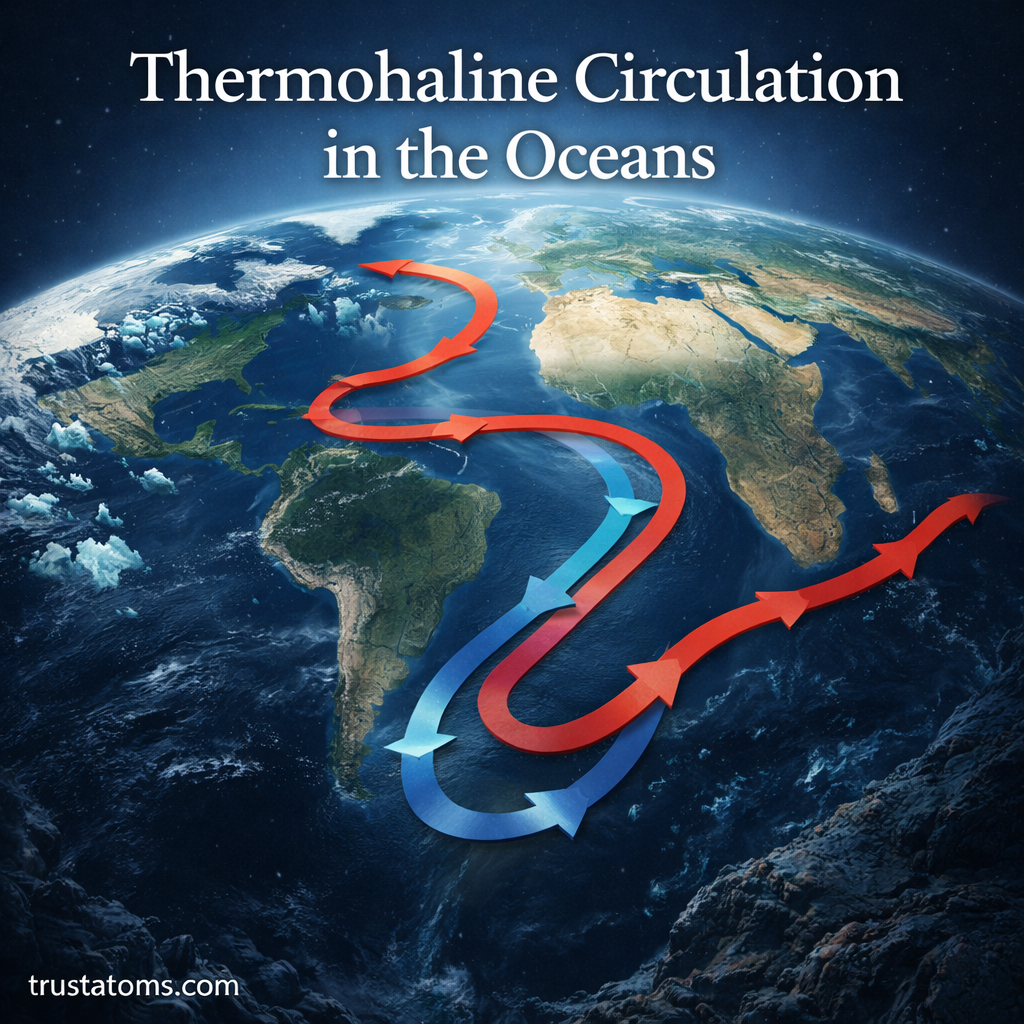
Thermohaline circulation is one of the most important processes in Earth’s ocean system. Often called the “global conveyor belt,” it is a large-scale movement of ocean water driven by differences in temperature (thermo) and salinity (haline).
This circulation plays a critical role in regulating global climate, distributing heat, and supporting marine ecosystems.
What Is Thermohaline Circulation?
Thermohaline circulation refers to the deep-ocean movement of water caused by density differences.
Water density is influenced by:
- Temperature (colder water is denser)
- Salinity (saltier water is denser)
When water becomes cold and salty, it sinks. When it is warmer or less salty, it rises. This continuous movement creates a global system of currents that connect all the world’s oceans.
How Thermohaline Circulation Works
The process begins in polar regions and continues through a slow, global loop.
Step-by-Step Process
- Cold, salty water forms near the poles
- Dense water sinks to the ocean floor
- Deep currents flow across ocean basins
- Water gradually rises in other regions (upwelling)
- Surface currents return the water to its origin
This cycle can take hundreds to thousands of years to complete.
Key Regions Where It Begins
Thermohaline circulation is most active in specific high-latitude areas.
North Atlantic Ocean
- Cold temperatures increase water density
- Sea ice formation leaves behind saltier water
- Dense water sinks and drives deep currents
Southern Ocean (Around Antarctica)
- Strong winds and cold conditions enhance mixing
- Major source of deep water formation
These regions act as “engines” of global ocean circulation.
The Global Conveyor Belt
The term “global conveyor belt” describes how ocean currents transport water around the planet.
Surface Currents
- Warm water moves from the equator toward the poles
- Helps regulate climate in coastal regions
Deep Currents
- Cold, dense water travels along the ocean floor
- Moves slowly but continuously
Together, these currents connect:
- The Atlantic Ocean
- The Pacific Ocean
- The Indian Ocean
Why Thermohaline Circulation Matters
This system has a profound impact on Earth’s environment.
Climate Regulation
- Transfers heat from the equator to the poles
- Helps maintain stable global temperatures
- Influences weather patterns
Example:
- Warmer conditions in parts of Europe are linked to ocean heat transport
Marine Ecosystems
- Brings nutrient-rich water to the surface (upwelling)
- Supports plankton growth
- Sustains entire food chains
Carbon Cycle
- Oceans absorb large amounts of carbon dioxide
- Deep currents store carbon for long periods
- Helps slow the rate of climate change
Upwelling and Downwelling
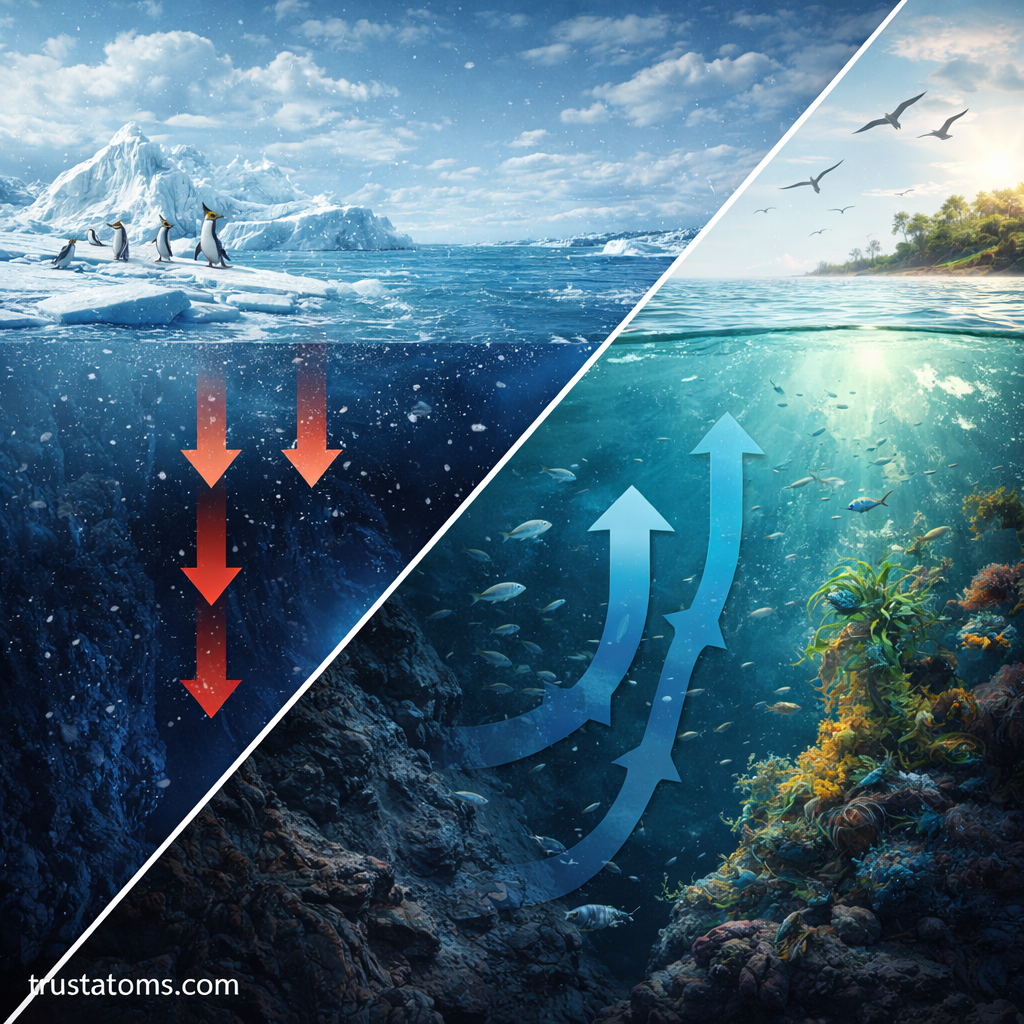
Two key processes are essential to thermohaline circulation.
Downwelling
- Occurs when dense water sinks
- Common in polar regions
- Drives deep ocean currents
Upwelling
- Occurs when deep water rises to the surface
- Brings nutrients to surface ecosystems
- Often found along coastlines and equatorial regions
Factors That Influence Thermohaline Circulation
Several variables affect how this system operates:
- Temperature changes
- Salinity variations (due to evaporation or freshwater input)
- Wind patterns
- Ice formation and melting
Even small changes in these factors can alter circulation patterns.
Effects of Climate Change
Climate change is beginning to impact thermohaline circulation.
Key Concerns
- Melting ice adds freshwater to oceans
- Reduced salinity lowers water density
- Slower sinking of water in polar regions
Potential Consequences
- Weakening of the global conveyor belt
- Changes in regional climates
- Disruption of marine ecosystems
Scientists are closely monitoring these changes due to their global implications.
How Scientists Study Thermohaline Circulation
Researchers use a variety of tools to understand ocean circulation:
- Satellite observations
- Ocean buoys and sensors
- Deep-sea probes
- Computer climate models
These tools help track temperature, salinity, and current movement over time.
Real-World Example: The Atlantic Meridional Overturning Circulation (AMOC)
The Atlantic Meridional Overturning Circulation is a key component of thermohaline circulation.
It involves:
- Northward flow of warm surface water
- Southward flow of cold deep water
Why it matters:
- Strong influence on climate in North America and Europe
- Changes in AMOC strength can impact weather patterns
Final Thoughts
Thermohaline circulation is a powerful and complex system that connects the world’s oceans and regulates Earth’s climate. Driven by differences in temperature and salinity, it moves water across vast distances and depths.
Understanding this system is essential for predicting climate changes, protecting marine ecosystems, and appreciating the interconnected nature of our planet.