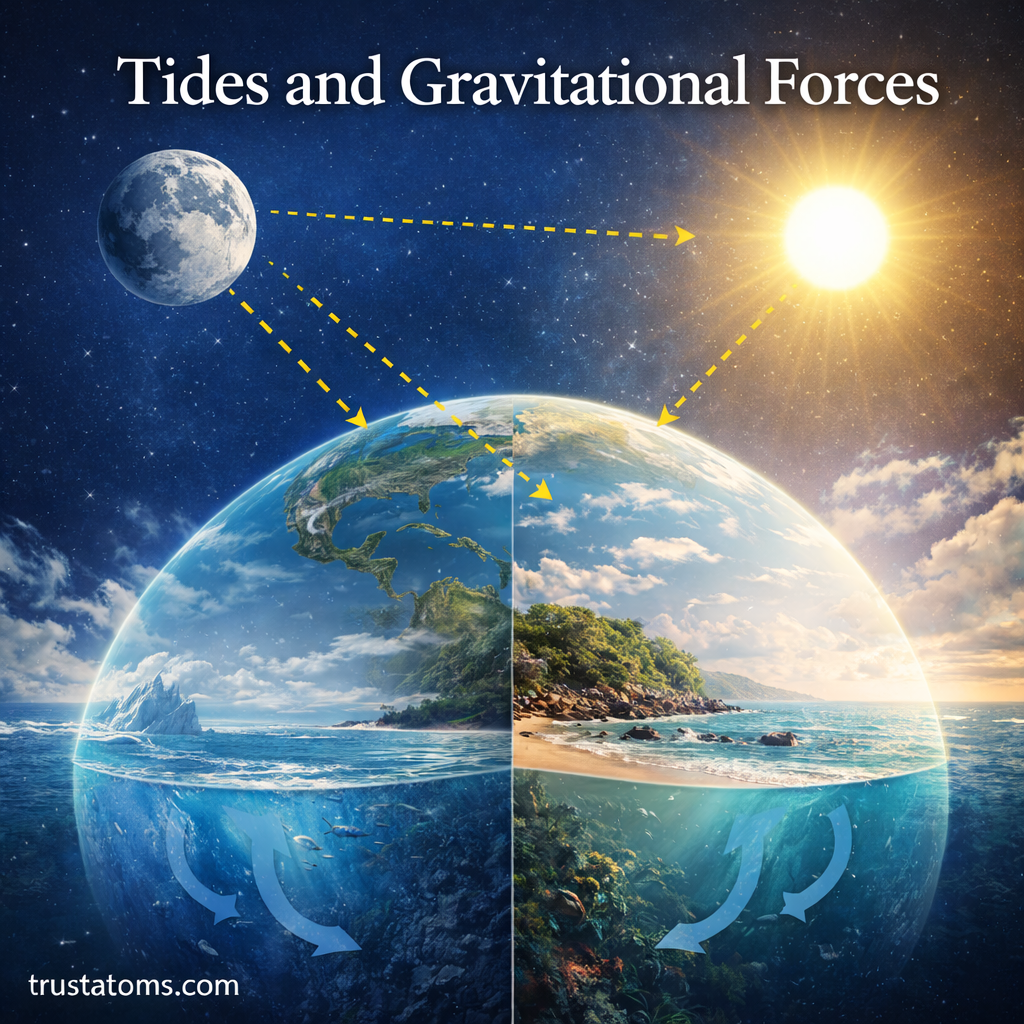
Tides are the regular rise and fall of sea levels along coastlines, driven primarily by gravitational forces. While they may seem simple—water moving in and out—they are the result of complex interactions between the Earth, the Moon, and the Sun.
Understanding tides is essential for navigation, coastal ecosystems, and even climate systems.
What Are Tides?
Tides are the periodic changes in sea level caused by gravitational attraction and the rotation of the Earth.
There are two main types:
- High tide: When water levels rise
- Low tide: When water levels fall
Most coastal areas experience two high tides and two low tides each day.
The Role of Gravity in Tides
Gravity is the primary force behind tides.
The Moon’s Influence
The Moon has the strongest effect on tides due to its proximity to Earth.
- Its gravitational pull draws ocean water toward it
- This creates a bulge of water on the side of Earth facing the Moon
- A second bulge forms on the opposite side due to inertia
These bulges are responsible for high tides.
The Sun’s Influence
Although the Sun is much larger than the Moon, it is farther away, so its effect is weaker but still significant.
- The Sun’s gravity enhances or reduces tidal effects
- It works together with the Moon to shape tidal patterns
How Earth’s Rotation Affects Tides
As the Earth rotates, different areas pass through tidal bulges.
This results in:
- Two high tides and two low tides roughly every 24 hours
- A cycle that repeats approximately every 12 hours and 25 minutes
The extra 25 minutes is due to the Moon’s orbit around Earth.
Types of Tides
Tidal patterns vary depending on geographic location.
Semidiurnal Tides
- Two high tides and two low tides of similar height each day
- Common along the Atlantic coast
Diurnal Tides
- One high tide and one low tide per day
- Found in some parts of the Gulf of Mexico
Mixed Tides
- Two high and two low tides with varying heights
- Common along the Pacific coast
Spring and Neap Tides
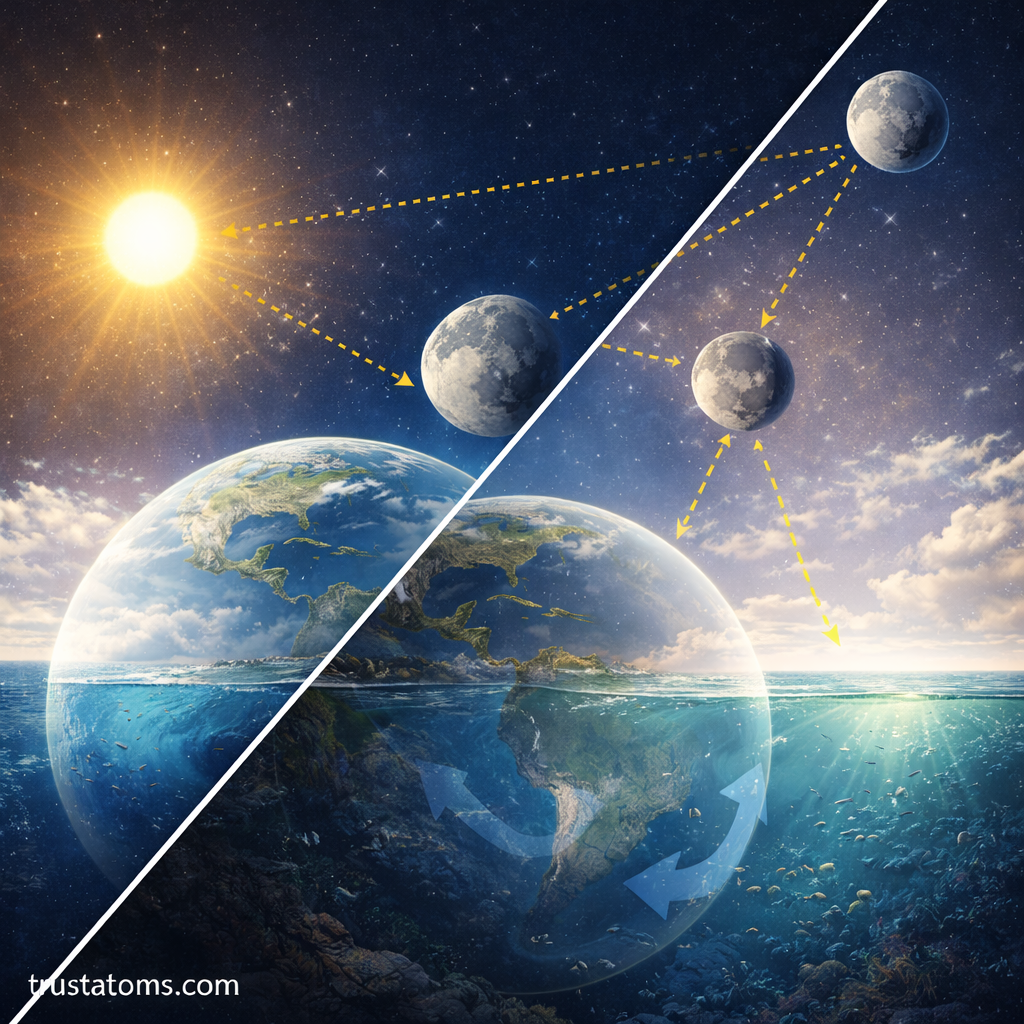
The alignment of the Earth, Moon, and Sun creates variations in tidal strength.
Spring Tides
Occur during full and new moons.
- Sun, Moon, and Earth are aligned
- Gravitational forces combine
- Results in higher high tides and lower low tides
Neap Tides
Occur during the first and third quarter moons.
- Sun and Moon are at right angles
- Gravitational forces partially cancel out
- Results in weaker tides
Tidal Range
Tidal range is the difference between high tide and low tide levels.
Factors That Affect Tidal Range
- Coastal shape
- Ocean basin size
- Seafloor topography
Examples:
- Narrow bays can amplify tides
- Open coastlines often have smaller tidal ranges
Real-World Example: Bay of Fundy
The Bay of Fundy, located between Canada’s provinces of New Brunswick and Nova Scotia, has the highest tidal range in the world.
- Tidal range can exceed 15 meters
- Unique geography funnels water into a narrow area
- Demonstrates how local conditions affect tides
Why Tides Matter
Tides play an important role in both natural systems and human activities.
Coastal Ecosystems
- Support intertidal habitats
- Provide nutrients for marine life
- Influence migration and feeding patterns
Navigation and Coastal Activities
- Affect ship movement and harbor access
- Important for fishing and boating
- Influence coastal construction
Energy Production
Tides can be used to generate renewable energy.
- Tidal turbines convert water movement into electricity
- Reliable and predictable energy source
How Scientists Study Tides
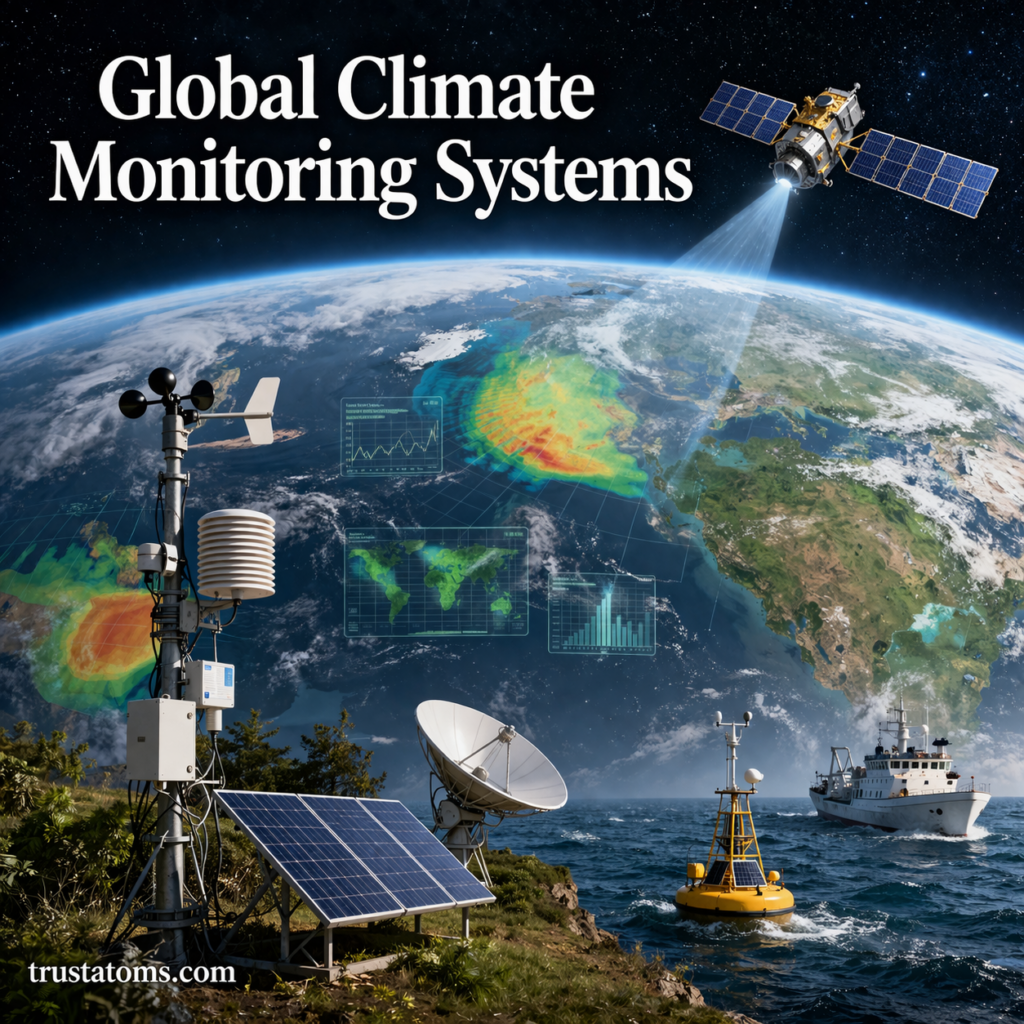
Scientists use various tools to monitor and predict tides:
- Tide gauges
- Satellite observations
- Mathematical models
These tools help forecast tidal changes and improve coastal planning.
Final Thoughts
Tides are a powerful demonstration of how gravitational forces shape Earth’s natural systems. Driven mainly by the Moon and influenced by the Sun, tides affect everything from marine ecosystems to human activity.
By understanding tides and gravitational forces, we gain deeper insight into the dynamic relationship between Earth and space—and how it impacts life on our planet.