Measuring distance on Earth is simple—we use miles or kilometers. But in space, those units quickly become impractical. The distances between planets, stars, and galaxies are so vast that astronomers rely on specialized units like the light-year and the astronomical unit.
This guide explains what these units mean, how they’re used, and why they’re essential for understanding the scale of the universe.
Why We Need Special Units for Space
Space is unimaginably large. Using everyday units would result in enormous, hard-to-read numbers.
Example:
- Distance from Earth to the Sun: about 93 million miles
- Distance to the nearest star: over 25 trillion miles
To simplify these measurements, astronomers use:
- Astronomical Units (AU) for distances within our solar system
- Light-years (ly) for distances beyond our solar system
What Is an Astronomical Unit (AU)?
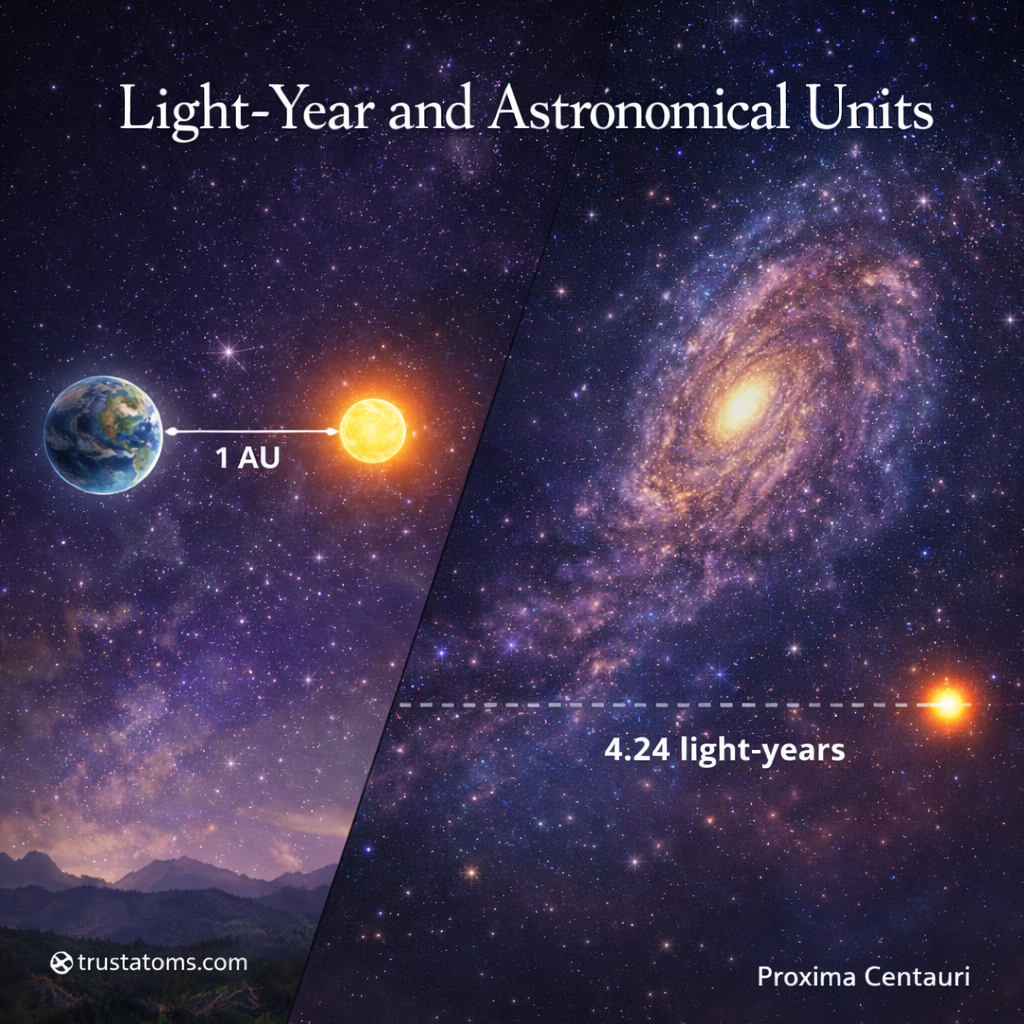
An astronomical unit (AU) is the average distance between Earth and the Sun.
Key Facts:
- 1 AU ≈ 93 million miles (150 million kilometers)
- Used primarily within our solar system
- Based on Earth’s orbit
Why It’s Useful:
Instead of saying Jupiter is about 484 million miles from the Sun, astronomers say:
- Jupiter is about 5.2 AU from the Sun
This makes comparisons simpler and more intuitive.
Distances in Our Solar System Using AU
Here’s how some planets compare using astronomical units:
- Mercury: ~0.39 AU
- Venus: ~0.72 AU
- Earth: 1 AU
- Mars: ~1.52 AU
- Jupiter: ~5.2 AU
- Neptune: ~30 AU
Using AU helps visualize how spread out the solar system really is.
What Is a Light-Year?
A light-year is the distance that light travels in one year.
Key Facts:
- Light travels at about 186,000 miles per second (300,000 km/s)
- 1 light-year ≈ 5.88 trillion miles (9.46 trillion kilometers)
- Used for distances between stars and galaxies
Important Clarification:
A light-year measures distance, not time.
Why Light-Years Are Important
Light-years help us understand distances far beyond our solar system.
Examples:
- The nearest star (Proxima Centauri) is about 4.24 light-years away
- The Milky Way galaxy is about 100,000 light-years across
Using miles here would be overwhelming and impractical.
Light-Years and Looking Back in Time
When we observe distant objects, we’re actually seeing them as they were in the past.
Why?
- Light takes time to travel
- If a star is 10 light-years away, we see it as it was 10 years ago
This means:
- Telescopes act like time machines
- The farther we look, the further back in time we see
Astronomical Unit vs Light-Year
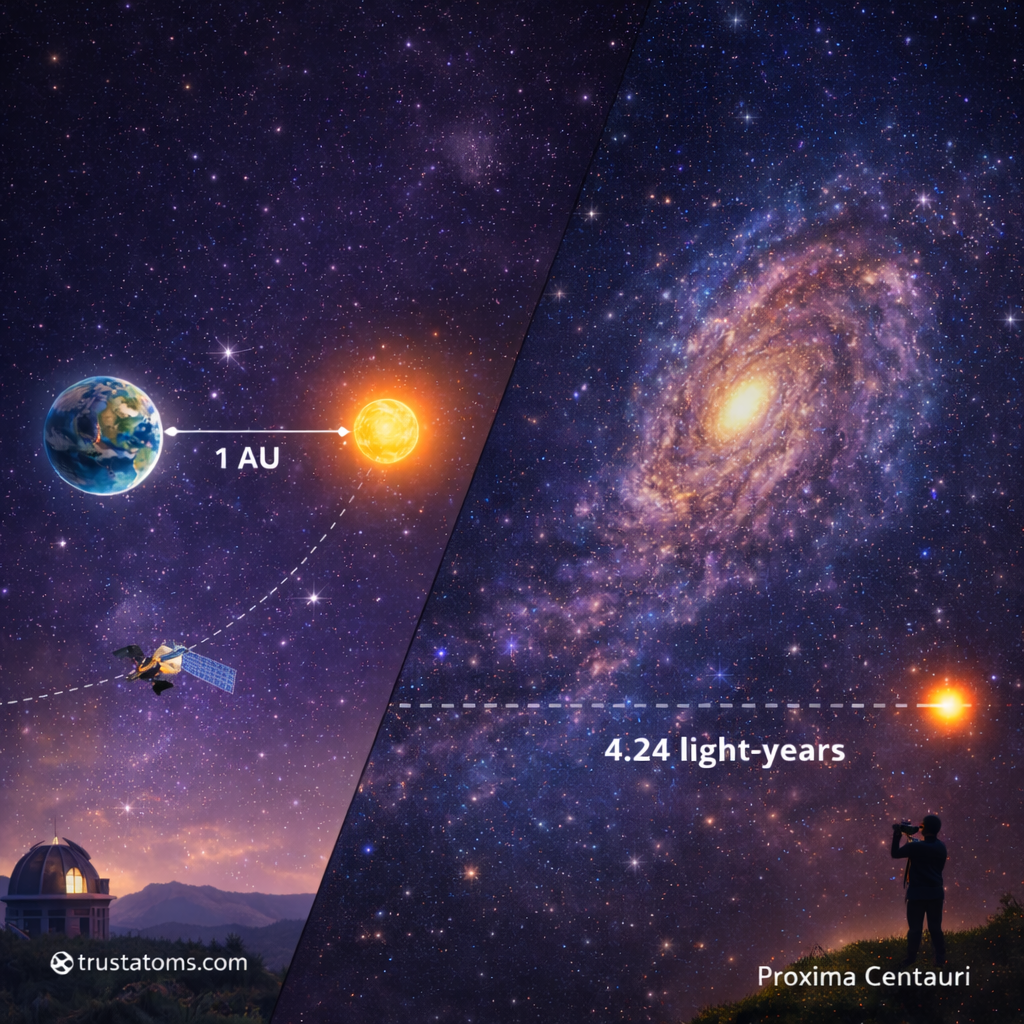
These two units serve different purposes depending on the scale.
Astronomical Unit (AU)
- Best for solar system distances
- Based on Earth–Sun distance
- Easier for planetary comparisons
Light-Year (ly)
- Best for interstellar and galactic distances
- Based on speed of light
- Useful for understanding cosmic scale
How Astronomers Use These Units Together
Astronomers often switch between units depending on what they’re studying.
Common Uses:
- Planet distances → AU
- Star distances → Light-years
- Galaxy distances → Light-years (or even larger units like parsecs)
This flexibility helps scientists communicate clearly across different scales.
Real-World Applications
Understanding these units has practical and scientific value.
Space Exploration
- Helps plan missions and trajectories
- Used in spacecraft navigation
Astronomy Research
- Essential for mapping stars and galaxies
- Helps measure expansion of the universe
Education and Awareness
- Makes complex distances easier to grasp
- Helps people understand the scale of space
Common Mistakes to Avoid
Beginners often misunderstand these concepts. Here are a few things to watch out for:
- Thinking a light-year measures time instead of distance
- Mixing up AU and light-years
- Underestimating how large a light-year really is
- Assuming distances in space are fixed (they can change over time)
Final Thoughts
Astronomical units and light-years are essential tools for understanding the universe. They simplify massive distances and make space more approachable.
Once you understand these units:
- You can better grasp the scale of the solar system
- You can appreciate how far away stars and galaxies really are
- You gain a clearer perspective on our place in the universe
These measurements don’t just describe distance—they help tell the story of space itself.