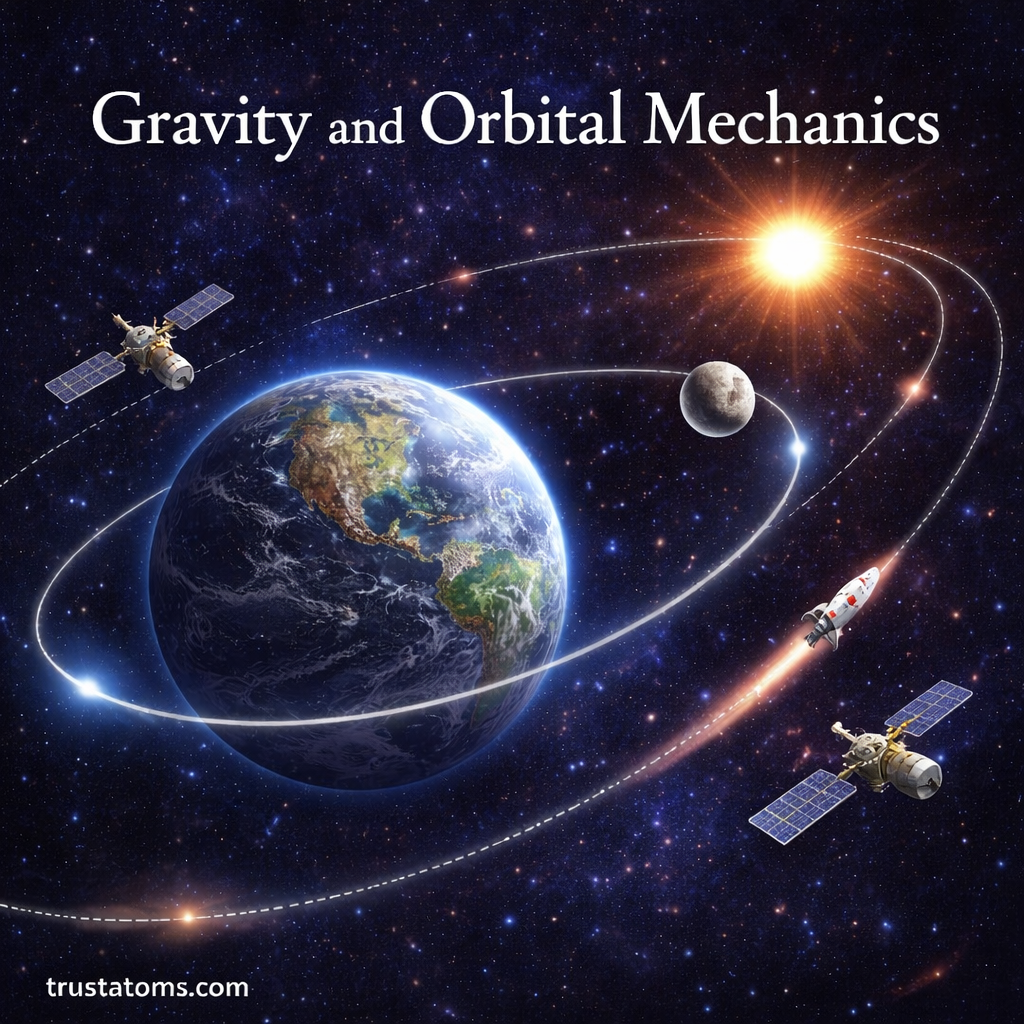
Gravity and orbital mechanics explain how objects move through space—from planets orbiting stars to satellites circling Earth. These principles are essential for understanding the structure of our solar system, launching spacecraft, and predicting motion in space.
By studying how gravity works and how objects respond to it, scientists can accurately model everything from moon orbits to interplanetary travel.
What Is Gravity?
Gravity is a fundamental force that attracts objects with mass toward one another. The more massive an object is, the stronger its gravitational pull.
Key characteristics of gravity
- Acts between all objects with mass
- Gets stronger with larger mass
- Weakens as distance increases
- Governs motion on both Earth and in space
Gravity is what keeps planets in orbit around stars and moons in orbit around planets.
What Is Orbital Mechanics?
Orbital mechanics is the study of how objects move under the influence of gravity. It focuses on predicting the paths—or orbits—of objects in space.
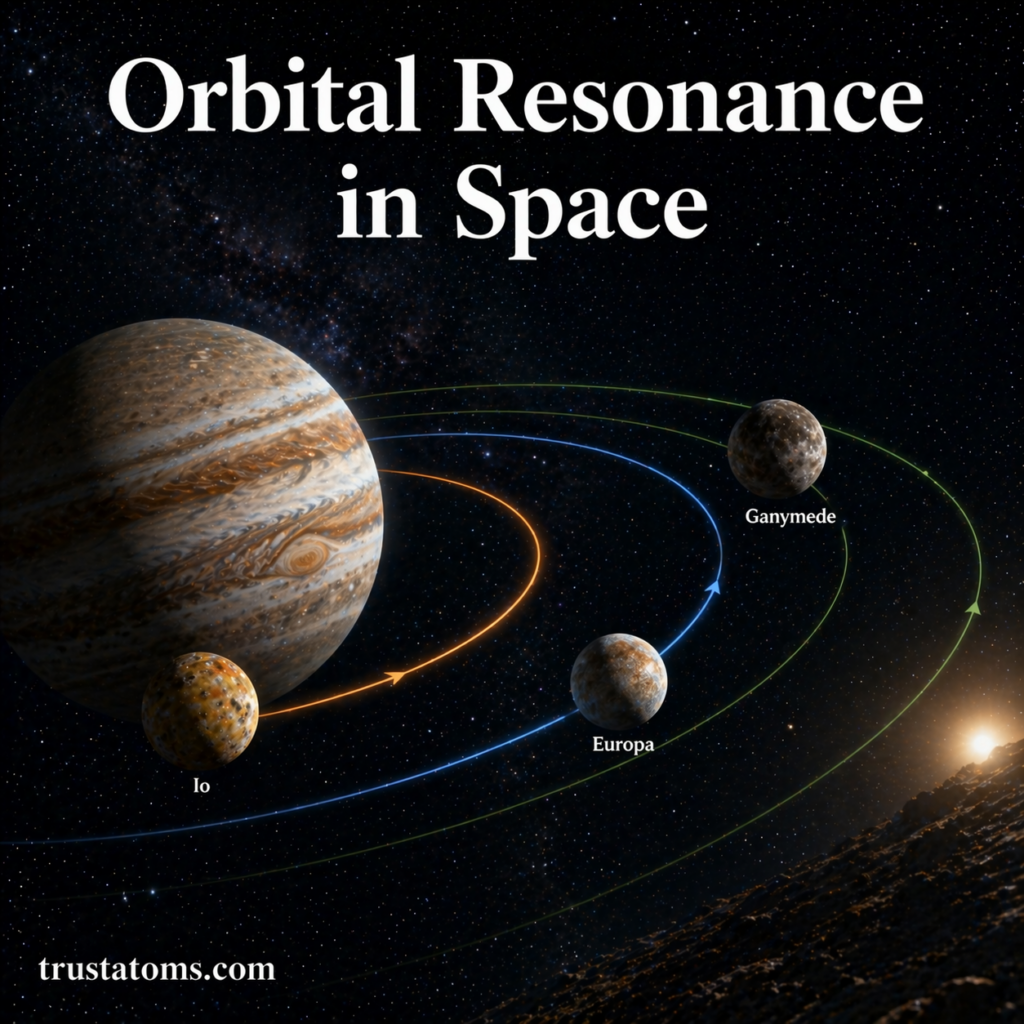
These orbits can take different shapes depending on speed, mass, and distance.
Common types of orbits
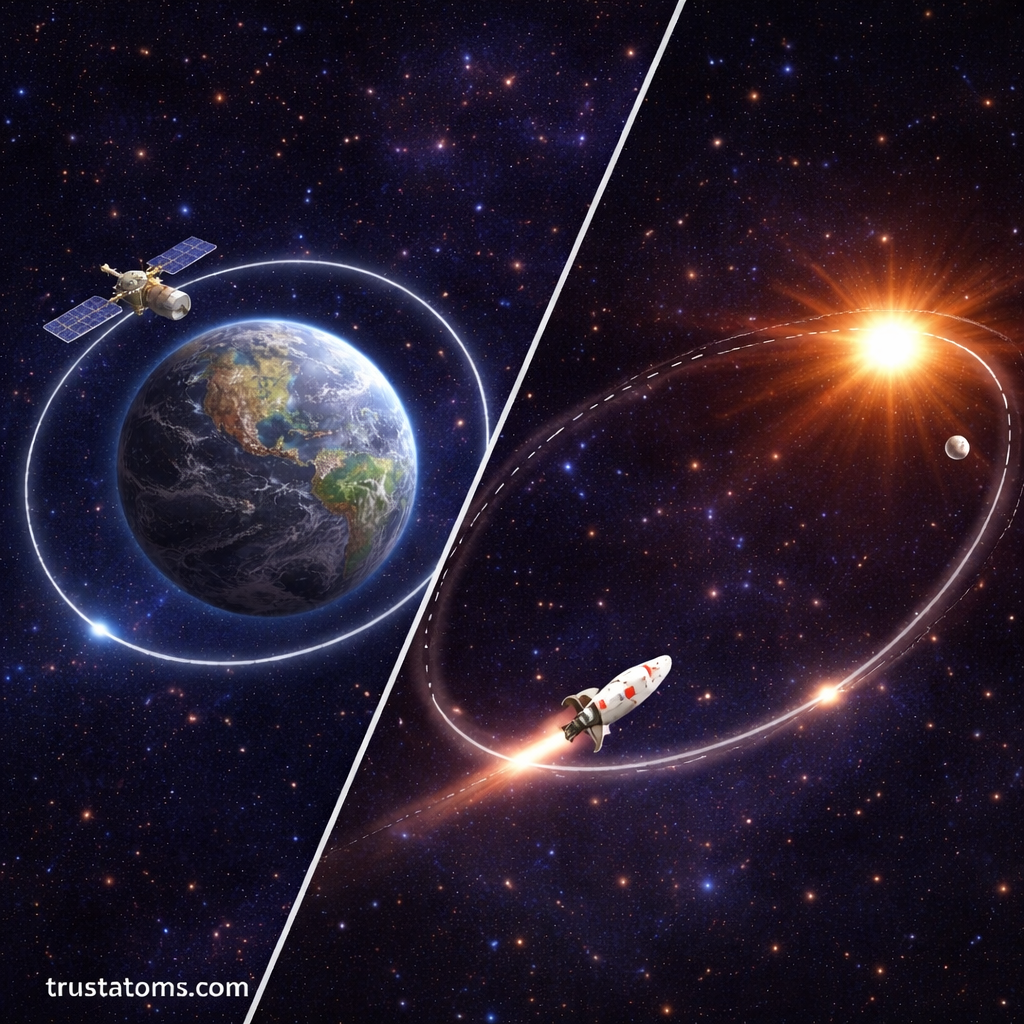
- Circular orbits: Objects move in a constant circular path
- Elliptical orbits: Most natural orbits are slightly stretched (oval-shaped)
- Parabolic or hyperbolic paths: Objects pass by and escape gravitational pull
How Orbits Work
An orbit happens when an object moves forward while being pulled inward by gravity. This balance creates a stable path around another object.
Simple explanation
- Gravity pulls the object inward
- Forward motion keeps it from falling straight down
- The result is a curved path (orbit)
If the speed is just right, the object continuously “falls around” the larger body instead of crashing into it.
Key Forces in Orbital Motion
Two main factors determine how an object behaves in orbit.
1. Gravitational force
- Pulls objects toward each other
- Depends on mass and distance
2. Velocity (speed and direction)
- Determines how fast an object moves
- Affects the shape and stability of the orbit
Balance between the two
- Too little speed → object falls inward
- Too much speed → object escapes into space
- Just the right speed → stable orbit
Kepler’s Laws of Planetary Motion
Johannes Kepler developed three laws that describe how planets move around the Sun.
First law: Elliptical orbits
- Planets move in elliptical paths
- The Sun is at one focus of the ellipse
Second law: Equal areas in equal time
- Planets move faster when closer to the Sun
- They move slower when farther away
Third law: Orbital period relationship
- The time it takes to orbit depends on distance from the Sun
- Farther planets take longer to complete an orbit
Gravity and Satellites
Satellites rely on orbital mechanics to stay in position around Earth. These can be natural (like the Moon) or artificial (like communication satellites).
How satellites stay in orbit
- Launched at high speeds
- Balanced between Earth’s gravity and forward motion
- Continuously falling around Earth without hitting it
Common satellite uses
- GPS navigation
- Weather monitoring
- Communication systems
- Scientific observation
Escape Velocity
Escape velocity is the speed an object must reach to break free from a planet’s gravitational pull without further propulsion.
Key points
- Depends on the planet’s mass and radius
- Earth’s escape velocity is about 11.2 km/s
- Rockets must reach this speed to leave Earth’s gravity
If an object doesn’t reach escape velocity, it will fall back or remain in orbit.
Why Orbital Mechanics Matters
Orbital mechanics is essential for modern science and technology.
Real-world applications
- Planning space missions
- Launching satellites
- Navigating spacecraft
- Predicting asteroid paths
- Understanding planetary systems
Without these principles, space exploration would not be possible.
Challenges in Orbital Mechanics
While the basic concepts are straightforward, real-world applications can be complex.
Common challenges
- Gravitational influences from multiple bodies
- Atmospheric drag affecting low-Earth orbits
- Precise calculations required for mission success
- Long-term orbital stability
Advanced computer models are used to simulate and predict these conditions.
Final Thoughts
Gravity and orbital mechanics form the foundation of how objects move in space. From planets orbiting stars to satellites circling Earth, these principles explain the motion of nearly everything in the universe.
As technology advances, our understanding of orbital mechanics continues to improve—allowing for more ambitious missions and deeper exploration of space.