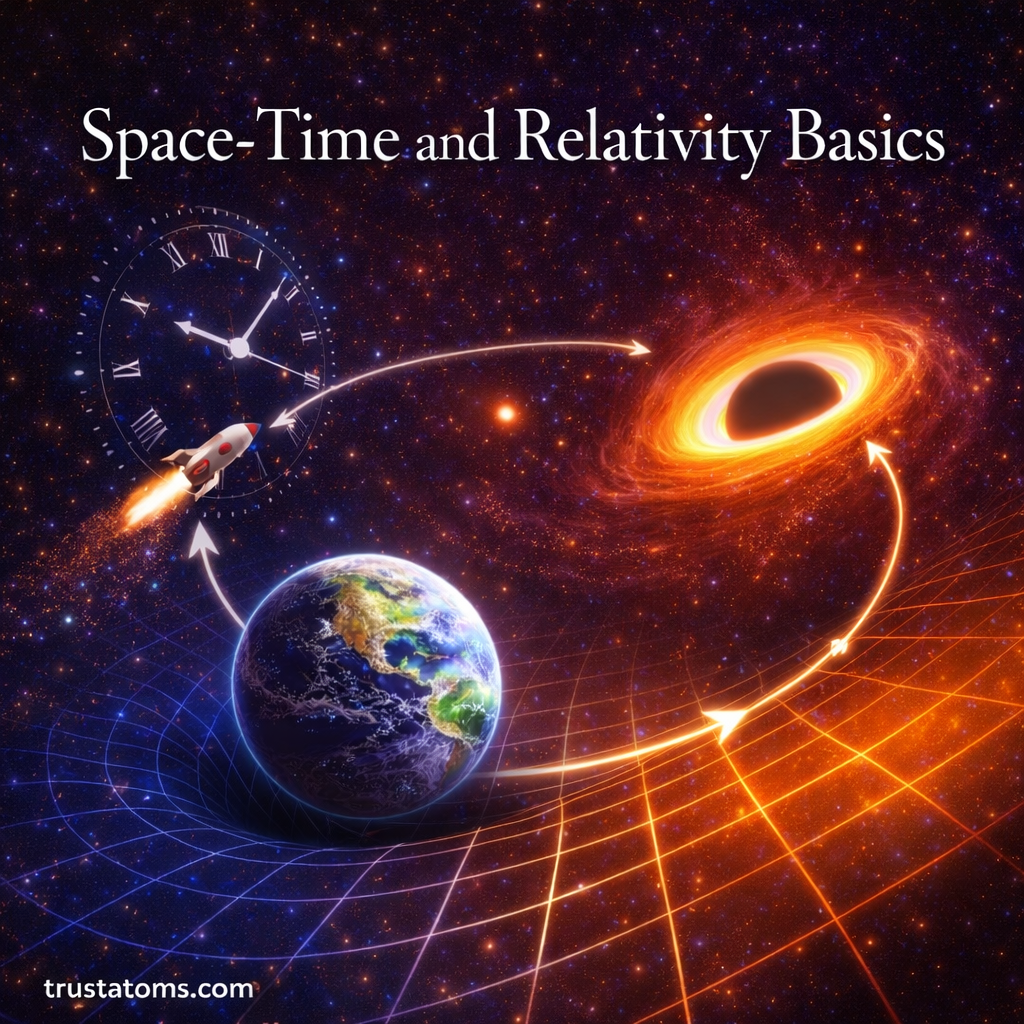
Space-time and relativity are fundamental concepts in modern physics that explain how space and time are connected—and how gravity, motion, and even light behave in the universe.
Developed by Albert Einstein, the theory of relativity revolutionized our understanding of the cosmos, showing that space and time are not fixed but dynamic and interconnected.
What Is Space-Time?
Space-time is the combination of the three dimensions of space (length, width, height) and the dimension of time into a single framework.
Instead of thinking of space and time separately, modern physics treats them as one unified system.
Key idea
- Everything exists within space-time
- Events are defined by both location and time
- Space and time influence each other
This concept allows scientists to describe motion and gravity more accurately.
What Is Relativity?
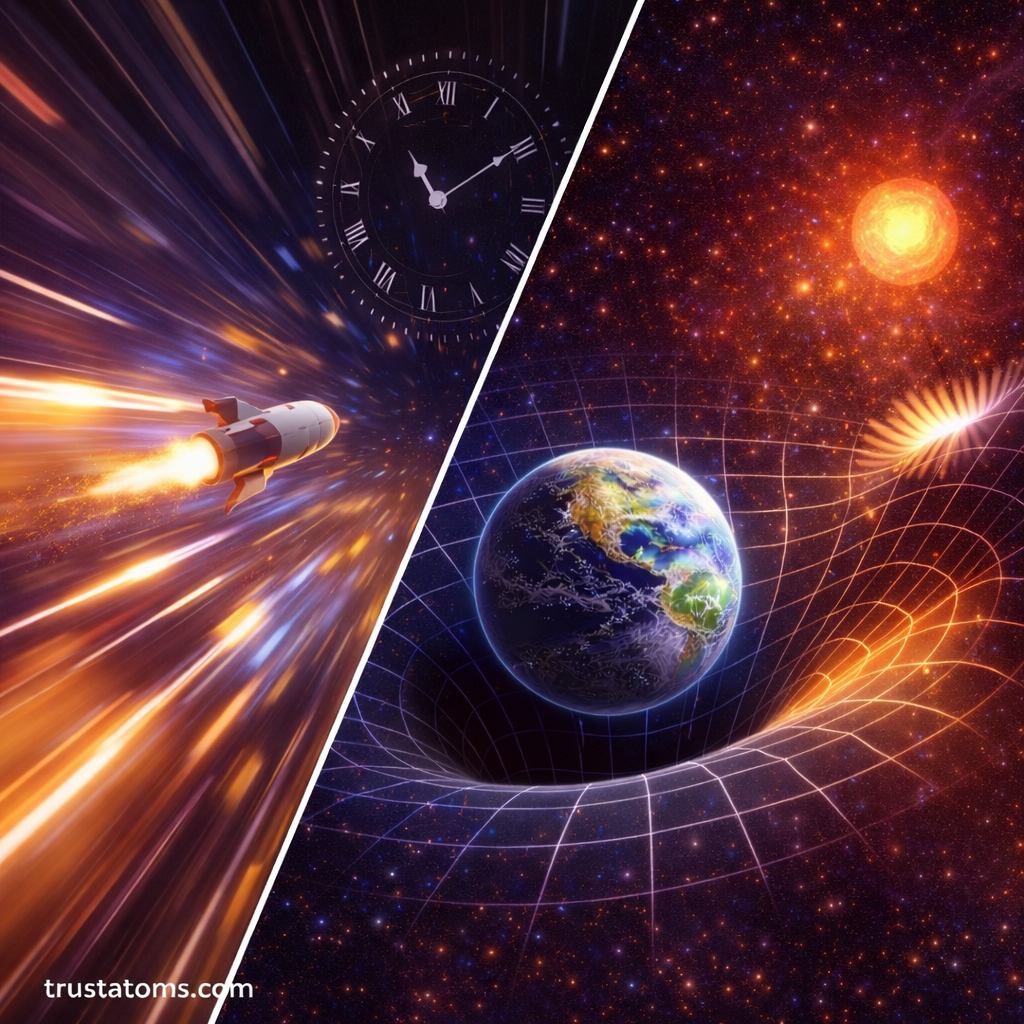
Relativity is a theory that explains how measurements of space and time change depending on speed and gravity.
There are two main parts to relativity:
1. Special Relativity
- Deals with objects moving at constant speeds
- Focuses on motion near the speed of light
- Shows that time and length can change depending on speed
2. General Relativity
- Explains gravity as a result of space-time curvature
- Describes how massive objects bend space-time
- Applies to planets, stars, and galaxies
Special Relativity: Motion and Time
Special relativity introduced the idea that time is not the same for everyone.
Key principles
- The speed of light is constant for all observers
- Time slows down for objects moving at high speeds
- Length contracts in the direction of motion
Example
If a spacecraft travels close to the speed of light, time for those on board would pass more slowly compared to someone on Earth. This effect is known as time dilation.
General Relativity: Gravity as Curved Space-Time
General relativity changed how we understand gravity. Instead of being just a force, gravity is the result of massive objects bending space-time.
How it works
- Massive objects (like planets and stars) curve space-time
- Other objects move along these curves
- This creates the effect we perceive as gravity
Simple analogy
Imagine placing a heavy ball on a stretched fabric. The fabric bends, and smaller objects roll toward it. This is similar to how space-time behaves around massive objects.
Effects of Relativity
Relativity leads to several fascinating and measurable effects.
Key effects
- Time dilation (time slows near high speeds or strong gravity)
- Gravitational lensing (light bends around massive objects)
- Redshift (light stretches due to motion or gravity)
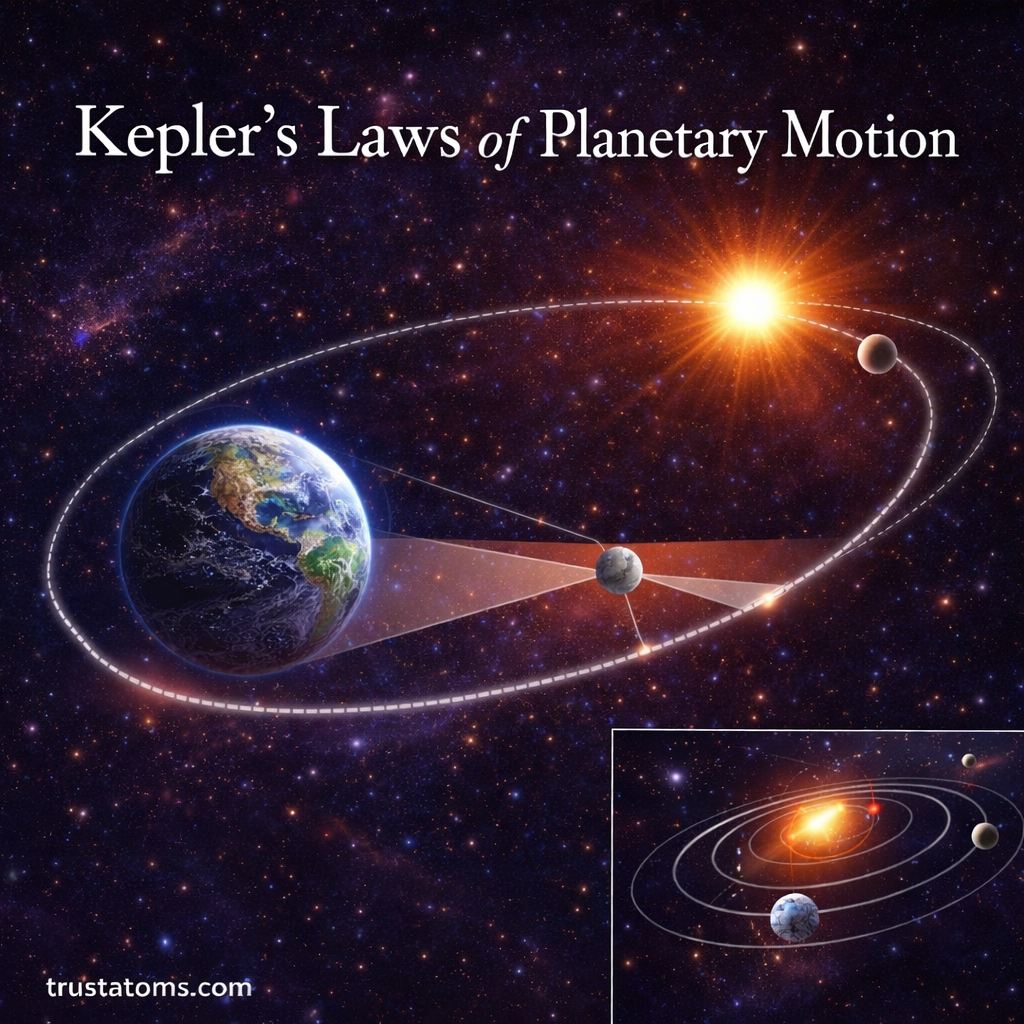
- Orbital changes due to curved space-time
These effects have been observed and confirmed through experiments and astronomical observations.
Why Space-Time Matters
Understanding space-time helps scientists explain complex phenomena in the universe.
What it helps us understand
- The motion of planets and galaxies
- The behavior of black holes
- The expansion of the universe
- The path of light through space
Without space-time, many cosmic events would be impossible to explain.
Real-World Applications
Relativity is not just theoretical—it has practical uses in everyday technology.
Examples
- GPS systems account for time dilation to maintain accuracy
- Satellite communication relies on precise time measurements
- Space missions use relativity for navigation and timing
Even small relativistic effects can make a big difference in high-precision systems.
Limitations and Ongoing Research
While relativity is highly accurate, scientists continue to explore its limits.
Current challenges
- Combining relativity with quantum mechanics
- Understanding extreme environments like black holes
- Exploring the nature of dark matter and dark energy
Research continues to expand our understanding of space-time and the universe.
Final Thoughts
Space-time and relativity transformed how we see the universe. By showing that space and time are connected and influenced by motion and gravity, these ideas opened the door to modern physics and cosmology.
From explaining planetary motion to predicting black holes, relativity remains one of the most powerful tools for understanding the universe.