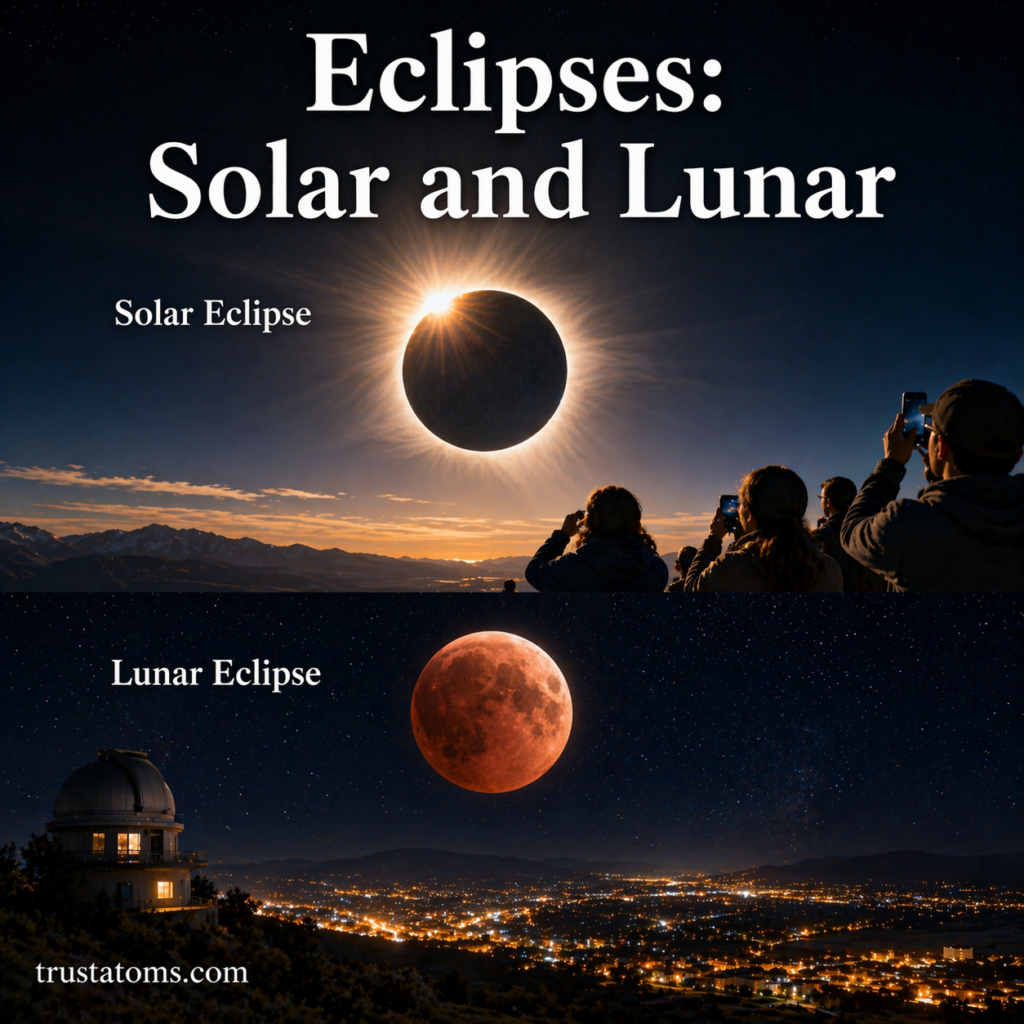
Eclipses are among the most dramatic and awe-inspiring events in the sky. They occur when the Sun, Earth, and Moon align in a precise way, causing one object to block the light of another.
There are two main types of eclipses—solar eclipses and lunar eclipses—and each offers a unique perspective on how our solar system works.
What Is an Eclipse?
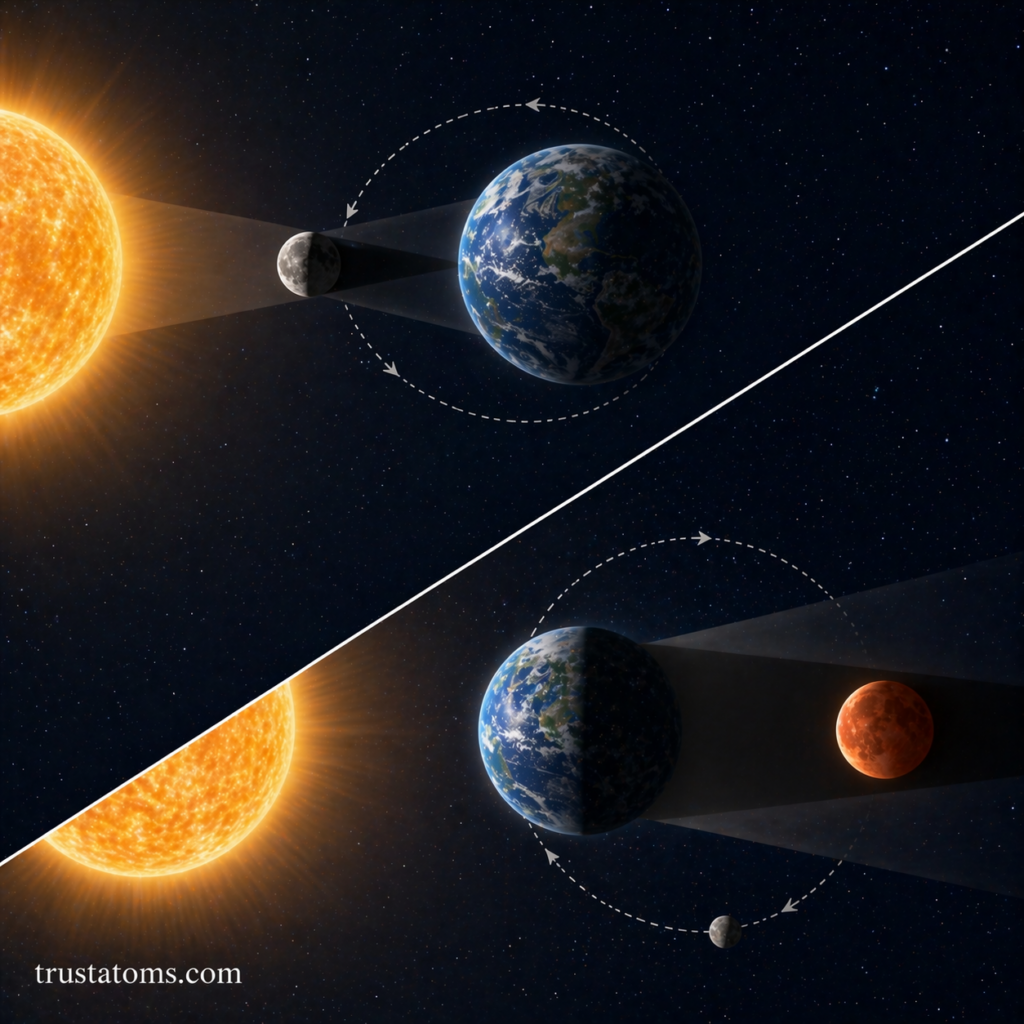
An eclipse happens when one celestial body moves into the shadow of another.
In simple terms:
- A solar eclipse occurs when the Moon blocks the Sun
- A lunar eclipse occurs when Earth blocks sunlight from reaching the Moon
These events depend on perfect alignment, which doesn’t happen every month.
Why Eclipses Don’t Happen Every Month
Even though the Moon orbits Earth every ~29.5 days, eclipses are relatively rare.
The reason:
- The Moon’s orbit is tilted about 5 degrees relative to Earth’s orbit around the Sun
- Most of the time, the Moon passes slightly above or below the alignment needed for an eclipse
Eclipses only occur when the Moon is near points called nodes, where its orbit crosses Earth’s orbital plane.
Solar Eclipses Explained
A solar eclipse occurs when the Moon passes between Earth and the Sun, casting a shadow on Earth.
Types of solar eclipses:
1. Total Solar Eclipse
- The Moon completely covers the Sun
- The Sun’s outer atmosphere (corona) becomes visible
- Only visible from a narrow path on Earth
2. Partial Solar Eclipse
- Only part of the Sun is covered
- Seen over a wider area
3. Annular Solar Eclipse
- The Moon is farther from Earth and appears smaller
- Leaves a bright “ring of fire” around the Sun
What Happens During a Solar Eclipse?
During a total solar eclipse:
- Daylight briefly turns to twilight
- Temperatures may drop slightly
- Stars and planets can become visible
- The Sun’s corona glows around the Moon
Important safety note:
Looking directly at the Sun during a solar eclipse without proper protection can damage your eyes. Always use certified eclipse glasses or indirect viewing methods.
Lunar Eclipses Explained
A lunar eclipse occurs when Earth moves between the Sun and the Moon, casting a shadow on the Moon.
Types of lunar eclipses:
1. Total Lunar Eclipse
- The entire Moon passes through Earth’s shadow
- The Moon often appears red (a “blood moon”)
2. Partial Lunar Eclipse
- Only part of the Moon enters Earth’s shadow
3. Penumbral Lunar Eclipse
- The Moon passes through Earth’s outer shadow
- The dimming is subtle and harder to notice
Why the Moon Turns Red
During a total lunar eclipse, the Moon can take on a reddish color.
This happens because:
- Earth’s atmosphere bends sunlight toward the Moon
- Shorter wavelengths (blue light) scatter
- Longer wavelengths (red/orange light) reach the Moon
This is similar to how sunsets appear red on Earth.
Key Differences Between Solar and Lunar Eclipses
Solar Eclipse
- Occurs during a new moon
- The Moon blocks the Sun
- Visible only from specific regions
- Requires eye protection
Lunar Eclipse
- Occurs during a full moon
- Earth’s shadow covers the Moon
- Visible from anywhere on the night side of Earth
- Safe to view with the naked eye
How Often Do Eclipses Occur?
Eclipses follow predictable cycles.
General patterns:
- At least 2 solar eclipses occur each year
- Between 2 and 5 solar eclipses can happen annually
- Lunar eclipses occur 2 to 3 times per year
However, seeing a total solar eclipse from the same location is rare—it may happen only once every few hundred years.
The Science Behind Eclipse Paths
For solar eclipses, the Moon’s shadow creates different viewing zones:
- Umbra – the darkest shadow (total eclipse)
- Penumbra – partial shadow (partial eclipse)
The narrow path of the umbra is why total solar eclipses are only visible from specific locations.
Cultural and Historical Significance
Eclipses have fascinated humans for thousands of years.
Historically:
- Seen as omens or supernatural events
- Recorded in ancient texts and calendars
- Used to predict celestial cycles
Today, eclipses are celebrated as scientific and educational events.
How to Observe Eclipses Safely
For solar eclipses:
- Use certified eclipse glasses
- Avoid looking directly at the Sun without protection
- Try pinhole projectors for indirect viewing
For lunar eclipses:
- No special equipment needed
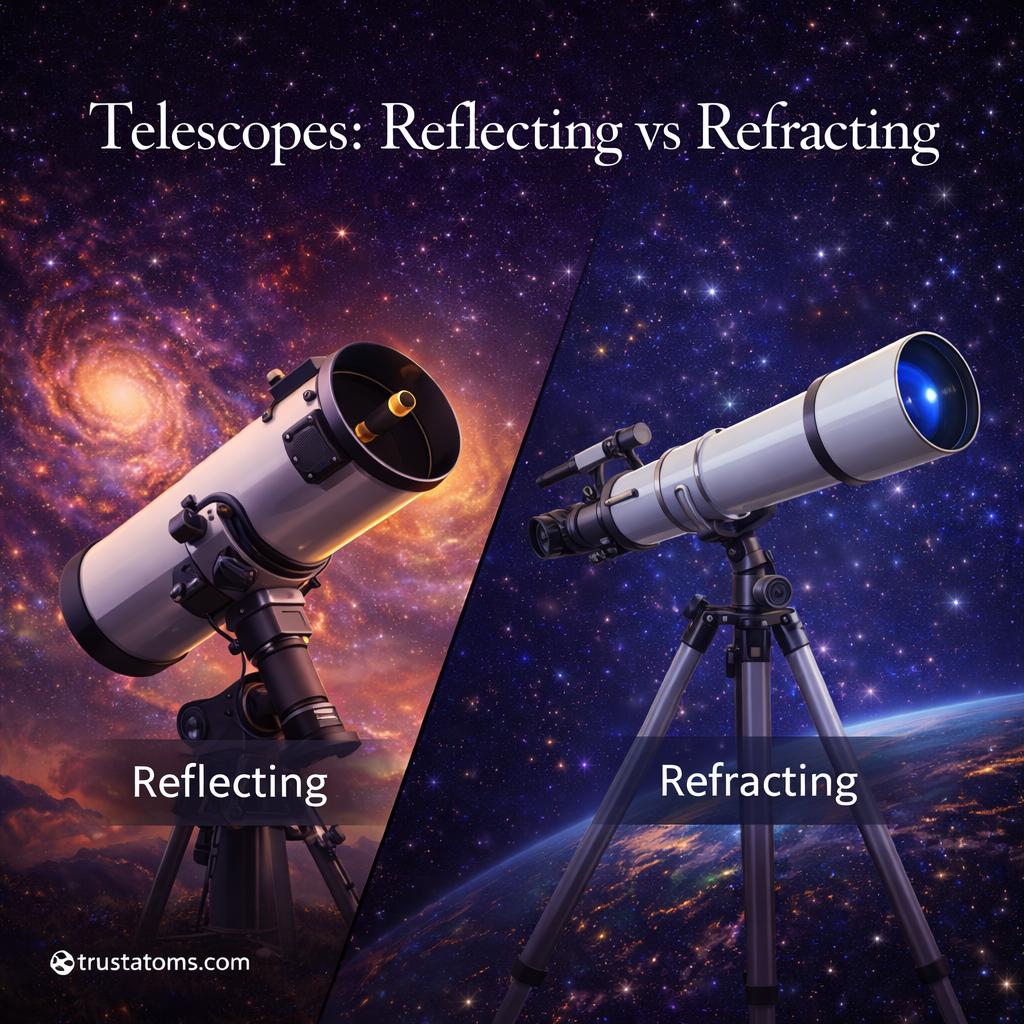
- Binoculars or telescopes enhance the view
- Best seen in dark, clear skies
Why Eclipses Matter
Eclipses are more than just visual spectacles—they help scientists study:
- The Sun’s corona
- Earth’s atmosphere
- Orbital mechanics
They also provide a powerful reminder of the precise and predictable motion of celestial bodies.
Final Thoughts
Solar and lunar eclipses showcase the beauty and precision of our solar system. These rare alignments between the Sun, Earth, and Moon create unforgettable experiences for observers around the world.
Whether it’s the eerie darkness of a total solar eclipse or the glowing red hue of a lunar eclipse, these events connect us to the larger universe in a direct and meaningful way.