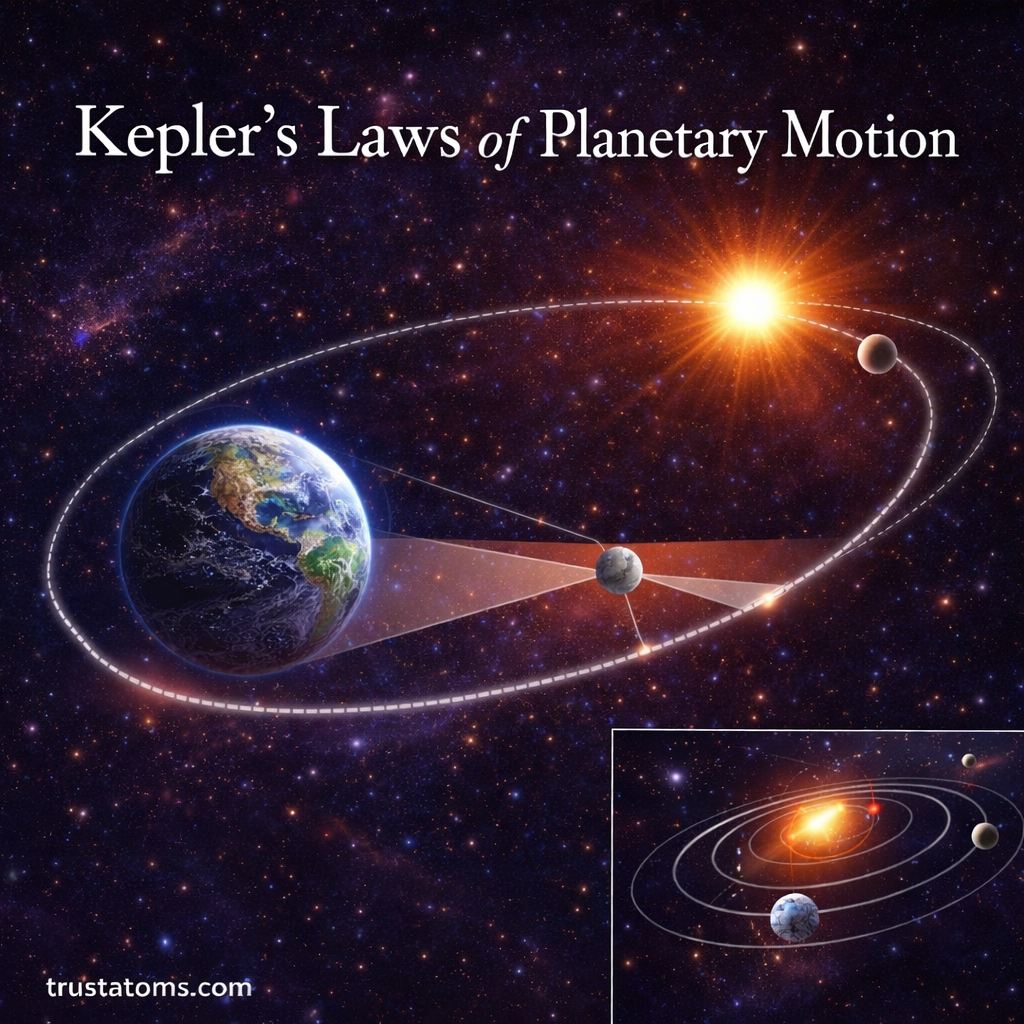
Kepler’s Laws of Planetary Motion describe how planets move around the Sun. Developed in the early 1600s by Johannes Kepler, these laws transformed our understanding of the solar system and laid the foundation for modern astronomy.
Rather than assuming perfectly circular orbits, Kepler showed that planetary motion follows precise mathematical patterns—helping scientists accurately predict the positions of planets and other celestial objects.
Who Was Johannes Kepler?
Johannes Kepler was a German astronomer and mathematician who built upon earlier observations made by Tycho Brahe. Using detailed data, Kepler discovered patterns in planetary motion that led to his three laws.
Why his work matters
- Replaced the idea of circular orbits with elliptical ones
- Provided accurate models for planetary motion
- Influenced later scientists like Isaac Newton
Overview of Kepler’s Three Laws
Kepler’s laws describe the shape of planetary orbits, how planets move within those orbits, and how orbital time relates to distance.
The three laws
- Law of Ellipses
- Law of Equal Areas
- Law of Harmonies
Each law reveals a different aspect of how gravity and motion work together in space.
First Law: The Law of Ellipses
The first law states that planets move in elliptical orbits, with the Sun located at one focus of the ellipse.
What this means
- Orbits are oval-shaped, not perfect circles
- The Sun is not at the center but slightly off-center
- Planets vary in distance from the Sun during their orbit
Key terms
- Perihelion: The closest point to the Sun
- Aphelion: The farthest point from the Sun
This law explains why planets sometimes appear closer or farther from the Sun at different times.
Second Law: The Law of Equal Areas
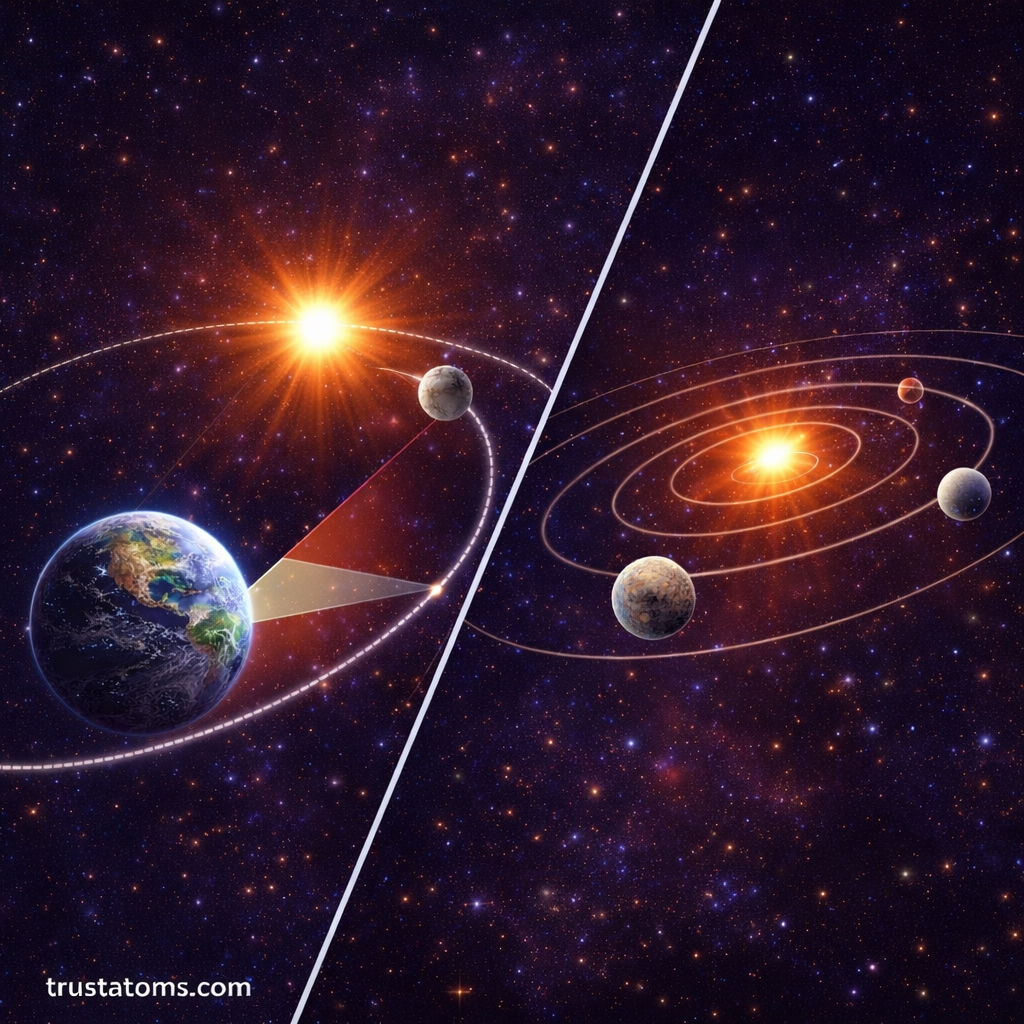
The second law states that a line connecting a planet to the Sun sweeps out equal areas in equal amounts of time.
What this means
- Planets move faster when closer to the Sun
- Planets move slower when farther away
- Orbital speed is not constant
Why it happens
The stronger gravitational pull near the Sun increases a planet’s speed, while weaker gravity farther away slows it down.
Third Law: The Law of Harmonies
The third law describes the relationship between a planet’s distance from the Sun and the time it takes to complete an orbit.
What this means
- Planets farther from the Sun take longer to orbit
- There is a consistent mathematical relationship between distance and orbital period
Simple interpretation
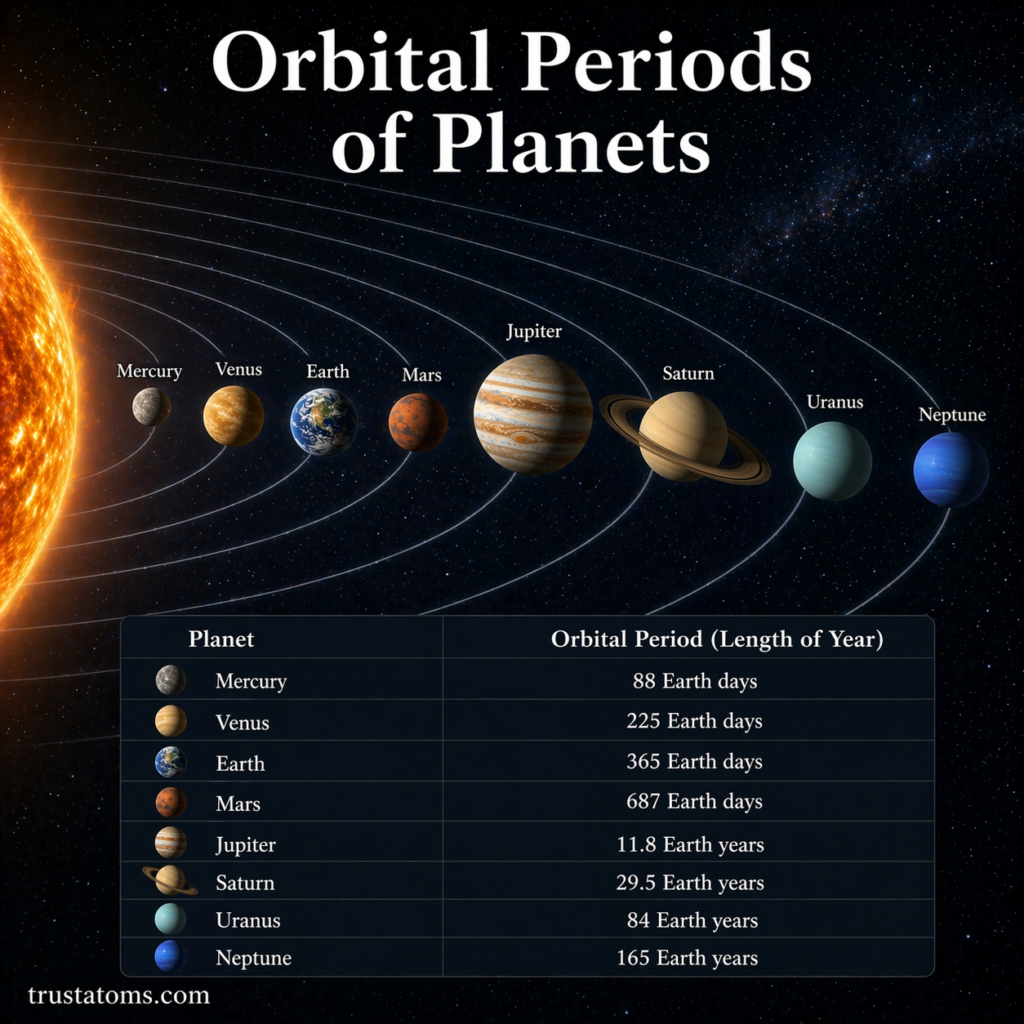
- Inner planets orbit quickly
- Outer planets orbit more slowly
This law allows scientists to compare different planetary systems and predict orbital behavior.
How Kepler’s Laws Changed Science
Kepler’s discoveries marked a major shift in how we understand the universe.
Key impacts
- Challenged long-held beliefs about circular orbits
- Provided accurate predictions of planetary positions
- Helped lead to Newton’s law of gravity
- Improved navigation and astronomical calculations
Real-World Applications
Kepler’s laws are still used today in many areas of science and technology.
Practical uses
- Designing satellite orbits
- Planning space missions
- Predicting planetary motion
- Understanding exoplanet systems
These laws are essential for modern space exploration and research.
Kepler’s Laws and Gravity
Although Kepler did not fully explain why planets move the way they do, his laws provided the groundwork for later discoveries.
Isaac Newton later explained that gravity is the force responsible for these motions, connecting Kepler’s observations with physical laws.
Why Kepler’s Laws Still Matter
Even centuries later, Kepler’s laws remain fundamental to astronomy. They help scientists understand not only our solar system but also distant planetary systems across the universe.
What we gain from these laws
- Accurate models of motion in space
- Better understanding of gravitational systems
- Tools for exploring beyond Earth
Final Thoughts
Kepler’s Laws of Planetary Motion revolutionized astronomy by showing that planetary motion follows predictable patterns. By describing how planets orbit the Sun, how their speed changes, and how distance relates to time, these laws continue to guide scientific discovery today.
From studying nearby planets to exploring distant galaxies, Kepler’s work remains a cornerstone of our understanding of the universe.