The Moon is one of the most visible and fascinating objects in the night sky. Over the course of a month, its shape appears to change—growing from a thin crescent to a full circle and then shrinking again. These changes are known as the phases of the Moon.
Understanding lunar phases helps explain not only what we see in the sky, but also how Earth, the Moon, and the Sun interact in space.
What Causes the Phases of the Moon?
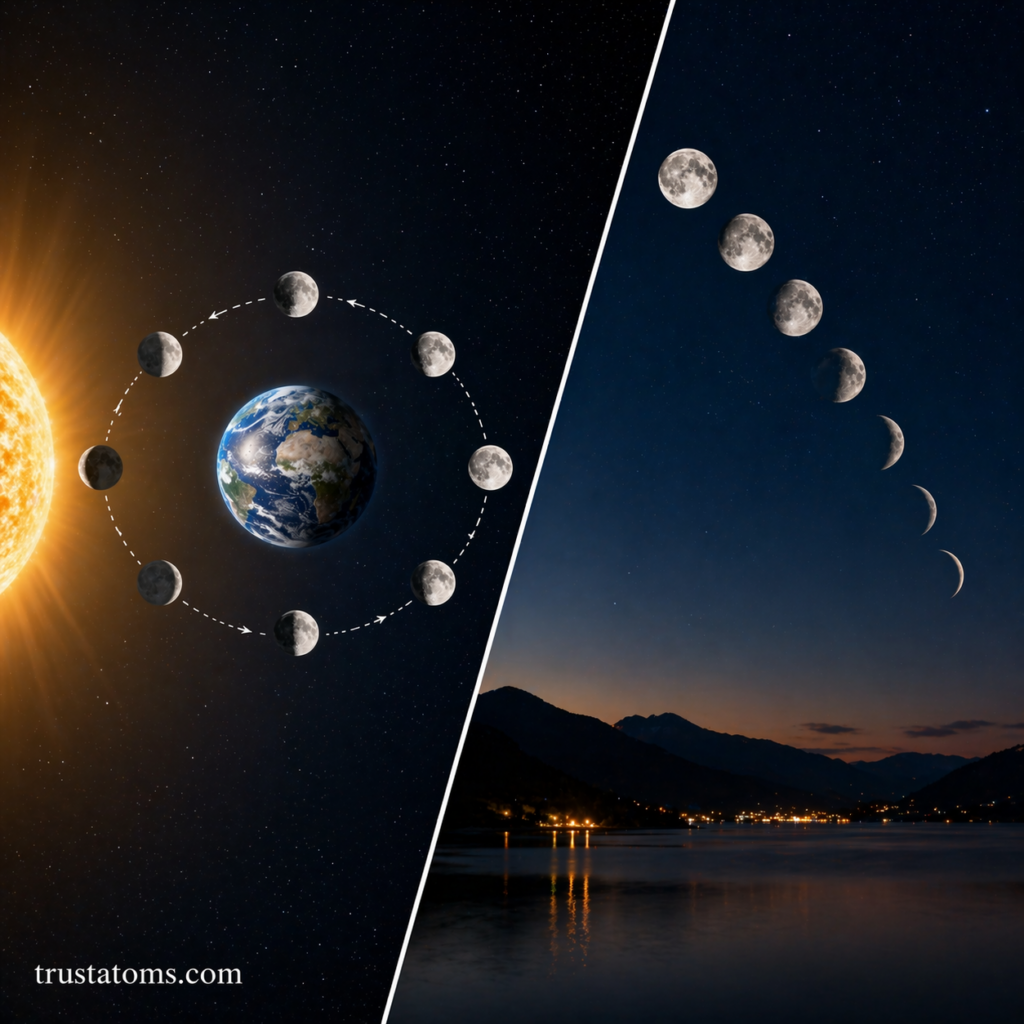
The Moon doesn’t produce its own light—it reflects sunlight. As the Moon orbits Earth, different portions of its sunlit side become visible from our perspective.
Key points:
- The Moon takes about 29.5 days to complete one full cycle of phases
- Half of the Moon is always illuminated by the Sun
- The phase depends on how much of the lit side we can see from Earth
The changing angle between the Sun, Earth, and Moon is what creates the lunar phases.
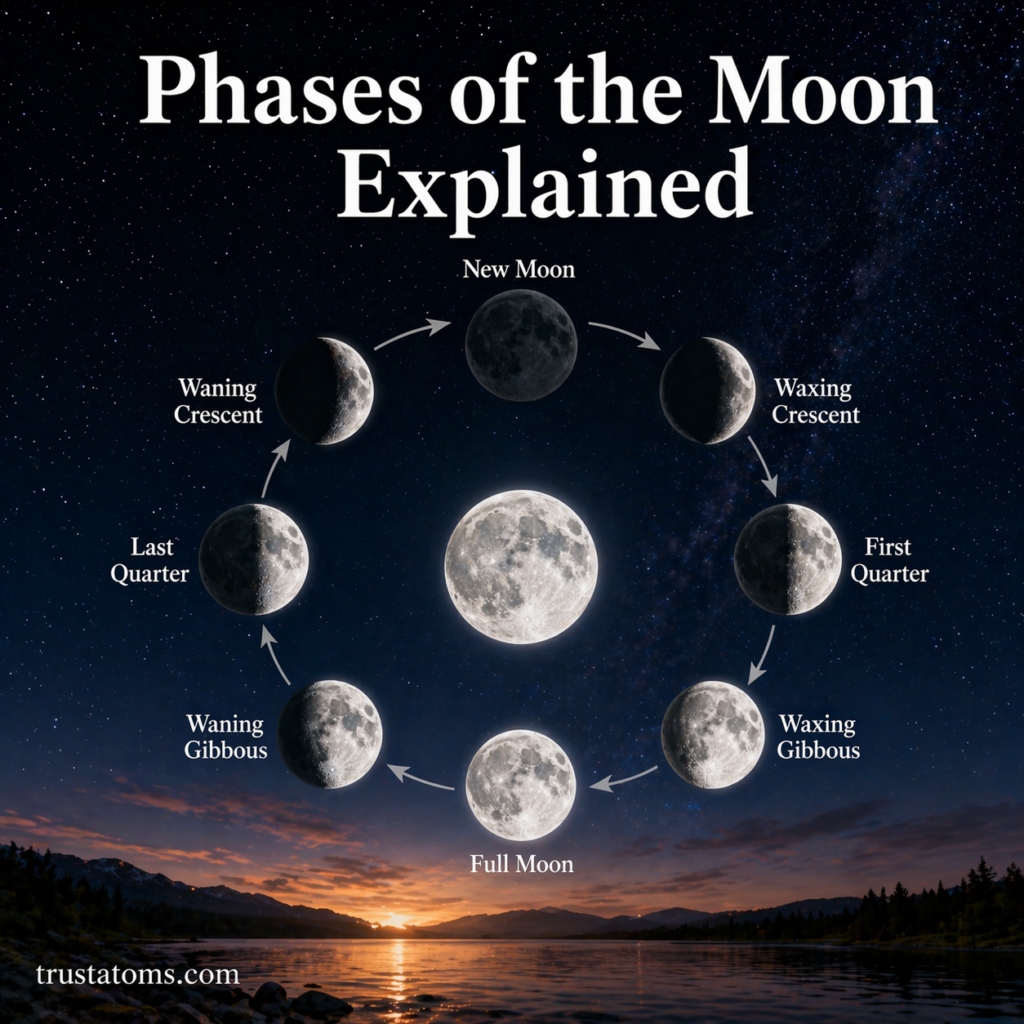
The 8 Phases of the Moon
The Moon goes through eight distinct phases during its cycle.
1. New Moon
- The Moon is positioned between Earth and the Sun
- The side facing Earth is not illuminated
- The Moon is nearly invisible in the sky
2. Waxing Crescent
- A small sliver of light becomes visible
- The illuminated portion is growing (waxing)
- Seen shortly after sunset
3. First Quarter
- Half of the Moon appears illuminated
- Occurs about one week after the new moon
- Visible in the afternoon and evening
4. Waxing Gibbous
- More than half of the Moon is illuminated
- Continues to grow toward a full moon
- Bright and prominent in the evening sky
5. Full Moon
- Earth is between the Sun and the Moon
- The entire face of the Moon is illuminated
- Rises at sunset and sets at sunrise
6. Waning Gibbous
- The illuminated portion begins to shrink (waning)
- Still more than half lit
- Visible late at night and early morning
7. Last Quarter (Third Quarter)
- Half of the Moon is illuminated again
- Opposite side compared to the first quarter
- Visible from midnight into the morning
8. Waning Crescent
- A thin crescent remains before returning to new moon
- Visible just before sunrise
- Marks the end of the lunar cycle
Why the Moon Appears to Change Shape
The Moon itself isn’t changing shape—only the portion we see illuminated is changing.
Think of it this way:
- The Sun always lights up half of the Moon
- As the Moon orbits Earth, our viewing angle shifts
- This creates the illusion of changing shapes
It’s similar to watching a ball being lit from one side while you walk around it.
The Lunar Cycle (Synodic Month)
The full cycle of lunar phases is called a synodic month, lasting about 29.5 days.
During this cycle:
- The Moon completes one orbit relative to the Sun
- All eight phases occur in sequence
- The cycle repeats continuously
This cycle has been used for centuries in calendars and timekeeping systems.
Phases vs. Moonrise and Moonset
Each phase of the Moon rises and sets at different times.
Examples:
- New Moon: Rises and sets with the Sun
- First Quarter: Rises around noon, sets around midnight
- Full Moon: Rises at sunset, sets at sunrise
- Last Quarter: Rises at midnight, sets around noon
These patterns help astronomers and skywatchers predict when the Moon will be visible.
How the Moon’s Phases Affect Earth
The Moon’s phases are linked to several natural phenomena.
Tides
- The gravitational pull of the Moon affects ocean tides
- Strongest tides (spring tides) occur during full and new moons
Wildlife Behavior
- Some animals rely on moonlight for navigation or hunting
- Nocturnal activity can change with lunar brightness
Cultural and Historical Importance
- Many calendars are based on lunar cycles
- Phases are tied to festivals, traditions, and agriculture
Common Misconceptions
There are a few common misunderstandings about lunar phases.
Myth vs. reality:
- Myth: Earth’s shadow causes phases
- Reality: That only happens during a lunar eclipse
- Myth: The Moon is only visible at night
- Reality: The Moon is often visible during the day
- Myth: The Moon rotates differently as it orbits
- Reality: The same side always faces Earth due to tidal locking
Tips for Observing the Moon
You don’t need special equipment to enjoy the Moon’s phases.
Simple observation tips:
- Track the Moon each night for a month
- Note how its shape and position change
- Use a smartphone app or calendar for guidance
- Observe during different times of day
Even basic observation can deepen your understanding of the lunar cycle.
Why Understanding Moon Phases Matters
The phases of the Moon are a perfect example of how celestial motion affects what we see from Earth.
They help us:
- Understand orbital motion and light reflection
- Connect with natural cycles
- Appreciate the relationship between Earth and its closest neighbor
The Moon’s changing appearance has inspired science, culture, and curiosity for thousands of years.
Final Thoughts
The phases of the Moon may seem simple, but they reveal a complex and elegant interaction between Earth, the Moon, and the Sun.
By observing these phases, you’re witnessing a predictable cosmic cycle that has guided humanity for centuries—and continues to shape our understanding of the universe today.