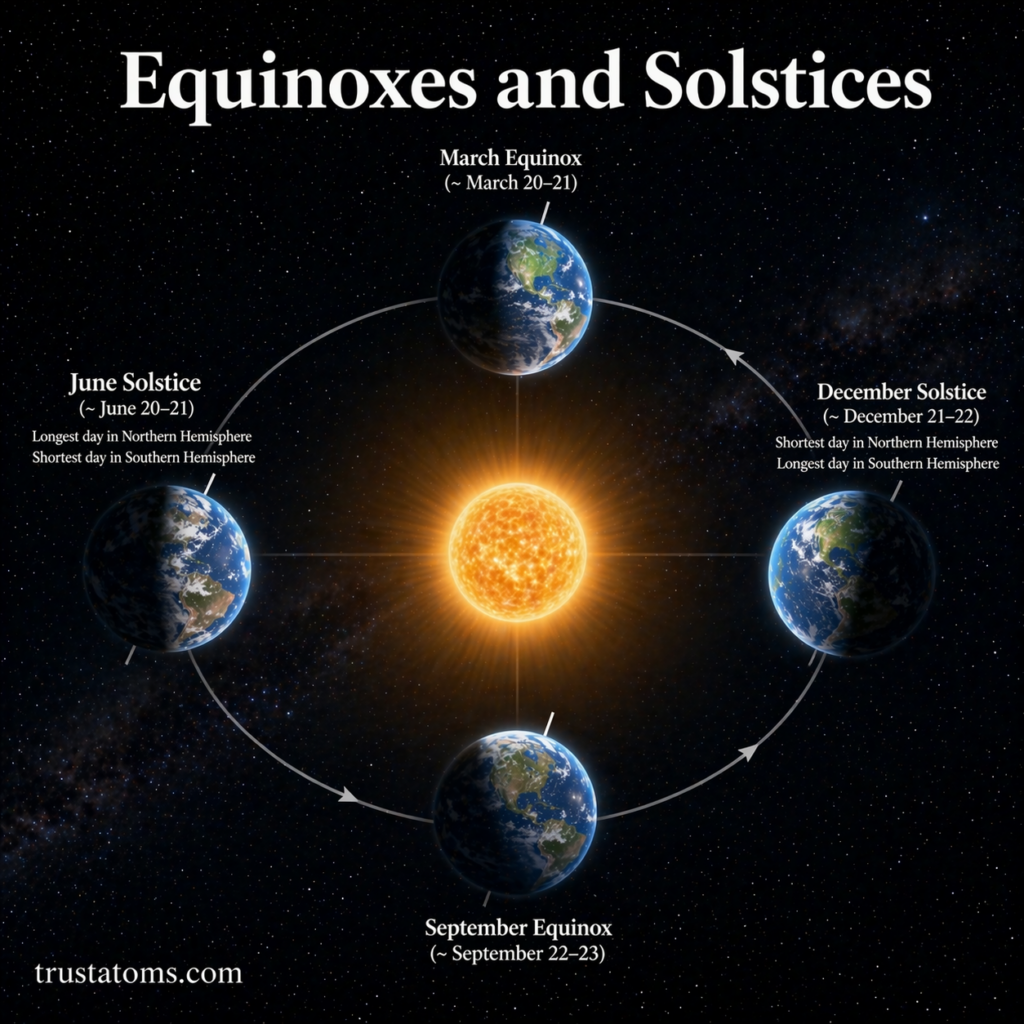
Every year, Earth experiences four key astronomical events that mark the changing seasons: two equinoxes and two solstices. These events are driven by Earth’s tilt and its orbit around the Sun, shaping the length of our days, the position of the Sun in the sky, and seasonal changes across the planet.
Understanding equinoxes and solstices helps explain why seasons exist and how sunlight is distributed across Earth throughout the year.
What Causes Seasons on Earth?
Seasons are not caused by how close Earth is to the Sun. Instead, they are the result of Earth’s axial tilt.
Key facts:
- Earth is tilted about 23.5 degrees on its axis
- As Earth orbits the Sun, different parts receive varying amounts of sunlight
- This tilt causes changes in daylight length and solar intensity
This shifting angle of sunlight is what creates seasonal patterns.
What Is an Equinox?
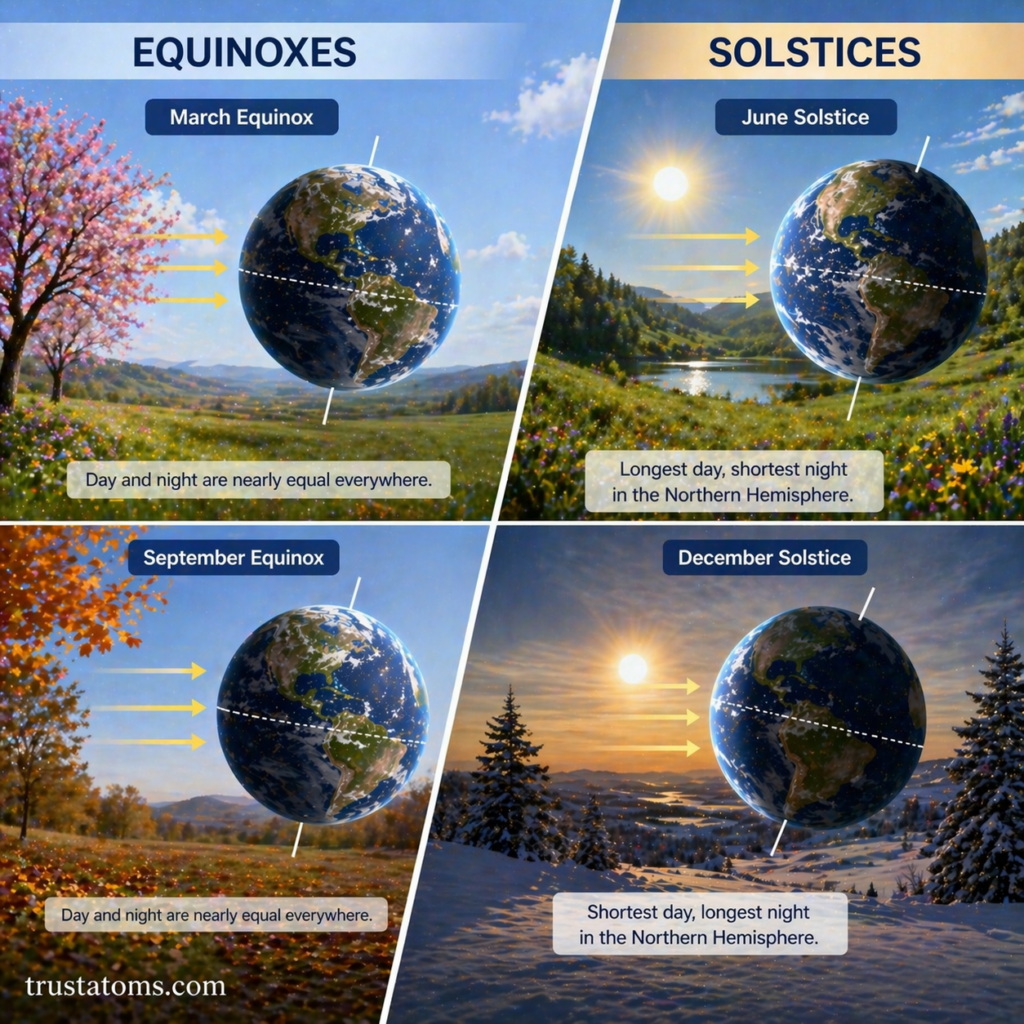
An equinox occurs when Earth’s axis is not tilted toward or away from the Sun, resulting in nearly equal day and night across the globe.
There are two equinoxes each year:
1. March Equinox (Spring Equinox in Northern Hemisphere)
- Occurs around March 20–21
- Marks the beginning of spring in the Northern Hemisphere
- Marks the beginning of autumn in the Southern Hemisphere
2. September Equinox (Autumn Equinox in Northern Hemisphere)
- Occurs around September 22–23
- Marks the beginning of autumn in the Northern Hemisphere
- Marks the beginning of spring in the Southern Hemisphere
Key characteristics:
- Day and night are nearly equal (about 12 hours each)
- The Sun rises directly in the east and sets directly in the west
What Is a Solstice?
A solstice occurs when Earth’s tilt is most strongly toward or away from the Sun, creating the longest and shortest days of the year.
There are two solstices each year:
1. June Solstice (Summer Solstice in Northern Hemisphere)
- Occurs around June 20–21
- Marks the longest day and shortest night in the Northern Hemisphere
- Beginning of summer in the Northern Hemisphere
- Beginning of winter in the Southern Hemisphere
2. December Solstice (Winter Solstice in Northern Hemisphere)
- Occurs around December 21–22
- Marks the shortest day and longest night in the Northern Hemisphere
- Beginning of winter in the Northern Hemisphere
- Beginning of summer in the Southern Hemisphere
How Daylight Changes Throughout the Year
The amount of daylight you experience depends on your location and the time of year.
General patterns:
- Days get longer after the winter solstice
- Days get shorter after the summer solstice
- Day and night are equal during equinoxes
Extreme examples:
- Near the poles, daylight can last 24 hours during summer
- In winter, these regions can experience polar night (no sunlight)
The Role of Latitude
Latitude plays a major role in how equinoxes and solstices are experienced.
Near the equator:
- Day length stays relatively consistent year-round
- Seasonal changes are less extreme
Mid-latitudes:
- Noticeable seasonal changes
- Significant variation in daylight hours
Near the poles:
- Extreme seasonal contrasts
- Long periods of continuous daylight or darkness
Solstices and the Sun’s Position
During solstices, the Sun reaches its highest or lowest point in the sky at noon.
Important markers:
- Tropic of Cancer (23.5° N) receives direct sunlight during the June solstice
- Tropic of Capricorn (23.5° S) receives direct sunlight during the December solstice
This shifting position of the Sun determines where the most intense sunlight is focused.
Cultural and Historical Significance
Equinoxes and solstices have been important to human societies for thousands of years.
Examples:
- Ancient monuments like Stonehenge align with solstice sunrises and sunsets
- Many cultures celebrate seasonal festivals tied to these events
- Agricultural societies use them to guide planting and harvesting
These events served as natural calendars long before modern timekeeping.
Common Misconceptions
Myth vs. reality:
- Myth: Seasons are caused by Earth being closer to the Sun
- Reality: Seasons are caused by Earth’s axial tilt
- Myth: Day and night are exactly equal during equinoxes
- Reality: They are nearly equal due to atmospheric effects
- Myth: Solstices are the hottest or coldest days
- Reality: Temperature lags behind sunlight changes due to Earth’s heat retention
Why Equinoxes and Solstices Matter
These events help us understand how Earth interacts with the Sun and how energy is distributed across the planet.
They influence:
- Climate and weather patterns
- Ecosystems and plant growth cycles
- Human activities and cultural traditions
They also provide a clear example of how Earth’s tilt shapes life on our planet.
Final Thoughts
Equinoxes and solstices are more than just dates on a calendar—they are key moments in Earth’s yearly journey around the Sun. They mark the rhythm of the seasons and reflect the dynamic relationship between our planet and its star.
By understanding these events, you gain a deeper appreciation for the natural cycles that influence everything from daylight to climate.