Tides are one of the most visible effects of gravity in action on Earth. Every day, ocean levels rise and fall in a predictable pattern, driven mainly by the gravitational pull of the Moon—and to a lesser extent, the Sun.
Understanding tides reveals how celestial bodies interact and how gravity influences not just space, but life here on Earth.
What Are Tides?
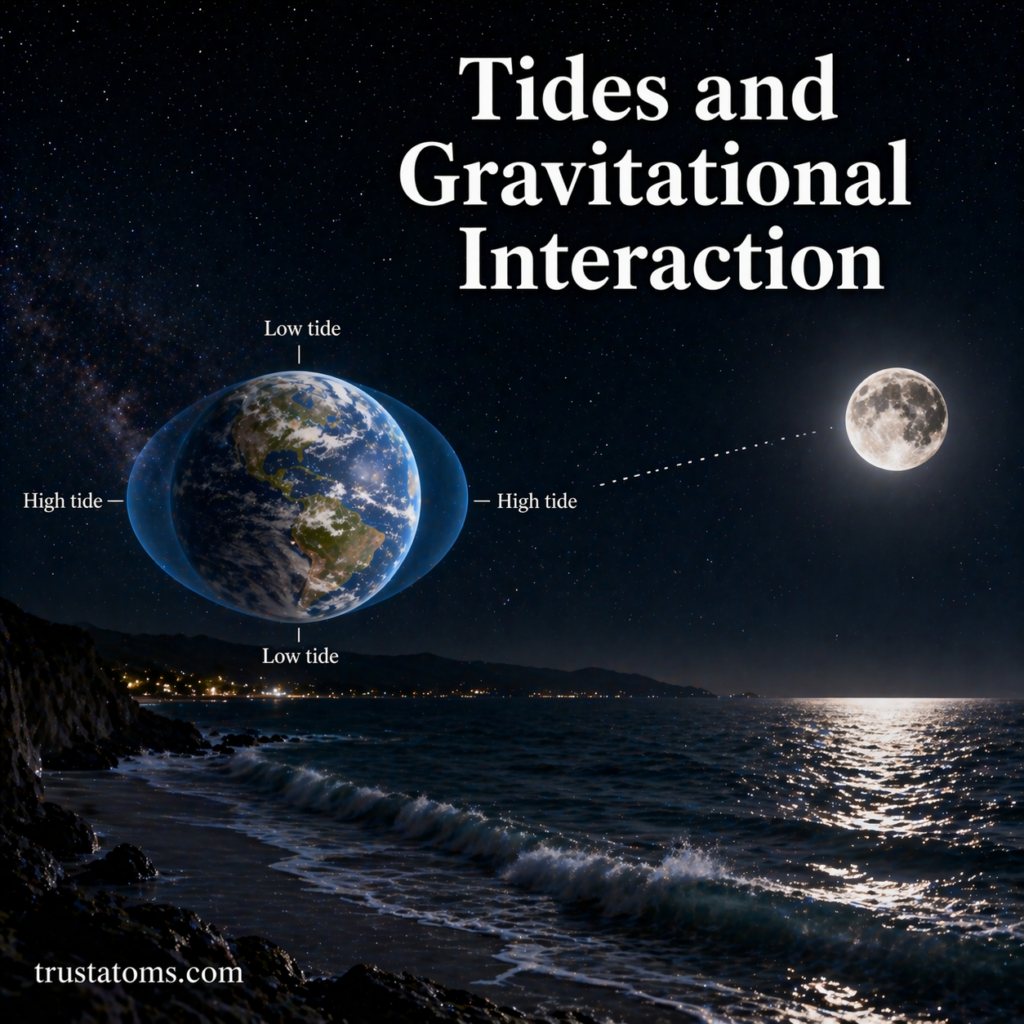
Tides are the regular rise and fall of sea levels caused by gravitational forces acting on Earth’s oceans.
Key features of tides:
- Most coastal areas experience two high tides and two low tides each day
- The timing of tides shifts slightly each day
- Tides vary in height depending on location and conditions
These changes are part of a continuous, global cycle influenced by gravity and motion.
The Role of the Moon’s Gravity
The Moon is the primary force behind tides.
How it works:
- The Moon’s gravity pulls water toward it, creating a bulge on the side of Earth facing the Moon
- A second bulge forms on the opposite side due to inertia (the tendency of water to continue moving)
- As Earth rotates, different regions pass through these bulges, causing high and low tides
This is why most places experience two high tides per day.
The Sun’s Influence on Tides
Although the Sun is much larger than the Moon, it is also much farther away. Its gravitational pull still affects tides, but less strongly than the Moon.
Combined effects:
- The Sun modifies the strength of tides
- When aligned with the Moon, tides become stronger
- When at right angles, tides become weaker
The interaction between the Sun and Moon creates different tidal patterns.
Spring Tides vs. Neap Tides
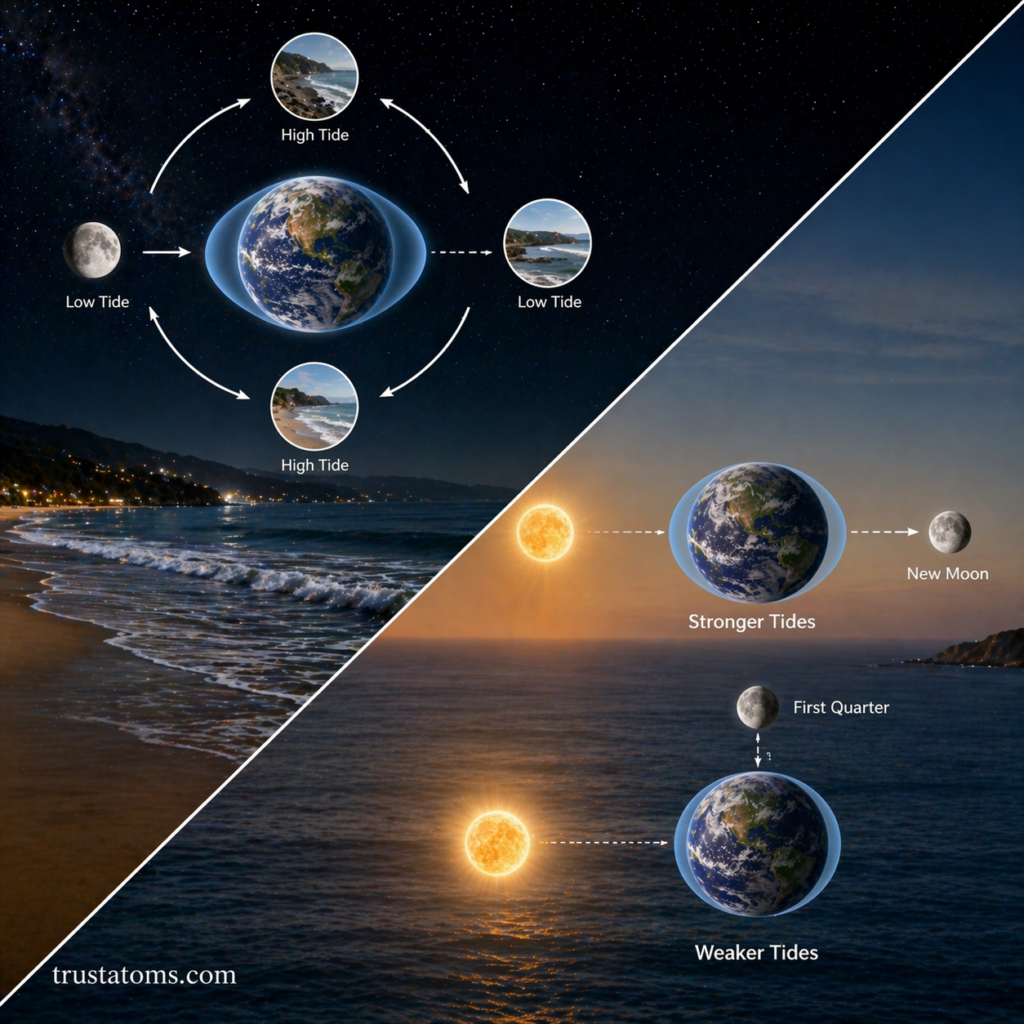
Tides vary in intensity depending on the positions of the Earth, Moon, and Sun.
Spring Tides (Stronger Tides)
- Occur during new moon and full moon
- Sun, Earth, and Moon are aligned
- Higher high tides and lower low tides
Neap Tides (Weaker Tides)
- Occur during first and last quarter moons
- Sun and Moon are at right angles
- Less extreme tidal changes
Despite the name, “spring tides” have nothing to do with the season—they refer to tides that “spring” higher.
Why Tides Differ Around the World
Not all locations experience tides in the same way.
Factors that influence tidal patterns:
- Shape of coastlines
- Ocean depth and seafloor features
- Local geography (bays, estuaries)
- Earth’s rotation and ocean currents
Types of tidal patterns:
- Semidiurnal tides – two high and two low tides daily (most common)
- Diurnal tides – one high and one low tide per day
- Mixed tides – varying heights of high and low tides
These variations explain why some areas have dramatic tides while others have minimal changes.
The Physics Behind Tidal Forces
Tides are caused by differences in gravitational force, known as tidal forces.
Key concept:
- Gravity decreases with distance
- The side of Earth closest to the Moon feels a stronger pull than the center
- The far side feels the weakest pull
This difference stretches Earth slightly, creating the tidal bulges in the oceans.
How Earth’s Rotation Affects Tides
Earth’s rotation plays a crucial role in how tides are experienced.
- Earth rotates once every 24 hours
- The Moon moves in its orbit during this time
- This causes tides to occur roughly every 12 hours and 25 minutes
This is why high tides occur later each day.
Real-World Effects of Tides
Tides have a significant impact on both nature and human activity.
Environmental effects:
- Shape coastal ecosystems
- Influence marine life behavior
- Support nutrient mixing in oceans
Human uses:
- Navigation for ships and boats
- Fishing and coastal industries
- Renewable energy (tidal power)
Understanding tides is essential for safety, planning, and environmental management.
Tidal Locking and Long-Term Effects
The gravitational interaction between Earth and the Moon goes beyond tides.
Long-term impacts:
- The Moon is tidally locked, always showing the same face to Earth
- Earth’s rotation is slowly slowing down due to tidal friction
- Days are gradually becoming longer over millions of years
These effects show how gravity shapes planetary systems over time.
Why Tides Matter
Tides are a direct and visible result of gravitational interaction in space.
They help us:
- Understand the relationship between Earth, the Moon, and the Sun
- Observe the effects of gravity on a large scale
- Study long-term changes in Earth’s rotation and climate
They also play a vital role in sustaining marine ecosystems and human coastal life.
Final Thoughts
Tides are more than just rising and falling water—they are a powerful reminder that Earth is part of a dynamic system influenced by forces beyond our planet.
By understanding tides and gravitational interaction, we gain insight into both everyday natural cycles and the larger workings of the universe.