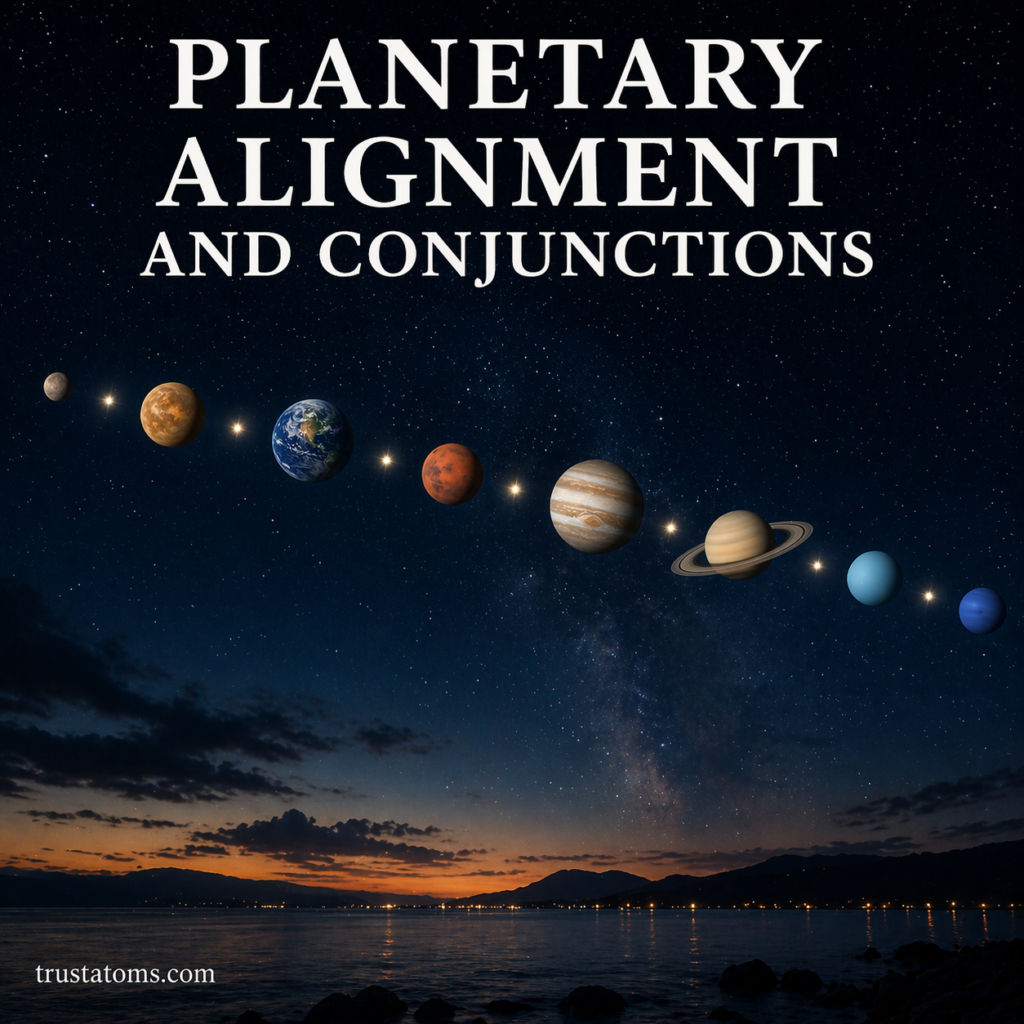
The night sky occasionally treats observers to rare and beautiful arrangements of planets. Headlines often call these events “planetary alignments,” but in astronomy, the more precise and common term is conjunction.
Understanding how these events work reveals both the beauty and the geometry of our solar system.
What Is a Conjunction?
A conjunction occurs when two or more celestial objects appear close together in the sky as seen from Earth.
These objects can include:
- Planets
- The Moon
- Stars
For example, when Venus appears very close to Jupiter in the sky, that is a planetary conjunction.
Important Note
A conjunction is:
- A line-of-sight effect
- Not a physical closeness in space
The planets remain millions—or even hundreds of millions—of miles apart.
What Is Planetary Alignment?
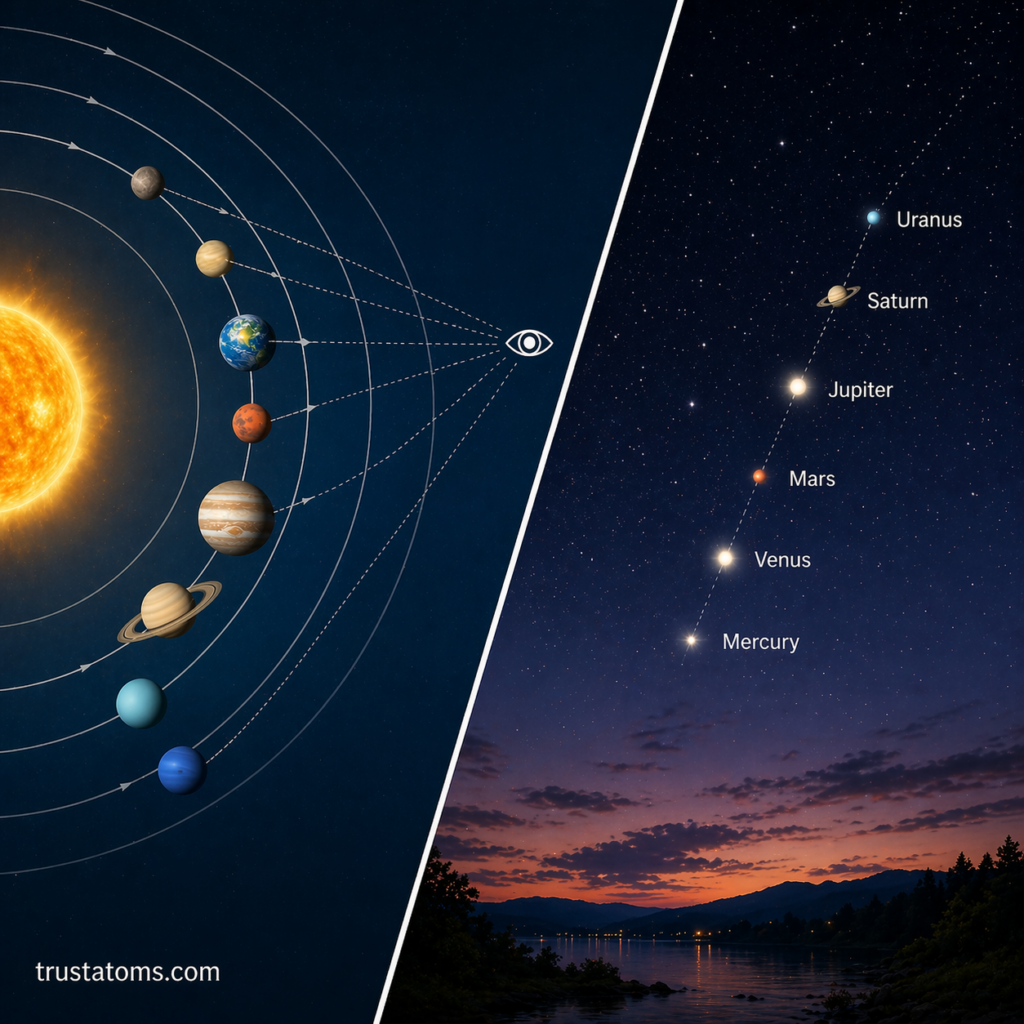
“Planetary alignment” is a less formal term used to describe when multiple planets appear lined up in the sky.
In reality:
- Planets never form a perfectly straight line in 3D space
- They only appear aligned from our perspective
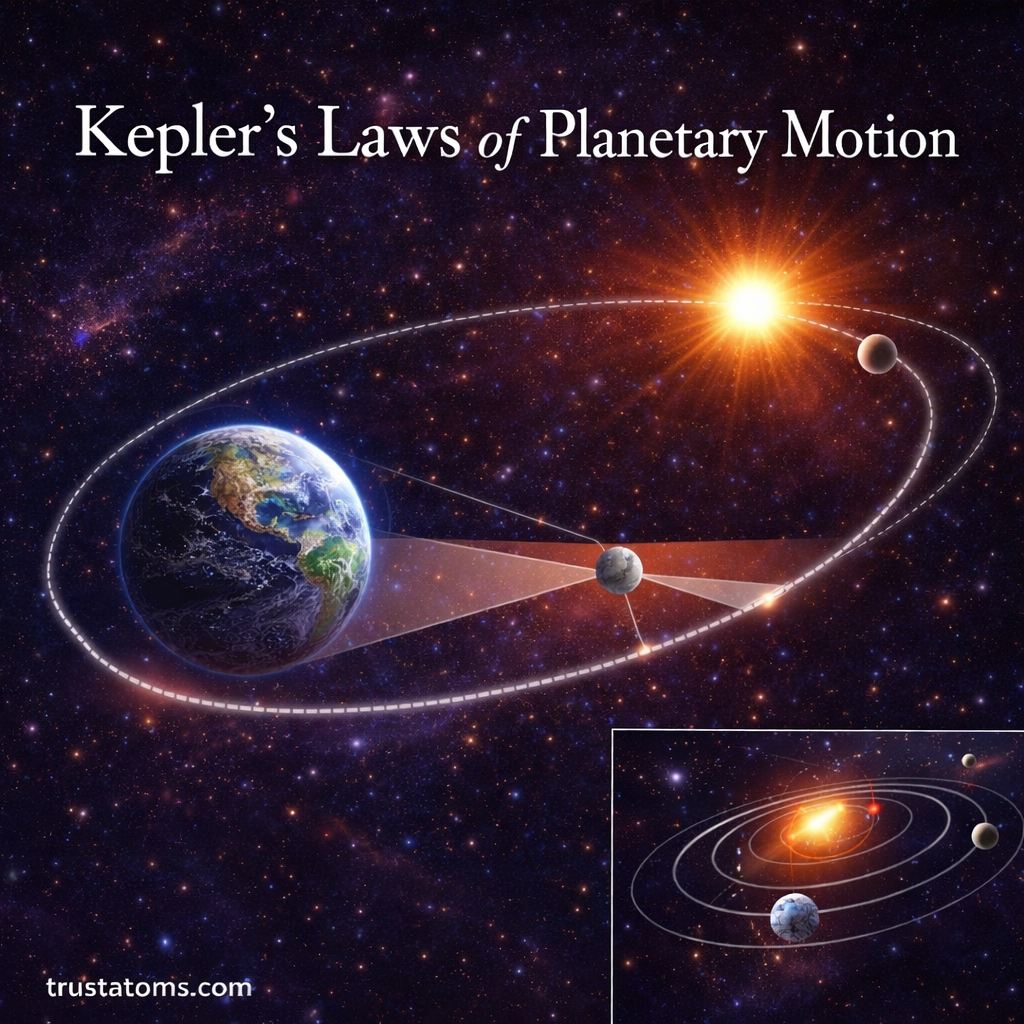
This happens because planets orbit the Sun in roughly the same flat plane, called the ecliptic plane.
Why Conjunctions Happen
Conjunctions occur because planets move at different speeds along their orbits.
Key factors:
- Inner planets (like Mercury and Venus) move faster
- Outer planets (like Jupiter and Saturn) move slower
- Earth is also moving, changing our viewing angle
As these motions shift, planets occasionally appear to “catch up” to each other in the sky.
Types of Conjunctions
There are several kinds of conjunctions depending on the objects involved.
Planet-to-Planet Conjunction
- Two planets appear close together
- Often bright and easy to spot
Example:
- Mars near Jupiter
Moon and Planet Conjunction
- The Moon appears near a planet
- Very noticeable due to the Moon’s brightness
Inferior and Superior Conjunction
These terms apply to inner planets like Mercury and Venus:
- Inferior conjunction: Planet is between Earth and the Sun
- Superior conjunction: Planet is on the far side of the Sun
What Is a Planetary Parade?
A planetary parade happens when several planets are visible at once in the sky, often in a rough line.
This can include:
- 3 to 5 planets easily visible to the naked eye
- Sometimes even more with telescopes
While visually impressive, these are still perspective-based alignments—not perfect cosmic lines.
How Often Do Alignments Occur?
Conjunctions are relatively common:
- Simple conjunctions: happen several times per year
- Rare multi-planet alignments: occur less frequently
More dramatic events involving many bright planets may only happen:
- Once every few years
- Or even decades, depending on the configuration
Can Planetary Alignments Affect Earth?
You may have heard claims that planetary alignments can cause:
- Earthquakes
- Tidal disruptions
- Climate changes
These claims are not supported by science.
Why not?
- The gravitational pull from other planets is extremely weak compared to the Moon and the Sun
- Even during alignments, the combined effect is negligible
In short:
- Alignments are visually exciting, not physically impactful
Best Times to Observe Conjunctions
To spot a conjunction:
Look during:
- Just after sunset
- Before sunrise
Tips for viewing:
- Check astronomy apps or sky charts
- Find a location with low light pollution
- Use binoculars for better detail
Bright planets like:
- Venus
- Jupiter
- Mars
…are often visible even in urban skies.
Why Conjunctions Matter in Astronomy
Conjunctions are more than just beautiful sky events—they help astronomers:
- Track planetary motion
- Understand orbital mechanics
- Predict future celestial events
Historically, conjunctions also played a role in:
- Calendar systems
- Navigation
- Early astronomical discoveries
Final Thoughts
Planetary conjunctions and alignments offer a reminder that our solar system is constantly in motion. While the planets may appear to line up from our viewpoint, what we’re really seeing is a dynamic, ever-changing cosmic dance.
The next time you notice two bright objects close together in the sky, you’re witnessing a precise alignment of orbits, timing, and perspective—an elegant intersection of science and wonder.