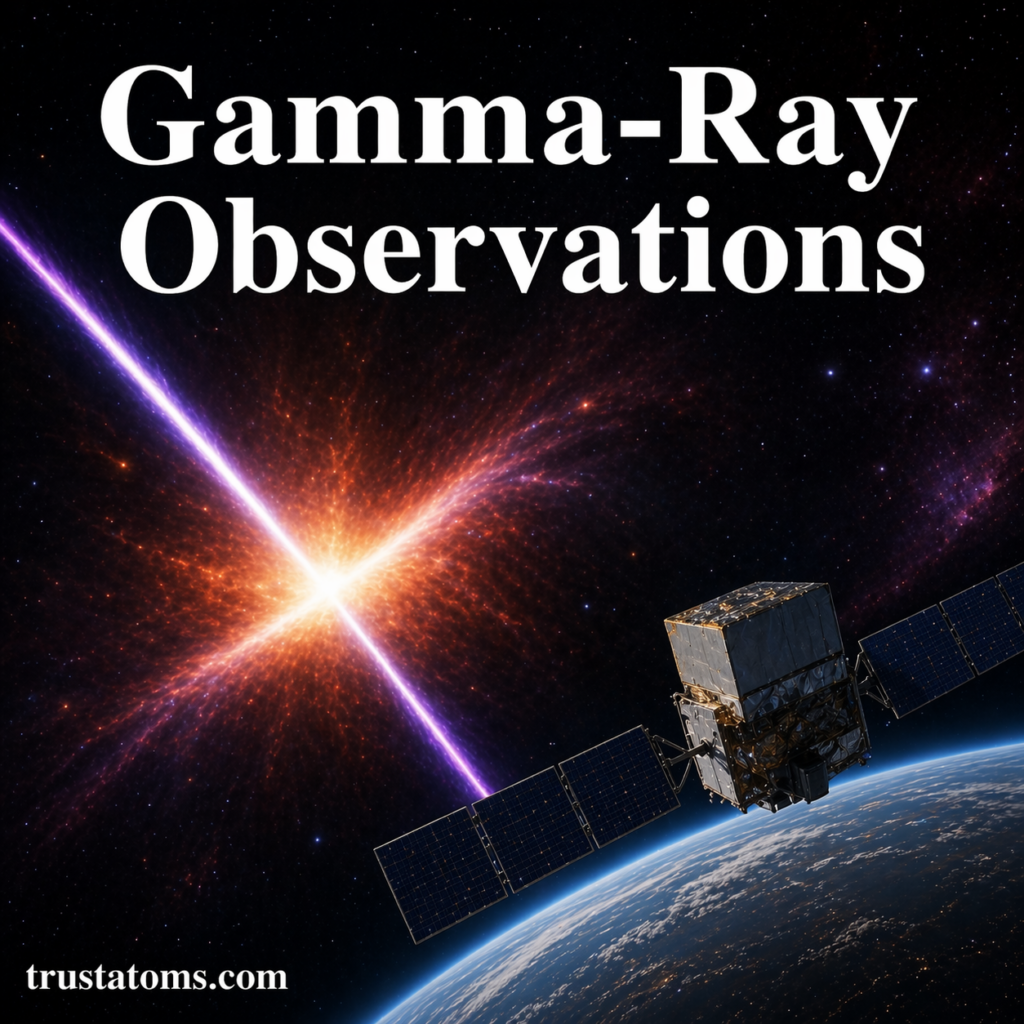
Gamma-ray observations allow astronomers to study the most powerful and extreme events in the universe. These high-energy waves reveal cosmic explosions, particle acceleration, and phenomena that cannot be detected through visible light or even X-rays.
Because gamma rays are absorbed by Earth’s atmosphere, scientists rely on space-based instruments and specialized ground techniques to observe them. With support from organizations like NASA and ESA, gamma-ray astronomy has become a key tool for exploring the high-energy universe.
What Are Gamma Rays?
Gamma rays are the most energetic form of electromagnetic radiation. They have extremely short wavelengths and carry more energy than X-rays, making them ideal for studying violent cosmic processes.
Key properties of gamma rays:
- Shortest wavelengths in the electromagnetic spectrum
- Highest energy levels of all light forms
- Produced by nuclear reactions and particle interactions
- Invisible and dangerous to living organisms
In astronomy, gamma rays help reveal events that involve massive energy releases, often linked to the life and death of stars.
Why Gamma-Ray Observations Matter
Gamma-ray observations provide insight into processes that cannot be seen in other wavelengths. They help scientists understand how energy is generated and transferred in extreme environments.
What gamma rays help scientists study:
- Gamma-ray bursts (GRBs)
- Supernova explosions
- Black hole activity
- Neutron star collisions
- Cosmic rays and particle acceleration
These observations are essential for understanding the fundamental physics of the universe.
How Gamma Rays Are Detected
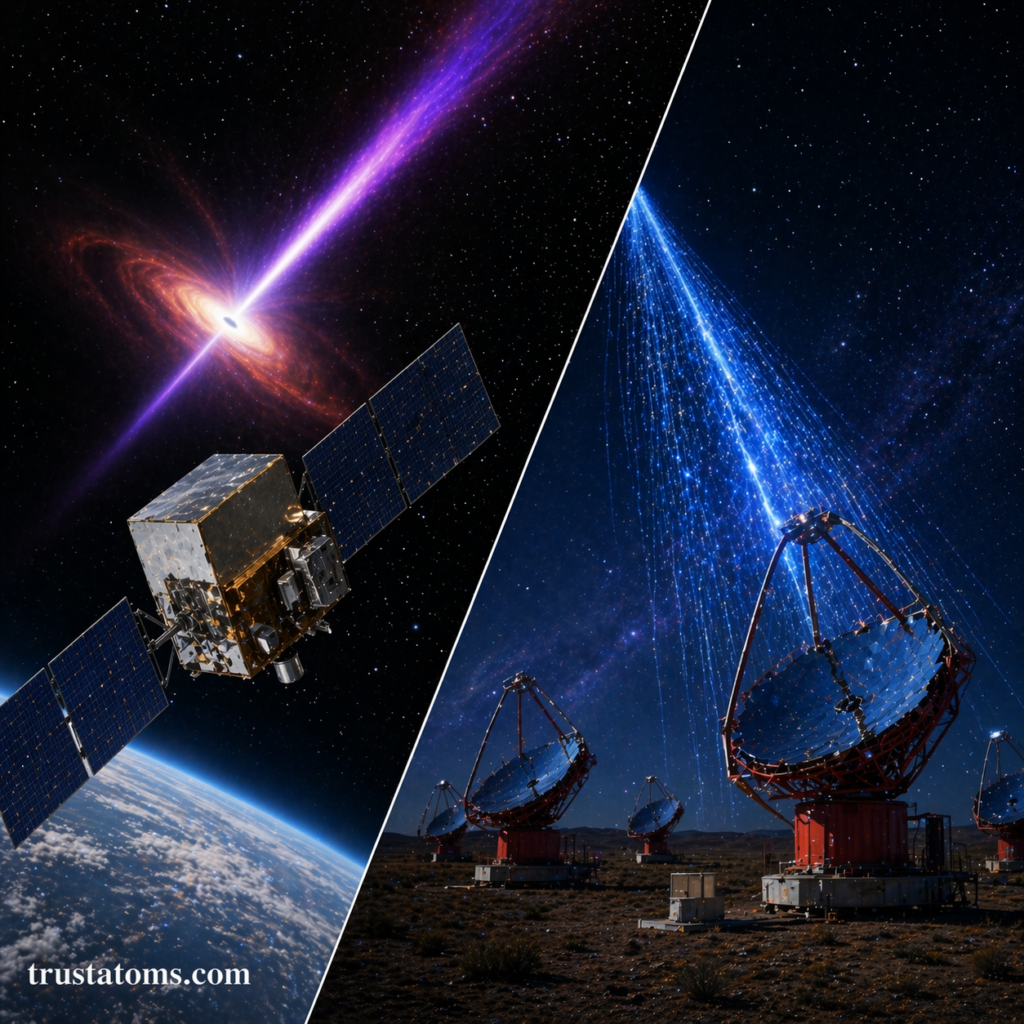
Since gamma rays cannot pass through Earth’s atmosphere, astronomers use both space-based telescopes and indirect ground-based methods.
Space-based observatories:
- Fermi Gamma-ray Space Telescope
- INTEGRAL
These satellites detect gamma rays directly using specialized sensors that measure energy and direction.
Ground-based techniques:
- Detect gamma rays indirectly through atmospheric interactions
- Use Cherenkov radiation produced when gamma rays strike Earth’s atmosphere
- Large telescope arrays capture brief flashes of light
What Objects Emit Gamma Rays?
Gamma rays originate from the most energetic and often catastrophic events in the universe.
Major gamma-ray sources:
Gamma-Ray Bursts (GRBs)
- Among the most powerful explosions ever observed
- Can release more energy in seconds than the Sun emits in its lifetime
Supernovae
- Exploding stars generate gamma rays through nuclear reactions
- Provide insight into element formation
Black Holes
- Matter falling into black holes emits gamma rays
- Jets from active galaxies can produce intense radiation
Neutron Star Collisions
- Merging neutron stars produce gamma-ray bursts
- Also linked to gravitational wave events
Major Discoveries from Gamma-Ray Observations
Gamma-ray astronomy has transformed our understanding of high-energy astrophysics.
Key discoveries include:
- Identification of gamma-ray bursts as distant cosmic events
- Evidence linking neutron star mergers to heavy element formation
- Detection of antimatter signals in space
- Insights into cosmic ray origins
- Mapping high-energy regions of the Milky Way
These findings continue to reshape theories about the universe’s most energetic processes.
Challenges of Gamma-Ray Astronomy
Observing gamma rays is technically complex and requires advanced technology.
Main challenges:
- Earth’s atmosphere blocks direct detection
- Instruments must operate in space or use indirect methods
- Gamma rays are difficult to focus like visible light
- Data requires complex interpretation
Despite these obstacles, ongoing advancements are improving detection capabilities.
How Gamma-Ray Observations Compare to Other Methods
Gamma-ray astronomy complements other observational techniques by focusing on the highest energy events.
Comparison with other wavelengths:
- Radio: studies cold gas and large-scale structures
- Infrared: reveals heat and dust-obscured regions
- Visible: shows stars and galaxies
- X-ray: focuses on hot, energetic environments
- Gamma-ray: captures extreme, explosive events
Combining all wavelengths provides a complete understanding of cosmic activity.
The Future of Gamma-Ray Astronomy
New missions and technologies aim to deepen our understanding of the high-energy universe.
Future developments:
- More sensitive gamma-ray detectors
- Improved sky mapping capabilities
- Faster detection of transient events like GRBs
- Integration with gravitational wave observatories
These advancements will allow scientists to study cosmic events in real time and with greater precision.
Final Thoughts
Gamma-ray observations open a window into the most powerful and energetic phenomena in the universe. From massive explosions to high-speed particle interactions, gamma rays reveal processes that shape galaxies and influence cosmic evolution.
As technology advances, gamma-ray astronomy will continue to uncover new mysteries and push the boundaries of what we know about the universe.