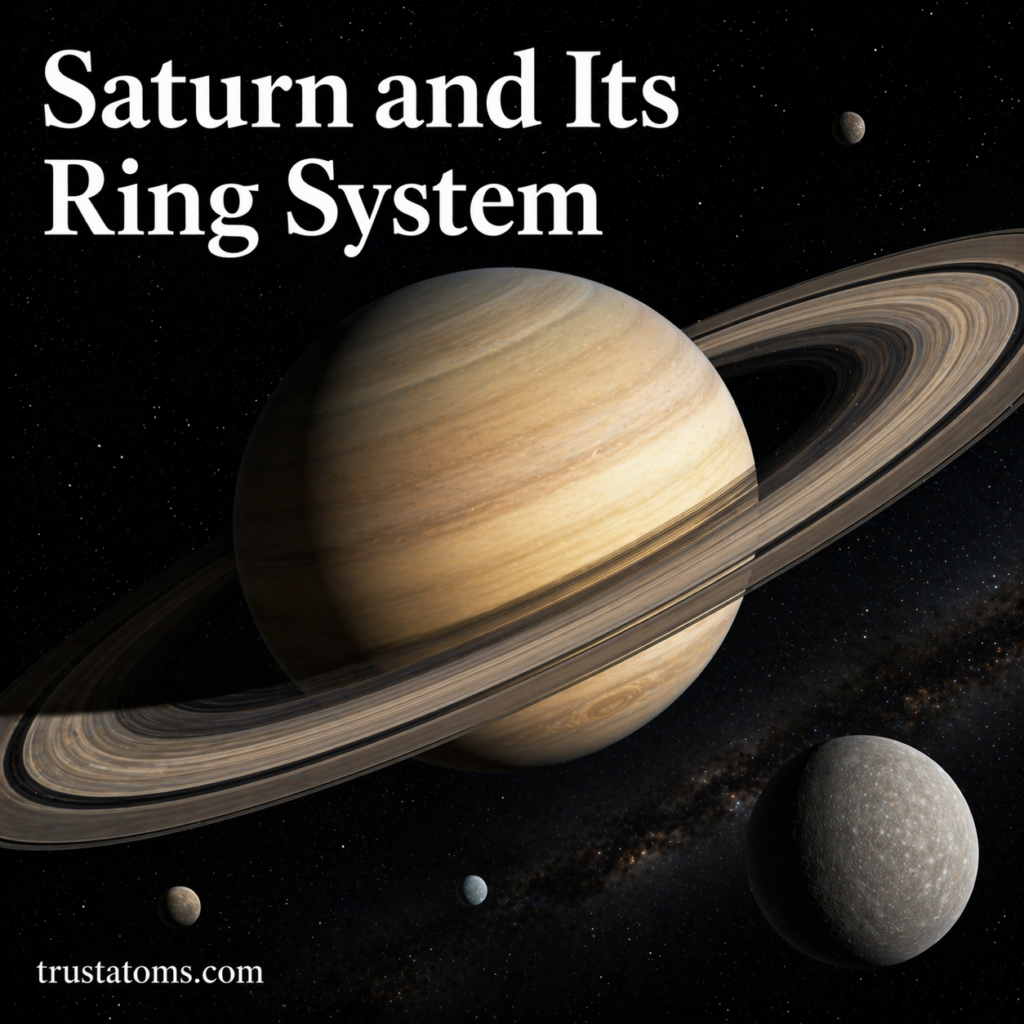
Saturn is one of the most visually striking planets in the Solar System, best known for its magnificent ring system. As a gas giant, Saturn is composed mostly of hydrogen and helium, but its rings and moons make it one of the most fascinating objects to study in astronomy.
This guide explores Saturn’s structure, its iconic rings, and why this planet continues to captivate scientists and observers alike.
Overview of Saturn
Saturn is the sixth planet from the Sun and the second-largest planet after Jupiter.
Key facts about Saturn:
- Diameter: About 9 times wider than Earth
- Composition: Primarily hydrogen and helium
- Day length: About 10.7 hours
- Year length: About 29 Earth years
- Density: Less than water (it would float in a large enough ocean)
Despite its massive size, Saturn is surprisingly light for a planet.
Saturn’s Structure
Like Jupiter, Saturn does not have a solid surface. Its structure consists of layers that become denser toward the center.
1. Atmosphere
Saturn’s outer layer is a thick atmosphere with subtle bands and storms.
- Mostly hydrogen and helium
- High-speed winds reaching up to 1,100 mph
- Occasional massive storms
Hexagonal Storm at the North Pole
Saturn features a unique atmospheric phenomenon known as the Saturn’s hexagon.
- A six-sided jet stream pattern
- Located at the north pole
- Stable for decades
2. Internal Layers
Below the atmosphere, Saturn transitions into deeper layers:
- Molecular hydrogen layer
- Liquid hydrogen layer
- Liquid metallic hydrogen (conductive layer)
- Dense core (rock and ice)
This internal structure contributes to Saturn’s magnetic field, though it is weaker than Jupiter’s.
Saturn’s Ring System
Saturn’s rings are its most iconic feature and are visible even with small telescopes.
What Are the Rings Made Of?
The rings are composed primarily of:
- Ice particles
- Rock fragments
- Dust
These particles range in size from tiny grains to chunks as large as mountains.
Structure of the Rings
Saturn’s rings are not a single solid structure—they are divided into multiple sections.
Main ring groups:
- A Ring (outermost major ring)
- B Ring (brightest and most massive)
- C Ring (inner, more transparent)
There are also faint rings such as the D, E, F, and G rings.
Gaps in the Rings
The rings contain distinct gaps caused by gravitational interactions with moons.
Example:
- Cassini Division separates the A and B rings
These gaps are often maintained by “shepherd moons” that help shape the ring structure.
How the Rings Formed
Scientists believe Saturn’s rings may have formed from:
- A shattered moon
- Collisions between icy bodies
- Leftover material from the early Solar System
Their exact origin is still debated, but they are thought to be relatively young in cosmic terms.
Saturn’s Moons
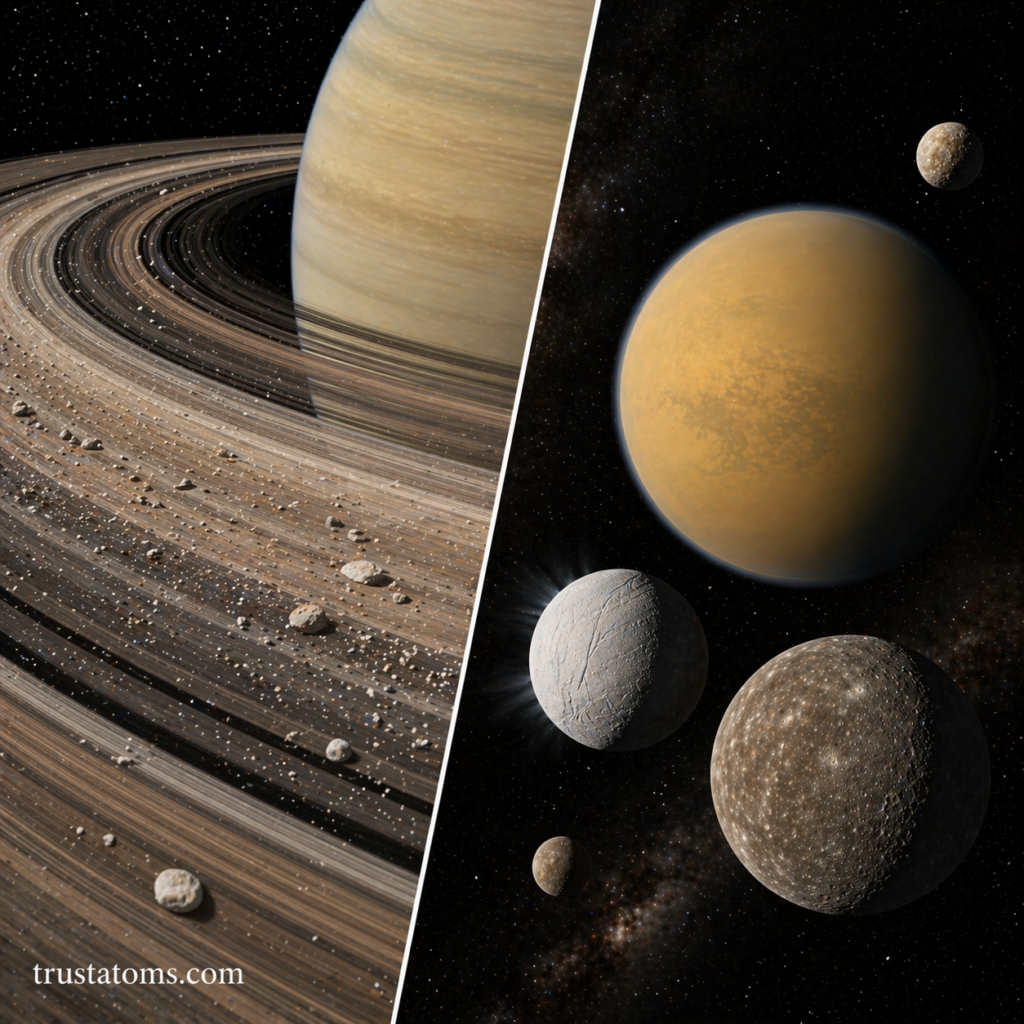
Saturn has over 140 known moons, each with unique characteristics.
Titan
Titan is Saturn’s largest moon and one of the most interesting in the Solar System.
- Larger than Mercury
- Thick nitrogen-rich atmosphere
- Lakes and rivers of liquid methane and ethane
Titan is a major target in the search for extraterrestrial chemistry and potential life processes.
Enceladus
Enceladus is a small but highly active moon.
- Covered in ice
- Geysers shoot water vapor into space
- Likely has a subsurface ocean
This makes Enceladus one of the most promising places to search for life beyond Earth.
Other Notable Moons
Saturn’s moon system includes a wide variety of objects:
- Icy moons with smooth surfaces
- Irregular moons with unusual orbits
- Moons that interact with and influence the rings
Together, they form a complex and dynamic system.
Saturn’s Magnetic Field
Saturn has a magnetic field generated by its internal structure.
Key features:
- Weaker than Jupiter’s but still powerful
- Aligned closely with the planet’s rotation axis
- Creates auroras near the poles
The magnetic field also interacts with the rings and moons, shaping Saturn’s space environment.
Why Saturn Matters
Saturn is more than just a beautiful planet—it plays an important role in scientific discovery.
Its significance includes:
- Understanding planetary ring systems
- Studying gas giant formation
- Exploring potential habitats for life (e.g., Titan and Enceladus)
- Learning about gravitational interactions in planetary systems
Final Thoughts
Saturn stands out as one of the most remarkable planets in the Solar System. Its stunning rings, complex structure, and diverse moons make it a centerpiece of astronomical study.
As missions and technology advance, Saturn will continue to reveal new insights into how planets and planetary systems evolve.