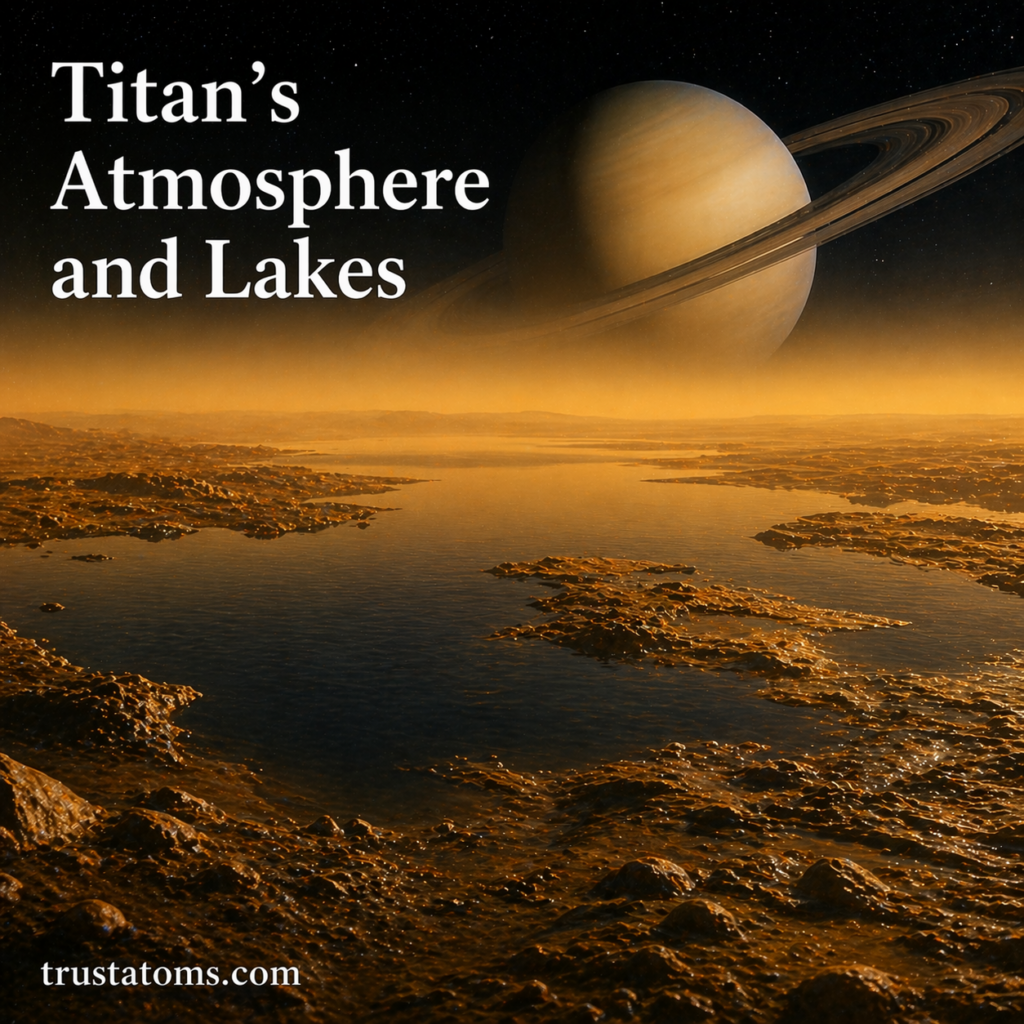
Titan, the largest moon of Saturn, is one of the most intriguing worlds in the solar system. Unlike any other moon, Titan has a thick atmosphere and stable liquid on its surface—features that make it surprisingly Earth-like, yet profoundly alien.
Instead of water, Titan’s lakes and rivers are made of methane and ethane, and its dense atmosphere creates a complex and dynamic environment that scientists are eager to understand.
What Is Titan?
Titan is the second-largest moon in the solar system and the only moon known to have a dense atmosphere.
Key Characteristics
- Larger than the planet Mercury
- Surface hidden beneath thick clouds
- Extremely cold (around -179°C / -290°F)
- Rich in organic molecules
Titan’s unique combination of atmosphere and surface liquids makes it a prime target for scientific exploration.
Titan’s Thick Atmosphere
Titan’s atmosphere is one of its most defining features.
Composition
The atmosphere is primarily made of:
- Nitrogen (about 95%)
- Methane (about 5%)
- Trace hydrocarbons and organic compounds
This composition is similar in some ways to early Earth’s atmosphere, making Titan a valuable natural laboratory.
Atmospheric Layers
Titan’s atmosphere is layered and complex:
- Troposphere: Where weather occurs
- Stratosphere: Contains hazy organic particles
- Thermosphere: Uppermost layer interacting with space
The thick haze gives Titan its orange appearance and blocks direct views of the surface in visible light.
Weather and Climate on Titan
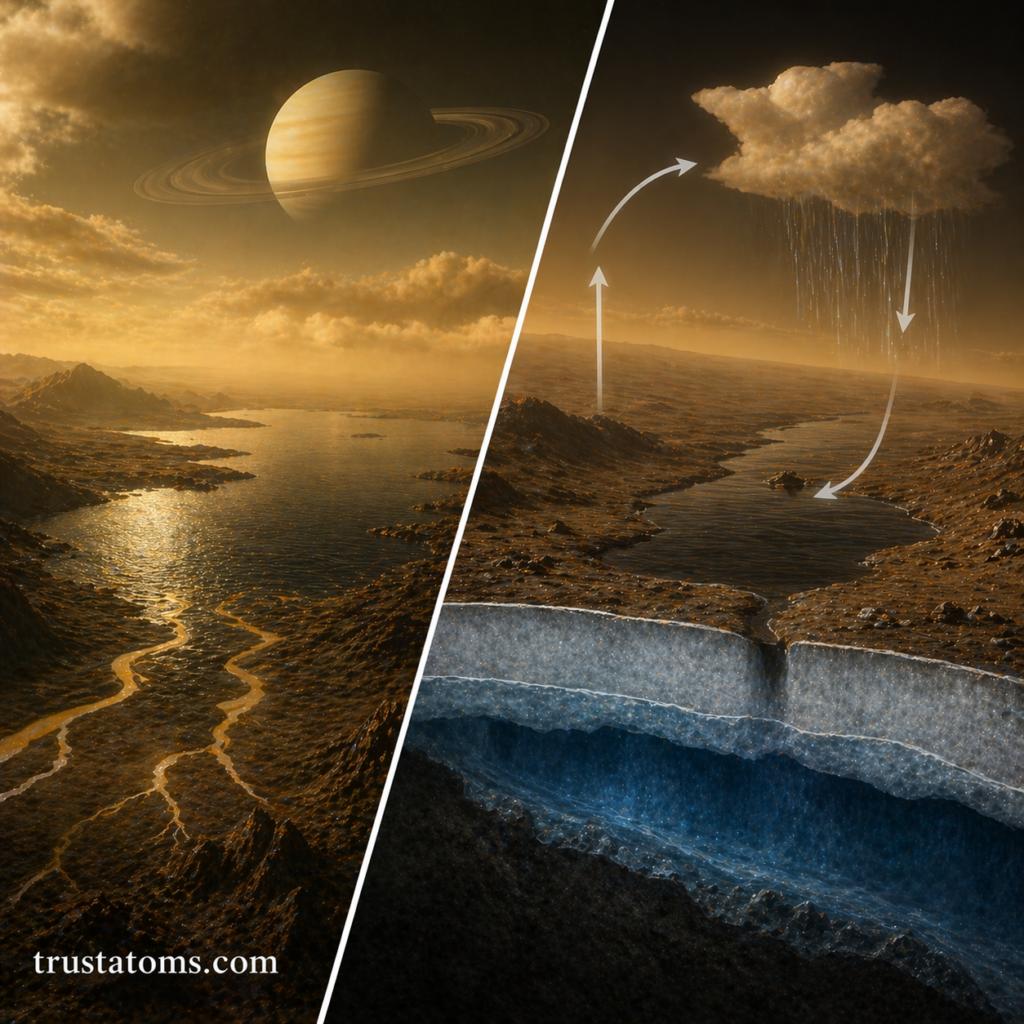
Despite its distance from the Sun, Titan has an active weather system.
Methane Cycle
Titan has a methane cycle similar to Earth’s water cycle:
- Methane evaporates from lakes and seas
- Forms clouds in the atmosphere
- Falls as methane rain
- Flows into rivers and lakes
Weather Phenomena
- Methane rainstorms
- Seasonal changes
- Wind-driven surface features
- Cloud formation and movement
This cycle shapes Titan’s landscape over time, just like water does on Earth.
Lakes, Rivers, and Seas of Titan
Titan is the only known world besides Earth with stable liquids on its surface.
Composition of Liquids
Instead of water, Titan’s surface liquids are made of:
- Methane
- Ethane
- Dissolved hydrocarbons
Major Surface Features
- Lakes: Smaller bodies of liquid
- Seas: Large, deep liquid reservoirs
- Rivers: Channels carved by flowing methane
Some of Titan’s largest seas are comparable in size to Earth’s Great Lakes.
Surface Conditions on Titan
Titan’s surface is both familiar and alien.
Key Features
- Dunes made of organic particles
- Ice “bedrock” instead of rock
- Liquid lakes and river channels
- Possible cryovolcanoes (ice volcanoes)
Temperature and Pressure
- Extremely cold temperatures
- Surface pressure higher than Earth’s
- Thick atmosphere allows for stable liquids
These conditions create a unique environment unlike any other in the solar system.
Why Titan Is Important for Science
Titan offers valuable insights into planetary science and the origins of life.
Prebiotic Chemistry
Titan’s atmosphere contains complex organic molecules that may resemble those that existed on early Earth.
This makes Titan an important location for studying:
- Chemical evolution
- Formation of life’s building blocks
- Atmospheric chemistry
Habitability Potential
While Titan’s surface is too cold for liquid water, scientists are exploring the possibility of:
- Exotic life forms based on methane
- Subsurface water-ammonia oceans
- Chemical processes that mimic biology
Exploration of Titan
Titan has been studied by several missions, revealing much of what we know today.
Cassini-Huygens Mission
Cassini-Huygens provided groundbreaking discoveries:
- Detailed images of Titan’s surface
- First landing on Titan (Huygens probe)
- Evidence of lakes, rivers, and dunes
Future Mission: Dragonfly
Dragonfly mission is a planned mission to explore Titan’s surface using a flying drone.
Goals include:
- Studying surface chemistry
- Investigating habitability
- Sampling different environments
Titan vs Earth: Similarities and Differences
Titan is often compared to Earth, but key differences remain.
Similarities
- Thick atmosphere
- Weather system
- Surface liquids
- Seasonal cycles
Differences
- Liquids are methane, not water
- Much colder temperatures
- Different chemical environment
- Lower gravity
These contrasts make Titan both familiar and uniquely alien.
Could There Be Life on Titan?
Titan challenges traditional ideas about life.
Possibilities
- Life based on methane instead of water
- Chemical processes similar to early Earth
- Subsurface environments with different conditions
While no life has been found, Titan expands our understanding of where life might exist.
Final Thoughts
Titan is one of the most complex and fascinating worlds in the solar system. Its thick atmosphere, methane lakes, and dynamic weather system make it a unique place to study planetary processes and the chemistry of life.
As future missions explore Titan more closely, it may provide answers to some of the biggest questions in science—about life, chemistry, and the nature of habitable worlds.