Not all stellar explosions are the same. While supernovae often steal the spotlight, novae are more subtle—but still incredibly powerful—events that occur in binary star systems. Even more fascinating, some stars don’t just erupt once—they do it repeatedly over time.
These recurring explosions, known as recurrent novae, reveal important insights into how stars interact, evolve, and recycle matter in the universe.
What Is a Nova?
A nova is a sudden, dramatic increase in brightness that occurs when a star rapidly releases energy from its surface.
Key Characteristics:
- Occurs in a binary star system
- Involves a white dwarf and a companion star
- Results in a temporary brightening (sometimes thousands of times brighter)
- Does not destroy the star
Unlike supernovae, novae are surface explosions, not total stellar destruction.
How Novae Form
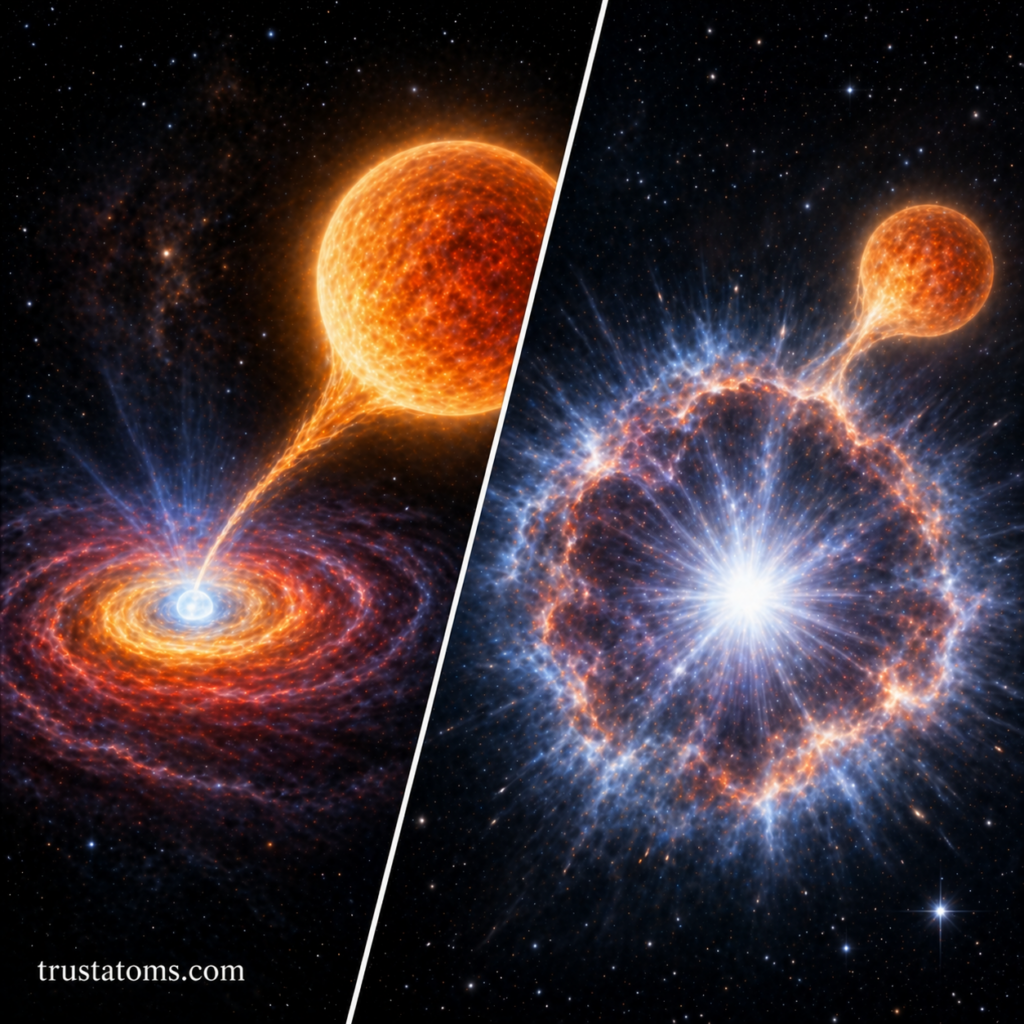
Novae occur when two stars orbit closely together, forming a binary system.
Step-by-Step Process:
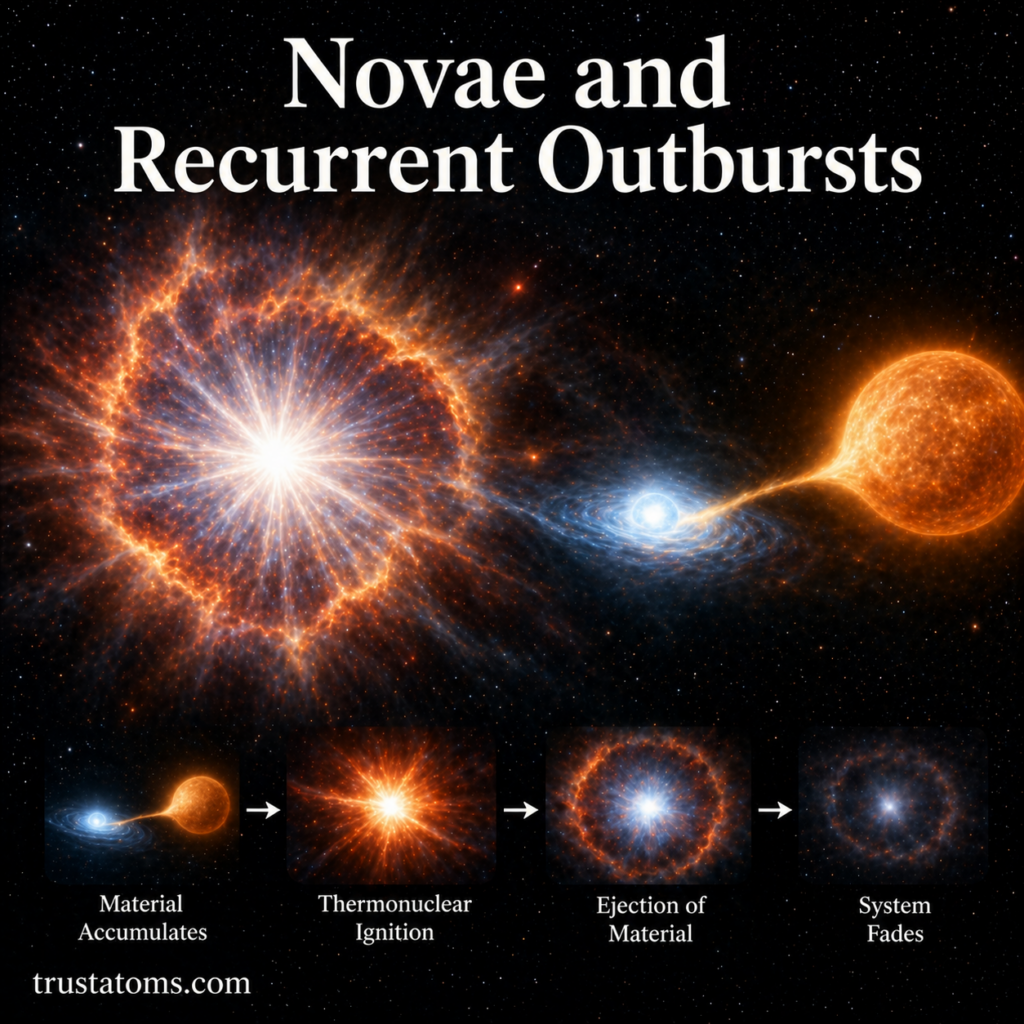
- A dense white dwarf pulls material from a nearby companion star
- Hydrogen gas accumulates on the white dwarf’s surface
- Pressure and temperature build over time
- A sudden thermonuclear reaction ignites
- Energy is released, causing a rapid brightening
This explosion ejects material into space, creating a glowing shell around the star.
What Is a Recurrent Nova?
A recurrent nova is a system where this process happens more than once.
Key Differences from Classical Novae:
- Multiple outbursts over decades or centuries
- Faster accumulation of material
- Often involve more massive white dwarfs
These systems don’t just erupt once—they go through repeated cycles of buildup and explosion.
Why Do Recurrent Outbursts Happen?
Recurrent novae require specific conditions:
1. High Mass White Dwarf
- Strong gravity pulls material efficiently
- Faster accumulation of hydrogen
2. Close Binary Orbit
- Companion star is close enough to continuously supply material
3. Rapid Accretion Rate
- Material builds up quickly, triggering frequent explosions
Because of these factors, the cycle of accumulation and ignition repeats over relatively short timescales.
Types of Novae
Novae can be classified based on how often they erupt and how they behave.
Classical Novae
- Occur once (or very rarely)
- Long intervals between eruptions (thousands of years)
- Slower accumulation of material
Recurrent Novae
- Multiple eruptions observed
- Intervals range from years to decades
- Rapid mass transfer between stars
Dwarf Novae (Related Phenomenon)
- Caused by changes in the accretion disk, not surface explosions
- Frequent but less energetic outbursts
- Important for studying binary star behavior
What Happens During an Outburst
During a nova event, several dramatic changes occur:
- The system brightens rapidly—sometimes visible from Earth
- Material is ejected at high speeds
- A shell of gas expands outward
- The brightness gradually fades over weeks or months
Despite the intensity, the white dwarf remains intact and can repeat the process.
The Role of Novae in Stellar Evolution
Novae play an important role in shaping stars and their environments.
Effects on the White Dwarf:
- Gradual changes in mass over time
- Potential growth toward a critical mass limit
Effects on the Companion Star:
- Continuous loss of outer material
- Altered structure and evolution
Can Novae Lead to Supernovae?
In some cases, yes.
If a white dwarf gains enough mass through repeated accretion, it may approach the Chandrasekhar limit (about 1.4 times the mass of the Sun).
Possible Outcome:
- The star becomes unstable
- A runaway reaction occurs
- A Type Ia supernova is triggered
This makes recurrent novae systems important candidates for studying supernova origins.
Why Novae Matter in Astronomy
Novae are more than just temporary flashes—they provide valuable insights into the universe.
Scientific Importance:
- Help scientists understand binary star systems
- Reveal how matter moves between stars
- Contribute to the chemical enrichment of space
- Provide clues about supernova formation
Observing Novae from Earth
Many novae are visible with telescopes, and some can even be seen with the naked eye.
What Observers Look For:
- Sudden brightening in a known star system
- Gradual fading over time
- Spectral signatures of ejected material
Astronomers monitor these systems closely to study their behavior and predict future outbursts.
Final Thoughts
Novae and recurrent outbursts showcase the dynamic and interconnected nature of stars. Rather than existing in isolation, many stars are part of binary systems where gravity, mass transfer, and energy combine to create spectacular events.
- Novae are powerful but non-destructive explosions
- Recurrent novae repeat the process over time
- These systems can even lead to supernovae under the right conditions
By studying novae, astronomers gain deeper insight into stellar life cycles, explosive phenomena, and the ongoing evolution of the cosmos.