Every atom in your body—except hydrogen—was forged in the heart of a star. From the carbon in your cells to the iron in your blood, the elements that make up the universe are products of stellar processes that span billions of years.
This process, known as nucleosynthesis, explains how simple particles formed after the Big Bang evolved into the rich chemical diversity we see today.
What Is Cosmic Element Formation?
Cosmic element formation refers to the creation of chemical elements inside stars and during stellar events.
Key Idea:
- Light elements formed early in the universe
- Heavier elements are created inside stars or during explosions
This process transforms hydrogen and helium into all other naturally occurring elements.
The First Elements After the Big Bang
Shortly after the Big Bang, only a few elements existed:
- Hydrogen
- Helium
- Trace amounts of lithium
These light elements became the building blocks for the first stars, where heavier elements would begin to form.
How Stars Create Elements
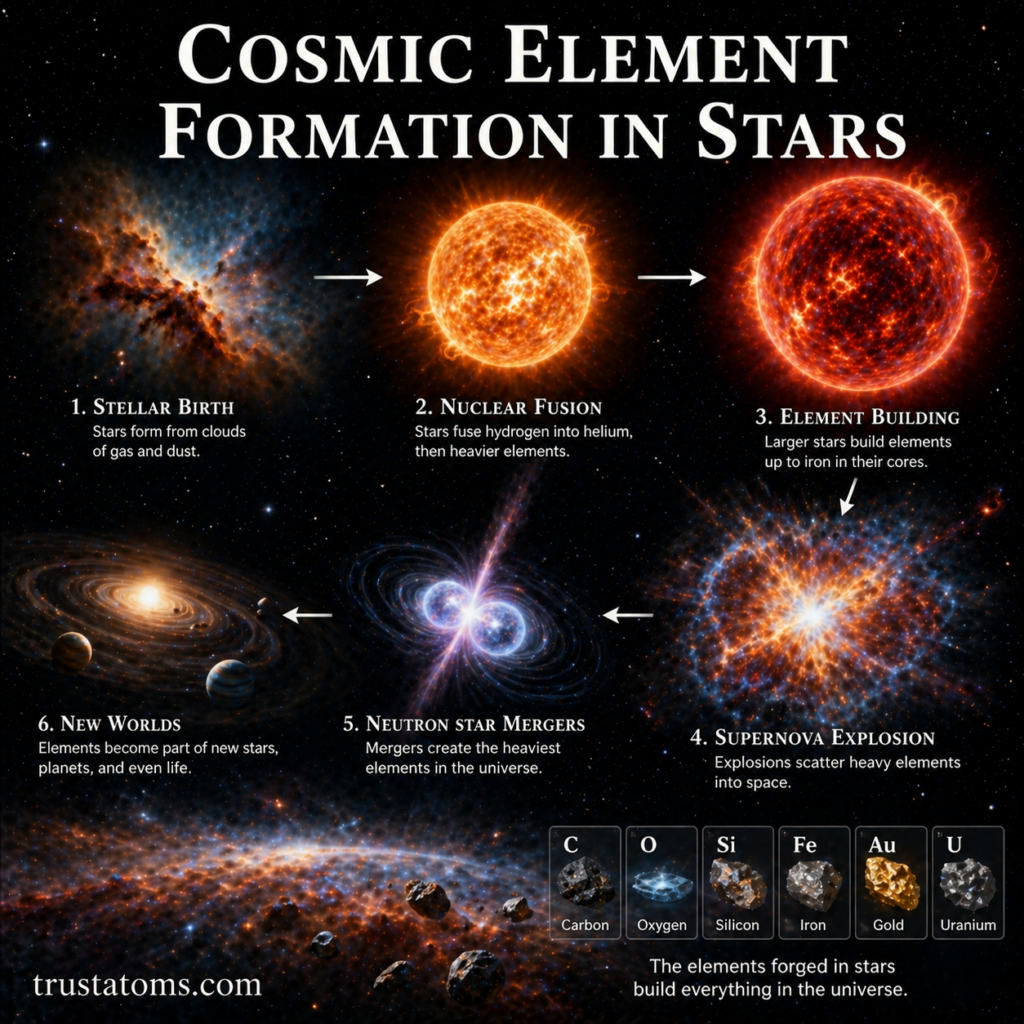
Stars act as cosmic furnaces, using nuclear fusion to build heavier elements from lighter ones.
Step-by-Step Fusion Process:
- Hydrogen atoms fuse to form helium
- Helium fuses into carbon and oxygen
- In massive stars, fusion continues into heavier elements
- Each stage requires higher temperatures and pressure
This process occurs in the core, where conditions are most extreme.
Element Formation by Star Type
Not all stars produce the same elements. A star’s mass determines how far fusion can go.
Low-Mass Stars
- Fuse hydrogen into helium
- May produce small amounts of carbon and oxygen
Result:
- Limited contribution to heavier elements
Medium-Mass Stars (Like the Sun)
- Fuse helium into carbon and oxygen
- Shed outer layers later in life
Result:
- Contribute carbon, nitrogen, and oxygen to space
High-Mass Stars
- Fuse elements up to iron in layered shells
- Experience multiple fusion stages
Result:
- Produce a wide range of elements, including silicon, sulfur, and iron
Why Fusion Stops at Iron
Iron represents a turning point in stellar fusion.
Key Reason:
- Fusion up to iron releases energy
- Fusion beyond iron requires energy
This means stars cannot generate energy by fusing elements heavier than iron, leading to instability in massive stars.
Supernovae and Heavy Element Creation
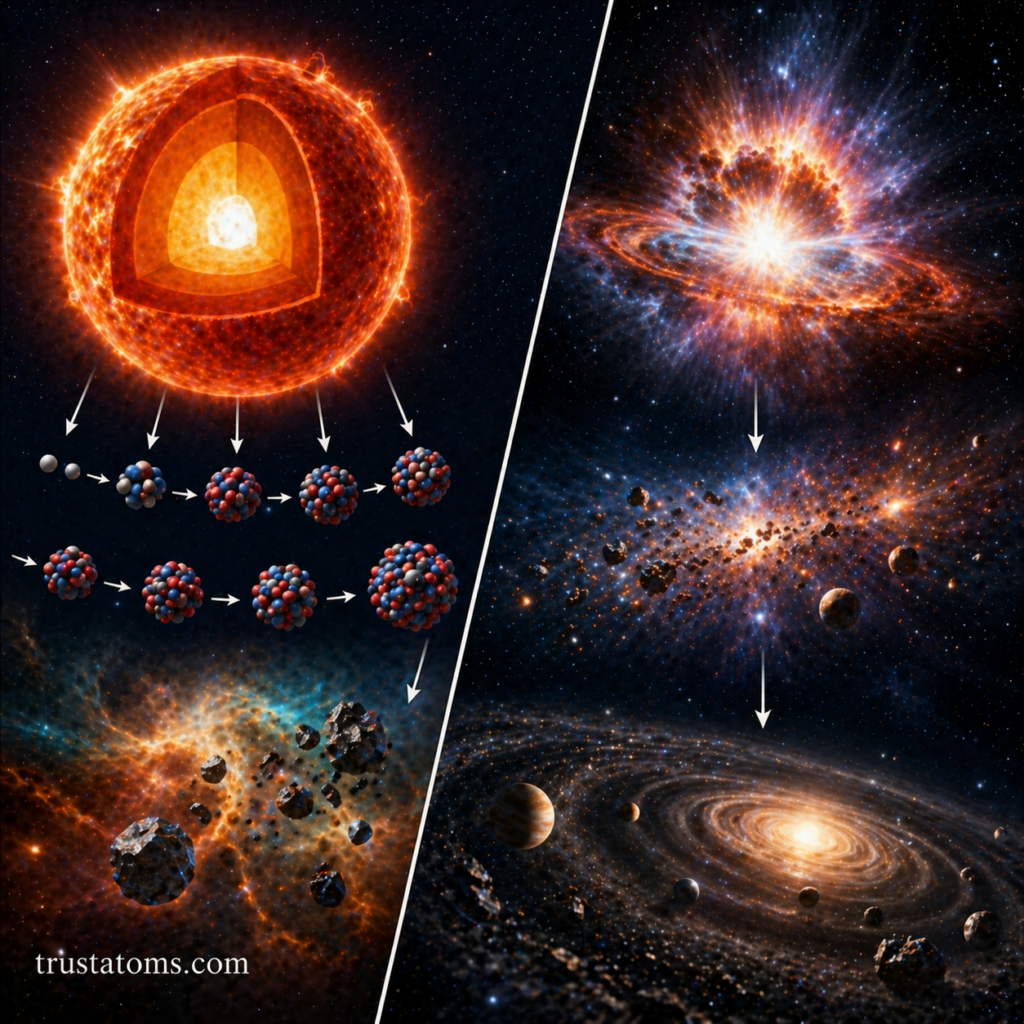
The heaviest elements in the universe are created during supernova explosions.
What Happens:
- Core collapses suddenly
- Extreme temperatures and pressures occur
- Neutrons are rapidly captured by atomic nuclei
- Heavy elements form in seconds
Elements Created:
- Gold
- Uranium
- Platinum
- Lead
These elements are then scattered into space.
Neutron Star Mergers and Element Formation
In addition to supernovae, neutron star collisions also produce heavy elements.
Key Features:
- Intense gravitational forces
- Rapid neutron capture (r-process)
- Formation of rare, heavy elements
These events are now considered major sources of elements like gold.
The Role of Stellar Winds
Stars also release elements through stellar winds.
Effects:
- Gradual ejection of material into space
- Enrichment of surrounding gas clouds
- Contribution to future star and planet formation
This process is especially important in red giants and supergiants.
The Cosmic Recycling Process
Element formation is part of a larger cycle.
The Cycle:
- Stars form from gas clouds
- Fusion creates new elements
- Stars eject material through winds or explosions
- New stars and planets form from enriched material
This ongoing cycle builds chemical complexity over time.
Why Element Formation Matters
Without stellar nucleosynthesis, the universe would remain simple and lifeless.
Importance:
- Enables formation of planets
- Provides building blocks for life
- Explains the origin of elements on Earth
- Helps scientists understand cosmic evolution
Every element heavier than helium has a stellar origin.
Final Thoughts
Cosmic element formation tells the story of how the universe evolved from simplicity to complexity. Stars are not just sources of light—they are creators of matter itself.
- Light elements formed after the Big Bang
- Stars fused elements up to iron
- Supernovae and mergers created heavier elements
- Stellar processes continue to recycle and enrich the universe
In a very real sense, we are made of star material—evidence of billions of years of cosmic evolution.