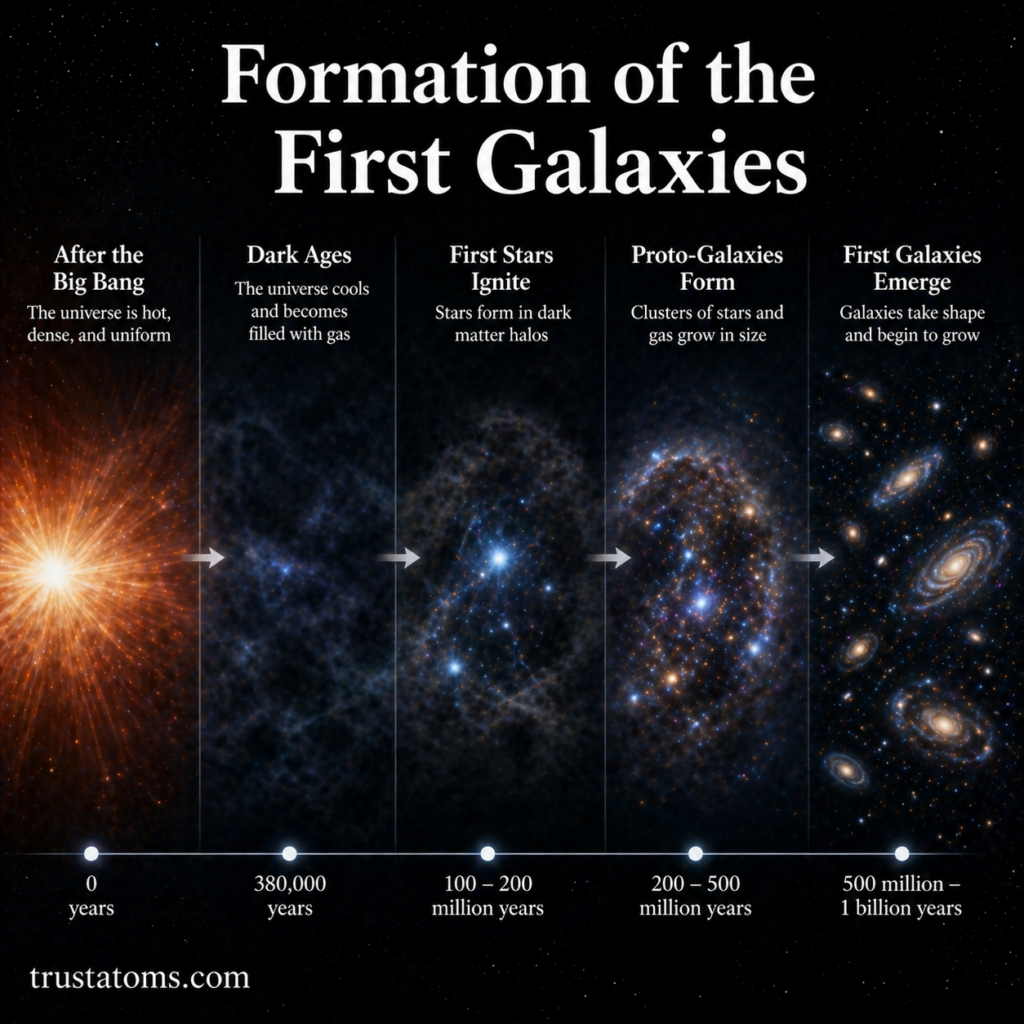
The first galaxies mark a major turning point in the history of the universe. After the Big Bang, the cosmos was initially filled with hot plasma, then later cooled into a dark, simple environment of hydrogen and helium gas. Over time, gravity shaped this matter into the first stars and eventually the first galaxies.
Understanding how the first galaxies formed helps scientists trace the origins of structure in the universe—and ultimately, the formation of galaxies like our own.
The Early Universe: Before Galaxies
Before galaxies existed, the universe went through several key phases.
Key Stages
- Big Bang – Universe begins expanding
- Recombination – Atoms form (~380,000 years later)
- Cosmic Dark Ages – No stars or galaxies yet
- First structures begin forming
During this time, the universe was mostly:
- Hydrogen and helium gas
- Slight density variations from early quantum fluctuations
- Completely dark, with no light sources
These small density differences would eventually grow into galaxies.
The Role of Dark Matter
Dark matter played a crucial role in galaxy formation.
Why It Matters
- It provided the gravitational “scaffolding” for structure
- It began clumping before normal matter
- It pulled gas into dense regions
Without dark matter, gas alone would not have formed galaxies as efficiently.
These dense regions are called dark matter halos, and they became the birthplaces of galaxies.
Birth of the First Stars
Before galaxies could form, the first stars had to ignite.
Population III Stars
The earliest stars are known as Population III stars.
- Formed from pure hydrogen and helium
- Likely very massive and short-lived
- Produced the first heavy elements through nuclear fusion
These stars changed the universe by:
- Emitting intense radiation
- Triggering further star formation
- Enriching the surrounding gas with heavier elements
This process set the stage for galaxy formation.
From Gas Clouds to Galaxies
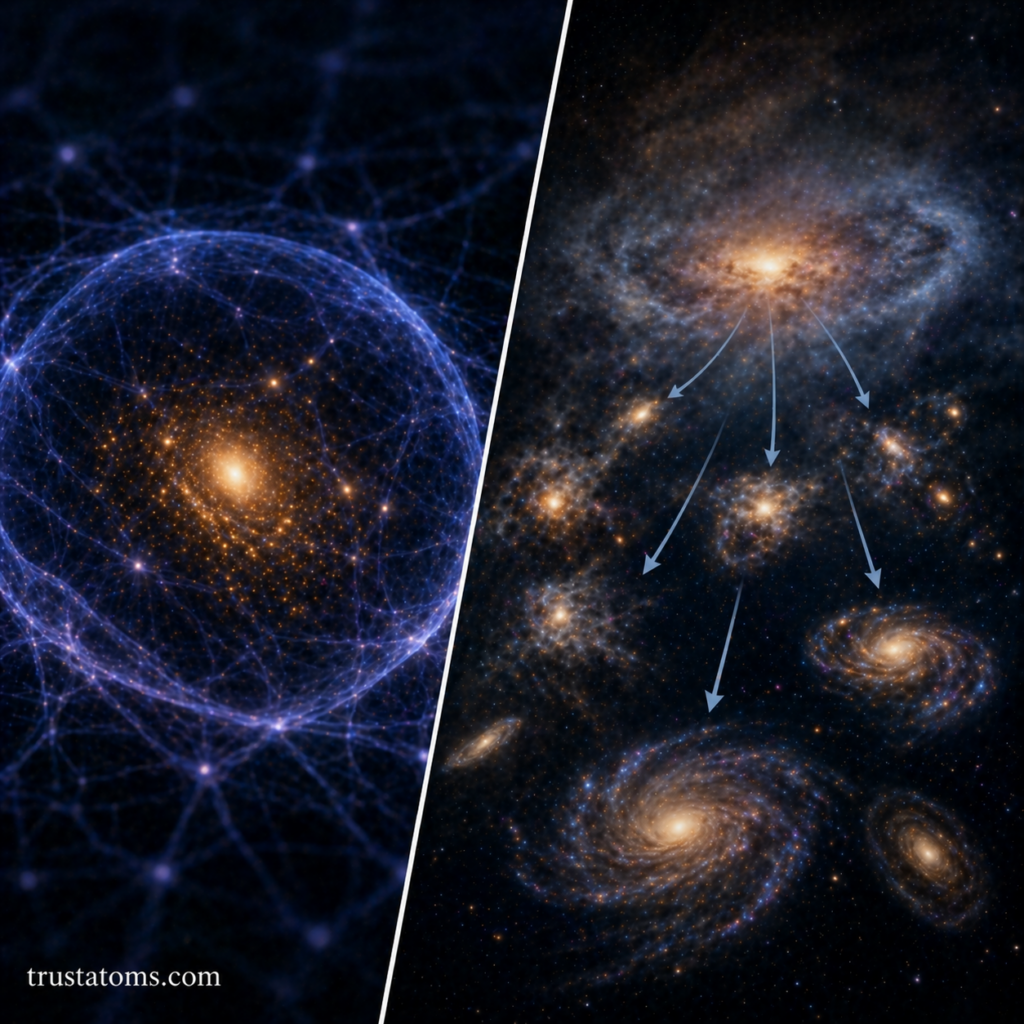
As gas collected inside dark matter halos, it began to collapse and form stars.
How Galaxies Formed
- Gas fell into dark matter halos
- Gravity caused gas clouds to collapse
- Stars formed within these regions
- Star clusters merged and grew
- Early galaxies took shape
These first galaxies were:
- Smaller than modern galaxies
- Irregular in shape
- Rapidly forming stars
Over time, they merged and evolved into larger systems.
Cosmic Reionization
The formation of the first galaxies led to a major cosmic event known as reionization.
What Happened
- Radiation from early stars and galaxies ionized hydrogen gas
- The universe became transparent to light
- This marked the end of the cosmic dark ages
Reionization allowed light to travel freely, making the universe visible in a new way.
Growth Through Mergers
Early galaxies didn’t remain small for long—they grew through collisions and mergers.
Key Processes
- Smaller galaxies merged to form larger ones
- Gas flows fueled ongoing star formation
- Structures became more organized over time
This hierarchical growth model explains how galaxies like the Milky Way formed.
Observing the First Galaxies
Studying the first galaxies is challenging because they are extremely distant.
How Astronomers Study Them
- Observing high redshift galaxies (very far away)
- Using powerful space telescopes
- Detecting faint infrared light
Instruments like the James Webb Space Telescope have revolutionized this field by allowing us to see galaxies from the earliest epochs.
Why First Galaxies Matter
The first galaxies are key to understanding cosmic evolution.
Key Insights
- Show how structure formed from simple beginnings
- Reveal the origins of stars and elements
- Help explain galaxy formation over time
- Provide clues about dark matter and early physics
They are essentially the building blocks of everything we see today.
Timeline of Early Galaxy Formation
Here’s a simplified timeline:
- 0–380,000 years – Atoms form
- Hundreds of millions of years – First stars ignite
- ~400–500 million years – First galaxies appear
- 1 billion years onward – Galaxies grow and merge
Final Thoughts
The formation of the first galaxies transformed the universe from a dark, simple place into a complex and luminous cosmos. Through gravity, dark matter, and star formation, the first structures emerged and began shaping everything that followed.
As technology advances, astronomers continue to push further back in time—bringing us closer to witnessing the birth of the very first galaxies.