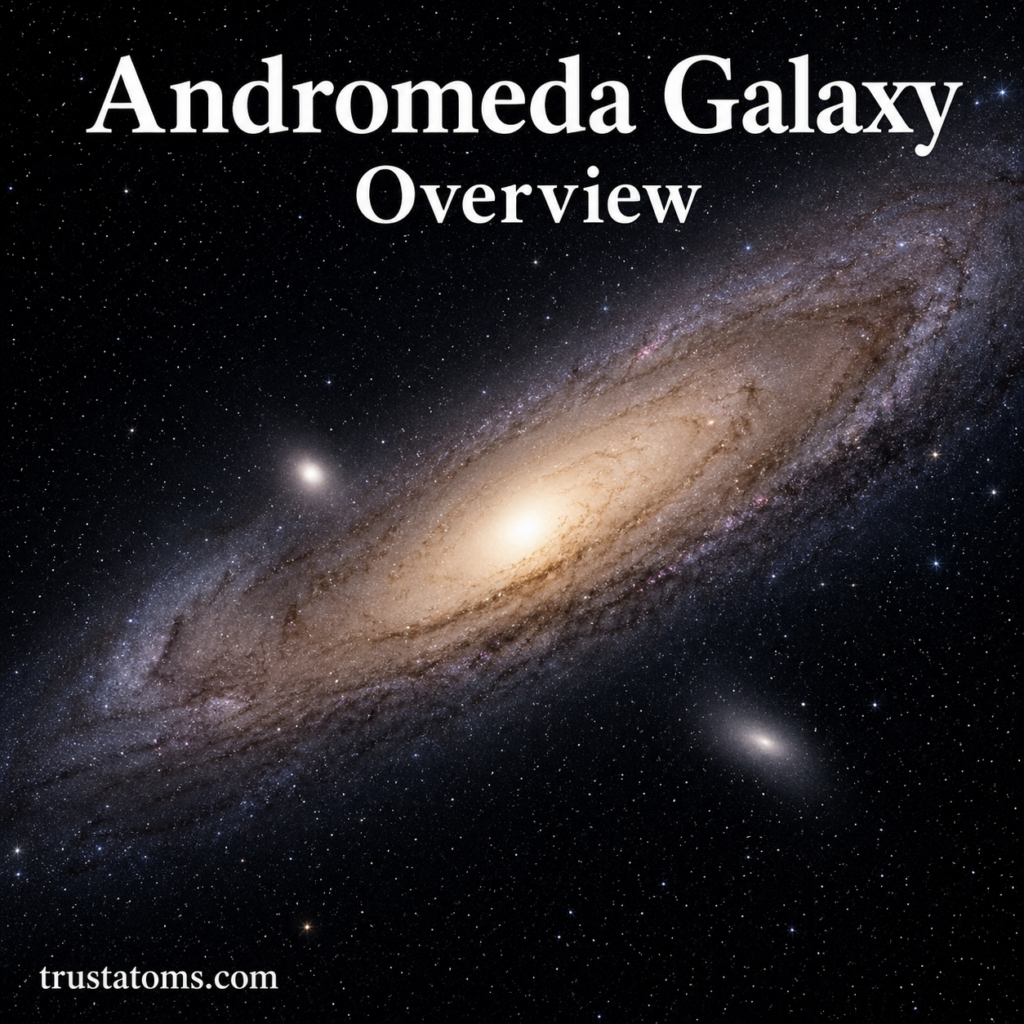
The Andromeda Galaxy is the closest large spiral galaxy to our own Milky Way—and one of the most fascinating objects in the night sky. Visible to the naked eye under dark conditions, Andromeda offers a rare glimpse into the structure, history, and future of galaxies like our own.
In this guide, we’ll explore what the Andromeda Galaxy is, its key characteristics, how to observe it, and what it reveals about the universe.
What Is the Andromeda Galaxy?
The Andromeda Galaxy, also known as Messier 31 (M31), is a massive spiral galaxy located about 2.5 million light-years from Earth. It belongs to the Local Group, a collection of more than 50 galaxies that includes the Milky Way.
Key Facts About Andromeda
- Type: Spiral galaxy
- Distance from Earth: ~2.5 million light-years
- Diameter: ~220,000 light-years
- Number of stars: ~1 trillion (more than the Milky Way)
- Constellation: Andromeda
Andromeda is the largest galaxy in the Local Group, making it a dominant gravitational force in our cosmic neighborhood.
Structure and Composition
Like the Milky Way, Andromeda has a well-defined spiral structure.
Major Components
- Central Bulge
A dense region packed with older stars and a supermassive black hole. - Spiral Arms
Curving arms filled with gas, dust, and active star formation. - Galactic Disk
A flattened region where most stars and nebulae are found. - Halo
A spherical region containing older stars and globular clusters.
Satellite Galaxies
Andromeda is surrounded by smaller companion galaxies, including:
- M32
- M110
These satellite galaxies orbit Andromeda and interact gravitationally with it.
How Andromeda Compares to the Milky Way
While similar in structure, Andromeda and the Milky Way have some important differences.
Comparison Highlights
- Andromeda is larger and more massive
- It contains more stars (up to twice as many)
- It may have experienced more galactic mergers
Despite these differences, both galaxies are spiral galaxies with central black holes and ongoing star formation.
Can You See the Andromeda Galaxy?
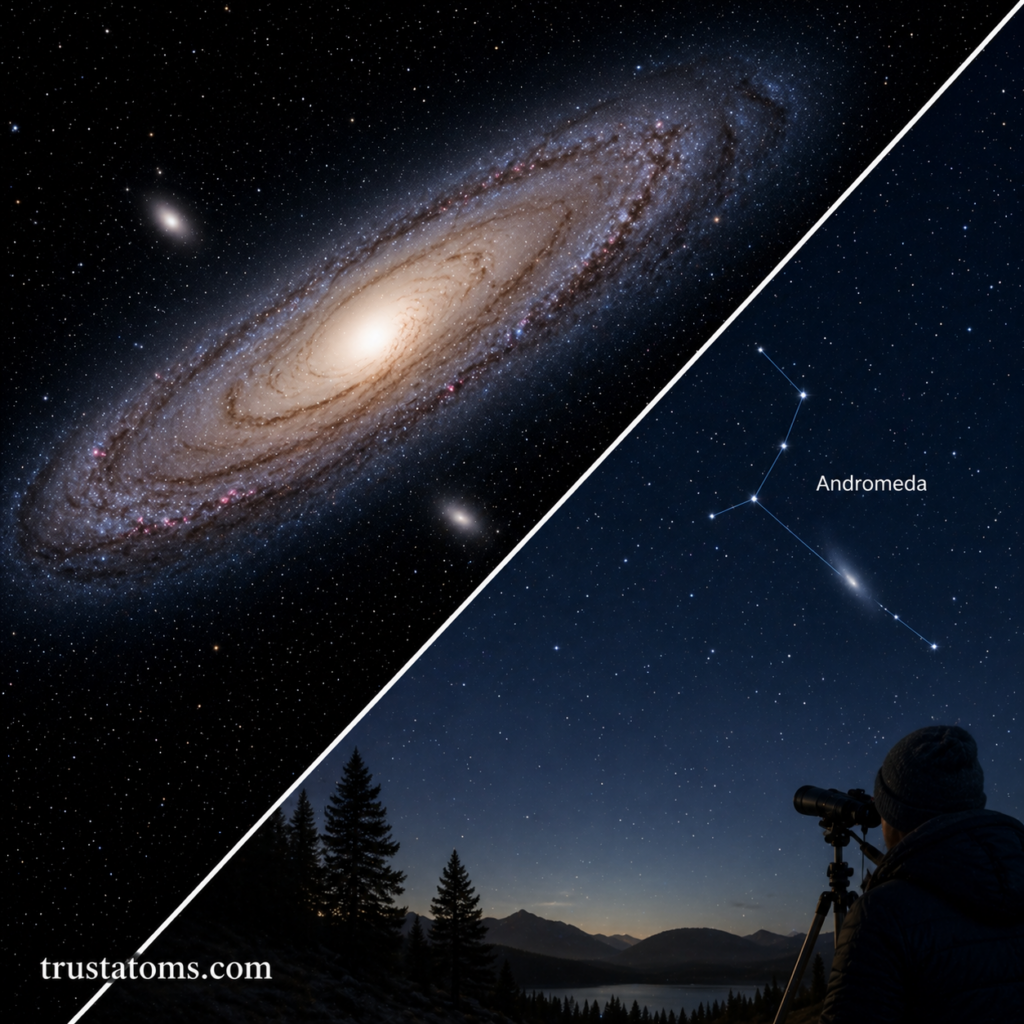
Yes—Andromeda is one of the few galaxies visible without a telescope.
How to Observe Andromeda
- Find a dark sky location away from city lights
- Locate the constellation Andromeda
- Look for a faint, fuzzy patch of light
Viewing Tips
- Best seen during autumn and winter in the Northern Hemisphere
- Use binoculars for a clearer view
- A telescope reveals more structure, including its bright core
Under ideal conditions, Andromeda appears as a soft, elongated glow, not a detailed spiral.
The Future: Collision with the Milky Way
One of the most intriguing aspects of Andromeda is its future interaction with our galaxy.
What Will Happen?
The Andromeda Galaxy is moving toward the Milky Way at about 110 km/s. Scientists predict a collision in roughly 4–5 billion years.
Expected Outcomes
- The galaxies will merge into a single, larger galaxy
- Stars are unlikely to collide due to vast distances
- Gravitational interactions will reshape both galaxies
This future galaxy is sometimes referred to as “Milkomeda.”
Why the Andromeda Galaxy Matters
Studying Andromeda helps astronomers understand galaxy formation and evolution.
Scientific Importance
- Provides a nearby model for studying spiral galaxies
- Offers insights into dark matter distribution
- Helps predict the future of the Milky Way
- Reveals the effects of galactic mergers
Because of its proximity, Andromeda is one of the most studied galaxies outside our own.
Interesting Facts About Andromeda
- It’s the farthest object visible to the naked eye
- Light from Andromeda takes 2.5 million years to reach Earth
- It contains hundreds of billions of planets
- It was once thought to be part of the Milky Way
Final Thoughts
The Andromeda Galaxy is more than just a distant neighbor—it’s a window into the past and future of our universe. From its massive size and structure to its eventual collision with the Milky Way, Andromeda continues to captivate astronomers and stargazers alike.
Whether you’re observing it through binoculars or studying its properties, Andromeda reminds us of the vast scale and dynamic nature of the cosmos.