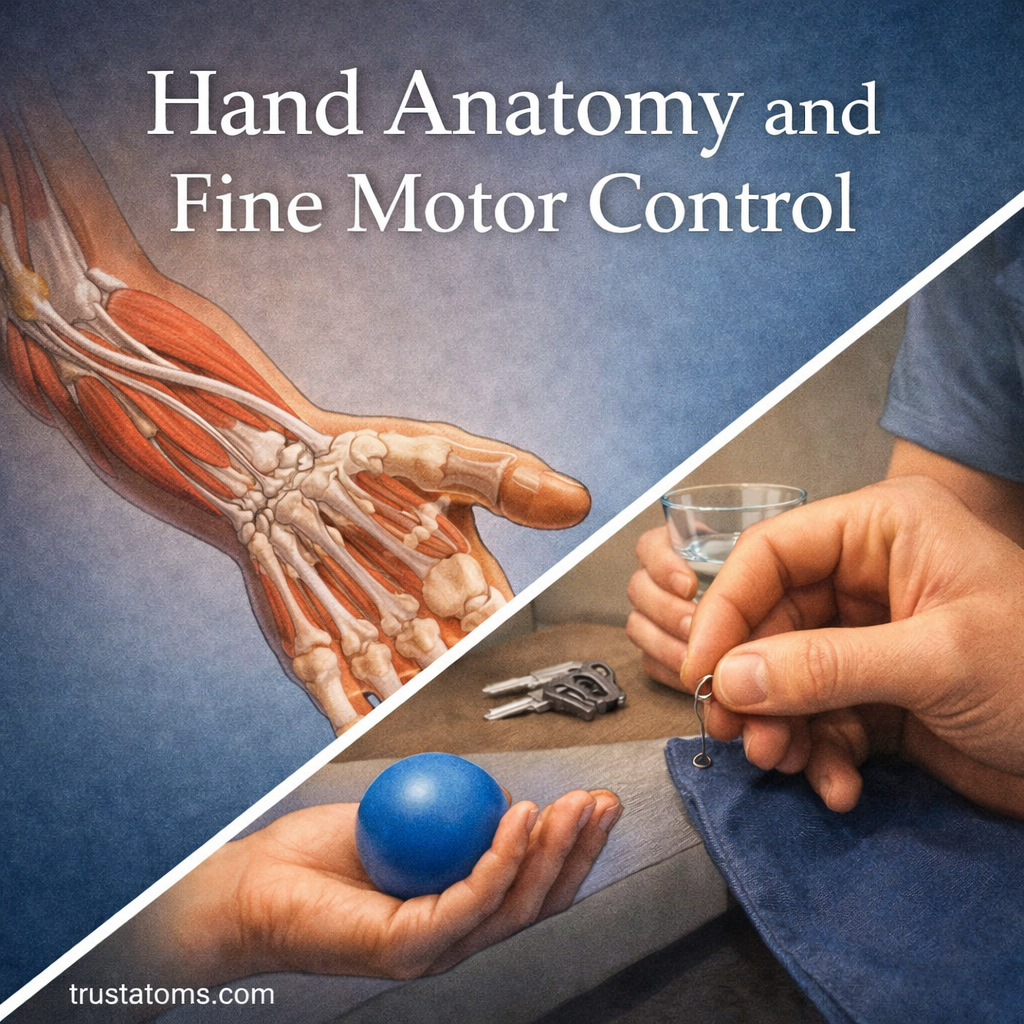
Hand Anatomy and Fine Motor Control

Illustration of hand anatomy and fine motor control showing muscles, bones, and precise finger movements.
Visual representation of hand anatomy and fine motor control in everyday tasks. trustatoms.com.

The human hand is one of the most intricate and functionally advanced structures in the body. It allows us to perform precise tasks like writing, typing, and buttoning a shirt, as well as powerful actions like gripping and lifting.

Hand anatomy and fine motor control work together to enable these movements. This coordination involves bones, muscles, tendons, nerves, and sensory feedback systems operating with remarkable precision.

Continue reading “Hand Anatomy and Fine Motor Control”
Upper Limb Mechanics in Reaching and Grasping

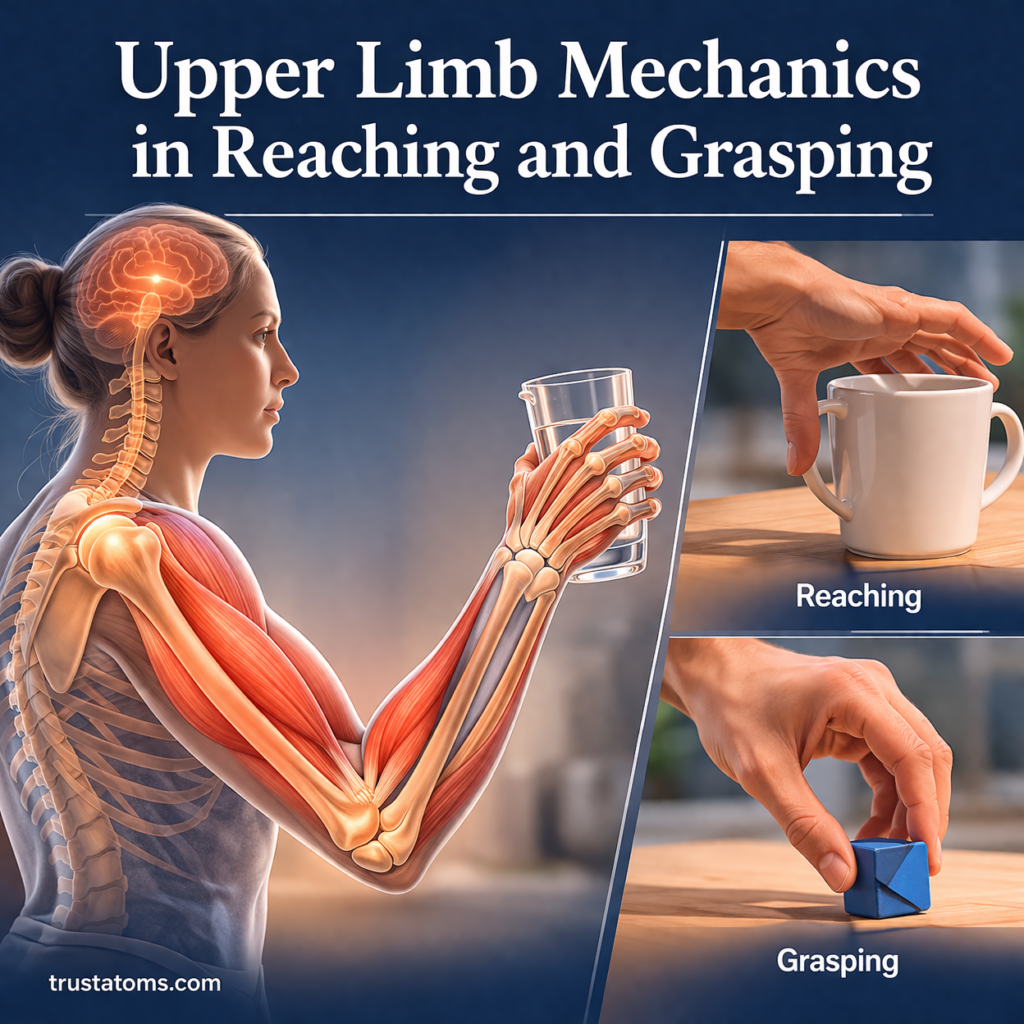
Illustration of upper limb mechanics showing arm movement during reaching and hand grasping actions.
Visual overview of reaching and grasping mechanics in the upper limb. trustatoms.com.

Reaching and grasping are essential human movements used in everyday tasks—from picking up a cup to typing on a keyboard. These actions rely on precise coordination between the shoulder, elbow, wrist, and hand, along with input from the nervous system.

Upper limb mechanics refers to how these structures work together to allow smooth, accurate, and controlled movement. Understanding this system is important in anatomy, rehabilitation, and performance optimization.

Continue reading “Upper Limb Mechanics in Reaching and Grasping”

Running Mechanics and Impact Forces

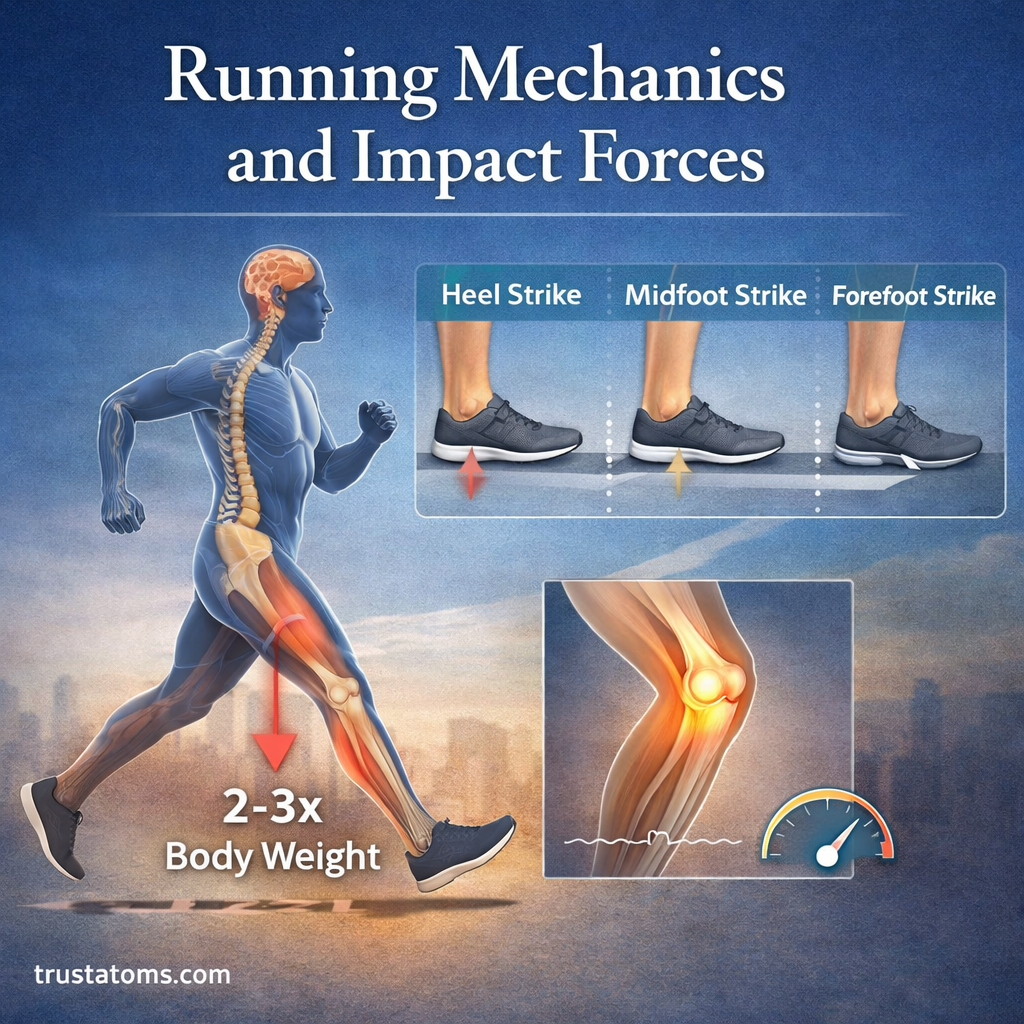
Illustration of running mechanics showing foot strike patterns and impact forces on the body.
Visual representation of running mechanics and how impact forces affect the body during movement. trustatoms.com.

Running is a dynamic, high-impact form of human movement that places greater demands on the body compared to walking. Each stride involves coordinated muscle activity, joint motion, and force absorption to propel the body forward efficiently.

Understanding running mechanics and impact forces is essential for improving performance, preventing injury, and optimizing movement patterns in both recreational and competitive runners.

Continue reading “Running Mechanics and Impact Forces”

Gait Mechanics in Walking

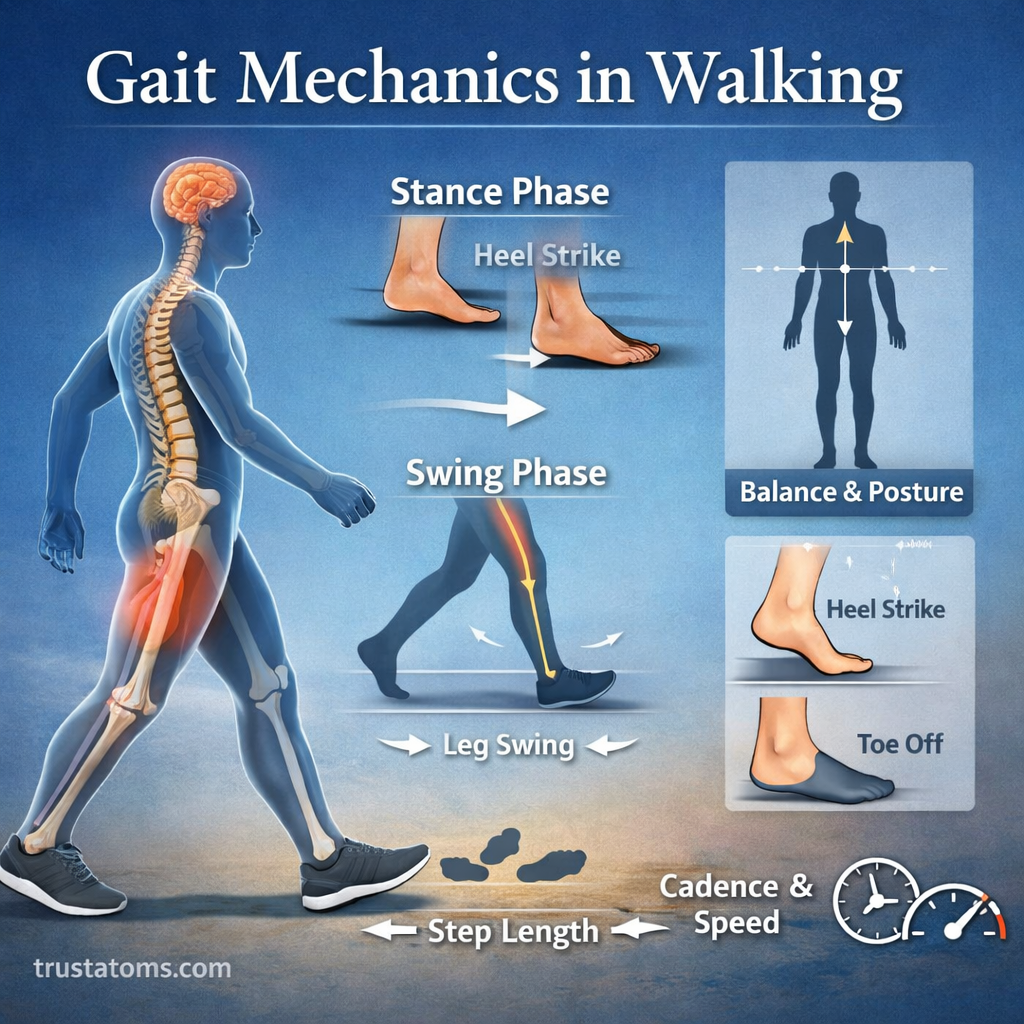
Illustration of gait mechanics in walking showing stance phase, swing phase, and basic human movement patterns.
Visual overview of gait mechanics in walking including stance and swing phases. trustatoms.com.

Walking is one of the most fundamental human movements, yet it involves a highly coordinated interaction between muscles, joints, nerves, and balance systems. Gait mechanics refers to how the body moves during walking—an efficient, repeatable pattern that allows humans to travel with minimal energy expenditure.

Understanding gait mechanics is important in fields like physical therapy, sports science, and rehabilitation, as even small abnormalities can affect posture, balance, and long-term joint health.

Continue reading “Gait Mechanics in Walking”

Proprioception in Joint Position Sensing

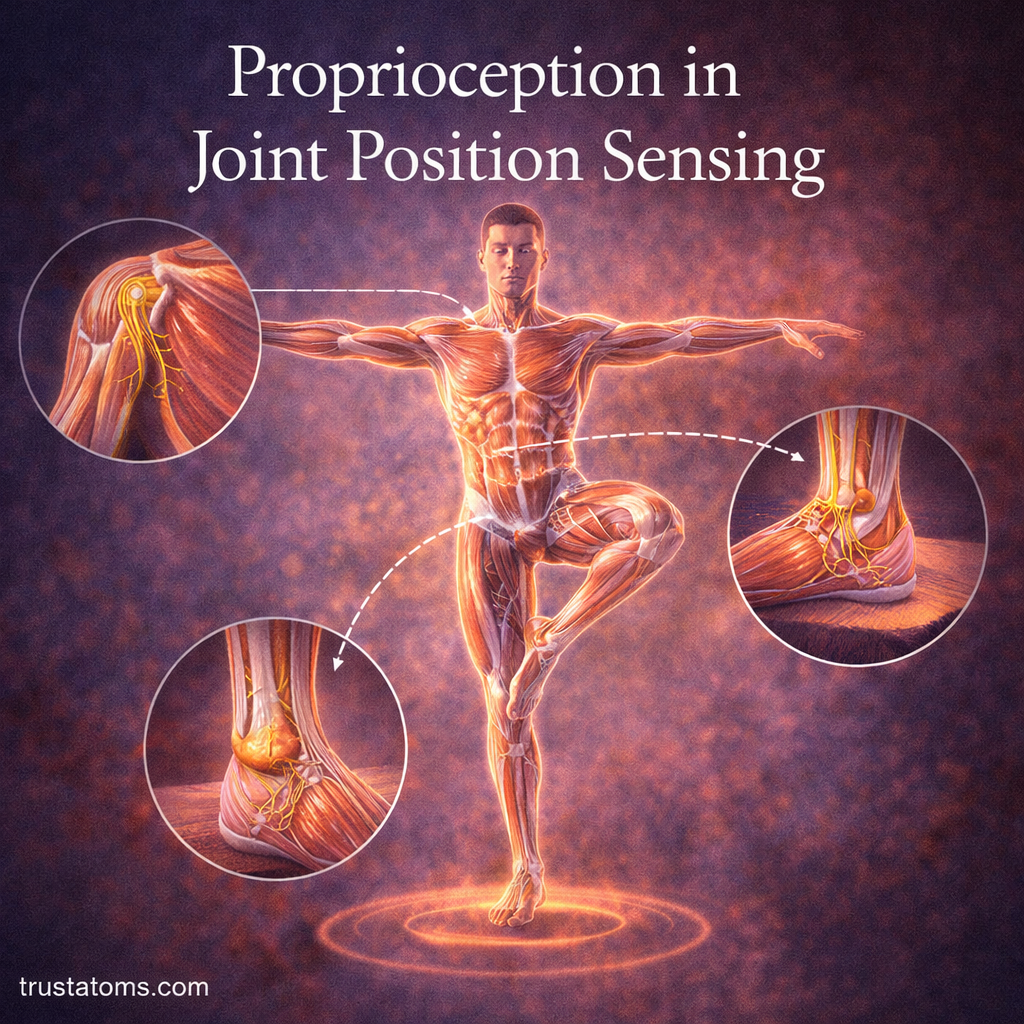
Illustration of proprioception in joint position sensing showing a person balancing with highlighted joints and nerve pathways.
Illustration showing how proprioception helps sense joint position and maintain balance. trustatoms.com

Have you ever touched your nose with your eyes closed or walked without constantly looking at your feet? These actions are possible because of proprioception—your body’s ability to sense its position, movement, and orientation in space.

Proprioception plays a critical role in joint position sensing, coordination, balance, and injury prevention.

Continue reading “Proprioception in Joint Position Sensing”

The Role of Fascia in Movement

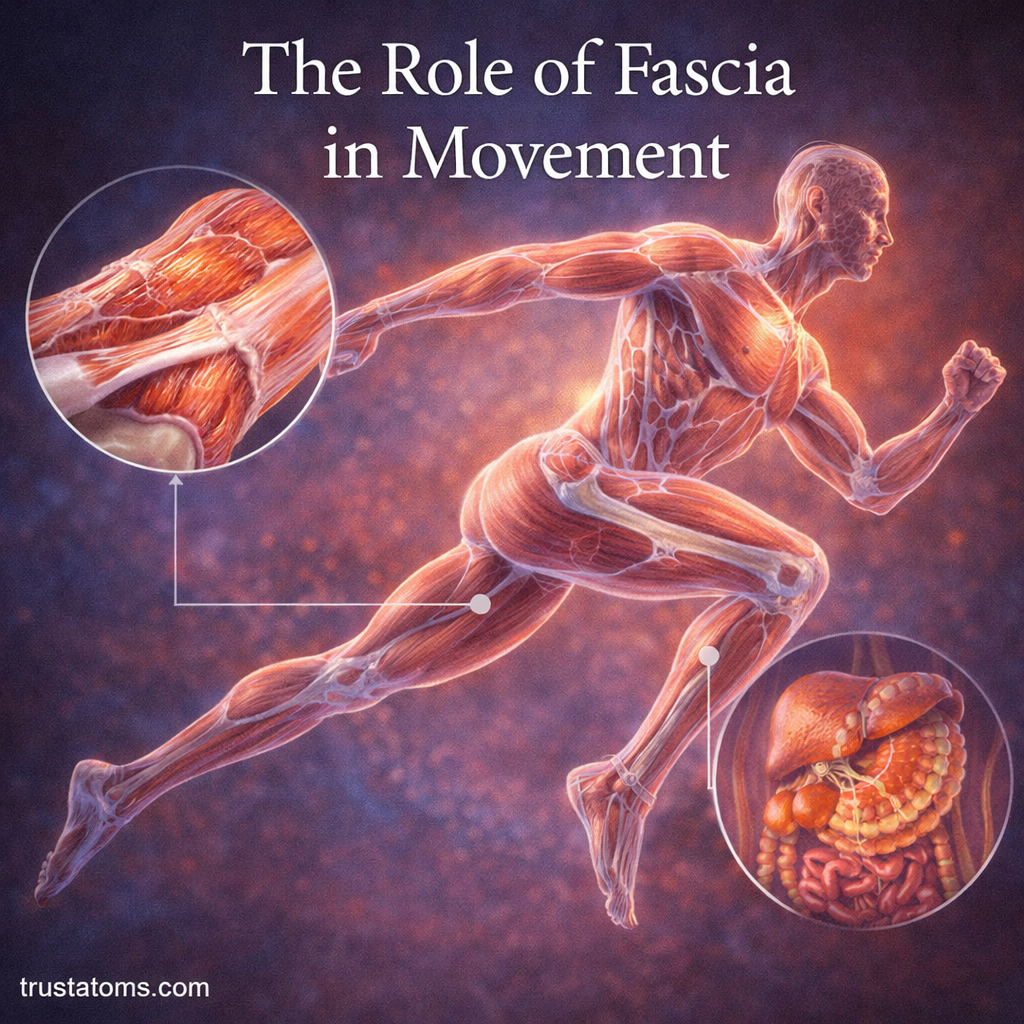
Illustration showing the role of fascia in movement with connective tissue network surrounding muscles and supporting body motion.
Illustration of fascia connecting muscles and supporting movement throughout the body. trustatoms.com

When most people think about movement, they focus on muscles, bones, and joints. However, an often-overlooked component plays a critical role in how the body moves: fascia.

Fascia is a connective tissue network that surrounds and links muscles, organs, and structures throughout the body. It not only supports movement but also helps coordinate force, stability, and flexibility.

Continue reading “The Role of Fascia in Movement”

Calcium Regulation in Muscle Activation

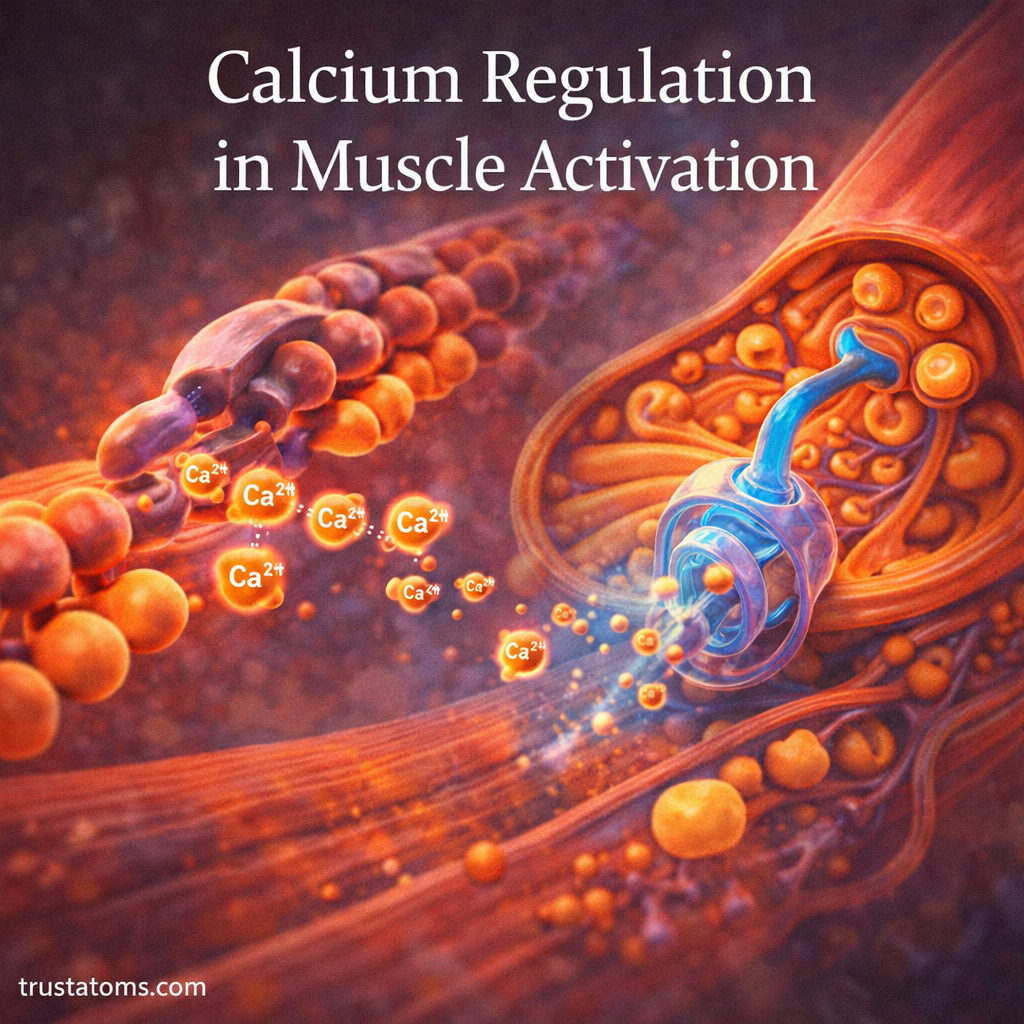
Illustration of calcium regulation in muscle activation showing calcium ions released from the sarcoplasmic reticulum and interaction with muscle fibers.
Visual representation of calcium ions regulating muscle activation and contraction processes. trustatoms.com

Calcium plays a central role in how muscles contract and relax. While ATP provides the energy for movement, calcium ions (Ca²⁺) act as the key signal that starts and stops muscle activity.

Understanding calcium regulation helps explain how your body controls muscle activation with precision, speed, and coordination.

Continue reading “Calcium Regulation in Muscle Activation”

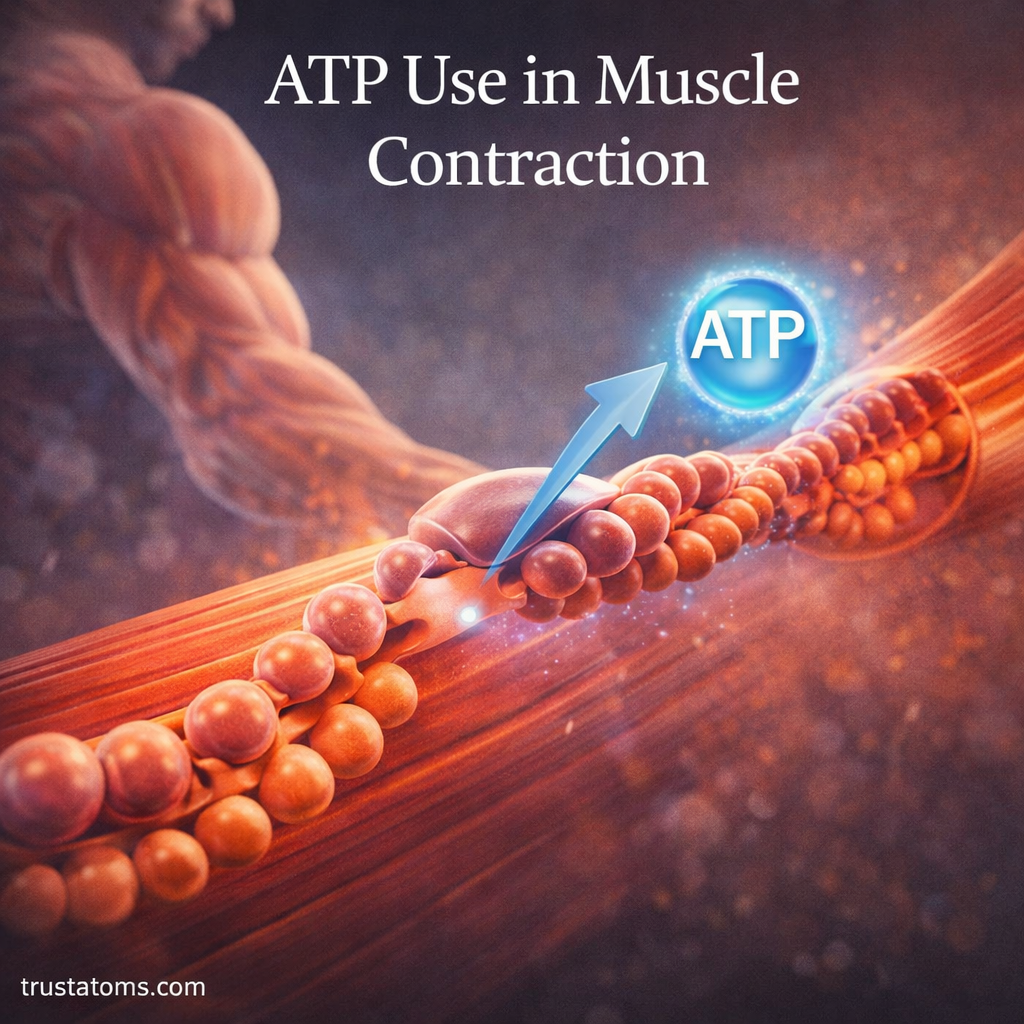
ATP Use in Muscle Contraction

Illustration of ATP use in muscle contraction showing interaction between actin and myosin with ATP providing energy.
Close-up illustration of ATP powering muscle contraction through actin and myosin interaction. trustatoms.com

Every time you move—whether lifting a weight, walking, or even blinking—your muscles rely on a single molecule for energy: ATP (adenosine triphosphate).

ATP is often called the “energy currency” of the cell, and in muscle contraction, it plays a direct and essential role. Without ATP, muscles cannot contract—or relax.

Continue reading “ATP Use in Muscle Contraction”

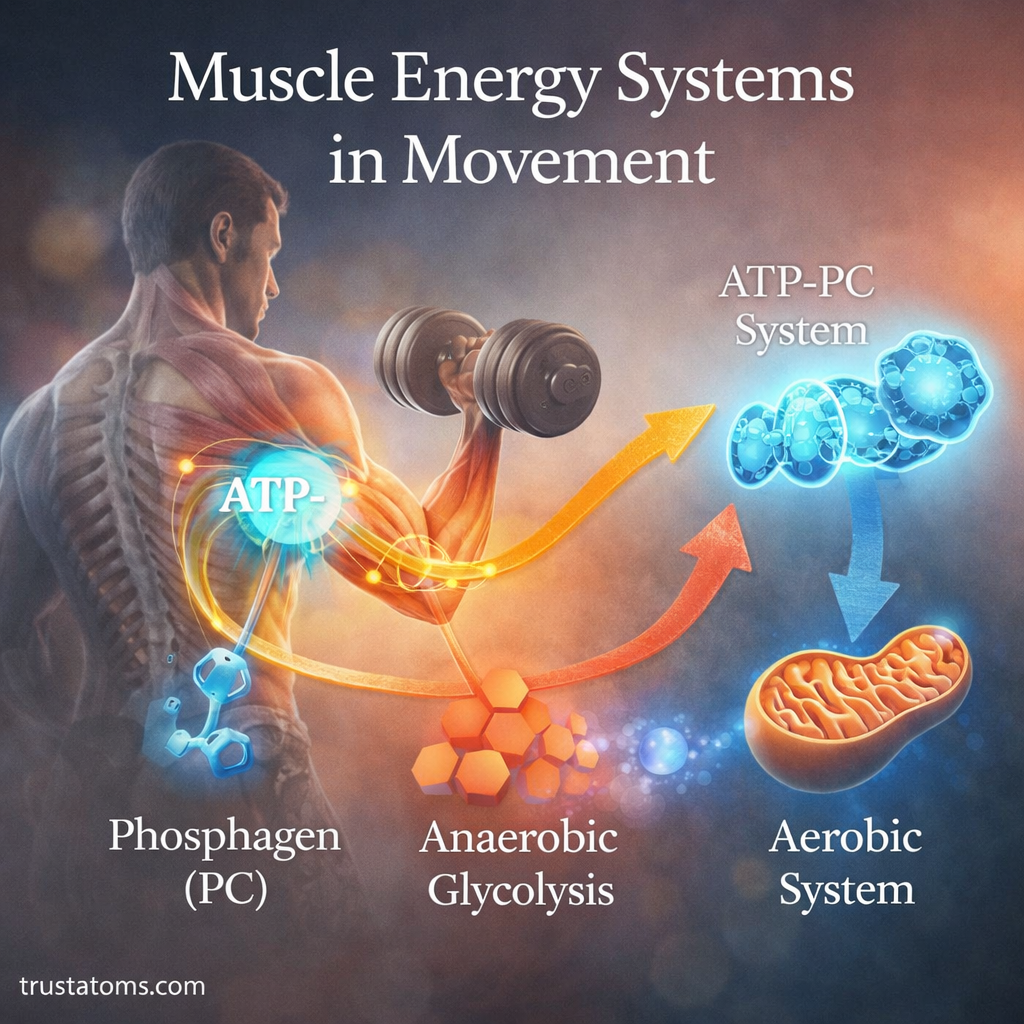
Muscle Energy Systems in Movement

Illustration of muscle energy systems in movement showing ATP-PC, anaerobic glycolysis, and aerobic energy pathways powering muscle activity.
Visual overview of muscle energy systems powering movement, including ATP-PC, anaerobic, and aerobic pathways. trustatoms.com

Every movement your body makes—from walking to sprinting—requires energy. This energy comes from specialized muscle energy systems that work together to fuel muscle contractions.

Understanding these systems helps explain how your body performs short bursts of power, sustained activity, and everything in between.

Continue reading “Muscle Energy Systems in Movement”

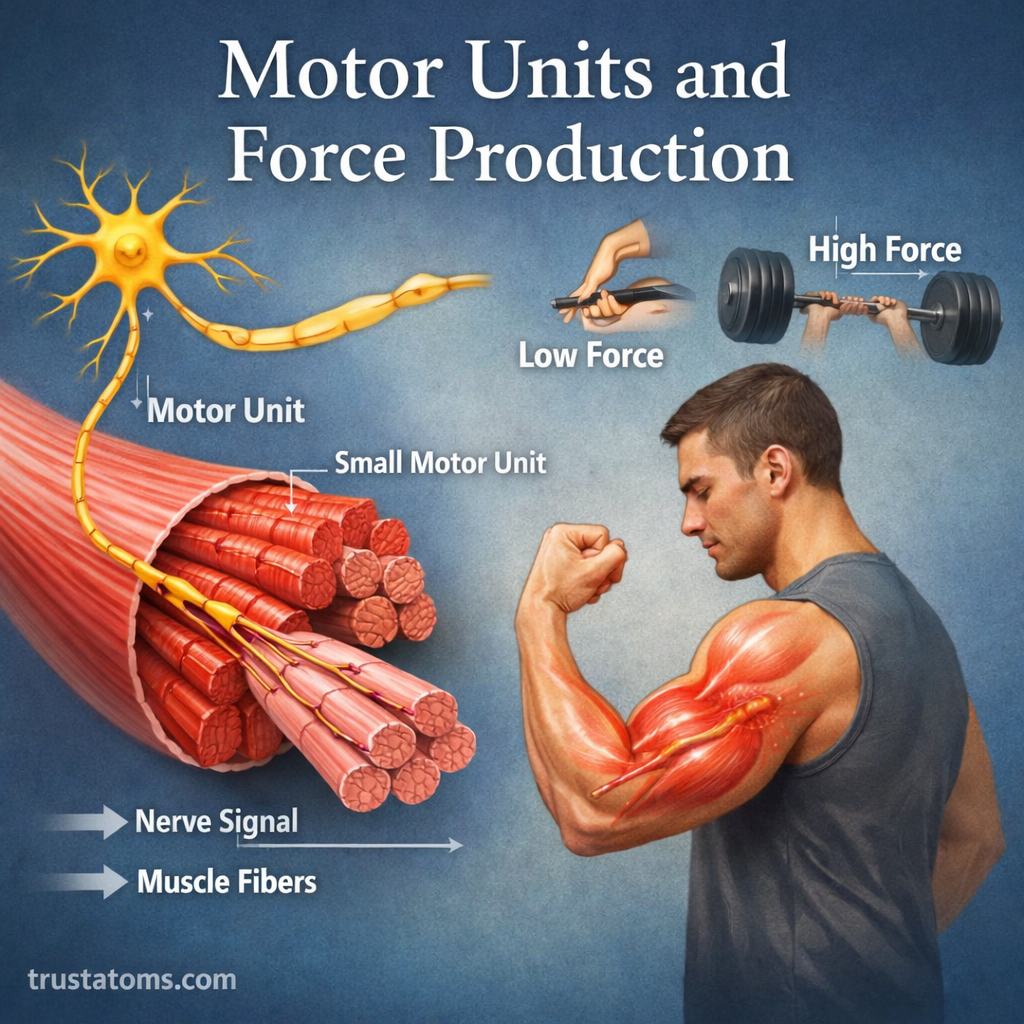
Motor Units and Force Production

Illustration of motor units and force production showing motor neuron connection to muscle fibers and differences between low and high force output.
Illustration showing how motor units control muscle fibers and influence force production. trustatoms.com

Understanding how your muscles generate force is essential for grasping everything from basic movement to athletic performance. At the core of this process are motor units, the functional building blocks that control muscle contraction and strength output.

This guide explains what motor units are, how they work, and how they influence force production in the human body.

Continue reading “Motor Units and Force Production”