Human spaceflight represents one of the greatest achievements in scientific and technological history. From the first person to leave Earth’s atmosphere to long-term missions aboard space stations, each milestone has expanded our understanding of space and human capability.
This guide explores the most important human spaceflight milestones, the people behind them, and their lasting impact on exploration.
What Is Human Spaceflight?
Human spaceflight refers to missions where people travel into space aboard spacecraft.
These missions are designed for:
- Scientific research
- Exploration
- Technology testing
- International collaboration
Unlike robotic missions, human spaceflight requires life support systems, safety measures, and careful mission planning.
The First Human in Space
The modern era of human spaceflight began on April 12, 1961, when Yuri Gagarin became the first person to travel into space.
Key Details
- Spacecraft: Vostok 1
- Country: Soviet Union
- Achievement: Completed one orbit around Earth
Gagarin’s mission proved that humans could survive and function in space, opening the door to future missions.
The First American in Space
Shortly after Gagarin’s flight, the United States sent its first astronaut into space.
Alan Shepard flew aboard Freedom 7 in May 1961.
Key Milestone
- Suborbital flight lasting about 15 minutes
- Demonstrated American capability in human spaceflight
The First Human Spacewalk
In 1965, Alexei Leonov became the first person to perform a spacewalk.
Why It Was Important
- Proved astronauts could work outside spacecraft
- Enabled future construction and repairs in space
- Paved the way for complex missions like space stations
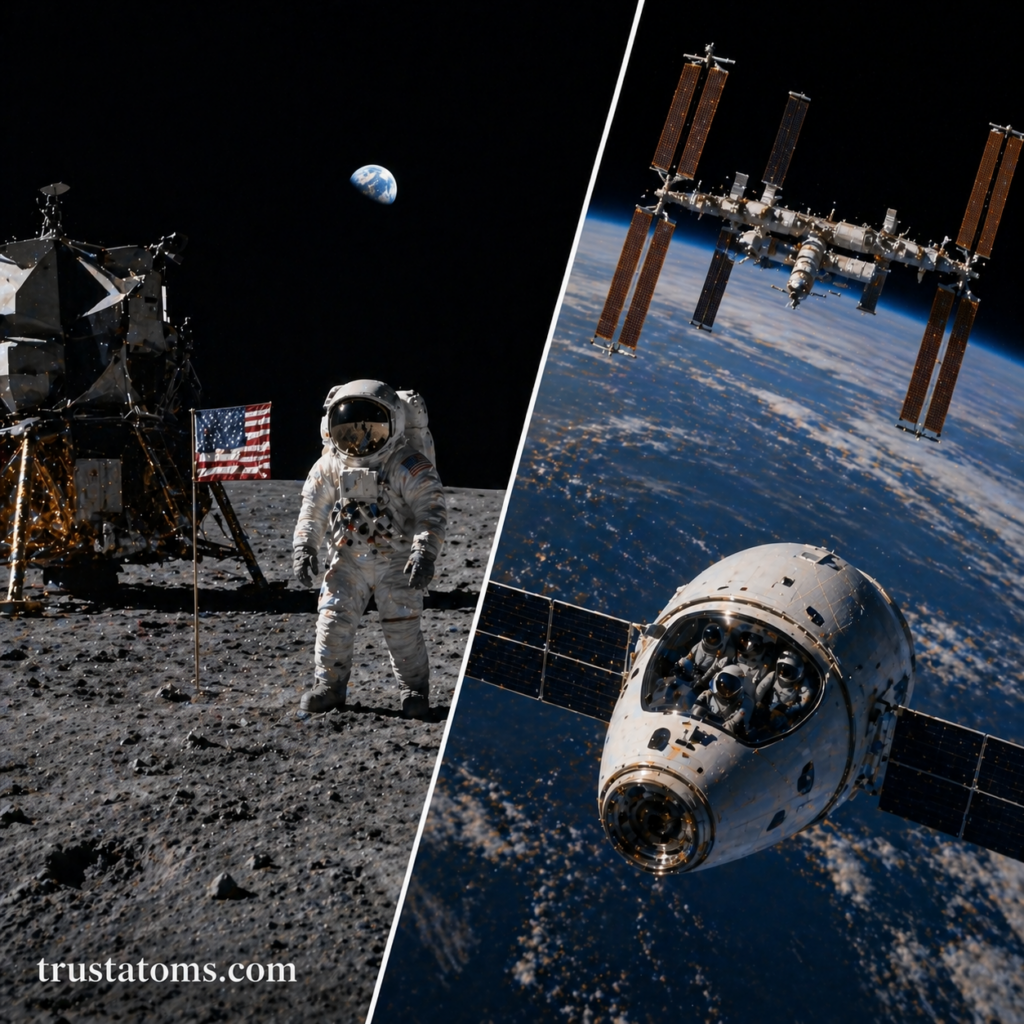
The First Moon Landing
One of the most iconic moments in history occurred in 1969 with Apollo 11.
Historic Achievements
- Neil Armstrong became the first human to walk on the Moon
- Buzz Aldrin followed shortly after
- Demonstrated the ability to travel to another celestial body
This milestone fulfilled a major goal of the Space Race and remains one of humanity’s greatest accomplishments.
The Era of Space Stations
After the Moon landings, focus shifted toward long-duration space missions.
Early Space Stations
- Salyut program
- Skylab
These missions tested how humans could live and work in space for extended periods.
The International Space Station
The International Space Station (ISS) represents one of the most important milestones in modern spaceflight.
Key Highlights
- Continuous human presence in space since 2000
- Collaboration between multiple countries
- Platform for scientific research in microgravity
The ISS shows how global cooperation can advance space exploration.
The Space Shuttle Program
The Space Shuttle program (1981–2011) introduced reusable spacecraft.
Major Contributions
- Reduced cost of access to space
- Enabled satellite deployment and repair
- Supported ISS construction
The Shuttle era marked a shift toward routine space missions.
The Rise of Commercial Human Spaceflight
In recent years, private companies have entered the field of human spaceflight.
Leading Companies
- SpaceX
- Blue Origin
- Virgin Galactic
Key Developments
- Reusable rockets
- Commercial astronaut missions
- Early space tourism
This shift is making space more accessible beyond government programs.
Modern Milestones and Future Goals
Human spaceflight continues to evolve with ambitious new missions.
Current and Future Objectives
- Return humans to the Moon through Artemis program
- Prepare for human missions to Mars
- Develop sustainable space habitats
- Expand commercial space travel
These goals aim to extend human presence deeper into space.
Why Human Spaceflight Matters
Human spaceflight has far-reaching benefits beyond exploration.
Key Impacts
- Advances in science and medicine
- Development of new technologies
- Inspiration for future generations
- Strengthening international partnerships
It also helps answer fundamental questions about human survival beyond Earth.
Challenges in Human Spaceflight
Despite progress, significant challenges remain:
- Radiation exposure
- Long-duration health effects
- High mission costs
- Technical risks and safety concerns
Solving these challenges is essential for future deep-space missions.
Final Thoughts
Human spaceflight milestones reflect humanity’s determination to explore beyond our planet. From Yuri Gagarin’s historic orbit to ongoing missions aboard the International Space Station, each step has brought us closer to becoming a spacefaring civilization.
As technology advances, the next chapter—returning to the Moon and reaching Mars—may redefine what it means to explore the universe.